Showing posts with label 1894. Show all posts

Wednesday, August 30, 2017

Bicycles

We are all aware but I admit I haven't seen too many bicycles in fiction. Below are some examples of bicycles being advertised in The Ladies' Home Journal ©June 1894. All of the ads below were found on a single page in the magazine. Take a look at the Hickory Bicycle ad, the wheels were made of wood, which after a moment of thought on the matter, made sense since wagon wheels were also made of wood. Enjoy!

Friday, July 14, 2017

Necktie or Neck-Dressings as they were called in the late 19th Century

There were a variety of ties represented in the 1894 The Clothier & Furnisher but I've included a picture of this rather unique neck-dressing from the Muldaur Company. A company finding themselves in the forefront of various new styles. I can imagine a gentleman big on fashion wearing this tie and other men scratching their heads wondering why. Below the picture is the excerpt from the magazine.

Very remarkable is the display of neck-dressings that has marked the career of the Muldaur Company. Each season finds them to the fore with a multiplicity of new styles such as is the wont of every first-class retailer to see. The revival of the flat scarf for winter wear has been one of the predictions of neckwear connoisseurs this season. The Muldaur Company is one of the first to bring ti out in their line of samples. The illustration herewith given is one of the many pretty shapes to be found in their offerings. The ground is a handsome dark blue silk, and is relieved by polka dots in white. This live concern introduced, this season, a new clasp for fastening the ends of the neck band at the back of the collar. This device is not only more sightly in appearance than any other that has ever been introduced in the trade, but it is also the most practicable. The retailer will do well to watch for this in the display that will be shown them by the Muldaur Company.

Below is the illustration of the tie clasp.

Thursday, July 13, 2017

Clothing Cartoon 1894

Below you will find a cartoon that appeared in an 1894 magazine called "The Clothier and Furnisher" I selected the cartoon for two reasons. One to share the sense of humor. Two to show the style of clothing depicted as well as the hair style of the tailor.

Monday, January 23, 2017

Keeping Flies Away

I found this tidbit while researching my Historical Writers Research of 19th Century Carriages & Wagons I ran across another use for "train oil." Train oil or Fist oil is made from whale blubber and/or codfish oil. 

From The Western Druggist Vol. 16 pg 209 ©1894 we find:
PREVENTIVE APPLICATIONS.
Almost any greasy substance will keep the flies away for several days. A number of experiments were tried in the field, with the result that train-oil alone, and trainoil with a little sulphur or carbolic acid added, will keep the flies away for from five to six days, while, with a small proportion of carbolic acid, it will have a healing effect upon the sores which may have formed. Train-oil should not cost more than 50 to 75 cents per gallon, and a gallon will anoint a number of animals. Common axle grease, costing 10 cents per box, will answer nearly as well, and this substance has been extensively and successfully used by Mr. William Johnson, a large stock dealer at Warrenton, Va. Tallow has also been used to a good advantage. The practice of smearing the horns with pine or coal tar s'mply repels from them these pests. Train-oil or fish-oil seems to be more lasting in its effects than any other of the substances used.

Tuesday, November 22, 2016

Pets

Below are some excerpts from Pets: a paper ©1859 by Edgerton Leigh I'm posting this because it will help those of us who write historical fiction realize pets are not new to society and to see how having pets was viewed during the mid 19th century.

The love of Pets is one of the flowers of civilization, a feeling either openly apparent or lying dormant until warmed into existence by circumstances, like the fire hid in the cold steel till it comes in contact with the flint. Many may carry this affection too far, but on the whole there is something humanizing in a Pet, which makes the heart open to the genial warmth of kindness, like the rose bud expanding its long folded leaves when kissed by the sunbeam. The word Pet is derived by some from the French word " petit," and there are similar words in Italian, Irish, Dutch, and even Persian, meaning bosom friend, idol, dear, &c. I would rather derive it from the Latin petere, to seek, as one of the characteristics (I may say one of the unamiabilities) of Pets is continually to be looking out and seeking for something for themselves. The derivation from the French "petit" may justly be preferred by others, as in many languages "diminutives" (as they are called) are peculiarly in use for fondling purposes. The French word " enfantiller, to talk affectionate nonsense to a child," is a very expressive instance of this. The other meaning of Pet is ill-temper, easily traceable to the unhappy effect of spoiling the Pet, which, whether human or animal, we are all too much inclined to do.

I shall not touch upon human Pets further than to recommend that no affectionate mamma (if she only values her own peace) should ever run the risk of deserving the toast proposed by an irritated old bachelor, upon the ladies and a batch of spoilt children leaving the dining room, viz.,
" The immortal memory of the good King Herod."

Gratitude sometimes causes the adoption of a Pet. A dog that has saved your own or child's life, or, as in the case of Lord Forbes's dog, which discovered that the castle was on fire and saved the inmates, has a right to be regarded during the rest of its life with care, gratitude, and affection. We hear of a Turkish Emperor who rewarded a horse which had carried him safely through danger by giving him a marble stable, an ivory manger, a rack of silver, shoeing him with gold, settling on him estates, appointing servants to wait on him, &c. The horror of solitude, whether natural or compulsory, is one of the greatest inducements to drive men to endeavour to relieve themselves from the monotonous oppression of the eternal self, by striving to gain the affection and extract sympathy from anything possessing life. We hear of prisoners taming the sparrows that twittered on the bars of their cell, and striking up friendship of a most ardent nature with a stray rat or mouse; and we have, I have no doubt, all felt indignant at the conduct of the heartless jailor who, to intensify misery, killed the spider, the sole friend and consolation of some political prisoner sentenced to a life imprisonment. We may many of us have read with interest the account of the pleasures, pains, hopes and fears that a chance-sown seedling, springing up between the flags of his small exercising court, gave to the poor creature cut off by prison from all communication with the outer world. He called the plant Picciola (poor little thing), and the story of the captive's flower expands into a volume.

The author goes on to name various types of pets: dogs, horse, guinea pigs, rabbits, tortoise (10k are sold in London a year), green frog, snake, hedgehog, monkeys (apparently out of date), birds of various types, squirrels, and cats to name a few the author lists.

If you'd like to read the entire paper you can at Google Books

Another book written during the 19th century that might give you further insight is History of My Pets by Grace Greenwood, also located at google books.

Later in the 19th century "Our Home Pets How to Keep Them Well and Happy" was written in 1895 by Olive Thorne Miller.

Wednesday, November 2, 2016

Taxes

There was no annual Federal Income Tax in the 19th century but the folks of that century still had to pay taxes. Here's a brief sketch of some of the taxes.

1812 because of the cost of the War of 1812 the nation's first income taxes were paid. Gold, silverware, jewelry and watches.
1817 did away with taxes and started to rely on tariffs on imported goods.
1862 Congress enacted the first income tax law
1862 Commissioner of Internal Revenue established.
1868 Congress enacted a tobacco and Spirits tax
1872 Eliminated the Income Tax law
1894-1895 Income tax returned
1895 Supreme Court decided the tax unconstitutional

Saturday, October 29, 2016

Block Planes

Hi all,

My dad has an incredible antique tool collection. I was hoping to photograph these tools to show on my blog but that wasn't possible without taking apart his display. I managed to pick up a couple of his planes and was surprised to find the bottoms weren't all flat.

Okay, some of you probably knew this but I didn't. My dad went on to explain that the various designs in the planes were for different cuttings, in much the same way we use a router today. This made me think back on the numerous door casings I'd seen over the years in older and Victorian homes and gave me a greater appreciation for all the hard work that went into making them. Think of the crown molding, the chair rails, etc. All of those curves were done by hand.

There's an article in American Woodworker Jun 1999 about Hand-Planned Moldings if you'd like to read further. There are a couple of photographs in which you'll see Wooden Block Planes.

I hope to have some photographs in the future but that will be quite a few months away. In the meantime you can search for Wooden Block Planes and find some images. Few show the bottom of the plane, the actual working edge, but you'll get the idea. And the articles gives you a greater appreciation for how the intrigue molding was made.

Wooden Block Planes have been around for centuries, in 1860 a cast iron bodied planes were developed by Leonard Bailey who sold his patents to Stanley Rule & Level in 1869. This design is still produced today.

If you'd like more information about Block Planes there is a great book out there "The Handplane Book" by Garrett Hack, John S. Sheldon, several pages of which are available for preview at Google books.

Here are a couple of pages from the 1894-1985 Fall Montgomery Ward Catalogue in full scan so you can read the details.
Pages 1 & 2
Pages 3

Saturday, September 3, 2016

Zebulon Montgomery Pike

This is from a book on the Louisiana Purchase ©1894. These events happened in 1806. This is a long excerpt but it contains some interesting material. It shares a little about indians, exploration, weather, how Pike handled his men, etc. Enjoy!

Pike kept a daily record, noting the country, weather and all incidents he considered valuable or interesting. As a literary work, Pike's diary may not rank very high; but as the narration of a sincere and patriotic soldier it will ever hold a place in the esteem of those who admire the straightforward story of a simple and brave man.

As the record of Colorado's discoverer, the journal of the man who built the first house and raised the first American flag upon the domain of our present state, I commend the perusal of his book to every citizen that loves his state.

Aside from his duty as explorer, Pike was instructed to visit the Pawnee and other Indian tribes and to make treaties of peace and alliance with them. This was not always easy to accomplish.

Not long before a splendid troop of Spanish cavalry, coming from Santa Fe, had passed through this same region upon a similar errand. In anticipation of boundary disputes arising between Spain and the United States, the Spaniards made an effort to form friendly alliances with the Indians. This troop was a magnificent body of men, five hundred strong. Every soldier was mounted on a milk white steed, while the commander and his two aides rode jet black stallions. This cavalcade of Spaniards had been lavish in presents to the chiefs. They left medals and flags of the Spanish king. The Indians had been much impressed with the superb uniforms, with the glitter and the boast of the Spanish officers. They were, indeed, in strange contrast with the sorry equipments and number of the American soldiers. It required much diplomacy to induce them to surrender the Spanish emblem and receive the Stars and Stripes. Often the small troop was in imminent danger, but the wonderful coolness, courage and decision of their leader saved them. With the Indians Pike was exacting, but just. As he wrote, "His experience had taught him that if you have justice on your side and do not enforce it, the Indians will universally despise you."

The Pawnees he found very reluctant to accept his tenders of peace and protection. They had been fascinated and flattered with the attention and magnificence of the Spaniards, and they sought no alliance with any power less splendid. Like most primitive people, the Indians judged the king by his em- bassador; the sender of a message by the display of the messenger that brought it. They looked with contempt upon this American captain, who wore the dress of a hunter; who carried packs and pioneered the trail. Like the Jews of old, they were disappointed in appearances and scoffed at Pike as being the representative of a mighty power, whose embassador he claimed to be. Proud of their many hundred warriors, these Pawnees refused to treat or smoke. They gathered their warriors in battle array and threatened to sweep the little band of whites from the earth. But when they saw no fear or signs of retreat, but instead the most cool and determined preparations to meet their assaults, they changed their mind, and, under a flag of truce, offered the calumet. In writing of this event, Pike writes as though he was a little disappointed that the Pawnees did not carry out their intention to fight, "as he had arranged his small troop so as to kill at least one hundred of the Indians before they could have been exterminated."

Day by day they press up the Arkansas. At first, on either hand great rolling prairies, and then the ocean-like plains. He is amazed at the vast herds of buffalo, deer, elk and other game. A single hunter could supply a small army with food; but as a mat- ter of humanity he forbids the killing of more game than required. Were it not that some of our living citizens have seen on the same plains herds of buffalo that were limited only by the horizon's line, and had felt the earth shake beneath their myriad tread, we might question the estimate Pike gives of the game he saw.

As -Pike enters the buffalo country, he comments freely upon the barrenness and desolation. He forgets that game could not be so plentiful if the land were so desolate. So impressed was he with the worthlessness of the plains, that when, reviewing his travels across them, he said: "The plains may in time become equally celebrated with the deserts of Africa. From these immense prairies may arise one great advantage to the United States by the restricting of our population to some certain limits, and thereby insuring a continuation of the Union. Our citizens through necessity will be constrained to limit their extent on the west to the Mississippi and Missouri, leaving the prairies—incapable of cultivation —to the uncivilized aborigines."

Pike, Quincy, Webster and other of our famed ancestors were great explorers and statesmen, but as prophets they were failures. After many days the mountains burst upon the vision of the explorers. To the left a pair of twin peaks cut the horizon; to the right, a mighty single mountain stood like a sentinel upon the boundary of plain and mountain. From the first sight of the grand peak it became the pole star—the compass of the explorer. During all his wanderings over plain and mountain he was seldom out of sight of the great mountain which he called his friend and guide, and a grateful people have made it his monument—one that will carry the name of Pike down the stream of time. Seldom have peaks been so royally named; seldom have heroes been worthy so lofty a commemoration.

When Pike reached the mouth of the Fountaine, and where Pueblo now stands, he established camp; built a rude temporary stockade, and over it raised the first American flag that had ever been kissed by the radiant sun and floated upon the crystal air of the Rocky Mountains. Considering it his duty as an explorer to ascend a peak that was such a prominent feature of the landscape, Pike, with several soldiers, took an early start one morning from his Pueblo camp, so that he might reach and climb the peak and return to camp in reasonable time. To their infinite surprise, the second day had well near passed before they came to the south end of Cheyenne Mountain. In this incident you will find the germ of that ancient story that is told to and about every tenderfoot that has visited this region since the days of Pike. It was near the first of December, and a winter of deep snow and intense cold. They had no blankets and little food, but they determined to attempt the ascent. After the best part of two days' struggling through the snow, they found themselves upon the top of the great ridge which, west of Cheyenne, leads up to the peak. They were in snow to their waists, and the mercury below zero. Still the peak, in its soaring grandeur, seemed as distant as ever. This led Pike to say that it seemed impossible that human foot could ever press its summit. To him it was as though the Almighty had marked "no thoroughfare" upon it rugged heights and eternal snows. As his men were without food, and dressed only in army overalls, shoes without stockings, no blankets or overcoats, he decided it folly to go farther, and ordered a return. Two days later they were in camp at Pueblo.

This was the first attempt to scale Pike's Peak, and that was as near as Pike ever came to its summit. Sixteen years later, Dr. James and others of Long's exploring party ascended the Peak in midsummer. It is a different task climbing Colorado mountains in August than in December.

In honor of this first ascent Long gave the name of James to the peak, and that is the name it bears in early government maps and reports. Pike gave it no specific name, and just when the name of James was dropped and it was christened Pike is one of the historical mysteries. I question whether it was ever legally baptized Pike. Trappers, traders and early voyagers across the plains resented the apparent slight to Pike and persisted in speaking of the mountain as Pike's Peak, in defiance of government reports and the envy of rival explorers. The name of Pike's Peak begins to appear in the literature of the prairies and mountains about the middle of the century, but it was not irrevocably christened until the Pike's Peak gold excitement, when the name was fixed to remain as long as men love to listen to stories of valor; as long as history is written.

From Pueblo Pike passed up to the soda springs at Canon. The walls of the Grand Canon prevented his following the course of the Arkansas. From here he drifted over the divide into South Park and upon the waters of the Platte. He recognized the streams as tributary to the Platte. He came into the Arkansas valley again near Buena Vista. He wandered west over routes we cannot identify until he must have found the Tomichi, a tributary of the Gunnison, and the only tune Pike touched Pacific waters. He recognized that this stream running west could not be the Eed he sought, and turned east and south. After a month of incredible exposure, hardship and suffering, he came back to his camp at Canon. His horses had been killed or disabled; his men were worn and frozen, weak and faint from exposure and starvation; his supplies exhausted ; guns injured and broken. During this terrible month of wandering in the wintry mountains the Christmas holidays and Pike's twenty-eighth birthday were passed. Christmas they spent in the heart of the mountains. They were almost starving and in a strange and wintry land. Yet this heroic man writes in his journal on that Christmas day " that food and diet were beneath the serious consideration of men who explore new countries." So often were their rations scant that "his men thought themselves fortunate with having plenty of buffalo meat without salt or any other thing whatever.'' As he was in camp celebrating this holiday he writes of the condition of his men: '' Not one person was properly clothed for winter; many without blankets, having been obliged to cut them up for socks and other articles; laying down at night upon the snow or wet ground, one side burning, the other pierced with the wind, the men making a miserable substitute for shoes and other covering out of raw buffalo hide."

At Canon camp they remained five days to recruit the strength of their men, and to make other necessary preparations for an assault against the mountains to the west, which was the barrier that they supposed hid the river they sought. When leaving Canon, the party was on foot, the horses living being in no condition to travel. The luggage was divided, giving seventy pounds to each man.

From Canon they started up Grape creek. After two or three days they entered Wet Mountain valley. Snow fell, covering the country to a depth of two to three feet. Most of the game had been driven out of the mountains, and the party was soon in a desperate condition, frost and hunger making sad havoc. On January 17 nine of the men had their feet frozen, among them the hunters. They had been two days without food, so a camp was made, and Pike and Dr. Robinson—his friend and companion— went out to hunt. The first day they killed nothing. Night came on and they thought it useless to go to camp and add to the general gloom, so took shelter under some rocks, where they remained all night, hungry and without cover or rest, as the cold was too intense to permit sleep. Next day they got eight shots at a buffalo, but failed to kill. Here, for the first time in his career, Pike weakened in courage. They had been four days without food, and the helpless men depending upon them. All these four days without sleep and tramping the deep snow, they were weak and faint, and it looked as though fate had decreed that the expedition should end in tragedy. They sought a small grove, determined to remain absent and die by themselves rather than return to camp and witness the misery of their companions. Just as they had made this resolution of despair, they discovered at a distance several buffalo. Hope at once took command, and with great exertion they crept through the snow and succeeded in killing a buffalo. At midnight they returned to camp with the food that saved the lives of the men and the exploration from tragic failure.

On January 21 two men—Thomas Dougherty and John Sparks—were so badly frozen that they could not travel. A cruel alternative was forced upon the leader. For all to remain with the poor cripples was almost equivalent to deciding that all must perish. The two were left. They gathered wood and left what meat remained with the poor men. After bidding them show their fortitude and bear up until help could be sent back, the party pushed on. A day or so later another man— Menaugh—became helpless, and he was left alone— not even the consolation of a comrade.

In all the danger and risk of exploration, be it in mountain land or polar ice, I know of nothing more terrible and desperate than the condition of these poor men left to fight the awful perils of a severe winter in the unknown mountain land. They were helpless; they could not hunt or fight; they could not retreat or go on. Their agony and suspense cannot be measured by words. I know of no parallel, unless it be in the solitary leper camps in the wintry solitudes of the Siberian forests.

On January 24 the condition of the party again became desperate—no food, and heavy snow through which they beat their slow and painful march. On this day Pike heard the first complaint that had ever fallen from the lips of his men. To illustrate the man as a soldier and a disciplinarian, I will ^ive this incident. Floundering through the snow, famished from want of food, private Brown scolded and said '' that it was more than human nature could bear to march three days without food through snows three feet deep and carry burdens only fit for horses."

Pike passed over the sedition at the moment, but that evening, after the company had broken their long fast and eaten their fill of game the doctor had been so fortunate as to kill, Pike called Brown and addressed him as follows:

" Brown, you this day presumed to make use of language that was seditious and mutinous. I then passed it over, pitying your condition and attributing your conduct to your distress. Had I reserved provisions for ourselves, whilst you were starving; had we been marching along light and at our ease, whilst you were weighed down with your burden, then you would have some pretext for your observations. But when we were equally hungry, weary, emaciated and charged with burdens which,! believe, my natural strength is less able to bear than any man's in the party, when we are always foremost in breaking the road, reconnoitering and enduring the fatigues of the chase, it was the height of ingratitude for you to indicate discontent. Your ready compliance and firm perseverance I had reason to expect, as the leader of men who are my companions in misery and danger. But your duty as a soldier called on your obedience to your officer and a prohibition of such language, which, for this time, I will pardon; but assure you, should it ever be repeated, by instant death I will revenge your ingratitude and punish your disobedience."

Two days later Pike stood upon the summit of Medano or Music Pass and looked out upon the San Luis valley. After his experience it is no marvel that it seemed to him to be " a terrestrial paradise shut in from the sight of man." They hastened down the pass, skirted the range of sand hills, crossed the valley, arriving at the Bio Grande near where Alamosa stands, passed down the river a few miles to the mouth of the Conejos, up which stream they went a short distance to the warm springs, near where Judge Mclntire now has his ranch and home. Here Pike determined to establish a camp and build a fort. As soon as his camp was located he sent a corporal and men to bring in the frozen men that had been cached in the mountains.

In due time they returned, bringing in Menaugh, the man left alone on January 27. Dougherty and Sparks were still unable to travel and could not be brought. As the corporal was leaving them they gave him a handful of bones (taken from their frozen feet) to be delivered to Pike as silent messages of appeal that he would not forget or abandon them.

Pike explored the surrounding valley and kept his men busy building the stockade.

On February 16 two Spanish scouts appeared. They went direct to Santa Fe to report the presence of American soldiers on Spanish territory.

Ten days later one hundred Spanish or Mexican soldiers present their compliments to the American captain. They bore an invitation to visit Governor Allencaster at Santa Fe. Pike was reluctant, but they were persistent in their offer of hospitality, offering money, horses, supplies, everything, but insisting upon Pike visiting the governor, giving as an excuse for insisting the clumsy fable that they had learned of the intention of the Utah Indians to surprise and capture Pike, and that they could not permit a representative of the United States to submit himself to so great danger.

In discussing the matter, the Spanish captain informed Pike that he was upon the Rio Grande and not upon the Red. Pike then pulled down his flag and realized that he was a prisoner, no matter how they might cushion the fact with offers of friendly hospitality. Pike said he would visit the governor, but that he must wait until he could bring in his invalid men. This was adjusted by leaving fifty of the Spanish soldiers to wait, while the balance of the troop escorted Pike to Santa Fe.

He is entertained by Governor Allencaster and maintains himself with becoming dignity. In fact, he never forgets that he represents the United States, and always insists that the Spanish officials recognize in him the power of his government. When presented at the little court at Santa Fe, Pike was much chagrined at the appearance of himself and men. As he described their clothes, Pike was dressed in a pair of blue trousers, moccasins, coat made out of a blanket, and a red cap made of scarlet cloth and lined with fox skins; the men in raw buffalo moccasins and leggings, breech cloths, leather coats and not a hat in the party. A native, looking upon their motley raiment, asked if the people in the United States did not wear hats and regular clothes. Under such conditions it would take a keen eye to see the hero.

After entertaining the American the governor said Pike must go into the interior until he could receive instructions from higher authorities. The leader and men were allowed their arms and, though carefully guarded, they were treated with consideration. Pike seemed rather pleased at the new orders, as it gave him an opportunity to see the Spanish territory. In case he was ill-treated, he had determined to drive off the guards, and then go into the Apache country and defy the Spaniards.

They passed through Albuquerque and El Paso and across the Rio Grande into Old Mexico to Chihuahua, south along the great table land, until May 21, when, under new instructions, they turned east and north, crossed the country to Monterey, Laredo and to San Antonio, the capital of the Spanish province of Texas. Here Pike was entertained in the most friendly manner by two courtly Spanish governors. An escort was provided, which accompanied him across Texas and delivered him to the American frontier on the Red river.

Here ended the memorable expedition of Pike to the Rocky Mountains.

Rhode Island

It's our smallest state but it is one of the original thirteen colonies as well.

Below you'll find a list taken from a Geographical Survey report on the state in 1894.
These counties are subdivided iuto towns and cities. There are in the State thirty-four towns and two cities. They are as follows:

Bristol County:
Barrington. Bristol. Warren.
Kent County:
Coventry. East Greenwich. West Greenwich. Warwick.
Newport County:
Jamestown. Little Compton. Middletown. Newport City. New Shoreham. Portsmouth. Tiverton.
Providence County:
Burrillville. Cranston. Cumberland. East Providence. Foster. Glocester. Johnston. Lincoln. North Providence.
North Smithfield. Pawtucket. Providence City. Scituate. Smithfield. Woonsocket.
Washington County:
Charlestowu. Exeter. Hopkinton. North Kingstown. South Kingstown. Richmond. Westerly.

Today Rhode Island has the same five counties but there are some differences in the cities & towns.
Bristol County
remains the same.
Kent County
Adds West Warwick
Newport County
no longer has New Shoreham
Providence County
Adds Central Falls
Washington County:
Adds Narragansett and New Shoreham

When I come across information like this I have to wonder why New Shoreham is no longer a part of Newport County. It makes my author/researcher brain wonder and then wonder if there is a story there. More than likely there is.

The other part of what's interesting in coming across a geographical report on Rhode Island is that it names every river, hill, etc and tells where it is and where it goes to. Here's an example of the type of information in a report like this.
Name of sheets.
Abington; village in Poinfret ......................................................... Woodstock.
Above All; hill in southwest part of Warren; elevation, 1.456 feet .. New Milford.
Alewife ; cove extending from Long Island Sound into southern coast
of Waterford and New London ...................................................... New London.
Alexander; pond in northwest part of Killingly .............................. Putnam.

Anyway, I feel this is a valuable resource when writing historical fiction. Some rivers, hills, etc. may have had name changes and to someone who knows the area you're writing about this could jar them from the story.

Thursday, April 28, 2016

Waffle Iron

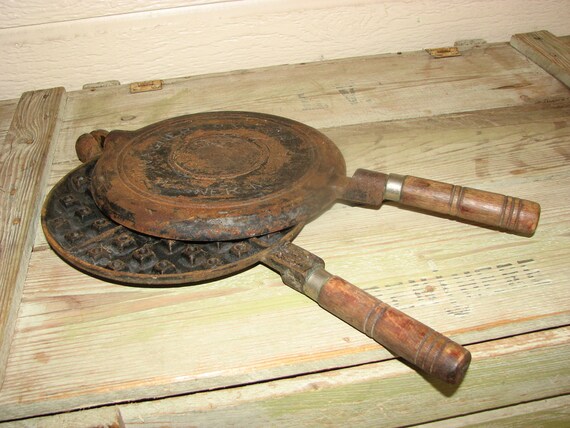
Below are various tidbits regarding waffle irons. Rather than copy lists of Essential Kitchen Utensils let me just say I saw the waffle iron mentioned in most lists. I also found they were sometimes listed under the heading of tin-ware for the kitchen, again a list of what most kitchens need. I've searched for an image of the waffle iron but haven't been able to find one from a 19th Century publication. My mom has one that is in much better shape than the picture I found on the internet but check this one out. It is made with cast iron and wooden handles. Here's the link to the photo.

A new waffle-iron is made of aluminum, and it appears to be one of the successes of that light and valuable metal, many of the possibilities of which are still a problem which the future must solve. This waffle-iron is upon the same principle as the fritter-mold, from whose products multitudes were fed at the German village in the World's Fair. The waffle-iron requires for accessories a pan of boiling lard on the stove, and a dish of batter conveniently close to it. The iron is dipped into the lard first, then plunged quickly halfway down into the batter, and immediately into the lard again. In less than a minute, with a slight tap on the back of the iron, the golden-brown, crisp and appetizing pastry is dropped on a plate.
Source: Home Furnishings Review ©1896

The wholesale price of waffle irons in 1884 was, No. 8, $7.20 per dozen; in 1890, $6.40; today they are sold at $5.60. Other goods have been reduced in the same ratio, and this reduction is not being checked by the McKinley bill being in force, which we expected would check the lower tendency. \Ve mean others thought so, not us, for it is as we expected.
Source: Bulletin-United States Congress ©1894

Friday, April 1, 2016

Paper Dolls

There were several books sold for Christmas and other occasions of paper dolls. This is not an exhausted list but it will help get you started. Note the various "kinds" of paper dolls.

Here is a list with descriptions:

THE BROWNIE PAPER DOLLS.
By Florence E. Cory.
©1891
Nine designs ofBrownies in characteristic costumes, front and bach, in many colors, and so made that they can be cut out as paper dolls.
I. In book form, with bright covers In colors, i vol., oblong 4to, cloth back 75 cents.
II. With the designs as loose sheets, in a box with bright covers in colon, 75 cents.


A Year of Paper Dolls,"
by Miss E. S. Tucker,
1894
is a beautiful and unique novelty for children, similar in general idea to the popular " Brownie Dolls," which have had such a great success. It has twelve designs of children in dresses appropriate to the different months of the year, front and back, in many colors, and so made that they can be cut out as paper dolls. One of these sets of dolls will furnish amusement to a child for months. One entirely new feature is that with these dolls comes a sheet of calendar dates. The dates of each month can be cutout and pasted on the doll representing that month, the twelve figures making a calendar that will last through the year. This new and interesting feature makes the dolls a source of instruc
tion as well as pleasure to children. (75c.)

The Dolls of A11 Nations.
1895
Figures of girls of different nations, in box. . .50

Lady Dolly and her Fancy Dresses.
1895
Figures of Mother Goose characters, in box...50
These dolls are on a different plan of any in the market, having easel backs to stand up and made very beautifully. Each doll has six costumes.

These next few are wholesale prices from 1894:
One Cent Dolls
New Paper Dolls, 4 kinds
Paper Soldiers, Infantry, 12 kinds
A Buffalo Bill, or the Wild West
Amusements for Children, 12 kinds Large Pictures of Animals to cut out. Cards 6 1/2 by 14 inches very handsomely printed in color.
New Paper Soldiers and Indians, These soldiers and Indians are represented in action, running, shooting, etc.
The sheets are 5 1/4X17 inches,

Five Cent Dolls
French Paper Dolls in Sheets
Paper Furniture, small, 4 kinds,
Jointed Dolls 8 kinds these are undressed dolls 6.5 inches tall.
Jointed Dolls 9 inches tall beautifully lithographed, having their arms and legs jointed so they can move in any position. They are intended to be dressed in tissue paper.

Ten Cent Dolls
My Dolly, 12 pages, with colored and monochrome illustrations, 3 3/8 x 8.5 inches, 6 kinds assorted.

Fifteen Cent Dolls
New Paper Dolls in Envelopes.
Size 7.5x11 inches

Tuesday, March 8, 2016

Cabbages

Folks in Florida have been harvesting cabbages for a month now. I recently sent my husband to the farmer's market to pick up a head of cabbage to make stuffed cabbage. He mis-understood and brought home 4 huge heads of cabbage, needless to say we've been cooking cabbage in all sorts of ways.

Below are some 19th Century Recipes for various cabbage dishes.
CABBAGE.
Boiled Cabbage.— Carefully clean a nice head of cabbage, divide into halves, and with a sharp knife slice very thin, cutting from the center of the head outward. Put into boiling water, cover closely, and cook rapidly until tender; then turn into a colander and drain, pressing gently with the back of a plate. Return to the kettle, add salt to taste, and sufficient sweet cream to moisten well; heat through if at all cooled ; dish, and serve at once. If preferred, the cream may be omitted, and the cabbage served with tomato sauce or lemon juice as a dressing.

Cabbage and Tomatoes.— Boil finely chopped cabbage in as little water as possible. When tender, add half the quantity of hot stewed tomatoes, boil together for a few minutes, being careful to avoid burning; season with salt if desired, and serve. If preferred, a little sweet cream may be added just before servingCabbage Celery.— A firm, crisp head of cabbage cut in slices half an inch or an inch thick, and then again into pieces four or five inches long and two or three inches wide, makes quite an appetizing substitute for celery.

Cabbage Hash.— Chop fine, equal parts of cold boiled potatoes and boiled cabbage, and season with salt. To each quart of the mixture add one half or three fourths of a cup of thin cream; mix well and boil till well heated.

Chopped Cabbage, or Cabbage Salad.— Take one pint of finely chopped raw cabbage; pour over it a dressing made of three tablespoonfuls of lemon juice, two tablespoonfuls of sugar, and a half cup of whipped cream, thoroughly beaten together in the order named; or serve with sugar and diluted lemon juice. Strained tomatoes with a tablespoonful of lemon juice to the pint also makes a nice dressing.

Mashed Cabbage.— Out a fine head of cabbage into quarters, and cook until tender. A half hour before it is done, drop in three good-sized potatoes. When done, take all up in a colander together, press out the water, and mash very fine. Season with cream, and salt if desired.

Stewed Cabbage.— Chop nice cabbage quite fine, and put it into boiling water, letting it boil twenty minutes. Turn into a colander and drain thoroughly; return to the kettle, cover with milk, and boil till perfectly tender; season with salt and cream to taste. The beaten yolk of an egg, stirred in with the cream, is considered an improvement by some.
Source: Every-day Dishes and Every-day work ©1897

Stuffed cabbage.
Choose a large white, close cabbage, take off all the hard green outside leaves, and blanch it; cut out the heart and press between two plates to squeeze out all water. Make a stuffing with finely-minced sausage-meat, four yolks of egg and marrow, mix well together and spread a teaspoonful between each leaf, tie up the cabbage to its original shape—be careful not to cut the leaves with the string—simmer over a slow fire in stock, season with a bouquet of herbs, onions, a saveloy, carrots, a pinch of grated nutmeg, salt, and black pepper, cover the whole with slices of bacon ; shake the stew-pan occasionally so that the cabbage may not stick to the bottom and get burnt. Dish up the cabbage after cutting off the string. Pass the sauce through a tammy, clear of all grease, stir in a little thin browning, and pour over the cabbage.
Source 366 menus and 1200 recipes ©1882

CABBAGE
Mrs. E. F. Spence. One cabbage; boiling salted water; 1/8 teaspoon soda. The cabbage should be fine and of medium size. Wash, quarter, and put it in a kettle of boiling salted water to which the soda has been added. Boil twenty minutes. Serve hot.
LADIES CABBAGE
C. S.
Cabbage; 4 tablespoons cream; I tablespoon butter; 1 egg; pepper; salt.
Select medium sized heads that feel firm and heavy. Shave the cabbage very fine, and let it lie in cold salted water one hour. Drain and place in plenty of boiling water. Cook rapidly for ten minutes, then drain; add butter, pepper, salt and cream. Simmer until it is nearly dry. Just before serving, beat the egg to a cream; stir quickly into the cabbage; boil up once and serve.
HOT CABBAGE SLAW
Mrs. H. L. Parlee.
One cabbage; I teacup milk; 1/2 teacup vinegar; butter the size of a walnut, pepper; salt.
Slice the cabbage fine; put it in a sauce pan with the milk, butter, salt and pepper. When it boils, add the vinegar; cover closely and cook slowly until done. Less vinegar may be used or none at all. If cream is used instead of milk, less butter is required.
STUFFED CABBAGE
Mrs. M. J. Danison.
One head cabbage; some cooked veal or chicken; 1 egg, (yolk); salt; pepper.
Choose a large fresh cabbage and cut out the heart; fill with the veal, or chicken chopped very fine, highly seasoned, and rolled into balls with yolk of egg. Then tie the cabbage firmly together, (some tie a cloth around it, ) and boil in a covered kettle two hours.
Source: How We Cook in Los Angeles ©1894

Thursday, February 4, 2016

Chafing Dish

This tidbit comes from "One Hundred Recipes for the Chafing Dish" ©1894. I'd like to start off with this introduction quote from the book. I wrote a post back in 2013 also on the chafing dish here's the link.


THIS Book is intended to give pleasure to those who enjoy using a Chafing Dish. The formulas are simple, easy to follow, and are not designed to prove that elaborate dishes can be prepared, but that many articles of food can easily be made very delicate, toothsome and enjoyable.

Next I'm going to include excerpts (tidbits) from the book:

More than two thousand years ago the Chafing Dish fulfilled its true office as the promoter of man's palatable pleasures at the tables of the wealthy Greeks and Romans.

The Chafing Dish is a cosmopolitan vessel. It belongs to all nations. It was no less appreciated by the French than the English.

The Chafing Dish ever identified with the progressive phase of life appeared in America in 1720.

The mastery of the Chafing Dish is one of the undisputed arts where a man and woman may share equal privileges and triumphs. A man may prove his skill in cooking with it without detracting from his dignity and a woman can scarcely manipulate it without adding to her charm.

The Chafing Dish not only makes possible the sincerest expression of the most perfect hospitality, but it seems the true symbol of good fellowship. It develops a spirit of royal camaraderie. Even a pessimist would be inclined to judge his neighbor by his excellencies and not by his defects, as succulent odors whet the appetite and carry the sweet assurance of coming gustatory joys.
Verily, " a good dish sharpens the wit and softens the heart." Who can measure the beneficent influence of exquisite savours!

The Chafing Dish is the culinary censer exceedingly important feature in successful Chafing Dish cooking, is that the wicks of the lamp should be perfectly trimmed, and the reservoir about one half full of alcohol, after cooking a dish, and when making preparations for another, look carefully after this feature.
Have the wicks so regulated that all available flame shall be entirely under the dish, and that none of it shall come up the sides.
As the water is very liable to boil over, it is best to have a tray under the Chafing Dish to catch it, or any other drippings.

The rest of the book is filled with recipes. If you're interested in a copy of the book it is available from Google Books. Here's the link One Hundred Recipes for the Chafing Dish

Can't you just see your characters using or rather trying to use one of these at the table? Oh the situations that could be written.

Tuesday, January 12, 2016

Rhubarb

Rhubarb is a vegetable that is sour to the taste but with a bit of sugar becomes a great treat. Below are some recipes and some tidbits about canning rhubarb. One of my husband's favorite pies is Strawberry Rhubarb. You don't find it in warmer states like Florida. It prefers climates that don't go over 75 in summer or above 40 in winter.

RHUBARB TART.
To one quart of stewed Rhubarb add three-fourth pounds of granulated sugar, five eggs, five ounces of pulverized crackers, after the Rhubarb is stewed put through a seive. The other ingredients should be mixed well. Use only a bottom crust and bake three-quarters of an hour.

RHUBARB PIE.
Peel and stew Rhubarb. Add juice of half a lemon, well beaten yokes of two eggs, and sweeten with a half cup full of granulated sugar. Line pie tins with a good crust, and fill the tins with Rhubarb; bake until the crust is a light brown, beat the whites of the eggs to a froth adding three tablespoonsful of powdered sugar. Flavor with nutmeg or vanilla and spread over the top of the pies, place in the oven and leave till a delicious brown.

PIE PLANT PIE.
Wash and peel. Place in a chopping bowl and chop up fine, turn off the juice. Line your tins with pie crust, fill up the pan with chopped plant, and one tea cup full of sugar, three tablespoonsful of cream cr a piece of butter size of a hickory nut, cut in small pieces and place around on the plate, cover with pie crust and bake in hot oven.

RHUBARB JELLY.
Wash Rhubarb. Cut in small pieces stew to a soft pulp, squeeze out the juice. To a pound of juice add a pound of granulated sugar, place again on the stove and stew until thick enough for jelly, put in tumblers, cover top of jelly with a round piece of tissue paper saturated with whisky or white of an egg, cover top of tumblers with paper tying tightly.

RHUBARB JELLY.
Wash the stalks and let them dry, do not pare them. Cut the stalks up in pieces of one or one-half inches long. Place them in a porcelain lined kettle. To every eight pounds of Rhubarb add one and onehalf pints of water. Boil until the small pieces are soft. Place in a jelly bag, do not squeeze the juice out, but place over something and let it drip. Add to every pint of this juice three-quarter pound of sugar, boil and fix same as other jelly.

PIE PLANT SAUCE.
A palatable sauce may be made by cutting up the the stalks into inch pieces, put in a porcelain lined kettle. To a quart of the plant add one tea cup full of sugar, stew slowly and stir at intervals to keep from burning; stew to a soft pulp and let cool.

RHUBARB JAM.
Always wash the stalks, do not pare them, cut into pieces an inch or so long. Weigh the Rhubarb. To every pound of Rhubarb, add one pound of granulated sugar; place in a porcelain lined kettle; let it come slowly to a boil, then stir continually for half an hour; place in jars or cans and seal tight.

And here are a couple tidbits about canning the vegetable for winter use.

CANNING RHUBARB.
Wash Rhubarb. Cut in small pieces. To every pound of Rhubarb add one-half pound of granulated sugar, bring slowly to a boil, stir at intervals to keep from burning. When thoroughly cooked through pour in cans hot and seal tightly.

CANNING RHUBARB.
To put up Rhubarb for winter use wash the stalks, cut in small pieces, peel, and place in cold water in jars and seal tightly.

Source: Rhubarb Or Pie Plant Culture ©1894

Friday, November 13, 2015

Friday the 13th

There wasn't much to be found on the Friday the 13th from the earlier parts of the 19th Century. Yes, it dates back to the middle ages but it wasn't until the later part of the century that some of the superstitions began in earnest. You will find more references to the superstitions in European literature. But since this page is primarily for those researching for 19th Century American purposes I've restricted my tidbits to the USA

This tidbit comes from the Sanitary & Heating Age ©1894
Americans are the least superstitious people on earth, observes a Buffalo (N. T.) daily, but they cling to more fool notions than are good for them. Friday and the number 13 are still made to serve as excuses for disaster, and that by people who know better. Evil things were predicted of the third trial race for the America's cup because it was to be sailed on a Friday and the 13th of the month. In the horrible disaster at Battle Creek, the fact is brought out that both of the colliding trains consisted of 13 cars. Such reminders are constantly being made, in great things and small. People will say they do not believe in any malign influence attached to Friday or to the numoer 13, yet tbey go on in an asinine way to associate them with any misfortune to wh:ch they can be hitched. There is probably very little, if any, deliberate instruction given to children as to what are evil days and numbers and signs generally; yet the folly persists, generation after generation. Selfpropagated, the popular superstitions have nersisted since the beginning of history. Reason and the spirit of the day are against them, but they stick. Experts in folk-lore and the evolution of nations may have profound explanations for this; but on the face of it it looks as if mankind enjoyed holding to anything which could occasionally be made to do duty as a reason for disasters which really are due to human carlessness, selfishness and lack of foresight or of knowledge.

Tuesday, September 29, 2015

Peanut Butter

I apologize for this late post. I had an early morning appointment.

Below you'll find some basic information on Peanuts and Peanut Butter. It appears to me that peanut butter was not common place until the last decade of the 19th Century.

Of the 4,000,000 bushels of peanuts raised annually in this country i.000,000 bushels are used roasted. The remainder of the crop and he peanuts of an inferior grade go to the confectioner and appear in peanut candy and other confections. Therefore at present the peanut, is used among us, is hardly to be considered a food, but, as already -aid, only as a food accessory or luxury. It is quite possible, how?ver, that this highly nutritious and cheap product of our Southern fields may come to be used in more ways than it is at present, and [■specially in combination with other food materials.
Peanut butter.—The roasted peanut ground into an oily meal has somewhat the consistency of butter and is now marketed under the name of peanut butter. Salt is perhaps quite generally added during the process of manufacture. Water is also sometimes added—usually before serving. Peanut butter is used like other butter to spread on bread, for the making of sandwiches, and in the preparation of a number of made dishes. Many persons like its flavor when it is fresh and of good quality, and it seems fair to say that the use of this and other sorts of nut butter is growing. As regards composition, peanut butter, which is essentially the ground roasted peanut, contains more protein and less fat than ordinary butter. Little is known regarding the digestibility of peanut butter, but the fine grinding would naturally seem to be of an advantage. Judged by Jaffa's experiments with a ration containing peanuts, it would be well digested.
Source: The Farmer's Bulletin ©1894

NUT BUTTER.
THE production of nut butter is a very simple process. The peanut and almond are the nuts that are chiefly used for this purpose; but the Brazil-nuts make a very fine butter. All of the nuts can be ground, but as they can not be blanched, they do not make a nice looking butter. The Spanish peanut has proved the most satisfactory for butter making, although some people prefer the Virginia variety. The first essential thing is to have a nut-grinding mill.
PEANUT BUTTER.
The first step is to roast the peanuts to a nice brown, being careful not to over-brown or scorch them, as too much cooking spoils the flavor. They can be roasted in an ordinary oven, but can be better done in a peanut roaster made especially for this purpose. As soon as they are roasted and cool, the skins or bran should be removed by rubbing them in the hands, or what is better, a coarse bag; or take a square piece of cloth and fold the edges together, forming a bag of it. The chaff can then be removed by the use of an ordinary fan, or by pouring from one dish to another where the wind is blowing. The process of removing the skins is called blanching. Next look them over carefully, remove all defective nuts and foreign substances, and they are ready for grinding. If a fine, oily butter is desired, adjust the mill quite closely, and place in the oven to warm. Feed the mill slowly, turn rapidly, and always use freshly roasted nuts; after they have stood a day or two they will not grind well nor make oily butter. If the butter is kept in a cool place in a covered dish, and no moisture allowed to come in contact with it, it will keep several weeks; and if put in sealed jars or cans, will keep indefinitely.
RAW PEANUT BUTTER.
Heat the peanuts just sufficiently to remove the skins, but do not allow them to get brown; prepare them as described in a former recipe, and grind in a nut mill. Although the raw peanut butter is not as palatable as the roasted butter, it is considered more healthful and easier of digestion. It is also preferable to use in making soups and puddings, in cooking grains, and in seasoning vegetables. Food seasoned with this butter does not have that objectionable taste that the roasted peanut butter imparts; and if it is properly used, the peanut taste is almost entirely eliminated.
ALMOND BUTTER.
Almond butter is more difficult to make than peanut butter because the skins can not be so easily removed. Roasting does not loosen the skins of the almond as it does of the peanut. They have to be soaked in boiling water from two to five minutes; then the skins become loose and can be pinched off by pressing on the nut with the thumb and finger; the skin will crack and the kernel pop out. But by this process the nuts have soaked up some water and become tough. They must then be dried in the oven until quite crisp, but the oven must not be hot, or they will brown. Then run them through a loosely adjusted mill or a sausage grinder, and place on a cloth stretched over the stove until perfectlydry; then grind them in the nut-butter mill, quite tightly adjusted. This makes excellent butter if the almonds are first-class, and sweet.
Source: Guide for Nut Cookery ©1899

Peanut Butter Cookies
1 teaspoon salt
1 cup sugar
1 cup brown sugar
1 cup lard
2 cups peanut butter Mix all ingredients adding flour last 2 eggs (well beaten) with soda and water. Drop on cookie
2 teaspoons baking soda sheet with teaspoon, press with fork. dissolved in Bake in 375° oven.
4 tablespoons warm water
3 cups flour added
Miss Blanche Roe
Source: Random Recipes ©1846 (Please note that might not be the actual date of the publication. There is no date on the original source from Google Books but the organization who put out the book was organized in 1846.)

The first patent for peanut butter was issued in the 1840's in Canada. (Lynn's note.)

Peanut Butter.—A new use for peanuts is developing as the peanut butter industry becomes better understood. This product of the peanut answers in the place of ordinary butter for table use, and is said to be excellent for shortening purposes and for gravies, sauces, etc. In point of purity it is superior to the best dairy butter. It is well designed for the use of the vegetarians who strenuously object to anything animal. There is already a demand for this butter substitute and it is very probable there will be an enlarged market for the nuts. At present the product of the United States is about 500,
000 bags annually and that of the world is 600,000,000 pounds.— West Coast Trade.
Source: Journal of Hygiene and Herald of Health ©1898

Tuesday, September 15, 2015

Chicken Salad

I know we're past labor day and summer salads will soon be a thing of the past until next summer but it's still warm and perhaps your characters are hosting a party and its the summer.

So today we're posting a few recipes for Chicken Salad.

Chicken Salad.
(For forty guests.) Four chickens, same quantity of celery.
SALAD DRESSING.
Twelve eggs, four tablespoons melted butter, four tablespoons oil, three tablespoons mustard, two teaspoons salt, two teacups vinegar, one pint cream. Beat yolks; add butter and oil slowly, then the mustard mixed smooth in a little hot water, then the beaten whites, then the vinegar and salt. Put on the stove in a custard kettle and cook until thick like custard. About an hour before serving mix the chicken and celery. Add cream to the dressing and pour over the chicken. Mrs. W. E. Burns.

Chicken Salad.
Shred fine two chickens and as much celery as chicken, chopped fine.
FOR DRESSING.
Two teaspoons mustard made in a paste with a little water, two teaspoons of sugar, one small teaspoon salt, three-fourths cup of vinegar, one-half cup of sweet cream, three eggs well beaten. Mix vinegar, sugar and salt with paste; add eggs; heat slowly with dish set in hot water and stir constantly till the thickness of cream. When done stir in a piece of butter size of an egg. Put cream in when you mix with chicken.
Mrs. H. Jay. Putman.

Chicken Salad.
Boil the fowls tender and remove all fat, gristle and skin, mince the meat in small pieces, but do not hash it. Take the same quantity of celery as chicken, cut into pieces of about one-quarter of an inch; mix thoroughly and set in a cool place. Use Eoyal Yacht Club Salad Dressing. Garnish the dish with fresh lettuce leaves, hard-boiled eggs or red beets cut in fancy shapes.
Source: Cook Book of Tried Recipes ©1897

Chicken Salad
Boil one chicken until tender, shred in fine pieces; cut white, tender stalks of celery very fine; about one cup of celery to one chicken. Mix chicken and celery together then stir well into them a mixture, in proportion of three tablespoonfuls of vinegar to one of oil,with pepper, salt, and a little mustard to taste. Put this aside for an hour or two or until just before serving, it will absorb the vinegar, etc. When about to serve mix the celery and chicken with a Mayonnaise sauce, leaving a portion of the sauce to mask the top. Reserve several fresh leaves of celery with which to garnish the dish. Stick a little bouquet of these tops into the center of the salad, then a row of them around it; sometimes slices or little cut diamonds of hard boiled eggs'are used for garnishing. Chicken salad is often made with lettuce instead of celery, the lettuce not being added until the last thing before serving. Salmon, shrimps and other salads are made in the same way, always using lettuce. Those desiring to, may add a little onion.
Source: Santa Rosa Recipes ©1891

CHICKEN SALAD
Mrs. Henderson's Cook Book.

One chicken; white celery stalks; 3 tablespoons vinegar; I tablespoon Howland's olive oil; salt, pepper, mustard.
Boil chicken till tender, when cold, separate the meat from the bones. Cut into small bits; do not mince it. Cut some white, tender stalks of celery into three-quarters inch lengths. Mix chicken and celery together; stir into them a mixture in the proportion of three tablespoons of vinegar to one of oil; pepper, salt, mustard to taste. Set this aside for an hour or two. When ready to serve mix the chicken and celery with a mayonnaise dressing, reserving a portion of the mayonnaise to mark the top. Garnish with fresh celery leaves, stick a bunch of these in the center of the salad and from the center to each of the four sides, sprinkle rows of capers.
Chicken salad is often made of lettuce instead of celery. Marinate the chicken alone a moment before serving, add the small, tender, sweet lettuce leaves, then pour mayonnaise dressing over the top. Garnish with the center heads of lettuce, capers, cold chopped red beets, or sliced hard-boiled eggs. Sometimes little slips of anchovy are added for a garnish. When on the table it should all be mixed together.
Many may profit by this recipe for chicken salad, for it is
astonishing how few understand making so common a a dish. It is often minced and mixed with hard-boiled eggs for a dressing.

CHICKEN SALAD
Mrs. E. A. Otis.
In mixing chicken salad allow one yolk of an egg to each chicken, and to four chickens one and a half pints of olive oil. Pick the chickens apart with fingers, removing carefully all fat and skin. Then take celery, pick likewise into small pieces and add it to the chicken until there is an equal quantity of each. If celery cannot be obtained, use lettuce prepared in the same manner.
For the dressing one level teaspoon of salt to each yolk of an egg; pepper to taste, one teaspoon of dry mustard, and juice of one lemon, more if the lemon is not very juicy. The oil should be added a few drops at a time, stirring constantly. While stirring, add an occasional drop of vinegar. To this mixture add the last thing one-half cup of rich cream, and when thoroughly mixed, pour over the salad just before it is served. The object of the lemon is to cut the oil, and make the dressing of a cream-like consistency.
Source: How We Cook in Los Angeles ©1894
(Gotta love that title for a cook book)

Friday, May 1, 2015

Catfish

Below are tidbits and recipes about the Catfish. It was a staple for many people and still is in some parts today.

A Report from the Fishing and Game Commissioners mentioned:
CATFISH.
A number of men engaged in cleaning out the Morris Canal impounded several thousand catfish, and these were secured by one of the wardens and placed in different waters in Sussex county.
In the Western States the channel catfish is much sought after, both for sport and the food it affords, its flesh being white, firm and sweet. The addition of this fish to the food-fish of the Delaware and other large bodies of water in this State would be very desirable, and consequently the Commission has made arrangements for securing a supply in the near future. A number of channel catfish have already been brought to the State, and have been placed in one of the reservoirs of the Passaic Water Company, in Paterson, where they are amply protected, and from whence it is hoped their progeny will be distributed to other parts of the State, although the Commission also expects to distribute a large number directly from the great lakes.
©1895

MR. THURMAN S CATFISH.
Once upon a time, when crowded about his presidential aspirations, Mr. Thurman replied: "I really have no ambition in that direction." A look of incredulity on erery face waithe only response. The judge took in these looks and related a little story. Said he: "One summer I was at the Oakland House, Maryland, spending a little vacation np In the cool mountain resion. We got to telling Ashing stories. I related something of my own experience when I was present and saw caught a catfish weighing ninety pounds. When 1 told the weight tbeie was a general laugb, and I was humorously awarded the prize for telling fish stories. I quietij remarked to my incredulous friends that I hoped soon to convince them of the correctness of my story, that la Western waters there were cattish of ninety pounds weight. When I returned to Columbus, I went to the leading restaurateur and instructed him to procure roe the largest catfish that could possiolv be secured. He reported in a few days that he had one. I walked over aud found an excellent specimen, weighing 75 pounds. I hid him boxed and carefully packed in ice, ami shipped him to my disbelieving friends at the Oakland. From the restaurateur I got all the recipes I could for catfish chowder, catfish steaks, stuffed catfish, roast, etc., and sent them on by mail. 1 telegraphed as follows: 'Skin your fish before you cook him,' a catfish's skin being so rank as to spoil the flesh when the fish is cooked with it on.' They got my telegram and were puzzled. When the box atrived, dripping from the melting ice, tbey were more puzzled. The letter, which arrived bv tbe same train as the fish, explained all They had a fine feast, and at it formally organized with a president and secretary, and passed tbe following resoluiion. which was sent me: '"Resolved, That the truth of Allen fi. Thurtnuu's statements should never be questionel; that his fish stories are alwavs absolutely true, especially his catfish stories." —Cleveland Press.
Source: Fishing Scraps ©1883

Shipping Tidbits:
The fish are then taken out and dressed and barreled for shipment. The dressing consists in cutting off the head, removing the viscera, and skinning the fish, after which it is washed, and then barreled with ice for shipment. The principal shipments are made to Texas, Oklahoma, Kansas, Missouri, Colorado, and New Mexico.
Source: Congressional Serial Set ©1899

DO CATFISH AND EELS INTERBREED:
There is a party here who has made the remarkable statement that catfish and eels are one and the same species, one being male, the other female. It seems so ridiculous to me that I took the chances of denying it, and now I want some definite information. He says that neither catfish or eels will breed by themselves. While I know that where you find catfish you also find eels, still I am not prepared to believe such a remarkable statement. Please enlighten me.
Butte, Mont., October 28. * R. H. M.
Our first impression on receiving the above was that our esteemed correspondent was being guyed, but remembering how persistently an intelligent angling writer insisted that a fish known in his local waters as the eel-killer was a cross between the trout and the eel, we decided to give the query respectful attention. En passant, the eel-killer turned out to be the burbot, lake lawyer or ling (Lota maculosa). Yes, friend “R. H. M.,” the catfish and the eel are distinct fish. The latter, as a rule, breeds in brackish water and is of both sexes, albeit much discussion occurred some years ago as to its spawning habits and probable hermaphroditism. The catfish is not only of dual sex but is the best of parents, guarding its young until they are able to take care of them.
Source: The American Angler ©1888

Recipes:
Catfish Soup.
Three pounds of fish when they have been cleaned, skinned and beheaded; two cups of milk, heated, with a tiny bit of soda; two tablespoonfuls of prepared flour rubbed up with three of butter; two beaten eggs; two tablespoonfuls of minced parsley; three cups of cold water; pepper and salt.
Cover the fish with cold water and stew gently until the flesh slips easily from the bones; take from the fire, pick out and throw away the bones; chop the fish, strain the liquor in which it was boiled, and return all to the fire; as it boils, stir in floured butter, seasoning and parsley; boil two minutes; pour the scalding milk from another vessel over the eggs, turn into the tureen, add the fish-soup and serve. Line the tureen with Boston crackers, split, soaked in boiling milk and well-buttered before pouring the soup upon them. Pass sliced lemon with it.
Ladies Home Cook Book ©1896

Fried Cattish.—Catfish must be cooked quite fresh—if possible, directly out of the water. The larger ones are generally coarse and strong; the small-sized fish are the best. Wash and clean them, cut off their heads and tails, remove the upper part of the backbone near the shoulders, and score them along the back with deep gashes or incisions. Dredge them with flour, and fry them in plenty of lard, boiling fast when the catfish are put into the pan. Or you may fry them in the drippings or gravy saved from roast beef or veal. They are very nice dipped in a batter of beaten egg and grated bread-crumbs, or they may be done plain, though not in so nice a way, with Indian meal instead of bread-crumbs. Drain off the lard before you dish them. Touch each incision or cut very slightly with a little cayenne before they go to table.

Waffles and catfish are a famous dish at some eating-houses.
Mrs. Clarke's Cook Book ©1899

Baked Catfish
Take a. string of catfish—one fish for each person to be served; clean well, and cut down the center, and let stand in salt water for a while to draw out the blood. Dry them in a cloth, and then dip them in the yellows of eggs, and roll in cornmeal. Have a pan with plenty of fat, lay the fish in, and brown in the oven. In this style catfish are very rich. It is a fish having only the backbone to handle, and can be eaten without the trouble of small bones bothering. Catfish should not be less than six to eight inches in length. .
I Mrs. Alice L. Mendenhall, Kinmundy, Ill.
Source: The Journal of Agriculture Cook Book ©1894


Tuesday, April 28, 2015

Football

Continuing the tread of recreational sports, last week was bicycling. Today we'll concentrate on football. These remarks come from "Outdoors: A Book of Healthful Pleasures" ©1894

FOOT BALL
BY WALTER CAMP.
Secretary Advisory Committee Inter-Collegiate Foot Ball Association.
IN the bright, crisp days of late October, when the air has in it a bracing exhilaration that tempts one to almost any belief in athletic strength and prowess, when the wheelman finds not his endurance but the day too short, when even the horsa under the rider seems to gather power from the air he breathes, when the wonderful and bewitching autumn of the year has given all her wealth in lavish display of colors, then is the season of the sport of foot ball.
The game is a too sharp and sturdy one for the hot days of summer, and winter renders the ground unfit for the hard tumbles of the players; but during the two months of October and November, the season is at its height and the gridiron field is covered with the hardy young players.
It is now nearly twenty years since the Rugby Union game of our English cousins was introduced in this country. Previous to that time American foot ball amounted to but little. Some indiscriminate kicking and bunting, a very poor, mongrel attempt at the old Association style of play, was all that could be brought out here. No more than a few score people would come to a match, and even they would hardly find a reward for coming. To-day, thirty-five thousand psople will sit, unprotected, through the heaviest rainstorm to see the final match of the American Inter-collegiate season, while other matches draw ten or twenty thousand. Schools and colleges from Maine to California all have foot-ball teams, and wherever there are two rival schools, colleges, or universities within travelling distance of each other, there is now an annual foot-ball contest, fraught with the greatest intensity of interest. And for all this, foot ball is still an undeveloped sport. Each year brings forward new lines of skill and tactics, each season witnesses some marked advance in the play, and ffom the last match in November until the opening of the next season in September, the busy brains of captains, coaches, and players are studying up new strategies, unusual and brilliant manoeuvres, many of which, it is true, come to naught when put to the test, but there are always a few of the best that succeed beyond all expectations and mark out still further lines of progress.
The fundamental theory of the game "is of the simplest character. Two teams of eleven men each meet upon a field 330 feet long and 160 feet wide, and each team endeavors to put the ball over the goal, or past the goal line of the opponents. The ball may be kicked, carried, or passed by the players, but by only the two former methods can it be advanced, for all passing or throwing the ball must be directly across the field or else toward the players' own goal and not toward the goal of the opponents. There are but two scoring places and those are at the ends of the field, and called the goal lines. They are the end boundaries and in the centre of each stands the goal itself, composed of two upright posts, set eighteen and a half feet apart and crossed by a bar at a height of ten feet from the ground. To score a goal the ball must be kicked by the player over this bar and between the two posts which project above it. There is but one kind of a kick that cannot score a goal, and that is what is technically termed a "punt." In a punt the kicker drops the ball from his hands and kicks it before it touches the ground. This style of kick is the most common one for advancing the ball in the field of play, but when a team is near enough to try for a goal their kickers either attempt a drop kick, that is, kicking the ball just as it rises from the ground on the bound, or a place kick, where a second player holds it on the ground for another to kick. In addition to kicking goals, points may be scored by gaining touch-downs. These are of two kinds, ordinary touch-downs and safeties. The former are made by carrying the ball over, or securing it behind the line of the enemy's goal, the latter are made by members of a hard pressed side carrying the ball behind their own goal line as a measure of protection. An ordinary touch-down entitles the side making it to a try at the opponent's goal by a place kick, but, even though the kick be unsuccessful, the touchdown itself counts four points. If the goal be kicked the two together count six points. A goal kicked in any other way than from a touch-down, counts but five points. Finally, a safety counts two points for the opponents; and the entire match is decided by the number of points scored in two halves of forty-five minutes each. The laws under which the game is played may be summed up briefly as follows : —
Any player may run with or kick the ball, and any opponent may seize him when he has the ball in his possession and stop him or try to secure the ball. The only limitation to a player's running with the ball or kicking it, is, that he must have received it when '.' on side," that is, without being between the ball and the opponent's goal. The only limitations to the tacklers are that they must not seize the runner below the knees or trip him. There are two judges under whose rulings the game is played, one known as the umpire, who sees that the players are guilty of no unfair acts, and the other called th2 referee, who judges the position and progress of the ball. The game is begun by placing the ball in the centre of the field, in the possession of one of the teams, [decided by toss,] and then follows the attempt to advance the ball either by kicks or runs. In order to prevent a side continually holding the ball and never relinquishing it to the opponents, the rules provide that whenever a man is caught and held with the ball, his side must at once place the ball on the ground and make another attempt to advance it. If in three of these attempts they have not gained five yards, or lost twenty, they must, either by kicking the ball or surrendering it, give the other side a chance to try their skill at advancing it.
The remarkable development of the game in America has rendered the division of players even more specific than in England. The line in front, consisting usually of seven men, is called the rush line, or forwards, while the man who stands just behind this line and passes the ball for a kick or run, is termed the quarter back. Next behind him are two half backs and a back or goal tend. The forwards are still further classified as ends, tackles, guards, and centre, as will be seen by reference to the accompanying diagram.
The exercise of foot ball is a thoroughly general one, calling upon almost every muscle in the body to bear its share, and for this reason all forms of out-door sport, cycling, riding, swimming, rowing, and tennis are excellent preparation for foot ball, as foot ball in its turn is for the others. In universities where both rowing and foot ball are cultivated, it is no unusual thing to find several of the crew men foot-ball players as well. Base ball and track athletics also furnish their quota to make up the foot-ball team. The prime requisite for a foot-ball man is soundness, and the wonderful "all 'round" development attained by the members of teams, as shown by the measurements taken by those interested in physical culture, has been something remarkable. That element known as pluck must enter largely into the make-up of anyone desiring to make a great success of competitive work in any branch of athletics, and perhaps ho place gives a better opportunity for the cultivation as well as the display of this attribute than the foot-ball field, where almost every moment brings forward some new and unexpected emergency to be faced, until quick thought and ready action come to be the rule rather than the exception.
The best advice to give to a man who desires to become a successful player is, to begin by putting himself in good physical condition, by engaging in any or all of the out-door sports of the summer season, being careful, however, not to overdo the matter by running any risks of overtraining, which is rather more liable to result from immoderate fatigue in the heat of summer than later in the year. In the early fall the teams begin work upon the field and the candidate for honors, who has spent some little of his summer in keeping in condition, at once finds himself better able to endure the violent exercise than those of his fellows who have devoted the summer to high living and little exercise. The man who tries foot ball for the first time is now, thanks to the popularity of the sport even among the younger schools and classes, so unusual, that one need only say to him, "Look on for a week, ask questions, and then put on a canvass jacket." To those who have had some experience, but who are ready to go up higher, to young school boys who want to get on the first team from the second, to preparatory school graduates just entering college who want to get on the freshman team, or to those who have aspirations for the 'Varsity, let me say that nothing will bring you so close to the object of your desires as-making a study of the particular position you wish to fill. A man must not be content with going through the daily routine of practice, doing merely what he has seen others do before him, thinking of none but the ordinary regulation work. He must begin by thinking, after his day of practice, just what plays were made during which he stood unoccupied, and lending no assistance. Then he must ask himself the question whether, without jeopardizing the play in any way, he could not perform some act that would add to its efficiency. For instance, a man is playing the position of left tackle, and the play has been that of sending the half back through between right end and tackle. As left tackle the mal* has merely blocked his opponent, and then psrhaps taken a step or two up the field, and looked on open-mouthed to see his runner making a fine gain on the right, but eventually brought down by the opposing full back. It occurs to the player who is really ambitious and thoughtful, that there was a possibility of the left tackle checking his man, and then, by fast running, getting over to the spot where the full back stopped the runner, and interfering so that the run might have yielded a touch-down.

Tuesday, April 21, 2015

Terrestrial Flight

The term had me looking it up so you'll find some information below are some tidbits about recreational sports from a book titled "Outdoors: A Book of Healthful Pleasure" ©1894 Enjoy the thoughts from the time about exercise and recreation.

The lazy Washington atmosphare, which seems to have been imported from the Land of the Lotus Eaters, and which affects everybody on foot, from the sable piccaniny to the Cabinet officer, is powerless to influence the rider on the steel horse. I forget how many bicycles are owned in Washington, though I did take the trouble to ask; but it appears at times as if everybody must own one. The broad, straight streets, smooth with polished asphalt, are swimming with shining wheels, following, passing, crossing, approaching, vanishing, gliding, all lightness, noiselessness, and speed. They stream to and fro in glaring currents, and no single rider can hold your eye but for an instant, but they are always coming, always going, and spin in continuous succession along thsir soundless paths, swift as birds, and with no more apparent effort, though their elastic tires never leave the solid surface of the planet.
Then terrestrial flyers are not restricted to sex, age, or occupation. If there are not, at present, as many women as men, the number of the former is constantly increasing; and a woman looks so graceful on a bicycle that the aesthetic instincts of the sex, no less than its good sense and love of movement, will aid in urging them to the saddle. The Washington Department clerks are almost all members of the steel cavalry division; their unwearying steeds enable them to stay so much* later at their breakfast, and so much earlier at their dinner; and at the journey's end there is no stable to hire, no hostler to fee, no fodder to provide. How much salary, how much lassitude, how much dyspepsia and low spirits do these tense, economic racers save in a twelvemonth ?" Post equitum sedet atra cura" says Horace; but I doubt if dull care often overtakes the airy sweep of the bicycler. His foot is on the pedal: he is the author of his own flights, and he can regulate it to suit his mood.
The small boy and the elderly gentleman, the tradesman and ths manabout-town, the seamstress and she for whom the seamstress works, all mingle with equal propriety and enjoyment in the wheeling lists. Bicycling is a freemasonry, broader in its membership than any other, save human nature itself. The man of brawn and the man of brains are at one in the saddle. Youth and age alike can do their mile in three minutes or under. The "winning wave, deserving note, in the tempestuous petticoat," is never more winning than when it whispers past you on the wheel. A woman on horseback, in a trim riding-habit, is an alluring sight; but we miss one important feature ■— the rhythmic grace of motion, which nothing but the bicycle affords. The entire pose shows the figure to the best advantage; and the slight, unconscious swayings of the body to maintain the balance imparts an element of life to the spectacle which is more fascinating than the most studied art of mere attitude.
But it would be omitting an important factor in the combination which has made the bicycle so universally popular, to ascribe its success to its practical business utility and to its faculty of making its riders look well. It is, above all, the solution of a problem which has puzzled hygienists and physical culturists for many years. The modern gospel of physical culture has been preached sinca before i860; and certainly, the multiplication since that revived of gymnasiums, of athletic clubs, of out-door sports, and of athletes, is evidence that it has not been preached in vain. Probably a majority of college-bred young men have made more or less practical acquaintance with bodily exercise. During their college career they attended the gymnasium, rowed, played base ball or foot ball, or took part in athletic games. In after life, a fair percentage of them kapt up their practise for a time; but, as a general rule, the business occupation of life, or other business, led them to discontinue their active habits soon after reaching their thirtieth year ; thenceforward they "took things easy," and rapidly developed portly abdomens, short breath, and sluggish circulation. This is especially noticeable in men who have been prominent in feats of strength and endurance while their athletic life lasted. The more acute their enthusiasm, the sooner it seems to exhaust itself. Some few persistent individuals, however, who have always done enough and never too much, keep up a moderate activity till past forty, fifty, and even sixty, and these retain their health, their vigor, and their figures till near the end.
Now, it is a physiological fact that rational exercise, constant, but not excessive, is never so beneficial and necessary as between the thirty-fifth and the fiftieth years. During the ebullient season of youth, our bodies instinctively crave to work off their superfluous animation; but later on, physical indolence supervives, and money-making pursuits seem to afford an excuse for the indulgence thereof. But, whereas vitality is abundant in youth, even when not artificially reinforced, the opposite is the case in age. As years accumulate, we must needs do something to keep the pot of life boiling. It need not be much, but it must be something; otherwise the penalties —■ dyspepsia, palpitation, asthma, nervous prostration — are tolerably sure to be inflicted. The conditions of our intellectual and business occupations are too arduous and exhausting to be endured with impunity (save in the case of exceptionally fine organizations) unless they are counteracted by deep breathing and systematized muscular movements.
These facts have been often repeated, and are widely accepted. But the truth is, it is not good advice that we lack, but the stimulus that shall prompt us to follow it. A man or woman may be assured that a certain nostrum, taken regularly, will give him or her health and long life; and he or she may know the statement to be true. Nevertheless, if the nostrum in question be nauseating to the taste, or involves much trouble to procure, the patient will take advantage of any specious pretext to avoid taking it; and the result will be that, for the parson concerned, the nostrum might as well be non-existent. The situation is the same with regard to bodily exercise. Unless it be administered in an attractive form, it will be neglected. In youth the competition and solid pleasure of out-door games, and even of gymnastic contests of a more precise and scientific kind, are sufficient to enlist participants. But, as we grow older, we perforce retire from such contests and must then do our work alone, or not at all. But who wants to play ball, or run races, or lift dumbbells, or practise leaping, alone by himself, after the hair has begun to thin on his temples? Who will practise calisthenic movements in the solitude of his chamber? Who, even should his geographical situation permit it, will set out to row a couple of miles out and back, for the mere hygienic advantage of the exertion? Even walking is too monotonous for the majority of temperaments, except a definite material goal be in view. It is true that a few of the faithful here and there will do all these things, in spite of spite: but their number is so small that, for purposes of argument, they cannot be considered.