From what I can see, the Gatling Gun was created and patented in 1861 by Dr. Richard Gatling during the Civil war. It was the first machine gun since it was crank-perated and multi-barreled. In 1862 the gun used steel chambers and percussion caps. In 1866 or 67 (I've seen both dates) Gatling redesigned the gun and this version was purchased by the U.S. army. The Gatling gun was obsolete in 1911 after 45 years of service with the army.
Below is a copy of the patent Gatling presented in 1865
Dr. Gatlin describes the gun:
The gun consists of a series of barrels in combination with a grooved carrier and lock cylinder. All these several parts are rigidly secured upon a main shaft. There are as many grooves in the carrier, and as many holes in the lock cylinder, as there are barrels. Each barrel is furnished with one lock, so that a gun with ten barrels has ten locks. The locks work in the holes formed in the lock cylinder on a line with the axis of the barrels. The lock cylinder, which contains the lock, is surrounded by a casing, which is fastened to a frame, to which trimmers are attached. There is a partition in the casing, through which there is an opening, and into which the main shaft, which carries the lock cylinder, carrier, and barrels, is journaled. The main shaft is also at its front end journaled in the front part of the frame. In front of the partition in the casing is placed a cam, provided with spiral surfaces or inclined planes.
" This cam is rigidly fastened to the casing, and is used to impart a reciprocating motion to the locks when the gun is rotated. There is also in the front part of the casing a cocking ring which surrounds the lock cylinder, is attached to the casing, and has on its rear surface an inclined plane with an abrupt shoulder. This ring and its projection are used for cocking and firing the gun. This ring, the spiral cam, and the locks make up the loading and firing mechanism.
" On the rear end of the main shaft, in rear of the partition in the casing, is located a gear-wheel, which works to a Kinion on the crank-shaft. The rear of the casing is closed by the cascable plate. There is hinged to the frame in front of the breech-casing a curved plate, covering partially the grooved carrier, into which is formed a hopper or opening, through which the cartridges are fed to the gun from feed-cases. The frame which supports the gun is mounted upon the carriage used for the transportation of the gun.
" The operation of the gun is very simple. One man places a feed-case filled with cartridges into the hopper; another man turns the crank, which, by the agency of the gearing, revolves the main shaft, carrying with it the lock cylinder, carrier, barrels, and locks. As the gun is rotated, the cartridges, one by one, drop into the grooves of the carrier from the feedcases, and instantly the lock, by its impingement on the spiral cam surfaces, moves forward to load the cartridge, and when the butt-end of the lock gets on the highest projection of the cam, the charge is fired, through the agency of the cocking device, which at this point liberates the lock, spring, and hammer, and explodes the cartridge. As soon as the charge is fired, the lock, as the gun is revolved, is drawn back by the agency of the spiral surface in the cam acting on a lug of the lock, bringing with it the shell of the cartridge after it has been fired, which is dropped on the ground. Thus, it will be seen, when the gun is rotated, the locks in rapid succession move forward to load and fire, and return to extract the cartridge-shells. In other words, the whole operation of loading, closing the breech, discharging, and expelling the empty cartridge-shells is conducted while the barrels are kept in continuous revolving movement. It must be borne in mind that while the locks revolve with the barrels, they have also, in their line of travel, a spiral reciprocating movement ; that is, each lock revolves once and moves forward and back at each revolution of the gun.
"The gun is so novel in its construction and operation that it is almost impossible to describe it minutely without the aid of drawings. Its main features may be summed up thus : ist.—Each barrel in the gun is provided with its own independent lock or firing mechanism. 2nd.—All the locks revolve simultaneously with the barrels, carrier, and inner breech, when thel,Tin is in operation. The locks also have, as stated, a reciprocating motion when the gun is rotated. The gun cannot be fired when either the barrels or locks are at rest.
There is a beautiful mechanical principle developed in the gun, viz., that while the gun itself is under uniform constant rotary motion, the locks rotate with the barrels and breech, and at the same time have a longitudinal reciprocating motion, performing the consecutive operations of loading, cocking, and firing without any pause whatever in the several and continuous operations.
The small Gatling is supplied with another improvement called the "drum feed." This case is divided into sixteen sections, each of which contains twenty-five cartridges, and is placed on a vertical axis on the top of the gun. As fast as one section is discharged, it rotates, and brings another section over the feed aperture, until the whole 400 charges are expended.
The 19th century was full of innovation, exploration and is one of the most popular eras for writing historical fiction. This blog is dedicated to tiny tidbits of information that will help make your novel seem more real to the time period.
Showing posts with label guns. Show all posts
Friday, September 23, 2016
Saturday, August 13, 2016
The Artemus Wheeler
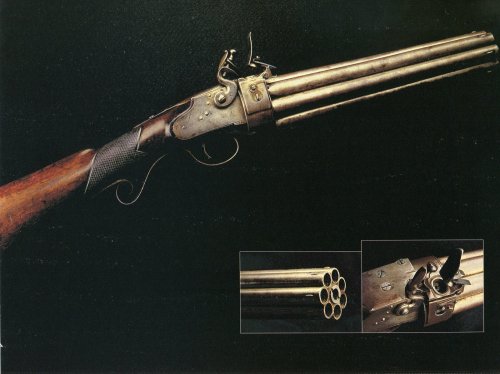
The first revolver was patented and sold to the military in 1820, the Artemus Wheeler.
Here's a link to a webpage with pictures of this revolver as well as the basic information about it. Link
It's a neat gun and as far as I could tell the first "real" revolver to be used during the 19th century. Other guns were developed during the 19th century and admittedly this one wasn't all that common. Since it was used by the military, my character had to have some background or connection with the Navy. Be realistic with the weapons you choose. I found this to be a terrifying weapon to look down the barrel of, so I used it.
Here's a link to a webpage with pictures of this revolver as well as the basic information about it. Link
It's a neat gun and as far as I could tell the first "real" revolver to be used during the 19th century. Other guns were developed during the 19th century and admittedly this one wasn't all that common. Since it was used by the military, my character had to have some background or connection with the Navy. Be realistic with the weapons you choose. I found this to be a terrifying weapon to look down the barrel of, so I used it.
Friday, August 1, 2014
How to buy a Rifle
Here's an excerpt from The Encyclopaedia of Sport on How to buy a Rifle.
HOW TO BUY A RIFLE—"What game do you propose to shoot with it ?" is the natural question which arises. If you want to shoot a rhinoceros or an elephant, a small cannon will be best, i.e. anything from a '500 express with expanding bullets to an eight or ten bore. If, on the other hand, your game consists of small deer such as gazelles, antelopes, or roe, a good rook rifle will be sufficient. But for almost all purposes the two best rifles at present in use are the '450 express and the '303 Lee-Metford, the latter used with the black bullet and cordite or rifleite powder. I say the black bullet, because it makes a more killing wound than the nickel-covered army bullet, which goes clean through any stag and does not stop him at once unless it strikes a vital part. I used to prefer the '303 to the express, owing to the noiseless and smokeless ammunition and to the absence of recoil; for, in stalking, noise and smoke are naturally prejudicial to a second chance.
But of late many experiments have been made with the '450 express with '400 chamber and smokeless powders; and, if the proper powder is used, I have but little doubt that this will supersede all other weapons. The size of the bullet and the wound it makes give it a great advantage over the "303. Besides, the lead of the black bullet is less likely to ire main in the groove of the express than in that of the '303. Some experiments with tubeite have succeeded well, fired from the '450, and this gives all the advantages of the '303—i.e. no noise and no smoke, plus a lighter and less delicate weapon and a larger bullet.
In buying a rifle, soundness and shooting are the points to be ascertained first, and then the pull of the triggers, which latter entirely depends upon the purchaser's taste. I prefer the pull to be very light, and in hammerless rifles the half cock or safety bolt should have a guard so .as to prevent its slipping when carried. The bend of a rifle is not so important as that •of a gun, as it is very rare that one requires to put it up quick to the shoulder and snap off as one does with a gun. But the sighting is quite .a study; and though the sight of a rifle may make admirable practice in one good shot's hands, it may not do so in the hands of another •equally good shot, for the reason that the two men's '(eyesights may be quite different. A man may shoot well with an army '303 rifle if he has young sight or even if he wears spectacles to assist short-sightedness. But a man with old •eyesight, that is, who can see any distance within reason, but cannot read without glasses, will be apt to find the back-sight of his rifle totally useless. Such a man will generally be .able to read the leader type of the Times newspaper, for a very short while, by holding it well away from him, say 26 inches or so, though it •will make his eyes ache. If the back-sight, therefore, is put at the usual distance from the eye (said to be 14 inches) the old sighted man will not see it clearly, though he sees the bead .at the end of the barrel. If he puts on his "clearers" he will see the back-sight, but not the bead or the bull's eye. This very common form of eyesight is rarely properly attended to •on sighting rifles, and yet the remedy seems simple enough, viz. : to put the back-sight forward until it is clearly seen. It will of course involve the altering of the V, but it will not hurt the shooter's eye for the few seconds he takes in aiming, as it would if he tried to read for any length of time at the same distance. But before using this extreme measure, i.e., of placing the back-sight so forward, I would recommend a trial of the bar-sight, which was so strongly advocated in the Deerstalking article in this Encyclopedia by Mr. Grimble. It suits some people with old sight, and its outline is very distinct, being white platinum on a black ground, but even this requires adjusting to the purchaser's sight. Hundreds of rifles are bought on the strength of a target pattern which is shown to the customer. They have been sighted to the proper eyesight of a man of thirty; but no offer is ever made by the seller to adjust the sight to the eyes ot the actual purchaser. This the latter should see to himself. The most conscientious gun-makers fall into this error, an error which eventually does them as much harm as any other shortcoming in the rifle they sell, for their customer shoots badly and the maker gets a certain amount of the blame. We know that a rifle is rather disfigured by having its back-sight forward on the barrels, but the outward appearance is only a secondary consideration. I prefer the doublebarrelled Lee-Metford to the single barrel and magazine. The former is a nice handy weapon, and to my mind two barrels should be sufficient, unless the sportsman (?) is of that blood-thirsty tribe who go out with the intention of killing all they can, not by fair stalking, but by penning deer into gorges and slaughtering them. Let them use magazines if they like, I shall not even be surprised if I hear some day of their adopting the Maxim!
As to the care necessary for preserving both guns and rifles during the non-shooting season, it is best to take the advice of a gun-maker. But the essential point is never to keep them in a damp place; and to examine them thoroughly not less than once a month, wiping every part each time and oiling where necessary. The browning of the barrels should also be attended to at the end of a season, as a small rub may give a shiny barrel.
W. G. Craven.
HOW TO BUY A RIFLE—"What game do you propose to shoot with it ?" is the natural question which arises. If you want to shoot a rhinoceros or an elephant, a small cannon will be best, i.e. anything from a '500 express with expanding bullets to an eight or ten bore. If, on the other hand, your game consists of small deer such as gazelles, antelopes, or roe, a good rook rifle will be sufficient. But for almost all purposes the two best rifles at present in use are the '450 express and the '303 Lee-Metford, the latter used with the black bullet and cordite or rifleite powder. I say the black bullet, because it makes a more killing wound than the nickel-covered army bullet, which goes clean through any stag and does not stop him at once unless it strikes a vital part. I used to prefer the '303 to the express, owing to the noiseless and smokeless ammunition and to the absence of recoil; for, in stalking, noise and smoke are naturally prejudicial to a second chance.
But of late many experiments have been made with the '450 express with '400 chamber and smokeless powders; and, if the proper powder is used, I have but little doubt that this will supersede all other weapons. The size of the bullet and the wound it makes give it a great advantage over the "303. Besides, the lead of the black bullet is less likely to ire main in the groove of the express than in that of the '303. Some experiments with tubeite have succeeded well, fired from the '450, and this gives all the advantages of the '303—i.e. no noise and no smoke, plus a lighter and less delicate weapon and a larger bullet.
In buying a rifle, soundness and shooting are the points to be ascertained first, and then the pull of the triggers, which latter entirely depends upon the purchaser's taste. I prefer the pull to be very light, and in hammerless rifles the half cock or safety bolt should have a guard so .as to prevent its slipping when carried. The bend of a rifle is not so important as that •of a gun, as it is very rare that one requires to put it up quick to the shoulder and snap off as one does with a gun. But the sighting is quite .a study; and though the sight of a rifle may make admirable practice in one good shot's hands, it may not do so in the hands of another •equally good shot, for the reason that the two men's '(eyesights may be quite different. A man may shoot well with an army '303 rifle if he has young sight or even if he wears spectacles to assist short-sightedness. But a man with old •eyesight, that is, who can see any distance within reason, but cannot read without glasses, will be apt to find the back-sight of his rifle totally useless. Such a man will generally be .able to read the leader type of the Times newspaper, for a very short while, by holding it well away from him, say 26 inches or so, though it •will make his eyes ache. If the back-sight, therefore, is put at the usual distance from the eye (said to be 14 inches) the old sighted man will not see it clearly, though he sees the bead .at the end of the barrel. If he puts on his "clearers" he will see the back-sight, but not the bead or the bull's eye. This very common form of eyesight is rarely properly attended to •on sighting rifles, and yet the remedy seems simple enough, viz. : to put the back-sight forward until it is clearly seen. It will of course involve the altering of the V, but it will not hurt the shooter's eye for the few seconds he takes in aiming, as it would if he tried to read for any length of time at the same distance. But before using this extreme measure, i.e., of placing the back-sight so forward, I would recommend a trial of the bar-sight, which was so strongly advocated in the Deerstalking article in this Encyclopedia by Mr. Grimble. It suits some people with old sight, and its outline is very distinct, being white platinum on a black ground, but even this requires adjusting to the purchaser's sight. Hundreds of rifles are bought on the strength of a target pattern which is shown to the customer. They have been sighted to the proper eyesight of a man of thirty; but no offer is ever made by the seller to adjust the sight to the eyes ot the actual purchaser. This the latter should see to himself. The most conscientious gun-makers fall into this error, an error which eventually does them as much harm as any other shortcoming in the rifle they sell, for their customer shoots badly and the maker gets a certain amount of the blame. We know that a rifle is rather disfigured by having its back-sight forward on the barrels, but the outward appearance is only a secondary consideration. I prefer the doublebarrelled Lee-Metford to the single barrel and magazine. The former is a nice handy weapon, and to my mind two barrels should be sufficient, unless the sportsman (?) is of that blood-thirsty tribe who go out with the intention of killing all they can, not by fair stalking, but by penning deer into gorges and slaughtering them. Let them use magazines if they like, I shall not even be surprised if I hear some day of their adopting the Maxim!
As to the care necessary for preserving both guns and rifles during the non-shooting season, it is best to take the advice of a gun-maker. But the essential point is never to keep them in a damp place; and to examine them thoroughly not less than once a month, wiping every part each time and oiling where necessary. The browning of the barrels should also be attended to at the end of a season, as a small rub may give a shiny barrel.
W. G. Craven.
Subscribe to:
Posts (Atom)