
Showing posts with label economics. Show all posts
Showing posts with label economics. Show all posts
Thursday, September 7, 2017
Farm Land for sale 1874
Here's an ad from American Agriculturalist ©1874 encouraging farmers to go out and settle the west. The price was $10 per acre. You didn't have to pay for the first four years. You can pay the note off early. All enticing the farmer to come and settle Nebraska.


Friday, September 1, 2017
1853 Fares
I stumbled on this while working on my 19th Century Carriages & Wagons Resource Book. Below is a list of fares published in Disturnell's American & European Railroad & Steamship Guide ©1853.
FOR ONE PERSON, FROM THE HOTELS, TO THE RAILBOAD DEPOTS, AND STEAMBOAT WHARVES.
BOSTON.
Coach fare, with baggage, 25 cents
NEW YORK.
Coach and Cab fare, with baggage, 25 cents
Carman's fees, 25 cents
Porter's fees, 18 ½ cents
PHILADELPHIA.
Coach fare,* with baggage, 50 cents
Porter's fees, 25 cents
BALTIMORE.
Coach fare, with baggage 50 cents
Porter's fees, 25 cents
WASHINGTON.
Coach fare, with baggage. . . 25 cents
(CT For further information, see the laws relating to Hackney Coaches, &c., which can usually be found in the carriages, as required by law.
* The law allows 50 cents for one or two passengers.
N. B. The best mode to reduce the coach fare in Philadelphia and Baltimore, where it is too high, is not to employ them at present rates.
FOR ONE PERSON, FROM THE HOTELS, TO THE RAILBOAD DEPOTS, AND STEAMBOAT WHARVES.
BOSTON.
Coach fare, with baggage, 25 cents
NEW YORK.
Coach and Cab fare, with baggage, 25 cents
Carman's fees, 25 cents
Porter's fees, 18 ½ cents
PHILADELPHIA.
Coach fare,* with baggage, 50 cents
Porter's fees, 25 cents
BALTIMORE.
Coach fare, with baggage 50 cents
Porter's fees, 25 cents
WASHINGTON.
Coach fare, with baggage. . . 25 cents
(CT For further information, see the laws relating to Hackney Coaches, &c., which can usually be found in the carriages, as required by law.
* The law allows 50 cents for one or two passengers.
N. B. The best mode to reduce the coach fare in Philadelphia and Baltimore, where it is too high, is not to employ them at present rates.
Thursday, August 17, 2017
1857 Fabric Advertisement
Below is an ad from the New York Daily Tribune Nov. 30, 1857. What is curious for me is the India camel hair shawls. They sound scratchy to me but apparently they were the rage in 1857 in NYC, along with Chantilly Lace Flounces. On the other hand with the reduction of cost perhaps they were no longer the rage.


Tuesday, August 15, 2017
1842 Bankruptcy
The Panic of 1837 caused financial hardships for many. By 1842 the country was beginning to rebound. For some unknown reason (to me at this time) Vermont however had many filings for bankruptcy. However, there are a few things I learned. In 1841 Congress enacted a 2nd Bankruptcy Law (formerly an 1803 bankruptcy repealed) in the wake of the panics of 1837 & 1839. In 1843 the second Bankruptcy law was repealed amid many complaints of corruption and expenses.
Ask yourself how did your characters fair during the Panics and the Bankruptcy Laws. If not your characters perhaps their parents or grandparents. Was there bitterness in the hearts of others who were unable to file for bankruptcy and lost their farms and homes? Was your character bitter? Was your character honorable? Or was your character less than honorable and did that have a cause and effect on someone else that profoundly changed your character's life.
These are some of the questions I look at when addressing issues surrounding the dates in which my characters were living. Perhaps these tidbits you will find helpful in learning more about your characters.
Ask yourself how did your characters fair during the Panics and the Bankruptcy Laws. If not your characters perhaps their parents or grandparents. Was there bitterness in the hearts of others who were unable to file for bankruptcy and lost their farms and homes? Was your character bitter? Was your character honorable? Or was your character less than honorable and did that have a cause and effect on someone else that profoundly changed your character's life.
These are some of the questions I look at when addressing issues surrounding the dates in which my characters were living. Perhaps these tidbits you will find helpful in learning more about your characters.
Monday, August 14, 2017
1842 Fall Clothing Line
Below is an Advertisement with the list of items for the Fall season. This comes from the Nov. 4, 1842 Burlington Free Press. Note the various items listed. It might help you as a writer put in an article of clothing that is perhaps a bit different than your normal description given by authors.


Friday, August 11, 2017
1842 Hat Prices
Below is a copy of an ad from the New York Daily Tribune May 3, 1842. The advertisement is listing the price of various hats. I'll type them out because they are difficult to read:
Silk Hats @ $2.25, $2.50 & $3.00 (says it is a reduction of .50 cents from the former prices)
Fur Hat $4.00 compares other hat prices in the city at $4.50 & $5.00

Silk Hats @ $2.25, $2.50 & $3.00 (says it is a reduction of .50 cents from the former prices)
Fur Hat $4.00 compares other hat prices in the city at $4.50 & $5.00

Tuesday, August 8, 2017
1869 Advertising
Below is an Lord & Taylor ad from the New York Tribue, Apr. 21, 1869. What I find useful from this is the pricing of the various clothing items in this newspaper ad. It starts with the Black silk dress for $2.50 worth $3.50. A point to remember is that 1869 is one of the recovery years from the Civil War.
Here's the Ad:

Here's the Ad:

Monday, July 31, 2017
Big Bonanza
The Big Bonanza was the events surrounding the Silver Mines in Nevada in the 19th Century. Dan deQuille, History of the Big Bonanza wrote the book in 1876 giving an account of the lives and people of Nevada.
Below I'm sharing the foreward written by Mark Twain, it is quite an endorsement.
One easily gets a surface-knowledge of any remote country, through the writings of travellers. The inner life of such a country is not very often presented to the reader. The outside of a strange house is interesting, but the people, the life, and the furniture inside, are far more so.
Nevada is peculiarly a surface-known country, for no one has written of that land who had lived long there and made himself competent to furnish an inside view to the public. I think the present volume supplies this defect in an eminently satisfactory way. The writer of it has spent sixteen years in the heart of the silver-mining region, as one of the editors of the principal daily newspaper of Nevada; he is thoroughly acquainted with his subject, and wields a practised pen. He is a gentleman of character and reliability. Certain of us who have known him personally during half a generation are well able to testify in this regard.
MARK TWAIN.
Hartford, May, 1876.
Below I'm sharing the foreward written by Mark Twain, it is quite an endorsement.
One easily gets a surface-knowledge of any remote country, through the writings of travellers. The inner life of such a country is not very often presented to the reader. The outside of a strange house is interesting, but the people, the life, and the furniture inside, are far more so.
Nevada is peculiarly a surface-known country, for no one has written of that land who had lived long there and made himself competent to furnish an inside view to the public. I think the present volume supplies this defect in an eminently satisfactory way. The writer of it has spent sixteen years in the heart of the silver-mining region, as one of the editors of the principal daily newspaper of Nevada; he is thoroughly acquainted with his subject, and wields a practised pen. He is a gentleman of character and reliability. Certain of us who have known him personally during half a generation are well able to testify in this regard.
MARK TWAIN.
Hartford, May, 1876.
Tuesday, July 18, 2017
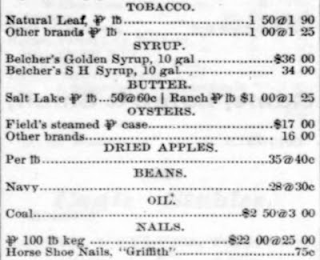
1867 Costs in Montana
The information below comes from "The Montana Post" (Virginia City, Montana Territory Jan. 5, 1867 newspaper. What I found is a market report of the costs of various products. They state theprices in gold or large lots from first hands, unless otherwise stated, and that in filling orders, higher rates have to be paid. I've enlarged the column and it is in several parts.




Wednesday, June 14, 2017
100 Hundred Dollar Note
When the first $100 bill was issued it was actually called a Note. In 1862 the first U.S. $100 note was issued. In 1863 you could purchase $100 gold certificates. In 1869 Abraham Lincoln was represented on the note.
These bills were larger than our current currency. They were approximately 7.4"x3.1"
You can find some good information about the $100 note at The paper money experts and some pictures of the bill.
At Wikipedia you can find nearly the same outline however they have an image of the Lincoln note.
Another source with some great images of the Hundred Dollar bill can be found at Matter of Life
These bills were larger than our current currency. They were approximately 7.4"x3.1"
You can find some good information about the $100 note at The paper money experts and some pictures of the bill.
At Wikipedia you can find nearly the same outline however they have an image of the Lincoln note.
Another source with some great images of the Hundred Dollar bill can be found at Matter of Life
Tuesday, June 13, 2017
1877 Railroad Strike
For a good overview of the strike, I recommend starting with Wikipedia.
Another source would be History of the United States from the Compromise of 1850: 1877-1896 by James Ford Rhodes.
The strike was fueled by several things, one the decrease of the wages being paid to the employees and the 1873 depression. It probably became as violent as it was because of Taft and how he won the election. But all of that is speculating, which our characters might do in conversation. If you choose to use the strike in your novel be sure of the dates and the time it entered your area.
Another source would be History of the United States from the Compromise of 1850: 1877-1896 by James Ford Rhodes.
The strike was fueled by several things, one the decrease of the wages being paid to the employees and the 1873 depression. It probably became as violent as it was because of Taft and how he won the election. But all of that is speculating, which our characters might do in conversation. If you choose to use the strike in your novel be sure of the dates and the time it entered your area.
Monday, June 12, 2017
1873 Depression
I don't know about you but when I hear the word Depression, I think of the Great depression of the 1929. But the 19th century wasn't without it own share of economic depression. A while back I wrote a post about the Panic of 1873
In google books I came across a periodical called "Commercial and Financial Chronicle, Vol. 17" There is an article written there about the two possible causes for the panic. Click Here to read the prevailing thoughts of the day regarding the cause of the 1873 Panic and Depression.
In google books I came across a periodical called "Commercial and Financial Chronicle, Vol. 17" There is an article written there about the two possible causes for the panic. Click Here to read the prevailing thoughts of the day regarding the cause of the 1873 Panic and Depression.
Wednesday, May 31, 2017
Money Exchange Rates
I've been searching for historical money exchange rates for the 19th century. Below is a link that will convert the British Pound to the American dollar. Link You select the year and time period you're looking for and it will convert. This has been a very helpful link with regard to the cost of carriages from the 19th century to American dollars.
Tuesday, May 16, 2017
1858 & 1859 Illinois Crop Failure
Well I couldn't walk away from the passage in yesterday's post regarding the crop failing in 1858 in Illinois. I believe I've mentioned here that one of my ancestors was born on the prairie, her mother died there and she and her father returned to New England a few years later. With the loss of his wife and the failure of his crops, I can see my ancestor returning home. But enough about my ancestors.
There was a huge crop failure in Illinois in 1858 that caused some issues with bank failures. As one report put it, "business was completely paralyzed owing to the economic crisis." The crop failure in Illinois in 1858 was so profound that even though 1859 was good it wasn't good enough and the economics of the state of Illinois didn't turn around until the second half of 1860.
There was a huge crop failure in Illinois in 1858 that caused some issues with bank failures. As one report put it, "business was completely paralyzed owing to the economic crisis." The crop failure in Illinois in 1858 was so profound that even though 1859 was good it wasn't good enough and the economics of the state of Illinois didn't turn around until the second half of 1860.
Thursday, May 11, 2017
Economy
I'm closing the week out with yet another post from The American Frugal Housewife ©1835. I find this book helpful in two ways, one it has some great information for my 19th century characters. 2, in our day and age where gas prices are sky rocketing, I feel it is important to be as economical as possible and this book is Mrs. Child's work on the topic of economics. I believe the passage below gives the reader a peak into the heart of Mrs. Child and her views of economics.
The other day, I heard a mechanic say, ' I have a wife and two little children ; we live in a very small house; but, to save my life, I cannot spend less than twelve hundred a year.' Another replied, ' You are not economical; I spend but eight hundred.' I thought to myself,—' Neither of you pick up your twine and paper.' A third one, who was present, was silent; but after they were gone, he said, 'I keep house, and comfortably too, with a wife and children, for six hundred a year; but I suppose they would have thought me mean, if I had told them so.' I did not think him mean; it merely occurred to me that his wife and children were in the habit of picking up paper and twine.
Economy is generally despised as a low virtue, tending to make people ungenerous and selfish. This is true of avarice ; but it is not so of economy. The man who is economical, is laying up for himself the permanent power of being useful and generous. He who thoughtlessly gives away ten dollars, when he owes a hundred more than he can pay, deserves no praise,—ho obeys a sudden impulse,. more like instinct than reason: it would be real charity to check this feeling; because the good he does may be doubtful, while the injury he does his family and creditors is certain. True economy is a careful treasurer in the service of benevolence ; and where they are united, respectability, prosperity and peace will follow.
The other day, I heard a mechanic say, ' I have a wife and two little children ; we live in a very small house; but, to save my life, I cannot spend less than twelve hundred a year.' Another replied, ' You are not economical; I spend but eight hundred.' I thought to myself,—' Neither of you pick up your twine and paper.' A third one, who was present, was silent; but after they were gone, he said, 'I keep house, and comfortably too, with a wife and children, for six hundred a year; but I suppose they would have thought me mean, if I had told them so.' I did not think him mean; it merely occurred to me that his wife and children were in the habit of picking up paper and twine.
Economy is generally despised as a low virtue, tending to make people ungenerous and selfish. This is true of avarice ; but it is not so of economy. The man who is economical, is laying up for himself the permanent power of being useful and generous. He who thoughtlessly gives away ten dollars, when he owes a hundred more than he can pay, deserves no praise,—ho obeys a sudden impulse,. more like instinct than reason: it would be real charity to check this feeling; because the good he does may be doubtful, while the injury he does his family and creditors is certain. True economy is a careful treasurer in the service of benevolence ; and where they are united, respectability, prosperity and peace will follow.
Wednesday, April 19, 2017
1884 Simple Interest Rates
From Houghtaling's Handbook of Useful Information ©1884
Simple Interest Bales.
FOUR FER CENT.—Multiply the principal by the number of days to run; separate the right hand figure from the product and divide by 9.
FIVE PER CENT.—Multiply by number of days and divide by 72,
SIX PER CENT.—Multiply by number of days; separate right hand figure, and divide Dy 6.
SEVEN AND THREE-TENTHS PER CENT.—Multiply by number of days, and double the amount so obtained. On $1(X> the interest is just two cents per day.
EIGHT PER CENT.—Multiply by number of days, and divide by 45.
NINE PER CENT.—Multiply by number of days; separate right hand figure, and divide by 4.
TEN PER CENT.—Multiply by number of days, and divide by 36.
TWELVE PER CENT.—Multiply by number of days; separate right hand figure, and divide by 3.
Simple Interest Bales.
FOUR FER CENT.—Multiply the principal by the number of days to run; separate the right hand figure from the product and divide by 9.
FIVE PER CENT.—Multiply by number of days and divide by 72,
SIX PER CENT.—Multiply by number of days; separate right hand figure, and divide Dy 6.
SEVEN AND THREE-TENTHS PER CENT.—Multiply by number of days, and double the amount so obtained. On $1(X> the interest is just two cents per day.
EIGHT PER CENT.—Multiply by number of days, and divide by 45.
NINE PER CENT.—Multiply by number of days; separate right hand figure, and divide by 4.
TEN PER CENT.—Multiply by number of days, and divide by 36.
TWELVE PER CENT.—Multiply by number of days; separate right hand figure, and divide by 3.
Friday, February 3, 2017
Mocha Coffee
No, this isn't what we think of today as mocha coffee. We are used to a chocolate coffee drink/flavor that makes up mocha coffee. But during the 19th century Mocha coffee was a type of coffee primarily grown in Yemen. In 1873 $2,216.00 was the income of trade between Egypt and the United States for mocha coffee. Below is a brief description of the bean from Reports of the United States Commissioners to the Universal Exposition of Paris ©1891 pg700
MOCHA COFFEE.
Mocha coffee is considered the best of all. Genuine Mocha is grown in Arabia where coffee culture has been carried on for more than four centuries, and for two centuries the Arabians furnished the coffee supply for the world. Now, however, a comparatively small amount of Arabian coffee enters into consumption, not more than 4,000 tons per year being exported, half of which goes to France. The Mocha seed has been planted in Brazil and other countries, but with change in place there seems to be a change in the character of the plant and berry. The Mocha berry is round, and when fresh roasted has a rich aroma. The large beans are preferred in Europe, while Americans prefer the small ones.
MOCHA COFFEE.
Mocha coffee is considered the best of all. Genuine Mocha is grown in Arabia where coffee culture has been carried on for more than four centuries, and for two centuries the Arabians furnished the coffee supply for the world. Now, however, a comparatively small amount of Arabian coffee enters into consumption, not more than 4,000 tons per year being exported, half of which goes to France. The Mocha seed has been planted in Brazil and other countries, but with change in place there seems to be a change in the character of the plant and berry. The Mocha berry is round, and when fresh roasted has a rich aroma. The large beans are preferred in Europe, while Americans prefer the small ones.
Tuesday, January 31, 2017
1896 Chocolate Prices
I thought it might be interesting to post what Sears & Roebuck was listing in their 1896 catalogue. Below is a copy of the information from an 1896 catalogue. I've enlarged the image.


Saturday, January 21, 2017
Wagon Builders
I stumbled on this bit of information from Law Notes: Vol. 5 Pg 147 ©1886 while researching various wagon builders. What I found interesting about this was the practice of the "financing" of the purchase of a wagon.
Throughout the kingdom are many wagon companies, so called, that never build a single wagon; in fact, were they to do so, it would actually be ultra vires. In reality, these companies are "financing" companies only; they are no more wagon companies than bodies that lend money on bills of sale of furniture are furniture companies.
A person wishing to buy wagons, but to pay for them by instalments spread over a term, say, of seven years, will go to a wagon builder and get him to build the sort of wagons he (the intending purchaser) requires. Application is then made to a "financing" wagen company, by whom the wagons are purchased from the builder at the price the intending purchaser agreed to give; the builder invoices them to the company; and then they are let by the latter to the intending purchaser on the hire and purchase system. The rent fixed by the agreement for hire is calculated on the basis that the payments made during the term shall at its expiration have recouped the company the cost of the wagons and interest at the rate agreed upon; and in the agreement is contained a license to seize and retake possession of the wagons on non-payment of the rent and in certain other events. A proviso is also inserted that the property in the wagons shall, at the expiration of the term, when all moneys due under the agreement shall have been paid, vest in the bailee for hire, or, as he is generally termed, "the tenant."
Throughout the kingdom are many wagon companies, so called, that never build a single wagon; in fact, were they to do so, it would actually be ultra vires. In reality, these companies are "financing" companies only; they are no more wagon companies than bodies that lend money on bills of sale of furniture are furniture companies.
A person wishing to buy wagons, but to pay for them by instalments spread over a term, say, of seven years, will go to a wagon builder and get him to build the sort of wagons he (the intending purchaser) requires. Application is then made to a "financing" wagen company, by whom the wagons are purchased from the builder at the price the intending purchaser agreed to give; the builder invoices them to the company; and then they are let by the latter to the intending purchaser on the hire and purchase system. The rent fixed by the agreement for hire is calculated on the basis that the payments made during the term shall at its expiration have recouped the company the cost of the wagons and interest at the rate agreed upon; and in the agreement is contained a license to seize and retake possession of the wagons on non-payment of the rent and in certain other events. A proviso is also inserted that the property in the wagons shall, at the expiration of the term, when all moneys due under the agreement shall have been paid, vest in the bailee for hire, or, as he is generally termed, "the tenant."
Sears & Roebuck Shipping Rates 1896
Below is a very small selection of the shipping rates for Sears & Roebuck from their 1896 Spring catalogue. Note the prices are set for a per 100 lbs. A fellow writer, from one of the writing groups I'm in, mentioned how her grandmother told stories about how items came to the farm from their orders to Sears and other places. The train simply stopped on the tracks (at the edge of their farm) and left the items on the side of the tracks then continued on their way.
Sears & Roebuck went into detail about the way to order, how to figure the shipping charges, etc. By placing a freight rate chart they not only helped their customers but saved themselves the headache of extra billing for freight.

Sears & Roebuck went into detail about the way to order, how to figure the shipping charges, etc. By placing a freight rate chart they not only helped their customers but saved themselves the headache of extra billing for freight.

Subscribe to:
Posts (Atom)