This recipe comes from Miss Leslie's Lady's New Receipt book ©1850. It could be used by your characters when sending off their spouse, father, brother or sequestered away in the folds of her shirt to prevent sea-sickness, or better yet to hide the morning sickness your character might be expecting. Or what about some busybody seeing your character eating such treats and gossiping that she is pregnant. The list can go on and on. Enjoy playing with the idea of this kind of a recipe for your characters.
SEA-VOYAGE GINGERBREAD.—Sift two pounds of flour into a pan, and cut up in it a pound and a quarter of fresh butter; rub the butter well into the flour, and then mix in a pint of West India molasses and a pound of the best brown sugar. Beat eight eggs till very light. Stir into the beaten egg two glasses or a jill of brandy. Add also to the egg a teacup-full of ground ginger, and a table-spoonful of powdered cinnamon, with a tea-spoonful of soda melted in a little warm water. Wet the flour, &c., with this mixture till it becomes a soft dough. Sprinkle a little flour on your paste-board, and with a broad knife spread portions of the mixture thickly and smoothly upon it. The thickness must be equal all through; therefore spread it carefully and evenly, as the dough will be too soft to roll out. Then with the edge of a tumbler dipped in flour, cut it out into round cakes. Have ready square pans, slightly buttered ; lay the cakes in them sufficiently far apart to prevent their running into each other when baked. Set the pans into a brisk oven, and bake the cakes well, seeing that they do not burn.
You may cut them out small with the lid of a cannister (or something similar) the usual size of gingerbread nuts.
These cakes will keep during a long voyage, and are frequently carried to sea. Many persons find highly spiced gingerbread a preventive to sea-sickness.
Showing posts with label Food. Show all posts
Showing posts with label Food. Show all posts
Wednesday, September 20, 2017


Tuesday, September 19, 2017
Almond Cream Pudding
Okay this was a new recipe for me. Perhaps, some of you have heard of it and possibly have eaten it before and if that is so, let us know. On the other hand, this recipe is a lot of work and has items I've never heard about before (definitions of those are below the recipe) so many it isn't made any longer.
Below is a recipe from the Miss Ledlie's Lady's New Receipt Book ©1850
ALMOND CREAM.—Take a pound of shelled sweet almonds, and two ounces or more of shelled bitter almonds, or peach-kernels. Blanch them in scalding water, throwing them as you proceed into a bowl of cold water. Then pound them (one at a time) in a mortar, till each becomes a smooth paste; pouring in, as you proceed, a little rosewater to make the almonds white and light, and transferring the paste to a plate as you go on. Then when they are all done, mix the almonds with a quart of rich cream, and a quarter of a pound of powdered loaf-sugar. Add half a dozen blades of mace; put the mixture into a porcelain kettle, and boil it, slowly, stirring it frequently down to the bottom. Having given it one boil up, remove it from the fire, take out the mace, and when it has cooled a little, put the cream into glass cups, grating nutmeg over each. Serve it up quite cold. You may ornament each cup of this cream with white of egg, beaten to a stiff froth, and heaped on the top.
Definitions:
Loaf-Sugar it is sold in a solid block and is granulated. A tool such as a sugar nip was used to break off chunks of this sugar.
Blades of Mace: is the outer lacy looking shell of nutmeg. Ground mace which we all tend to be accustomed to today is made from this lacy scarlet-colored shell. Once the shell is dried fades to light brown.
Below is a recipe from the Miss Ledlie's Lady's New Receipt Book ©1850
ALMOND CREAM.—Take a pound of shelled sweet almonds, and two ounces or more of shelled bitter almonds, or peach-kernels. Blanch them in scalding water, throwing them as you proceed into a bowl of cold water. Then pound them (one at a time) in a mortar, till each becomes a smooth paste; pouring in, as you proceed, a little rosewater to make the almonds white and light, and transferring the paste to a plate as you go on. Then when they are all done, mix the almonds with a quart of rich cream, and a quarter of a pound of powdered loaf-sugar. Add half a dozen blades of mace; put the mixture into a porcelain kettle, and boil it, slowly, stirring it frequently down to the bottom. Having given it one boil up, remove it from the fire, take out the mace, and when it has cooled a little, put the cream into glass cups, grating nutmeg over each. Serve it up quite cold. You may ornament each cup of this cream with white of egg, beaten to a stiff froth, and heaped on the top.
Definitions:
Loaf-Sugar it is sold in a solid block and is granulated. A tool such as a sugar nip was used to break off chunks of this sugar.
Blades of Mace: is the outer lacy looking shell of nutmeg. Ground mace which we all tend to be accustomed to today is made from this lacy scarlet-colored shell. Once the shell is dried fades to light brown.
Thursday, August 31, 2017
Superior Muffins
It's been a while since I've had some recipes and I stumbled on this while searching for ways to stay cool in the summer. I hope you enjoy.
Superior Muffins. 1 quart of flour. 1 teaspoonful of salt. 1 tablespoonful of white sugar.
Rub in one heaping tablespoonful of butter and lard mixed, and one tablespoonful of Irish potato, mashed free from lumps.
Pour in three well beaten eggs and a half teacup of yeast. Make into a soft dough with warm water in winter and cold in summer. Knead well for half an hour. Set to rise where it will be milk-warm, in winter, and cool in summer. If wanted for an eight o'clock winter breakfast, make up at eight o'clock the night before. At six o'clock in the morning, make out into round balls (without kneading again), and drop into snow-ball moulds that have been well greased. Take care also to grease the hands and pass them over the tops of the muffins. Set them in a warm place for two hours and then bake.
These are the best muffins I ever ate.—Mrs. 8. T.
Source: Housekeeping in Old Virginia ©1879
PS Remember a teacup is one cup, so she's suggesting 1/2 cup of yeast.
Superior Muffins. 1 quart of flour. 1 teaspoonful of salt. 1 tablespoonful of white sugar.
Rub in one heaping tablespoonful of butter and lard mixed, and one tablespoonful of Irish potato, mashed free from lumps.
Pour in three well beaten eggs and a half teacup of yeast. Make into a soft dough with warm water in winter and cold in summer. Knead well for half an hour. Set to rise where it will be milk-warm, in winter, and cool in summer. If wanted for an eight o'clock winter breakfast, make up at eight o'clock the night before. At six o'clock in the morning, make out into round balls (without kneading again), and drop into snow-ball moulds that have been well greased. Take care also to grease the hands and pass them over the tops of the muffins. Set them in a warm place for two hours and then bake.
These are the best muffins I ever ate.—Mrs. 8. T.
Source: Housekeeping in Old Virginia ©1879
PS Remember a teacup is one cup, so she's suggesting 1/2 cup of yeast.
Wednesday, August 2, 2017
Sesame Oil
The Egyptians uses Sesame long before others. During the 19th century I haven't found many food recipes that involved sesame seed oil. Below are a few excerpts with some information on sesame oil and it's uses during the 19th century. Also note that sesame seeds were primarily grown in India and the Middle East. It would be extremely rare for someone in America to have sesame seeds in America.
Sesame oil, almond oil, earth-nut oil, and rape oil arc better fitted for the preparation of machine oils, and the last named, being the cheapest, is more used than all the others. Source: Journal of the Society of Chemical Industry Vol. 2 pg 481 ©1883
Was often mixed with Olive oil. Various sources
SESAME OIL: ITS SUITABILITY FOR PHARMACEUTICAL PURPOSES.
By Thomas Haben, Pharmaceutical Chemist.
The literature relating to sesame oil is very meagre, and in "Pharmacographia" alone do we find anything like a satisfactory description of the article and its uses. The learned authors of that work state that the oil "might be employed without disadvantage for all the purposes for which olive oil is used," and it is with the view of indicating the reliability or otherwiso of this opinion, that I have, acting on the suggestion contained in the "Blue List," undertaken the preparation of this report.
Sesame oil differs little in its physical characters from either olive or almond oils. It has not the tinge of green which all but the finest specimens of the former possess, and is of a rather more decided shade of yellow than the latter, but generally speaking the difference in colour is not very marked. The odour of a fine specimen of sesame oil is very slight, while the tasto is at first sweetish and bland with a peculiar after-flavour. Olive oil becomes grainy through the deposit of a crystalline fatty body at 5° C, but the olein does not solidify till about -5° C. Sesame oil congeals at-5° C, and almond oil is liquid till -20° C. is reached. The difference in the congealing points is doubtless due to the percentage of olein, of which almond oil " consists almost wholly" (" Pharmacographia "); sesame oil contains 76 per cent, {ibid.), and olive oil 72 per cent. (Braconnot). According to the best authorities, however, the percentage of olein varies according to circumstances; and, in like manner, different samples of the same oil differ in density, as is evident from the fact that hardly two authors agree in giving the same specific gravity for any one oil.
Source: Year-Book of Pharmacy comprising Abstracts of Papers pg 540 ©1883
Three varieties of sesame seed are cultivated in India—the white-seeded (Suffed-iil), the red or parti-coloured (Kala-til), and the black variety (Tillee); it is the latter which affords the greater proportion of the Gingelly oil of commerce. At the commencement of 1861, white seed was worth in the London markets 65s.; black and brown, 58s. and 60s. per quarter.
A second sort of sesame oil, sometimes called "rape," is obtained from the red-seeded variety.
Black sesame is sown in March, and ripens in May. Red sesame is not sown till June.
Sesamum seed has of late been exported largely to France, where it is said to be employed for mixing with olive oil. Source:House of Commons Papers Vol. 35 pg59 ©1877
Below is a clip from the Omaha Daily Bee, Feb 12, 1886. In the article the dairymen were trying to fight the increase of oleo margarine.

Sesame oil, almond oil, earth-nut oil, and rape oil arc better fitted for the preparation of machine oils, and the last named, being the cheapest, is more used than all the others. Source: Journal of the Society of Chemical Industry Vol. 2 pg 481 ©1883
Was often mixed with Olive oil. Various sources
SESAME OIL: ITS SUITABILITY FOR PHARMACEUTICAL PURPOSES.
By Thomas Haben, Pharmaceutical Chemist.
The literature relating to sesame oil is very meagre, and in "Pharmacographia" alone do we find anything like a satisfactory description of the article and its uses. The learned authors of that work state that the oil "might be employed without disadvantage for all the purposes for which olive oil is used," and it is with the view of indicating the reliability or otherwiso of this opinion, that I have, acting on the suggestion contained in the "Blue List," undertaken the preparation of this report.
Sesame oil differs little in its physical characters from either olive or almond oils. It has not the tinge of green which all but the finest specimens of the former possess, and is of a rather more decided shade of yellow than the latter, but generally speaking the difference in colour is not very marked. The odour of a fine specimen of sesame oil is very slight, while the tasto is at first sweetish and bland with a peculiar after-flavour. Olive oil becomes grainy through the deposit of a crystalline fatty body at 5° C, but the olein does not solidify till about -5° C. Sesame oil congeals at-5° C, and almond oil is liquid till -20° C. is reached. The difference in the congealing points is doubtless due to the percentage of olein, of which almond oil " consists almost wholly" (" Pharmacographia "); sesame oil contains 76 per cent, {ibid.), and olive oil 72 per cent. (Braconnot). According to the best authorities, however, the percentage of olein varies according to circumstances; and, in like manner, different samples of the same oil differ in density, as is evident from the fact that hardly two authors agree in giving the same specific gravity for any one oil.
Source: Year-Book of Pharmacy comprising Abstracts of Papers pg 540 ©1883
Three varieties of sesame seed are cultivated in India—the white-seeded (Suffed-iil), the red or parti-coloured (Kala-til), and the black variety (Tillee); it is the latter which affords the greater proportion of the Gingelly oil of commerce. At the commencement of 1861, white seed was worth in the London markets 65s.; black and brown, 58s. and 60s. per quarter.
A second sort of sesame oil, sometimes called "rape," is obtained from the red-seeded variety.
Black sesame is sown in March, and ripens in May. Red sesame is not sown till June.
Sesamum seed has of late been exported largely to France, where it is said to be employed for mixing with olive oil. Source:House of Commons Papers Vol. 35 pg59 ©1877
Below is a clip from the Omaha Daily Bee, Feb 12, 1886. In the article the dairymen were trying to fight the increase of oleo margarine.

Monday, July 24, 2017
Chocolate Cake
This recipe comes from "Six Little Cooks" By Elizabeth Stansbury Kirkland ©1877 Note the debate about the one cup measurement at the end of this entry.
No. 5—Chocolate Cake.
One cup butter, two of sugar, three and a half of flour, one scant cup sweet milk, five eggs, omitting two whites, one teaspoonful cream tartar, one-half do. soda, one do. extract vanilla.
Meringue for the same. Beat the whites of the 'two eggs very light with one and a half cups powdered sugar; six tablespoon fills grated chocolate, two teaspoonfuls vanilla. Put the meringue on while the cake is hot, and leave it in the pan to cool.
"I don't see how any one can judge of what a 'cupfull ' is, Aunt Jane," said Hose, "cups are of such different sizes. Papa's coffee-cup is a perfect monster, and' mamma's tea-cup is a mite, small enough'for a fairy."
"Kitchen cups are not apt to vary much in size^" replied Aunt Jane, "and those are what are taken as a measure. If there is a great difference, we should choose one of a medium size. Then, you must remember, that when there are several things measured in cups, they will be proportioned to one another; so if you find after one experiment that your cake has not enough eggs in proportion to the other ingredients, you will know that your cups are too large; if the egg is too predominating, it will be because the cups are too small; so you will-'sbon . learn the happy medium."
"Besides," said Edith, "I suppose every little girl will have some grown person to show, her about these things , the first time, and then, after that she can remember. Won't you give us some more receipts, Mrs. King?"
No. 5—Chocolate Cake.
One cup butter, two of sugar, three and a half of flour, one scant cup sweet milk, five eggs, omitting two whites, one teaspoonful cream tartar, one-half do. soda, one do. extract vanilla.
Meringue for the same. Beat the whites of the 'two eggs very light with one and a half cups powdered sugar; six tablespoon fills grated chocolate, two teaspoonfuls vanilla. Put the meringue on while the cake is hot, and leave it in the pan to cool.
"I don't see how any one can judge of what a 'cupfull ' is, Aunt Jane," said Hose, "cups are of such different sizes. Papa's coffee-cup is a perfect monster, and' mamma's tea-cup is a mite, small enough'for a fairy."
"Kitchen cups are not apt to vary much in size^" replied Aunt Jane, "and those are what are taken as a measure. If there is a great difference, we should choose one of a medium size. Then, you must remember, that when there are several things measured in cups, they will be proportioned to one another; so if you find after one experiment that your cake has not enough eggs in proportion to the other ingredients, you will know that your cups are too large; if the egg is too predominating, it will be because the cups are too small; so you will-'sbon . learn the happy medium."
"Besides," said Edith, "I suppose every little girl will have some grown person to show, her about these things , the first time, and then, after that she can remember. Won't you give us some more receipts, Mrs. King?"
Tuesday, July 18, 2017
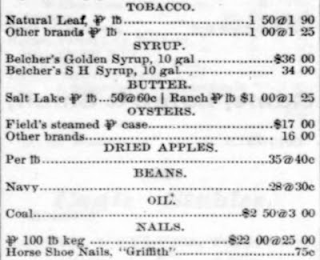
1867 Costs in Montana
The information below comes from "The Montana Post" (Virginia City, Montana Territory Jan. 5, 1867 newspaper. What I found is a market report of the costs of various products. They state theprices in gold or large lots from first hands, unless otherwise stated, and that in filling orders, higher rates have to be paid. I've enlarged the column and it is in several parts.




Wednesday, July 12, 2017
Chicken Pot-Pie
This is one of my family's favorite meals. I put chicken, a broth-gravy, potatoes, carrots, peas an various spices cover with biscuits or pie crust. However, as I searched recipe books from the 19th century there were no vegetables added to the dish. Personally, we love our veggies.
Below are various recipes:
Veal and Chicken Potpie. Joint the chickens, if made of them, and boil them till half done ; take them out; put them, dry, into a pot, making alternate layers of crust and fowl, seasoned with pepper and salt; then, pour in the liquor in which the fowls were boiled, upon the upper layer of crust, which covers the fowls. If a brown crust is desired : with a heated bake pan lid, keep the pot covered. Add, from the teakettle, boiling water, as that in the pot wastes. Raised piecrust , *- * is preferable to that made for fruit pies, though, if but, little
shortened, that is good. For raised crust, mix a teaspoonful of salt, and a teacup of melted butter, with three pints of flour, and then pour in half a teacup of yeast, adding cold water to make it stiff enough to roll out; placing it where warm, it will require from se'ven to eight hours to rise, unless you use brewer's yeast. Roll it out, when risen, and cut it into small cakes.
Potato pie crust is good. Peel and mash fine eight boiled potatoes ; mix with them half a pint of milk, a teaspoonful of salt, a hen's egg size piece of butter, and flour enough for rolling out. Put with the meat, the cakes after rolled out and cut.
By working into unbaked wheat dough, a little melted lukewarm butter, nice crust may be made. Before putting it with the meat, let it lay ten or fifteen minutes, after it is cut and rolled into cakes.
Source: The Improved Housewife ©1847
Chicken Pot Pie.—Cut a chicken in pieces; if it is not a young chicken parboil it in water enough to cover it, with half a pound of salt pork cut in slices, or a tea-spoonful of salt in it. Skim it carefully. Make a paste with half a pound of sweet lard rubbed into one pound of flour and a tea-spoonful of salt; add enough water to work it to a smooth paste ; roll the crust about half an inch thick, and line with it the sides of n stew-pan nearly to the bottom. Lay the chicken in the crust, and add a piece of butter the size of an egg rolled in flour; put in the water the chicken was parboiled in, and if necessary add more hot water till the stew-pan is nearly full. Cut part of the paste in small diamonds, and put them in the pie. Put on the top crust, first laying skewers across the top of the stew pan. Cut a slit in the centre. Put on the lid of the stew-pan, and let it boil slowly three-quarters of an hour, or more, if necessary. When the crust is well done the dish can be served.
Source: Mrs. Hale's New Cook Book ©1857
A CHICKEN POT-PIE.
Mrs. F. D. J.
Cut in small pieces one chicken, not too young; wash and put into a stone or earthen basin with sufficient water to cover, set this on the stove and let it cook until quite tender; then add to this broth (which will have cooked away a little,) half a pint of sweet milk, (perhaps not quite so much,) and one-half a can of fine oysters; season with pepper and salt, and mace if liked; put in bits of butter, and two tablespoons of flour. Now make a nice soda biscuit crust; roll out about an inch-thick and cover the meat; cut a hole in the middle of the crust, and put in the oven. When the crust is baked a rich brown set the dish on the stove, where the meat will gently simmer in the gravy, and steam the crust, (with a tin cover over,) for about ten minutes. Serve in the dish in which it is cooked, with a knitted cover.
Source: The Home Cook Book ©1876
Chicken Pot-pie.—Clean, singe, and joint a pair of chickens. Pare and slice eight white potatoes; wash the slices and put with the pieces of chicken into a stewpan lined with pie-crust; season with salt and pepper, dredge with flour, and cover with water. Cover with-paste, making a hole in the centre; cover the kettle, and either hang it over the fire or set it in the oven. If in the oven, turn occasionally to brown evenly. Two hours' cooking is sufficient. When done, cut the upper crust into moderate-sized pieces and place them on a large dish; with a perforated ladle take up the potato and chicken, put it upon the crust; cut the lower crust and put on the top. Serve the gravy hot in a gravy tureen.
Source: Our New Cook Book ©1883
Below are various recipes:
Veal and Chicken Potpie. Joint the chickens, if made of them, and boil them till half done ; take them out; put them, dry, into a pot, making alternate layers of crust and fowl, seasoned with pepper and salt; then, pour in the liquor in which the fowls were boiled, upon the upper layer of crust, which covers the fowls. If a brown crust is desired : with a heated bake pan lid, keep the pot covered. Add, from the teakettle, boiling water, as that in the pot wastes. Raised piecrust , *- * is preferable to that made for fruit pies, though, if but, little
shortened, that is good. For raised crust, mix a teaspoonful of salt, and a teacup of melted butter, with three pints of flour, and then pour in half a teacup of yeast, adding cold water to make it stiff enough to roll out; placing it where warm, it will require from se'ven to eight hours to rise, unless you use brewer's yeast. Roll it out, when risen, and cut it into small cakes.
Potato pie crust is good. Peel and mash fine eight boiled potatoes ; mix with them half a pint of milk, a teaspoonful of salt, a hen's egg size piece of butter, and flour enough for rolling out. Put with the meat, the cakes after rolled out and cut.
By working into unbaked wheat dough, a little melted lukewarm butter, nice crust may be made. Before putting it with the meat, let it lay ten or fifteen minutes, after it is cut and rolled into cakes.
Source: The Improved Housewife ©1847
Chicken Pot Pie.—Cut a chicken in pieces; if it is not a young chicken parboil it in water enough to cover it, with half a pound of salt pork cut in slices, or a tea-spoonful of salt in it. Skim it carefully. Make a paste with half a pound of sweet lard rubbed into one pound of flour and a tea-spoonful of salt; add enough water to work it to a smooth paste ; roll the crust about half an inch thick, and line with it the sides of n stew-pan nearly to the bottom. Lay the chicken in the crust, and add a piece of butter the size of an egg rolled in flour; put in the water the chicken was parboiled in, and if necessary add more hot water till the stew-pan is nearly full. Cut part of the paste in small diamonds, and put them in the pie. Put on the top crust, first laying skewers across the top of the stew pan. Cut a slit in the centre. Put on the lid of the stew-pan, and let it boil slowly three-quarters of an hour, or more, if necessary. When the crust is well done the dish can be served.
Source: Mrs. Hale's New Cook Book ©1857
A CHICKEN POT-PIE.
Mrs. F. D. J.
Cut in small pieces one chicken, not too young; wash and put into a stone or earthen basin with sufficient water to cover, set this on the stove and let it cook until quite tender; then add to this broth (which will have cooked away a little,) half a pint of sweet milk, (perhaps not quite so much,) and one-half a can of fine oysters; season with pepper and salt, and mace if liked; put in bits of butter, and two tablespoons of flour. Now make a nice soda biscuit crust; roll out about an inch-thick and cover the meat; cut a hole in the middle of the crust, and put in the oven. When the crust is baked a rich brown set the dish on the stove, where the meat will gently simmer in the gravy, and steam the crust, (with a tin cover over,) for about ten minutes. Serve in the dish in which it is cooked, with a knitted cover.
Source: The Home Cook Book ©1876
Chicken Pot-pie.—Clean, singe, and joint a pair of chickens. Pare and slice eight white potatoes; wash the slices and put with the pieces of chicken into a stewpan lined with pie-crust; season with salt and pepper, dredge with flour, and cover with water. Cover with-paste, making a hole in the centre; cover the kettle, and either hang it over the fire or set it in the oven. If in the oven, turn occasionally to brown evenly. Two hours' cooking is sufficient. When done, cut the upper crust into moderate-sized pieces and place them on a large dish; with a perforated ladle take up the potato and chicken, put it upon the crust; cut the lower crust and put on the top. Serve the gravy hot in a gravy tureen.
Source: Our New Cook Book ©1883
Tuesday, June 6, 2017
Celery
In 1860 Theophilus Roessie and Henry Steel Olcott wrote a small book called "How to Cultivate and Perserve Celery."
In the preface we find this interesting tidbit:
"So with celery. In its wild state, in which it is found in ditches throughout Europe, it is rank, coarse, and even poisonous, but by cultivation it becomes crisp, sweet, juicy, and of an agreeable flavor."
Not being a gardner I found it interesting that there was/is varieties in celery, including Summer and Winter varieties.
SUMMER CELERY.
VARIETIES.
After an experience of many years, with a great number of varieties of celery, I have narrowed my list to the following few kinds which I recommend as most profitable for general cultivation:
No. 1. Early White Solid.
No. 2. Joint do
No. 3. New Silver Leaf.
No. 4. Red Solid, or Rose-colored.
No. 5. Celeriac—or Turnip-rooted.
The varieties 1, 2, and 4 are best. I recommend number 1 for an early, and number 2 for the main crop. There are doubtless other kinds which under peculiar circumstances are valuable, but none I think which in every respect are so valuable, both to the market-gardener and the private cultivator, as those above mentioned.
If you're interested in more information about planting, growing and making a profit off of raising celery here's a link to How to Cultivate & Preserve Celery
In the preface we find this interesting tidbit:
"So with celery. In its wild state, in which it is found in ditches throughout Europe, it is rank, coarse, and even poisonous, but by cultivation it becomes crisp, sweet, juicy, and of an agreeable flavor."
Not being a gardner I found it interesting that there was/is varieties in celery, including Summer and Winter varieties.
SUMMER CELERY.
VARIETIES.
After an experience of many years, with a great number of varieties of celery, I have narrowed my list to the following few kinds which I recommend as most profitable for general cultivation:
No. 1. Early White Solid.
No. 2. Joint do
No. 3. New Silver Leaf.
No. 4. Red Solid, or Rose-colored.
No. 5. Celeriac—or Turnip-rooted.
The varieties 1, 2, and 4 are best. I recommend number 1 for an early, and number 2 for the main crop. There are doubtless other kinds which under peculiar circumstances are valuable, but none I think which in every respect are so valuable, both to the market-gardener and the private cultivator, as those above mentioned.
If you're interested in more information about planting, growing and making a profit off of raising celery here's a link to How to Cultivate & Preserve Celery
Friday, May 19, 2017
Measuring Cups
This is not a thorough study on measuring cups during the 19th century. However there are a few tidbits to be aware of.
For example in the 1810 The New Family Receipt Book they don't have a measurement of one cup. They refer to a common tea cup, ordinary tea cup, one coffee cup.
I have found images of (Victorian) pewter measuring cups on the Internet. I've also found tin measuring cups dating back around 1840.
The earliest cookbook that I found any measurements for was in the 1830 Seventy-five Receipts for Pastry Cakes and the measurements were in pounds, ounces and quarts, pints. However there do have "A tea-spoonful of salt." The only cup measurement was again a tea-cup. 1/2 pint I started to referenced around this time as well, but never referred to as one cup.
By the end of the century I found glass measuring cups available as well as some high end copper and brass measuring cups.
For example in the 1810 The New Family Receipt Book they don't have a measurement of one cup. They refer to a common tea cup, ordinary tea cup, one coffee cup.
I have found images of (Victorian) pewter measuring cups on the Internet. I've also found tin measuring cups dating back around 1840.
The earliest cookbook that I found any measurements for was in the 1830 Seventy-five Receipts for Pastry Cakes and the measurements were in pounds, ounces and quarts, pints. However there do have "A tea-spoonful of salt." The only cup measurement was again a tea-cup. 1/2 pint I started to referenced around this time as well, but never referred to as one cup.
By the end of the century I found glass measuring cups available as well as some high end copper and brass measuring cups.
Wednesday, May 17, 2017
Lightning Jars
These came into existence in 1882. The inventor was Henry William Putnam. The fruit jar had a glass lid that had a clamp to hold the lid in place. One of the reasons they became popular was because no metal contacted the food. The metal clamps made it easier to seal and remove thus the name "Lightning".
Mason Jars
John L. Mason was an inventor and tin smith. In 1858 he invented the Mason jar. First he created a machine that could cut threads into the lids. This made it practical for the jar makers to make a threaded top on the jars. His patent was granted on Nov. 30, 1858.
Wednesday, April 26, 2017
Pumpkin Seed Oil
With all the discussion and interest in Essential Oils these days, I thought this article in the American Farmer ©1828 at first they were discussing how pumpkin seeds affect horses then they went on to explain pumpkin seed oil and it's possible uses. Personally, I love the roasted pumpkin seeds we would have as kids after we cut out the Jack-o-lantern, it was part of the holiday. But one pumpkin for a family at Halloween wouldn't deal with the rich harvest of pumpkins and their seeds to the average farmer. Below is the excerpt:
On The Oil Op Pumpkin Seeds. To Dr. C. L. Setger, Northampton, [Mass.)
Your inquiries respecting pumpkins, which have lately reached me, I hasten to answer to the best of my knowledge.
I understood that pumpkin seeds were pressed like rape seed, and of course cold: when I added "or like flax seed," it was because I had never seen flax seed or linseed pressed warm after roasting, as you say it is done with you.
Pumpkin seeds, being very oily, and containing thin oil, require no heat to help the effect of the press. They will yield their oil to the press as easily as almonds, walnuts, and seeds of the melon tribe.
The Harmonists press this oil in the press used for rape seed oil.
I do not think that the pumpkin seed oil can be employed, like linseed oil, for painting. It is too thin and fluid, but it will answer in the instances where walnut oil is employed, being similar to it in that respect, although otherwise much sweeter and less desecative.
Pumpkin bread and cakes are much used in the interior of the state of Kentucky, as pumpkin pies in New England. The bread is made either by itself or mixed with corn meal, by kneading pumpkins either raw or boiled, and baking them immediately afterwards, without any addition of yeast It has, therefore, a great similarity to corn bread, and is eaten either warm or cold. It is very sweet and of a reddish colour: I cannot say it is very palatable to me, but those that are used to it like it well. You know that corn bread is not liked at first by many persons. I think that the best pumpkin bread is that made by uniting equal parts of corn meal and boiled pumpkins.
Respecting the cultivation of pumpkins, I can hardly give you any additional information. Their culture is well understood all over the country, and all the farmers know how to avail themselves of the facility which they have of growing among corn, without injury to either crop. I do not conceive that any positive advantage might result from their separate cultivation. But manures might be highly beneficial in either instance, and would increase the crops.
I remember the following additional uses which may be made of pumpkins:
1. The cakes, remaining after the oil is pressed from the seeds, are eaten greedily by cattle and hogs.
2. In Europe, they make good preserves of pumpkins, by cutting them in slices and boiling them for a long time in strong syrup of sugar.
S. In the south of Europe, a very good soup is made by mashed or diluted pumpkins with oil, butter, or broth. This dish is called Furlata in Tuscany. Rice is often added to it.
4. The hard skin of pumpkins, if uninjured, may be used for pails, buckets, baskets, &c. The pumpkins may be made to assume almost any shape, by being confined while young, in wooden or hard vessels, which they will fill gradually, moulding themselves to their shapes.
I remain, respectfully, yours, &c.
C S. RAFINESQUE, Professor of Botany and JYat. History. Transylvania University, Sept. 10, 1819.
Another use for pumpkin seeds was written up in the American Journal of the Medical Sciences Vol. 25 ©1854 Fresh seeds rubbed up with sugar and water were administered once an hour in four doses. The patient had been prepared with a light breakfast and dinner then fasted for the evening. The seeds were prepared and administered as mentioned above and within half an hour the patent passed a tape-worm measuring about three yards. A month later the patient left the hospital without any evidence of the return of the affection. Theophilus Parvin, MD
On The Oil Op Pumpkin Seeds. To Dr. C. L. Setger, Northampton, [Mass.)
Your inquiries respecting pumpkins, which have lately reached me, I hasten to answer to the best of my knowledge.
I understood that pumpkin seeds were pressed like rape seed, and of course cold: when I added "or like flax seed," it was because I had never seen flax seed or linseed pressed warm after roasting, as you say it is done with you.
Pumpkin seeds, being very oily, and containing thin oil, require no heat to help the effect of the press. They will yield their oil to the press as easily as almonds, walnuts, and seeds of the melon tribe.
The Harmonists press this oil in the press used for rape seed oil.
I do not think that the pumpkin seed oil can be employed, like linseed oil, for painting. It is too thin and fluid, but it will answer in the instances where walnut oil is employed, being similar to it in that respect, although otherwise much sweeter and less desecative.
Pumpkin bread and cakes are much used in the interior of the state of Kentucky, as pumpkin pies in New England. The bread is made either by itself or mixed with corn meal, by kneading pumpkins either raw or boiled, and baking them immediately afterwards, without any addition of yeast It has, therefore, a great similarity to corn bread, and is eaten either warm or cold. It is very sweet and of a reddish colour: I cannot say it is very palatable to me, but those that are used to it like it well. You know that corn bread is not liked at first by many persons. I think that the best pumpkin bread is that made by uniting equal parts of corn meal and boiled pumpkins.
Respecting the cultivation of pumpkins, I can hardly give you any additional information. Their culture is well understood all over the country, and all the farmers know how to avail themselves of the facility which they have of growing among corn, without injury to either crop. I do not conceive that any positive advantage might result from their separate cultivation. But manures might be highly beneficial in either instance, and would increase the crops.
I remember the following additional uses which may be made of pumpkins:
1. The cakes, remaining after the oil is pressed from the seeds, are eaten greedily by cattle and hogs.
2. In Europe, they make good preserves of pumpkins, by cutting them in slices and boiling them for a long time in strong syrup of sugar.
S. In the south of Europe, a very good soup is made by mashed or diluted pumpkins with oil, butter, or broth. This dish is called Furlata in Tuscany. Rice is often added to it.
4. The hard skin of pumpkins, if uninjured, may be used for pails, buckets, baskets, &c. The pumpkins may be made to assume almost any shape, by being confined while young, in wooden or hard vessels, which they will fill gradually, moulding themselves to their shapes.
I remain, respectfully, yours, &c.
C S. RAFINESQUE, Professor of Botany and JYat. History. Transylvania University, Sept. 10, 1819.
Another use for pumpkin seeds was written up in the American Journal of the Medical Sciences Vol. 25 ©1854 Fresh seeds rubbed up with sugar and water were administered once an hour in four doses. The patient had been prepared with a light breakfast and dinner then fasted for the evening. The seeds were prepared and administered as mentioned above and within half an hour the patent passed a tape-worm measuring about three yards. A month later the patient left the hospital without any evidence of the return of the affection. Theophilus Parvin, MD
Tuesday, April 25, 2017
Raisins
Raisins have been around for hundreds and thousands of years but in 1876 William Thompson introduced the Lady deCoverly seedless grape at the Marysville District Fair (California). These are the same grapes we use today. They have a thin skin and are seedless. Sun-dried produces the dark raisins and oven dried and cured with sulfur produce the golden raisin.
Prior to this time the raisins included the seeds and had thicker skins but still delicious. Below I've included an excerpt from The Boston Journal of chemistry and popular science review Vol. 15-17 pg 79 ©1881:
How Raisins Are Made In California. — In Mr. Blower's vineyard, Yolo County, the grapes are allowed to remain on the vine until of a golden color and translucent. They are then picked, and put on wooden trays two by three feet in size, placed between the rows, sloping to the sun. When half dried they are turned by putting a tray on top, and by inverting them both are transferred to the new tray. When the new grapes lose their ashy appearance, and after removing the green ones, the rest are put into large sweat-boxes, placing sheets of paper between every twenty-five pounds of raisins. They are left there for two weeks, when the stems are tough and the raisins soft. The packing follows, in which iron or steel packing frames are used, the raisins being assorted, weighed, inspected, and made presentable.
Prior to this time the raisins included the seeds and had thicker skins but still delicious. Below I've included an excerpt from The Boston Journal of chemistry and popular science review Vol. 15-17 pg 79 ©1881:
How Raisins Are Made In California. — In Mr. Blower's vineyard, Yolo County, the grapes are allowed to remain on the vine until of a golden color and translucent. They are then picked, and put on wooden trays two by three feet in size, placed between the rows, sloping to the sun. When half dried they are turned by putting a tray on top, and by inverting them both are transferred to the new tray. When the new grapes lose their ashy appearance, and after removing the green ones, the rest are put into large sweat-boxes, placing sheets of paper between every twenty-five pounds of raisins. They are left there for two weeks, when the stems are tough and the raisins soft. The packing follows, in which iron or steel packing frames are used, the raisins being assorted, weighed, inspected, and made presentable.
Monday, February 27, 2017
Dressing Rice
A Black Man's Recipe to Dress Rice.—Wash him well, much wash in cold water, the rice flour make him stick. Water boil all ready verj fast. Throw him in, rice can't burn, water shake him too much. Boi> quarter of an hour or little more; rub one rice in thumb and finger, if all rub away him quite done. Put rice in colander, hot water run away; pour cup of cold water on him, put back rice in saucepan, keep him covered near the Are. then rice all ready. Eat him up!
Source: Dr. Chase's Recipes ©1887
Source: Dr. Chase's Recipes ©1887
Wednesday, February 15, 2017
Best Cement for Jars (Preserving)
You read that title right. "Cement" for jars had me smiling. In Miss Leslie's New Cookery Book ©1857 pg.645 she gives instructions on a substance for sealing canned foods, like wax on home-made jellies today. Today the idea of cement covering and protecting our perishable food doesn't sound appetizing however to those living in the 19th century it was practical and descriptive of the function it did. Below is the excerpt from Miss Leslie's book:
THE BEST CEMENT FOR JARS.—Before preserving and pickling time, buy at a druggist's, two ounces of the clearest and whitest gum tragacanth. Obtain also two grains of corrosive sublimate, (indispensable to this cement), and having picked the gum tragacanth clean, and free from dust and dark or discolored particles, put it with the sublimate into a very clean yellow or whiteware mug that holds a small quart and has a closefitting lid belonging to it. Then fill the vessel more than two-thirds with very clean water, either warm or cold, and put on the lid. Let it rest till next morning. Then stir it with an unpainted stick, that will reach quite down to the bottom. Repeat the stirring frequently through the day, always replacing the lid. In a few days the cement will have risen to the top of the mug, and have become a fine, clear, smooth paste, far superior to any other; and, by means of the corrosive sublimate, it will keep perfectly well to an indefinite period, if always closely covered, and having no sort of metal dipped into it. On no account attempt to keep this paste in tin, or even in silver. Both paste and metal will turn black and become spotted. Remember this.
Whan going to put away your sweetmeats or pickles, this paste will come into use, and be found invaluable. It is best to keep all these things in small jars, as opening a large jar frequently, may injure its contents by letfing in the air. In a large family, or where many pickles are eaten, those in most frequent use may be kept in stone-ware jars, with a wooden spoon always at hand for taking them out when wanted. On the surface of every jar of pickles, put one or two table-spoonfuls of salad oil, and then cover the top of the jar closely with a circular piece of bladder or thin leather. Next cut out a narrow band of the same, and cement it on with gum tragacanth paste, (made as above), and let it remain till you open the jar for use.
For sweetmeats, have glass or white-ware jars. Lay on the surface of each a circular paper, cut to fit and dipped in brandy. Next, put on an outside cover of bladder or thick white paper secured with a band of the same, coated with tragacanth paste. When this cement is used, the jars will not be infested with ants or other insects, the corrosive sublimate keeping them out.
This paste should be at hand in every library or office, when wanted for papers or books. It requires no boiling when made, and is always ready, and never spoils. For a small quantity, take an ounce of the best gum tragacanth and a grain of corrosive sublimate. Get a covered white or yellow-ware mug that holds a pint; such a mug will cost but twelve cents. Dissolve in less than a pint of water.
THE BEST CEMENT FOR JARS.—Before preserving and pickling time, buy at a druggist's, two ounces of the clearest and whitest gum tragacanth. Obtain also two grains of corrosive sublimate, (indispensable to this cement), and having picked the gum tragacanth clean, and free from dust and dark or discolored particles, put it with the sublimate into a very clean yellow or whiteware mug that holds a small quart and has a closefitting lid belonging to it. Then fill the vessel more than two-thirds with very clean water, either warm or cold, and put on the lid. Let it rest till next morning. Then stir it with an unpainted stick, that will reach quite down to the bottom. Repeat the stirring frequently through the day, always replacing the lid. In a few days the cement will have risen to the top of the mug, and have become a fine, clear, smooth paste, far superior to any other; and, by means of the corrosive sublimate, it will keep perfectly well to an indefinite period, if always closely covered, and having no sort of metal dipped into it. On no account attempt to keep this paste in tin, or even in silver. Both paste and metal will turn black and become spotted. Remember this.
Whan going to put away your sweetmeats or pickles, this paste will come into use, and be found invaluable. It is best to keep all these things in small jars, as opening a large jar frequently, may injure its contents by letfing in the air. In a large family, or where many pickles are eaten, those in most frequent use may be kept in stone-ware jars, with a wooden spoon always at hand for taking them out when wanted. On the surface of every jar of pickles, put one or two table-spoonfuls of salad oil, and then cover the top of the jar closely with a circular piece of bladder or thin leather. Next cut out a narrow band of the same, and cement it on with gum tragacanth paste, (made as above), and let it remain till you open the jar for use.
For sweetmeats, have glass or white-ware jars. Lay on the surface of each a circular paper, cut to fit and dipped in brandy. Next, put on an outside cover of bladder or thick white paper secured with a band of the same, coated with tragacanth paste. When this cement is used, the jars will not be infested with ants or other insects, the corrosive sublimate keeping them out.
This paste should be at hand in every library or office, when wanted for papers or books. It requires no boiling when made, and is always ready, and never spoils. For a small quantity, take an ounce of the best gum tragacanth and a grain of corrosive sublimate. Get a covered white or yellow-ware mug that holds a pint; such a mug will cost but twelve cents. Dissolve in less than a pint of water.
Wednesday, February 8, 2017
Custard Pie
Custard goes back long before the 19th century. The recipe below is from the White House Cook Book, not to be confused that this cook book is authorized from the White House in Washington, DC. However later editions of this cook book were co-authored by White House steward Hugo Ziemann. The name was chosen as a marketing ploy, which seemed to work. Fannie Gillete the original author started her writing career and fame when she was sixty years old and with the first edition of the White House Cook Book in 1887.
BAKERS' CUSTARD PIE.
Beat up the yolks of three eggs to a cream. Stir thoroughly a tablespoonful of sifted flour into three tablespoonfuls of sugar; this separates the particles of flour so that there will be no lumps; then add it to the beaten yolks, put in a pinch of salt, a teaspoonful of vanilla, and a little grated nutmeg; next the well-beaten whites of the eggs; and lastly, a pint of scalded milk (not boiled) which has been cooled; mix this in by degrees, and turn all into a deep pie-pan, lined with puff-paste, and bake from twenty-five to thirty minutes.
I received this recipe from a celebrated cook in one of our best New York bakeries. I inquired of him "why it was that their custard pies had that look of solidity and smoothness that our home-made pies have not." He replied, "The secret is the addition of this bit of flour—not that it thickens the custard any to speak of, but prevents the custard from breaking or wheying, and gives that smooth appearance when cut."
Source: White House Cook Book ©1889 pg293
BAKERS' CUSTARD PIE.
Beat up the yolks of three eggs to a cream. Stir thoroughly a tablespoonful of sifted flour into three tablespoonfuls of sugar; this separates the particles of flour so that there will be no lumps; then add it to the beaten yolks, put in a pinch of salt, a teaspoonful of vanilla, and a little grated nutmeg; next the well-beaten whites of the eggs; and lastly, a pint of scalded milk (not boiled) which has been cooled; mix this in by degrees, and turn all into a deep pie-pan, lined with puff-paste, and bake from twenty-five to thirty minutes.
I received this recipe from a celebrated cook in one of our best New York bakeries. I inquired of him "why it was that their custard pies had that look of solidity and smoothness that our home-made pies have not." He replied, "The secret is the addition of this bit of flour—not that it thickens the custard any to speak of, but prevents the custard from breaking or wheying, and gives that smooth appearance when cut."
Source: White House Cook Book ©1889 pg293
Friday, February 3, 2017
Mocha Coffee
No, this isn't what we think of today as mocha coffee. We are used to a chocolate coffee drink/flavor that makes up mocha coffee. But during the 19th century Mocha coffee was a type of coffee primarily grown in Yemen. In 1873 $2,216.00 was the income of trade between Egypt and the United States for mocha coffee. Below is a brief description of the bean from Reports of the United States Commissioners to the Universal Exposition of Paris ©1891 pg700
MOCHA COFFEE.
Mocha coffee is considered the best of all. Genuine Mocha is grown in Arabia where coffee culture has been carried on for more than four centuries, and for two centuries the Arabians furnished the coffee supply for the world. Now, however, a comparatively small amount of Arabian coffee enters into consumption, not more than 4,000 tons per year being exported, half of which goes to France. The Mocha seed has been planted in Brazil and other countries, but with change in place there seems to be a change in the character of the plant and berry. The Mocha berry is round, and when fresh roasted has a rich aroma. The large beans are preferred in Europe, while Americans prefer the small ones.
MOCHA COFFEE.
Mocha coffee is considered the best of all. Genuine Mocha is grown in Arabia where coffee culture has been carried on for more than four centuries, and for two centuries the Arabians furnished the coffee supply for the world. Now, however, a comparatively small amount of Arabian coffee enters into consumption, not more than 4,000 tons per year being exported, half of which goes to France. The Mocha seed has been planted in Brazil and other countries, but with change in place there seems to be a change in the character of the plant and berry. The Mocha berry is round, and when fresh roasted has a rich aroma. The large beans are preferred in Europe, while Americans prefer the small ones.
Tuesday, January 31, 2017
1896 Chocolate Prices
I thought it might be interesting to post what Sears & Roebuck was listing in their 1896 catalogue. Below is a copy of the information from an 1896 catalogue. I've enlarged the image.


Milk Toast, Milk Biscuits & Yeast
Today I'm including an old recipe for Milk Toast and Milk Biscuits from Mrs. Hale's New Cook Book ©1857
Milk Toast.—Boil a pint of rich milk; then take it off the fire and stir into it a quarter of a pound of fresh butter, with a small tablespoonful of flour, and a teaspoonful of salt. Let it come again to a boil. Have ready two deep plates with 6 slices of toasted bread in each. Pour the milk over them hot, and keep them covered till they go to table. Milk toast is generally eaten at breakfast.
Milk Biscuit—Take three-quarters of a pound of flour, and put in a wine-glassful of yeast, half a pint of milk, and a little salt. Roll the dough into small balls, and set them to rise. When risen sufficiently, bake them in a quick oven.
I have to wonder from the above recipe what the size of their wine-glasses were. It seems like a lot of yeast. Today, I use one or two teaspoons for an entire love of whole-wheat bread. Mrs. Cornelius in The Young Housekeeper's friend ©1846 says 1 teaspoonful of saleratus (baking soda) for butter-milk biscuits. However in The Improved Housewife ©1847 it says a half pint of yeast.
So I searched further and found this information in Mrs. Hale's cookbook about Yeast:
Yeast.—It is impossible to have good light bread, unless you have lively, sweet yeast. When common family beer is well brewed and kept in a clean cask, the settlings are the best of yeast. If you do not keep beer, then make common yeast by the following method :—
Take 2 quarts of water, 1 handful of hops, 2 of wheat bran: boil these together 20 minutes ; strain off the water, and while it is boiling hot, stir in either wheat or rye flour, till it becomes a thick batter; let it stand till it is about blood-warm; then add a half pint of good smart yeast and a large spoonful of molasses, if you have it, and stir the whole well. Set it in a cool place in summer, and a warm one in winter. When it becomes perfectly light, it is fit for use. If not needed immediately, it should, when it becomes cold, be put in a clean jug or bottle; do not fill the vessel, and the cork must be left loose till the next morning, when the yeast will have done working. Then cork it tightly, and set in a cool place in the cellar. It will keep 10 or 12 days.
Obs.—Never keep yeast in a tin vessel. If you find the old yeast sour, and have not time to prepare new, put in saleratus, a tea-spoonful to a pint of yeast, when ready to use it. If it foams up lively, it will raise the bread ; if it does not, never use it.
To Preserve Yeast.—Lay the yeast with a brush on a board or tub, and as it dries, lay on more, and continue to do so till it cracks and falls off; put it into clean bottles, and cork it well. This is excellent for taking to sea, where sugar-beer with little trouble might be made in any quantity, and always fr«sh.
To Assist Yeast.—When there is a scarcity of yeast, use the following method: Work into half a pint of water a spoonful of flour, until it becomes smooth, and boil it; put it into a jug, and stir it till it cools. When milk-warm, put in a spoonful of yeast, and a spoonful of moist sugar; stir them well, and put in a warm place, and if well made, there will be as much in a short time as will raise 3 pecks of flour; the bread made of this yeast requires to be laid 5 hours before it is baked.
To Extract Bitter from Yeast.—Beat it up with the white of an egg; add a double quantity of water; beat all well together : cover it; let it stand all night, and pour off the water, when it will be sweet; 1 egg is sufficient for a quart of yeast.
Milk Yeast.—Take 1 pint of new milk; 1 tea-spoonful of fine salt, and a large spoon of flour—stir these well together: get the mixture by the fire, and keep it just lukewarm ; it will be fit for use in an hour. Twice the quantity of common yeast is necessary ; it will not keep long. Bread made of this yeast dries very soon; but in the summer it is sometimes convenient to make this kind when yeast is needed suddenly.
Hard Yeast.—Boil 3 ounces of hops in 6 quarts of water, till only 2 quarts remain. Strain it, and stir in while it is boiling hot, wheat or rye meal till it is thick as batter. When It is about milk-warm, add half a pint of good yeast, and let it stand till it is very light, generally about 3 hours; then work in sifted Indian meal till it is a stiff dough. Roll it out on a board; cut it into oblong cakes about 3 inches by 2, and half an inch thick. Lay these cakes on a smooth board, over which a little flour has been dusted; prick them with a fork, and place the board in a dry clean room, where the sun and air may be freely admitted. Turn them every day. They will dry in a fortnight, unless the weather be damp. When the cakes are perfectly dry, put them in a coarse cotton bag ; hang it up in a cool, dry place. If rightly prepared these cakes will keep a year.
Two cakes will make yeast enough for a peck of flour. Break them into a pint of lukewarm water, and stir in a table-spoonful of flour, the evening before you bake. Set the mixture where it ceo be kept moderately warm. In the morning it will be fit for use.
Milk Toast.—Boil a pint of rich milk; then take it off the fire and stir into it a quarter of a pound of fresh butter, with a small tablespoonful of flour, and a teaspoonful of salt. Let it come again to a boil. Have ready two deep plates with 6 slices of toasted bread in each. Pour the milk over them hot, and keep them covered till they go to table. Milk toast is generally eaten at breakfast.
Milk Biscuit—Take three-quarters of a pound of flour, and put in a wine-glassful of yeast, half a pint of milk, and a little salt. Roll the dough into small balls, and set them to rise. When risen sufficiently, bake them in a quick oven.
I have to wonder from the above recipe what the size of their wine-glasses were. It seems like a lot of yeast. Today, I use one or two teaspoons for an entire love of whole-wheat bread. Mrs. Cornelius in The Young Housekeeper's friend ©1846 says 1 teaspoonful of saleratus (baking soda) for butter-milk biscuits. However in The Improved Housewife ©1847 it says a half pint of yeast.
So I searched further and found this information in Mrs. Hale's cookbook about Yeast:
Yeast.—It is impossible to have good light bread, unless you have lively, sweet yeast. When common family beer is well brewed and kept in a clean cask, the settlings are the best of yeast. If you do not keep beer, then make common yeast by the following method :—
Take 2 quarts of water, 1 handful of hops, 2 of wheat bran: boil these together 20 minutes ; strain off the water, and while it is boiling hot, stir in either wheat or rye flour, till it becomes a thick batter; let it stand till it is about blood-warm; then add a half pint of good smart yeast and a large spoonful of molasses, if you have it, and stir the whole well. Set it in a cool place in summer, and a warm one in winter. When it becomes perfectly light, it is fit for use. If not needed immediately, it should, when it becomes cold, be put in a clean jug or bottle; do not fill the vessel, and the cork must be left loose till the next morning, when the yeast will have done working. Then cork it tightly, and set in a cool place in the cellar. It will keep 10 or 12 days.
Obs.—Never keep yeast in a tin vessel. If you find the old yeast sour, and have not time to prepare new, put in saleratus, a tea-spoonful to a pint of yeast, when ready to use it. If it foams up lively, it will raise the bread ; if it does not, never use it.
To Preserve Yeast.—Lay the yeast with a brush on a board or tub, and as it dries, lay on more, and continue to do so till it cracks and falls off; put it into clean bottles, and cork it well. This is excellent for taking to sea, where sugar-beer with little trouble might be made in any quantity, and always fr«sh.
To Assist Yeast.—When there is a scarcity of yeast, use the following method: Work into half a pint of water a spoonful of flour, until it becomes smooth, and boil it; put it into a jug, and stir it till it cools. When milk-warm, put in a spoonful of yeast, and a spoonful of moist sugar; stir them well, and put in a warm place, and if well made, there will be as much in a short time as will raise 3 pecks of flour; the bread made of this yeast requires to be laid 5 hours before it is baked.
To Extract Bitter from Yeast.—Beat it up with the white of an egg; add a double quantity of water; beat all well together : cover it; let it stand all night, and pour off the water, when it will be sweet; 1 egg is sufficient for a quart of yeast.
Milk Yeast.—Take 1 pint of new milk; 1 tea-spoonful of fine salt, and a large spoon of flour—stir these well together: get the mixture by the fire, and keep it just lukewarm ; it will be fit for use in an hour. Twice the quantity of common yeast is necessary ; it will not keep long. Bread made of this yeast dries very soon; but in the summer it is sometimes convenient to make this kind when yeast is needed suddenly.
Hard Yeast.—Boil 3 ounces of hops in 6 quarts of water, till only 2 quarts remain. Strain it, and stir in while it is boiling hot, wheat or rye meal till it is thick as batter. When It is about milk-warm, add half a pint of good yeast, and let it stand till it is very light, generally about 3 hours; then work in sifted Indian meal till it is a stiff dough. Roll it out on a board; cut it into oblong cakes about 3 inches by 2, and half an inch thick. Lay these cakes on a smooth board, over which a little flour has been dusted; prick them with a fork, and place the board in a dry clean room, where the sun and air may be freely admitted. Turn them every day. They will dry in a fortnight, unless the weather be damp. When the cakes are perfectly dry, put them in a coarse cotton bag ; hang it up in a cool, dry place. If rightly prepared these cakes will keep a year.
Two cakes will make yeast enough for a peck of flour. Break them into a pint of lukewarm water, and stir in a table-spoonful of flour, the evening before you bake. Set the mixture where it ceo be kept moderately warm. In the morning it will be fit for use.
Friday, January 27, 2017
Chowder
Occasionally it is cold in Florida and making stews and chowders is wonderful to warm us. So, I thought I'd add an old recipe of a New England Fish Chowder. This comes from De Witt's Connecticut Cook Book by N. Orr ©1871
Chowder.
Having sliced very thin some salt fat pork, season it with pepper, lay it in the bottom of a large iron pot, set it over the fire, and let. it fry. When done, take out the pork, leaving the liquid fat in the bottom. Next, peel and slice some onions, and lay them on the fat. Pour in sufficient clam or oyster liquor to stew the onions. Have ready a sufficient quantity of sea-bass, blackflsh, tutaug, porgie, haddock, or fresh cod. Cut the fish in small pieces,. and put it into the pot. Add plenty of potatoes pared and quartered. Then some clam liquor; and lastly, some crackers (soaked and split), or some soda biscuit; the crackers to cover the top. If you wish to fill a large pot, repeat all these ingredients, arranging them in layers. If there is not gravy enough, add some boiling milk, poured in at the last, and enriched with bits of butter mixed, with flour. Cover the pot closely, and let it strew half an hour, or more, till all the contents are thoroughly done. You may bake the chowder in an iron oven, over a wood fire, heaping liver coals on the oven lid. '.
Chowder.
Having sliced very thin some salt fat pork, season it with pepper, lay it in the bottom of a large iron pot, set it over the fire, and let. it fry. When done, take out the pork, leaving the liquid fat in the bottom. Next, peel and slice some onions, and lay them on the fat. Pour in sufficient clam or oyster liquor to stew the onions. Have ready a sufficient quantity of sea-bass, blackflsh, tutaug, porgie, haddock, or fresh cod. Cut the fish in small pieces,. and put it into the pot. Add plenty of potatoes pared and quartered. Then some clam liquor; and lastly, some crackers (soaked and split), or some soda biscuit; the crackers to cover the top. If you wish to fill a large pot, repeat all these ingredients, arranging them in layers. If there is not gravy enough, add some boiling milk, poured in at the last, and enriched with bits of butter mixed, with flour. Cover the pot closely, and let it strew half an hour, or more, till all the contents are thoroughly done. You may bake the chowder in an iron oven, over a wood fire, heaping liver coals on the oven lid. '.
Subscribe to:
Posts (Atom)