For today's tidbit I'm sharing some of the various ways I've come across during the later part of the 19th century, to keep cool.
Another New York bookseller, who has been interviewed on the subject of keeping a store cool in summer, claims that it can be done if proper measures of precaution are taken.
"For example,*' he says, "I have a transom over my door that I leave open every night; also the top of the back window. This gives a draft of cool air during the night, and I find it cool in the morning. I also follow the trail of the sun, and in the hot days in summer see that it never gets into my store."
"All the cleaning that is done in my place of business is done between six and seven in the morning. This gets the store in trim for the day's work. In order to keep out flies the store should always be darkened and, above all, the atmosphere pure. Flies and other insects will only come when the air is bad. Care should always be taken to place everything out of the way that will attract them. If possible, do not permit any eating or cooking in your store during the hot months. If you do, then place all your stock under covers, for flies and other insects will play havoc with it."
There are electric fans and other machine devices to cool stores, but for the small city and town bookseller the above is simple and low in price.
Source: The Bookseller and Newsman ©1896
How to Keep Cool in Summer.—In summer we should eat less meat and less food than in winter. Usually our appetite is not so good in summer as it is in winter, and naturally, therefore, we take less food, and we should wear light clothing. Everything we do during the warm parts of the summer days we should do slowly and should not hurry. We should not walk much in the sun without being shaded.
How the Body is Kept Cool in Summer.—It would seem difficult to prevent the body from being overheated in summer when the air around us is so warm; and you might wonder, too, why it is that the blood of a locomotive engineer, or of a cook, who is in front of a hot fire all day long, is no warmer than that of persons who can keep cool. There are two ways in which the bodily heat is prevented from rising above 98 degrees when persons must be near furnaces and fires or are otherwise exposed to the heat.
Both methods depend upon the fact that whenever moisture or water leaves any surface it makes that surface cold; that is, it takes some of the heat of that surface with it. In India, the drinking-water is cooled by placing it in porous clay
In this way our blood does not get any warmer in summer than in winter. For in summer more moisture leaves the body than in winter. Moisture leaves the body in two ways: By the lungs and by the skin. We breathe more rapidly in summer than in winter, especially if it is very warm, and in this way, more moisture is given off to the air from the blood passing through the lungs. Then again, the expired air contains more moisture in summer.
Perspiration.—The moisture which passes off by the skin is called perspiration. This is taking place constantly through the pores, but in summer so much passes off that it collects in drops and is then called visible or sensible perspiration.
Ice-water in Summer.—There is no objection to ice-water in summer if you do not drink too much, and if you take but a little at a time. Some people get into the habit of drinking ice-water constantly. This is very unhealthy and will make them suffer. But if it be remembered to drink it slowly and only a little at a time, it will not usually do any harm.
Source: May's Anatomy, Physiology and ©1899
ABOUT YOUR HAIR
YOU will never look cool in summer unless you learn to arrange your hair properly—that is to say, to bid good-by to the heavy bang which is on your forehead, and which will, after a few hours, look frowzy and become uncurled. Draw part of this back and pin it down with small lace hairpins, and have the very shortest fringe possible, if, indeed, you wear one at all. If your forehead is low and broad you can say farewell to the bang, and parting your hair in the centre draw it back in the neatest way possible. Instead of the soft, full loops that retained their position during the winter, braid your back hair and pin it closely to your head. This done one's coiffure will be neat all the day long, and if you have a well-shaped head it will bring out its outlines to perfection. I do not want any girl to think that I wish her to lose her good looks, and if she doesn't look well with her hair parted then let her elect to wear it rolled off her forehead, or if she has a very high forehead then she must have a short fringe or bang, with the ends just turned to soften her face. Do not wear fancy pins or ribbons during the day. In the evening, though, it is quite proper for you to put among your locks anything that you may choose. By-the-by, it must be remembered that I am talking now to the busy girl who wants to look her best in the summer time, and who yet has not the half hours in which to rest, and who cannot wear dainty house dresses, as does the girl who has no occupation in the outside world.
Source: Ladies' Home Journal ©1893
Showing posts with label 1896. Show all posts
Showing posts with label 1896. Show all posts
Monday, August 28, 2017


Wednesday, August 23, 2017
1896 Mean Temperatures for the United States
I've divided the chart below for better readability. This information comes from The standard American Encyclopedia Vol. 8 ©1897 The reason I've included this tidbit is because of the discussions regarding Global Warming. These records help us to see what the average temp for the year was in 1896.


Friday, June 9, 2017
Sprained Ankle Part 2
Below is an excerpt from "Transaction" Volumes 28-29 by the Texas Medical Association ©1896 I share this tidbit not only for the medical information of the time but also for the 6 case histories the author cites. Not because of the unusualness or the significance of these injuries happening in the 19th century but because these same events could happen today, with the exception of jumping down from one's buggy. Enjoy!
PS Tomorrow's post will give more food for thought about sprained ankles and the treatment mentioned below.
THE MODERN TREATMENT OF SPRAINED ANKLE. J. E. GILCREEST, M. I).
GAISESVILLE.
My excuse for offering a paper on this subject is because I have found so few physicians who have adopted this method of treatment in sprained ankles.
The treatment of which I am going to speak is by basket strapping, with adhesive plaster. This originated with Mr. Edward Cottrell, of London, as far as I know. Dr. V. P. Gibney, of New York, commenced using this treatment in 1888. One year later I consulted him in a case of this kind, and he advised the basket strapping. The patient, however, rebelled, and would not allow me to try it. I then determined to test its value on some other case when opportunity presented. Speaking of this class of injuries, Dr. Gibney said: "I had learned to look upon a sprain as a kind of mystery involving a laceration of fibrous structures about the joint, a rupture of the ligament or ligaments, sometimes a teno-synovitis, sometimes contusion of the cartilege, and was inclined to look with a certain degree of admiration or pity on the man who was able to say that this ligament or that ligament was torn or detached from the bone; but was never able to say which was which, and I treated my cases as most men do to-day, by fomentation for a little while, then plaster of paris bandage or silicate of sodium, rest on axillary crutches, subsequent rubbing and massage, etc., etc. I confess I was never enamored of this treatment, and I had a grave apprehension always when I took charge of a case, lest I should get a stiffish joint following treatment, an irritable joint—one very much like the joints left after tuberculous disease in children, where suppuration has not been a part of the disease. The external features of a sprain, the signs, were always very well pronounced. One could see the puffiness in the neighborhood of the malleolus or over the dorsum of the foot, the localized swelling with extra heat, and sometimes ecchymosis."
The method adopted by Dr. Gibney, as described in Mr. CottrelPs little book, is as follows: "Cut strips of rubber adhesive plaster about one-half inch in width and long enough to completely encircle the foot. Then, with the foot raised, begin strapping the ankle and lower third of the leg, as I would an ulcer. The first strip came over the outer side of the foot down near the base of the little toe. It was put obliquely so that the next strip should cross this, one end beginning near the heel and terminating under the ball of the great toe. The third strip overlapped the first about one-half and was snugly applied, while the fourth overlapped the second in same direction, and so on until I had completely covered the foot, ankle and lower third of leg."
In the cases I have treated this way, I have generally tried to hold the foot elevated, rubbing it gently to reduce the swelling as as much as possible for half an hour or so before applying the strips. I have treated quite a number of cases in this manner, and must say that it is the most satisfactory way that I have ever treated sprained ankles. I have notes of six cases in particular in which I adopted this method of treatment.
Case 1.—D. L., a colored porter at the depot, sprained his ankle badly by a bale of cotton turning over on it. When I saw him it was swollen badly and quite painful. I had it elevated, after bathing thoroughly and gentle rubbing kept up for about half an hour, while I was cutting my plaster ready to apply. I then applied it as described, and also a cheese-cloth bandage over the plaster to hold it more snugly. I told him to put on his sock and shoe and lace it up around his ankle, which he did, and continued at his work. He wore the plaster for about one week, considered his ankle was well, removed it and had no further trouble.
Case 2. — Mr. ti., a lawyer by profession, jumped out of his buggy one afternoon in the country, lighting on a stone which turned under his foot, causing a very painful sprain. I saw him in about two hours afterwards; his ankle was swollen quite badly and very painful. I followed the same course of treatment, applying the adhesive strips and bandage. He staid in bed until the next morning, got up and put on his shoe and walked about the house some that day; and the next day went to his office, and continued from that time going on and attending to his business. His ankle, however, was somewhat sore in a week's time, and some of the strips had become loose, when I removed them and applied another dressing. He wore that for a week longer, then removed it and had no further trouble.
Case 3.—Mrs. D., a lady about 35- years old, rather tteshy and heavy, applied to me with a sprained ankle, which had been done about a week. She had not been able to walk without suffering a great deal of pain, or going on crutches. I applied the basket strappings as in the other cases. Her relief, however, was not so prompt as in the two former cases, but said it felt more comfortable immediately after the dressing was applied; she could wear her shoe and go with much less pain than before. It continued improving slowly and at the end of two weeks she was able to walk and have the dressing removed.
Case 4.—Miss C, a young lady about 15 years old, clerking in a dry goods store, stepped on a stone one morning while coming to the store, and sprained her right ankle. She called in my office soon afterwards. The ankle was swollen and painful: was hardly able to bear her foot on the floor. I applied the basket dressing, after which she put her shoe on and continued at work in the store. It gave her a little pain for a few days, but she continued goingr and wearing the dressing. I rebandaged the ankle in about a week. She wore the second bandage a week longer, when the ankle was well.
Case 5.—Miss H., a young lady attending school, jumped off the steps one evening; her foot turned, causing a painful sprain of the left ankle. I saw her two hours afterwards; she had been keeping it in hot water for some time before I saw it. I had it elevated for half an hour, having some one to rub it during that time, and then applied adhesive strips and bandage, as in the first case. She remained in bed that night, got up and put on her shoe the next morning. While she felt considerable soreness of the ankle, she could walk without much pain, and continued to do so. All pain and soreness was gone in about three days. She wore the dressing about a week, removed it and had no further trouble.
Case 6.—Mr. H., an attorney, stepped on a stone in his yard at noon and sprained his left ankle. It hurt him for a little while right badly, but he afterwards walked up to his office with the aid of a stick. It was hurting him so badly by night that he was hardly able to get home, and after walking home it became exceedingly painful. I saw it about eight hours after the injury, applied the adhesive plaster and bandages, told him' to get a laced shoe to put on the next morning, and try to walk around the house, which he did, and the next day he went to his office and continued using his ankle every day. He wore the dressing about ten days, then removed it, his ankle being perfectly well. There were no after effects.
I am highly pleased with the results I have had with this method of treating sprained ankles. With the old method of putting them up in plaster paris sometimes for weeks, we often find, upon taking them out, the joints sore and stiff, unable to move it. The modern method has certainly saved much valuable time for.my patients. The old method would have perhaps made larger bills for me, but I feel that we are more than recompensed by gratefulness from our patients when we can save them time and suffering.
Dr. Gibney, in commenting on this treatment, says: ilI have treated sprained ankles in this way at my clinic and in the outpatient department of the hospital. Both at clinic and at hospital we kept pretty full notes of cases, but they have not been tabulated. Suffice it to way that members of my staff and students have been very much impressed with the facility with which patients get about when thus treated, and medical friends who have asked me about sprains, and have adopted the plan here advocated, have reported to me almost uniformly the brilliant results they have obtained. I do not call to mind any adverse opinion."
PS Tomorrow's post will give more food for thought about sprained ankles and the treatment mentioned below.
THE MODERN TREATMENT OF SPRAINED ANKLE. J. E. GILCREEST, M. I).
GAISESVILLE.
My excuse for offering a paper on this subject is because I have found so few physicians who have adopted this method of treatment in sprained ankles.
The treatment of which I am going to speak is by basket strapping, with adhesive plaster. This originated with Mr. Edward Cottrell, of London, as far as I know. Dr. V. P. Gibney, of New York, commenced using this treatment in 1888. One year later I consulted him in a case of this kind, and he advised the basket strapping. The patient, however, rebelled, and would not allow me to try it. I then determined to test its value on some other case when opportunity presented. Speaking of this class of injuries, Dr. Gibney said: "I had learned to look upon a sprain as a kind of mystery involving a laceration of fibrous structures about the joint, a rupture of the ligament or ligaments, sometimes a teno-synovitis, sometimes contusion of the cartilege, and was inclined to look with a certain degree of admiration or pity on the man who was able to say that this ligament or that ligament was torn or detached from the bone; but was never able to say which was which, and I treated my cases as most men do to-day, by fomentation for a little while, then plaster of paris bandage or silicate of sodium, rest on axillary crutches, subsequent rubbing and massage, etc., etc. I confess I was never enamored of this treatment, and I had a grave apprehension always when I took charge of a case, lest I should get a stiffish joint following treatment, an irritable joint—one very much like the joints left after tuberculous disease in children, where suppuration has not been a part of the disease. The external features of a sprain, the signs, were always very well pronounced. One could see the puffiness in the neighborhood of the malleolus or over the dorsum of the foot, the localized swelling with extra heat, and sometimes ecchymosis."
The method adopted by Dr. Gibney, as described in Mr. CottrelPs little book, is as follows: "Cut strips of rubber adhesive plaster about one-half inch in width and long enough to completely encircle the foot. Then, with the foot raised, begin strapping the ankle and lower third of the leg, as I would an ulcer. The first strip came over the outer side of the foot down near the base of the little toe. It was put obliquely so that the next strip should cross this, one end beginning near the heel and terminating under the ball of the great toe. The third strip overlapped the first about one-half and was snugly applied, while the fourth overlapped the second in same direction, and so on until I had completely covered the foot, ankle and lower third of leg."
In the cases I have treated this way, I have generally tried to hold the foot elevated, rubbing it gently to reduce the swelling as as much as possible for half an hour or so before applying the strips. I have treated quite a number of cases in this manner, and must say that it is the most satisfactory way that I have ever treated sprained ankles. I have notes of six cases in particular in which I adopted this method of treatment.
Case 1.—D. L., a colored porter at the depot, sprained his ankle badly by a bale of cotton turning over on it. When I saw him it was swollen badly and quite painful. I had it elevated, after bathing thoroughly and gentle rubbing kept up for about half an hour, while I was cutting my plaster ready to apply. I then applied it as described, and also a cheese-cloth bandage over the plaster to hold it more snugly. I told him to put on his sock and shoe and lace it up around his ankle, which he did, and continued at his work. He wore the plaster for about one week, considered his ankle was well, removed it and had no further trouble.
Case 2. — Mr. ti., a lawyer by profession, jumped out of his buggy one afternoon in the country, lighting on a stone which turned under his foot, causing a very painful sprain. I saw him in about two hours afterwards; his ankle was swollen quite badly and very painful. I followed the same course of treatment, applying the adhesive strips and bandage. He staid in bed until the next morning, got up and put on his shoe and walked about the house some that day; and the next day went to his office, and continued from that time going on and attending to his business. His ankle, however, was somewhat sore in a week's time, and some of the strips had become loose, when I removed them and applied another dressing. He wore that for a week longer, then removed it and had no further trouble.
Case 3.—Mrs. D., a lady about 35- years old, rather tteshy and heavy, applied to me with a sprained ankle, which had been done about a week. She had not been able to walk without suffering a great deal of pain, or going on crutches. I applied the basket strappings as in the other cases. Her relief, however, was not so prompt as in the two former cases, but said it felt more comfortable immediately after the dressing was applied; she could wear her shoe and go with much less pain than before. It continued improving slowly and at the end of two weeks she was able to walk and have the dressing removed.
Case 4.—Miss C, a young lady about 15 years old, clerking in a dry goods store, stepped on a stone one morning while coming to the store, and sprained her right ankle. She called in my office soon afterwards. The ankle was swollen and painful: was hardly able to bear her foot on the floor. I applied the basket dressing, after which she put her shoe on and continued at work in the store. It gave her a little pain for a few days, but she continued goingr and wearing the dressing. I rebandaged the ankle in about a week. She wore the second bandage a week longer, when the ankle was well.
Case 5.—Miss H., a young lady attending school, jumped off the steps one evening; her foot turned, causing a painful sprain of the left ankle. I saw her two hours afterwards; she had been keeping it in hot water for some time before I saw it. I had it elevated for half an hour, having some one to rub it during that time, and then applied adhesive strips and bandage, as in the first case. She remained in bed that night, got up and put on her shoe the next morning. While she felt considerable soreness of the ankle, she could walk without much pain, and continued to do so. All pain and soreness was gone in about three days. She wore the dressing about a week, removed it and had no further trouble.
Case 6.—Mr. H., an attorney, stepped on a stone in his yard at noon and sprained his left ankle. It hurt him for a little while right badly, but he afterwards walked up to his office with the aid of a stick. It was hurting him so badly by night that he was hardly able to get home, and after walking home it became exceedingly painful. I saw it about eight hours after the injury, applied the adhesive plaster and bandages, told him' to get a laced shoe to put on the next morning, and try to walk around the house, which he did, and the next day he went to his office and continued using his ankle every day. He wore the dressing about ten days, then removed it, his ankle being perfectly well. There were no after effects.
I am highly pleased with the results I have had with this method of treating sprained ankles. With the old method of putting them up in plaster paris sometimes for weeks, we often find, upon taking them out, the joints sore and stiff, unable to move it. The modern method has certainly saved much valuable time for.my patients. The old method would have perhaps made larger bills for me, but I feel that we are more than recompensed by gratefulness from our patients when we can save them time and suffering.
Dr. Gibney, in commenting on this treatment, says: ilI have treated sprained ankles in this way at my clinic and in the outpatient department of the hospital. Both at clinic and at hospital we kept pretty full notes of cases, but they have not been tabulated. Suffice it to way that members of my staff and students have been very much impressed with the facility with which patients get about when thus treated, and medical friends who have asked me about sprains, and have adopted the plan here advocated, have reported to me almost uniformly the brilliant results they have obtained. I do not call to mind any adverse opinion."
Tuesday, April 11, 2017
Etiquette & Manners
Etiquette & Manners is something often discussed on some of my of the writer loops I belong to as they pertain to the 19th century. Through Google books I've found a great source of books regarding such topics. Below is a list ordered by the year they were published. I've gathered this resource list over the past two years from Google Books. Hope it helps you in your search for proper behavior in the time period of your setting.
1832 Domestic Manners of the Americans
1835 Pencil Sketches
1837 The Young Lady's Friend
1839 Miss Leslie's Behavior Book
1842 Elegant Extracts
1843 Etiquette or, A Guide to The Usages of Society with a Glance at Bad Habits
1854 Etiquette Social Ethics and the Curtiousy of Society
1854 The Behavior Book
1860 The Gentlemen's Book of Etiquette and Manners
1860 The Hand Book of Etiquette
1866 Marine's Sensible Letter Writer
1868 Manners or Happy Homes
1870 Good Manners a Manual of Ediquette
1872 The Ladie's Book of Etiquette and Manual of Politeness
1873 The Gentlemen's Book of Etiquette and Manual of Politeness
1884 Don't: A Manual of Mistakes and Improprieties More or Less
1888 Manners
1889 American Etiquette and Rules of Politeness
1889 Perfect Etiquette or How to Behave in social...
1892 Etiquette An Answer to the Riddle, When? Where? How?
1896 Social Etiquette or Manners and Customs of Polite Society
1897 Manners for Men
1897 Practical Letter Writing
1899 Twenty Letters in Letter Writing and Business
1832 Domestic Manners of the Americans
1835 Pencil Sketches
1837 The Young Lady's Friend
1839 Miss Leslie's Behavior Book
1842 Elegant Extracts
1843 Etiquette or, A Guide to The Usages of Society with a Glance at Bad Habits
1854 Etiquette Social Ethics and the Curtiousy of Society
1854 The Behavior Book
1860 The Gentlemen's Book of Etiquette and Manners
1860 The Hand Book of Etiquette
1866 Marine's Sensible Letter Writer
1868 Manners or Happy Homes
1870 Good Manners a Manual of Ediquette
1872 The Ladie's Book of Etiquette and Manual of Politeness
1873 The Gentlemen's Book of Etiquette and Manual of Politeness
1884 Don't: A Manual of Mistakes and Improprieties More or Less
1888 Manners
1889 American Etiquette and Rules of Politeness
1889 Perfect Etiquette or How to Behave in social...
1892 Etiquette An Answer to the Riddle, When? Where? How?
1896 Social Etiquette or Manners and Customs of Polite Society
1897 Manners for Men
1897 Practical Letter Writing
1899 Twenty Letters in Letter Writing and Business
Tuesday, January 31, 2017
1896 Chocolate Prices
I thought it might be interesting to post what Sears & Roebuck was listing in their 1896 catalogue. Below is a copy of the information from an 1896 catalogue. I've enlarged the image.


Saturday, January 21, 2017
Sears & Roebuck Shipping Rates 1896
Below is a very small selection of the shipping rates for Sears & Roebuck from their 1896 Spring catalogue. Note the prices are set for a per 100 lbs. A fellow writer, from one of the writing groups I'm in, mentioned how her grandmother told stories about how items came to the farm from their orders to Sears and other places. The train simply stopped on the tracks (at the edge of their farm) and left the items on the side of the tracks then continued on their way.
Sears & Roebuck went into detail about the way to order, how to figure the shipping charges, etc. By placing a freight rate chart they not only helped their customers but saved themselves the headache of extra billing for freight.

Sears & Roebuck went into detail about the way to order, how to figure the shipping charges, etc. By placing a freight rate chart they not only helped their customers but saved themselves the headache of extra billing for freight.

Thursday, November 24, 2016
Turkey Recipes
Below are a couple of recipes for Turkey from 19th century cookbooks:
The first recipe comes from Riverside Recipe Book ©1890
Roast Turkey.
183. Allow % of a pound of dressed fowl to a man. Pick and clean the turkey well—saving the heart, liver, and gizzard for the stuffing. To prepare the stuffing, take 1-3 bread and soak well in water and squeeze out with the hands. Add 1-3 minced potatoes and 1-5 brown minced onions. Season with pepper, salt and a little sage, thyme or other flavor. Mix well and stuff into the turkey filling the space vacated by the entrails and craw. Sew up the turkey with a strong thread, and bend the wings under the back and tie down to the body. Make a batter, with flour and fat, seasoning it with pepper and salt and rub over the turkey with hand, before placing in the oven. Place in the oven. In about 20 minutes add a little hot water and baste frequently until done. This willigenerally take about 2VZ hours, but depends greatly Upon the particular fowl roasted, as some are small and tender and others large and tough. Turkeys, as a rule, have a dry skin, and it is for that reason that the batter is rubbed on; if the turkey is very fat it may be omitted, but it will do no harm to use it under any circumstances. The above stuffing is the one generally used, but as an alternative the bread may be soaked in oyster juice and the oysters (proportion 1-3) may be used in the preparation. Again the sliced onions may be replaced by chopped celery; or, the bread may be cut into 1%-inch cubes, toasted and used as bread. A little lemon juice may well be added. Sometimes in Spanish countries, the onions or celery are replaced by currants or raisins. This stuffing may be used at any time when stuffing is required. It is equally good for fowl or fish.
To Serve Turkey.
Remove the stuffing and place on the platter; then carve the turkey, cutting the breast pieces as large and thin as possible. Take the breast bone and press into the stuffing on top. Place the legs, wings and finer parts around the stuffing then spread the large white pieces over the whole. Make a little gravy in the pan where the turkey was roasted and pour over. Garnish the dish with greens of some description—water cresses or parsley preferred. Serve hot with cranberry sauce.
The recipe comes from a 1896 publication "The Young Woman's Journal" Vol. 7 Pg. 103
RECIPE FOR COOKING TURKEY.
Select a nice young turkey. Clean and wash thoroughly; wipe dry, as moisture will spoil the stuffing. Take one loaf of stale bread, grated fine; mix into this one teacup of melted butter, and if not moist enough a little water or milk; season with pepper, salt and a little powdered sage, if liked, also onion. Rub all together and fill the turkey, sewing it up so that the stuffing cannot cook out. (We need hardly say that the strings are to be clipped and removed before placing upon the table.) Rub salt on the outside, put in some large vessel to steam, where it will not touch water. Steam till tender, which will require two hours or more, according to size and age.
Remove to your dripping pan, pour in a cup or more of boiling water, and some pieces of butter; baste frequently, till nicely browned, then remove. After taking out the turkey, add flour; stir until brown. Add the giblets (which have been previously steamed with turkey), chopped fine; serve hot.
Elmina S. Taylor.
Wednesday, November 23, 2016
Menu for Thanksgiving
In The Boston Cooking-school cook book by Fannie Merritt Farmer ©1896 you'll find this menu for Thanksgiving.
MENU FOR THANKSGIVING DINNER.
Oyster Soup. Crisp Crackers.
Celery. Salted Almonds.
Roast Turkey. Cranberry Jelly.
Mashed Potatoes. Onions in Cream. Squash.
Chicken Pie.
Fruit Pudding. Sterling Sauce.
Mince, Apple, and Squash Fie.
Neapolitan Ice Cream. Fancy Cakes.
Fruit. Nuts and Raisins. Bonbons.
Crackers. Cheese. Cafe Noir.
MENU FOR THANKSGIVING DINNER.
Oyster Soup. Crisp Crackers.
Celery. Salted Almonds.
Roast Turkey. Cranberry Jelly.
Mashed Potatoes. Onions in Cream. Squash.
Chicken Pie.
Fruit Pudding. Sterling Sauce.
Mince, Apple, and Squash Fie.
Neapolitan Ice Cream. Fancy Cakes.
Fruit. Nuts and Raisins. Bonbons.
Crackers. Cheese. Cafe Noir.
Monday, November 14, 2016
Oil Discovery
Here is a brief outline sketch of the oil history in the 19th century.
1846 Kerosene as fuel was introduced by Canadian Abraham Gesner
1853 a Russian sea captain noted the oil along the shoreline of Cook Inlet, Alaska.
1854 the North American Gas Light Company was formed.
1859 NW Pennsylvania an important well is drilled for the soul purpose of finding oil.
1862 first commercial oil well in Canon City, Colorado.
1865 first oil pipeline was constructed.
1865 California's first productive well was drilled.
1866 First well in Texas drilled by Lyne T. Barret. wasn't exploited until 1888 when a crew of drillers from the PA came to lend a hand.
1872 Robert Augustus patents Vaseline from the unwanted goop of the PA wells.
1892 First well strike in Southern California was drilled by Edward L. Doheny indowntown LA
1896 some marginally successful wells were drilled in Corsicana, Texas.
1897 500 wells in LA, California
1897 oil discovered in Oklahoma
1898 Oil drilling begins in Alaska
1846 Kerosene as fuel was introduced by Canadian Abraham Gesner
1853 a Russian sea captain noted the oil along the shoreline of Cook Inlet, Alaska.
1854 the North American Gas Light Company was formed.
1859 NW Pennsylvania an important well is drilled for the soul purpose of finding oil.
1862 first commercial oil well in Canon City, Colorado.
1865 first oil pipeline was constructed.
1865 California's first productive well was drilled.
1866 First well in Texas drilled by Lyne T. Barret. wasn't exploited until 1888 when a crew of drillers from the PA came to lend a hand.
1872 Robert Augustus patents Vaseline from the unwanted goop of the PA wells.
1892 First well strike in Southern California was drilled by Edward L. Doheny indowntown LA
1896 some marginally successful wells were drilled in Corsicana, Texas.
1897 500 wells in LA, California
1897 oil discovered in Oklahoma
1898 Oil drilling begins in Alaska
Saturday, October 29, 2016
Montgomery Ward Catalogues
Mail order catalogues came into vogue in the late 19th century. In 1872 Montgomery Ward started the first mail order business. Aaron Montgomery Ward started out as a traveling salesman working in many rural areas. He believed that the rural customer wanted what the city customers had but they had no guarantee of quality. He decided he could take the orders and have them delivered to the nearest train station. His first catalog was a single sheet of paper with the price list of 163 items. By 1875 he had a money back guarantee and a growing catalog.
By 1883 he had 10,00 items in the catalog.
By 1896 Ward had serious competition from Sears & Roebuck.
And by the end of the century Wards sales were $8.7 million.
There's no question Aaron Montgomery Ward had a huge impact on the 19th century. Today, we historical fiction writers use his catalogs for pricing of items, fashion design, etc. All to help us understand what our characters from this time period were looking experiencing.
1875 Montgomery Ward Catalog Online
By 1883 he had 10,00 items in the catalog.
By 1896 Ward had serious competition from Sears & Roebuck.
And by the end of the century Wards sales were $8.7 million.
There's no question Aaron Montgomery Ward had a huge impact on the 19th century. Today, we historical fiction writers use his catalogs for pricing of items, fashion design, etc. All to help us understand what our characters from this time period were looking experiencing.
1875 Montgomery Ward Catalog Online
Friday, October 21, 2016
Olympics 1896
The Olympics are currently playing in Vancouver, Canada. So, in light of this games I thought I'd point out that the current Olympics had their roots in the 19th Century. Truth is the real roots go back to the old Greek culture 776 BC. Our modern day Olympics date back to the Summer Olympics of 1896 from April 6th -15th.
14 nations participated.
122 total medals were given.
USA earned the most gold at a count of 11.
Greece earned the most medals with a total of 46.
Sports represented: Athletic basically our Track & Field today, Cycling, Fencing, Gymnastics, Shooting, Swimming, Tennis, Weightlifting, and Wrestling.
Links with additional information.
Wikipedia
1896 Summer Olympics This site also has some pictures of from the event.
14 nations participated.
122 total medals were given.
USA earned the most gold at a count of 11.
Greece earned the most medals with a total of 46.
Sports represented: Athletic basically our Track & Field today, Cycling, Fencing, Gymnastics, Shooting, Swimming, Tennis, Weightlifting, and Wrestling.
Links with additional information.
Wikipedia
1896 Summer Olympics This site also has some pictures of from the event.
Thursday, October 6, 2016
Female Steamboat Captain
Below you will find an article that was written in 1896, primarily about Mary Greene earning her Master Pilot license. Many report that she was the only female Captain but in fact there were a few others, which is reported in the second to the last paragraph. This information come from the Ohio public library site http://wheeling.weirton.lib.wv.us/history/bus/river/m_greene.htm
I like what I've read about Mary, but more importantly, I like the actual interviews that have been reported and the account her granddaughter gave in a recent book, an excerpt is at Google books. Link
Wheeling Daily Intelligencer, Feb. 3, 1896; p. 2
A WOMAN PILOT
Mrs. Gordon Green Tells of Her Experience on the River.
Since Mrs. Gordon Green, wife of Captain Green, of the Wheeling-Pittsburgh packet, H. K. Bedford, took out papers making her a fully authorized pilot on the river between Pittsburgh and Marietta, there has been much interest in the incident. The Pittsburgh Post prints an interview with Mrs. Green, in the course of which she tells her story as follows:
"Well, it was very easy: you see, I spend a good bit of time in the pilot house with the captain -- my husband, you know -- and it is only natural that I should get to know the river. Of course, he took a great deal of pains to show me everything and often let me try my hand at managing the boat. In the course of the five years of our married life I have seen a great deal of the river, and it seems very natural that I should learn something of it. It requires only a good memory to know the channel, and, as for learning to ring the bells, and how to handle the boat, that is comparatively easy.
"You see, we have never gone to housekeeping yet. This boat has been my home ever since the captain and I were married, and I nearly always stand watch with him. Five years as a 'striker' ought to qualify almost anyone for a pilot, even if they had a less able and willing instructor than I had."
"But do you like the river? Is your floating home as pleasant as one on the bank would be?" asked the reporter.
"Oh, yes. I like the river ever so much. The captain has to be with his boat nearly all the time, and if we were keeping house we would be practically separated. Then I have very nice rooms here, and when I want to get away from the passengers I can retire to them. There is a constant change of scene, which is very agreeable, and then one is always meeting so many people that one knows. A great deal of my time is spent in the pilot house though, and altogether, I think it very nice to live on a boat."
"Do you intend to stand a regular watch on the boat?" queried the reporter.
"No, indeed; I didn't get my license for that. We have a pilot and Mr. Green stands one watch, so there is no necessity for my doing anything of the kind. I wanted my license because I felt that I was entitled to it. Then I can help the captain when he is on watch, or take the wheel for awhile for amusement if I like. If we should be left without a pilot for a time I could take a turn in the pilot house until we could get someone else. That is all the piloting I expect to do."
"But don't you find it hard work?"
"Oh, it is easy to handle the Bedford. It is a small boat, you know, and by being careful I have no trouble. Sometimes the wheel throws me around a little, but I always manage to keep it under control."
"Are we to infer from your entering the ranks of pilots that you look with favor on the new woman idea?"
"Several of my friends have asked me that since I got my license," she said, laughing. "I always tell them that I don't bother much about such stuff. I am contented to be just what I am, a woman, in the good old-fashioned way. I don't think there is anything unwomanly or advanced in my being able to steer a boat, and I am contented to let the captain do the voting for the family."
The captain has a far higher opinion of his wife's abilities than she has herself. In response to a query as to whether he was not a little proud of his new pilot, he straightened himself up, and said in a way that was eloquent of his earnest sincerity:
"You bet I am."
Mrs. Greene was Miss Mary Becker before her marriage, and her home is on Little Muskingum creek six miles from Marietta. Her father was the proprietor of a prosperous country store, and before Captain Greene won her, at the age of twenty-two, she had proved herself a shrewd business woman. One of her brothers is a prominent physician of Cincinnati, and the family are at least well-to-do.
Mrs. Greene is the only woman who ever took out her initial license at the Pittsburgh office. Mrs. Callie French, however, renewed her papers as pilot at this port last year. She is the wife of the proprietor of the French's show boat, and is said to be the best pilot that ever turned the wheel on the Ruth, the little craft that pushes the show up and down the rivers. Mrs. T. P. Leathers is licensed as a pilot at the New Orleans office, and stands a regular watch on her husband's boat, the T. P. Leathers, running out of New Orleans. A Mrs. Miller, formerly held a pilot's license at Cincinnati, but is not now on the river. Mrs. Ben Young, of Cincinnati, holds a master's license, and spends her time on her husband's boat, the Lee H. Brooks.
When the H. K. Bedford left the harbor Friday afternoon, Mrs. Greene was in the pilot house, and her husband stood on the roof watching her clever manipulation of the big pilot wheel. As it spun around and the Bedford rounded out into the stream, he looked as well satisfied as if he owned the whole river.
I like what I've read about Mary, but more importantly, I like the actual interviews that have been reported and the account her granddaughter gave in a recent book, an excerpt is at Google books. Link
Wheeling Daily Intelligencer, Feb. 3, 1896; p. 2
A WOMAN PILOT
Mrs. Gordon Green Tells of Her Experience on the River.
Since Mrs. Gordon Green, wife of Captain Green, of the Wheeling-Pittsburgh packet, H. K. Bedford, took out papers making her a fully authorized pilot on the river between Pittsburgh and Marietta, there has been much interest in the incident. The Pittsburgh Post prints an interview with Mrs. Green, in the course of which she tells her story as follows:
"Well, it was very easy: you see, I spend a good bit of time in the pilot house with the captain -- my husband, you know -- and it is only natural that I should get to know the river. Of course, he took a great deal of pains to show me everything and often let me try my hand at managing the boat. In the course of the five years of our married life I have seen a great deal of the river, and it seems very natural that I should learn something of it. It requires only a good memory to know the channel, and, as for learning to ring the bells, and how to handle the boat, that is comparatively easy.
"You see, we have never gone to housekeeping yet. This boat has been my home ever since the captain and I were married, and I nearly always stand watch with him. Five years as a 'striker' ought to qualify almost anyone for a pilot, even if they had a less able and willing instructor than I had."
"But do you like the river? Is your floating home as pleasant as one on the bank would be?" asked the reporter.
"Oh, yes. I like the river ever so much. The captain has to be with his boat nearly all the time, and if we were keeping house we would be practically separated. Then I have very nice rooms here, and when I want to get away from the passengers I can retire to them. There is a constant change of scene, which is very agreeable, and then one is always meeting so many people that one knows. A great deal of my time is spent in the pilot house though, and altogether, I think it very nice to live on a boat."
"Do you intend to stand a regular watch on the boat?" queried the reporter.
"No, indeed; I didn't get my license for that. We have a pilot and Mr. Green stands one watch, so there is no necessity for my doing anything of the kind. I wanted my license because I felt that I was entitled to it. Then I can help the captain when he is on watch, or take the wheel for awhile for amusement if I like. If we should be left without a pilot for a time I could take a turn in the pilot house until we could get someone else. That is all the piloting I expect to do."
"But don't you find it hard work?"
"Oh, it is easy to handle the Bedford. It is a small boat, you know, and by being careful I have no trouble. Sometimes the wheel throws me around a little, but I always manage to keep it under control."
"Are we to infer from your entering the ranks of pilots that you look with favor on the new woman idea?"
"Several of my friends have asked me that since I got my license," she said, laughing. "I always tell them that I don't bother much about such stuff. I am contented to be just what I am, a woman, in the good old-fashioned way. I don't think there is anything unwomanly or advanced in my being able to steer a boat, and I am contented to let the captain do the voting for the family."
The captain has a far higher opinion of his wife's abilities than she has herself. In response to a query as to whether he was not a little proud of his new pilot, he straightened himself up, and said in a way that was eloquent of his earnest sincerity:
"You bet I am."
Mrs. Greene was Miss Mary Becker before her marriage, and her home is on Little Muskingum creek six miles from Marietta. Her father was the proprietor of a prosperous country store, and before Captain Greene won her, at the age of twenty-two, she had proved herself a shrewd business woman. One of her brothers is a prominent physician of Cincinnati, and the family are at least well-to-do.
Mrs. Greene is the only woman who ever took out her initial license at the Pittsburgh office. Mrs. Callie French, however, renewed her papers as pilot at this port last year. She is the wife of the proprietor of the French's show boat, and is said to be the best pilot that ever turned the wheel on the Ruth, the little craft that pushes the show up and down the rivers. Mrs. T. P. Leathers is licensed as a pilot at the New Orleans office, and stands a regular watch on her husband's boat, the T. P. Leathers, running out of New Orleans. A Mrs. Miller, formerly held a pilot's license at Cincinnati, but is not now on the river. Mrs. Ben Young, of Cincinnati, holds a master's license, and spends her time on her husband's boat, the Lee H. Brooks.
When the H. K. Bedford left the harbor Friday afternoon, Mrs. Greene was in the pilot house, and her husband stood on the roof watching her clever manipulation of the big pilot wheel. As it spun around and the Bedford rounded out into the stream, he looked as well satisfied as if he owned the whole river.
Tuesday, September 20, 2016
19th Century Specialized Medicine
Below you will find an excerpt from "The Medical And Surgical Reporter" ©1896 specifically talking about Antiseptics, Electricity & SpecialIzed medicine during the later half of the 19th century.
Antiseptics, the introduction of Lister, and its legitimate outgrowth, asepsis, have so lessened the former disastrous results of surgery that the surgeon has been made bold in his operative work. Because of these gains untold suffering has been relieved, and, in innumerable instances, life has been prolonged. The greatest progress that surgery has ever known has been made in the last half of the 19th century, and the two factors that have had the most to do with this progress are anesthesia and asepsis. A closer study of pathology and symptomatology have aided greatly in the march of surgery.
Electricity has been tamed to serve the well and heal the diseased. When Franklin tapped the clouds with his kites and brought the fiery fluid in a gentle stream down the slender cord to the key in his hand, he dreamed not that, in the 19th century, it would be made to light our streets and drive our cars. When Galvani saw the muscles of the dead frog contract and relax under the influence of this subtle agent, he had no thought to what uses it would be put by medicine and surgery ere the dawn of the 20th century. When Crookes invented his tube only a few years ago, he did not foresee that, by means of it, Röntgen would be able to make shadowgraphs of things hidden from the light of day. Electricity is today one of the invincible forces giving speed and effectiveness to the progress of medicine.
Specialism had its birth in modern times, and has been a most important factor in the advances that our science and art have made. Neurology became a possibility with Wilson's study of the brain in the 17th century ; but did not grow to its present beautiful proportions until men of the 19th century devoted their time and talents to perfecting the work begun so long ago. McDowell's boldness in opening the abdomen of his Kentucky patient, led men to a more careful study of the pelvic and abdominal organs, and made gynecology and abdominal surgery a possibility. Helm- holtz's invention of the ophthalmoscope, in 1851, created modern ophthalmology, and gave to medicine one of its most useful branches. It bears to-day the proud distinction of being more nearly founded on a purely scientific basis than any other department of medicine. Proud of her progress and position, she is humiliated only by the fact that gynecology, her younger sister, has far surpassed her in adding long and high- sounding names to the medical vocabulary. Other specialties might be mentioned that have done much in advancing medicine.
Antiseptics, the introduction of Lister, and its legitimate outgrowth, asepsis, have so lessened the former disastrous results of surgery that the surgeon has been made bold in his operative work. Because of these gains untold suffering has been relieved, and, in innumerable instances, life has been prolonged. The greatest progress that surgery has ever known has been made in the last half of the 19th century, and the two factors that have had the most to do with this progress are anesthesia and asepsis. A closer study of pathology and symptomatology have aided greatly in the march of surgery.
Electricity has been tamed to serve the well and heal the diseased. When Franklin tapped the clouds with his kites and brought the fiery fluid in a gentle stream down the slender cord to the key in his hand, he dreamed not that, in the 19th century, it would be made to light our streets and drive our cars. When Galvani saw the muscles of the dead frog contract and relax under the influence of this subtle agent, he had no thought to what uses it would be put by medicine and surgery ere the dawn of the 20th century. When Crookes invented his tube only a few years ago, he did not foresee that, by means of it, Röntgen would be able to make shadowgraphs of things hidden from the light of day. Electricity is today one of the invincible forces giving speed and effectiveness to the progress of medicine.
Specialism had its birth in modern times, and has been a most important factor in the advances that our science and art have made. Neurology became a possibility with Wilson's study of the brain in the 17th century ; but did not grow to its present beautiful proportions until men of the 19th century devoted their time and talents to perfecting the work begun so long ago. McDowell's boldness in opening the abdomen of his Kentucky patient, led men to a more careful study of the pelvic and abdominal organs, and made gynecology and abdominal surgery a possibility. Helm- holtz's invention of the ophthalmoscope, in 1851, created modern ophthalmology, and gave to medicine one of its most useful branches. It bears to-day the proud distinction of being more nearly founded on a purely scientific basis than any other department of medicine. Proud of her progress and position, she is humiliated only by the fact that gynecology, her younger sister, has far surpassed her in adding long and high- sounding names to the medical vocabulary. Other specialties might be mentioned that have done much in advancing medicine.
Monday, September 12, 2016
Enameled Cast Iron Tub
In 1883 the first cast iron clawfoot bath tub was introduced. The process of enameling the cast iron tub was developed to provide a smooth, easy to clean surface for the tub.
By 1890 production of enameled sinks were being advertised.
By 1896 a company named Lodge sold enameled covered cast iron pots. This same company today still produces many cast iron products.
The above dates are a historical marker of some of the events revolving around the process of enameling cast iron. The process actually dates back to 1850, with regard to commercial uses of enameling iron. Prior to that it was used in art and enameling porcelain dates hundreds of years before that.
By 1890 production of enameled sinks were being advertised.
By 1896 a company named Lodge sold enameled covered cast iron pots. This same company today still produces many cast iron products.
The above dates are a historical marker of some of the events revolving around the process of enameling cast iron. The process actually dates back to 1850, with regard to commercial uses of enameling iron. Prior to that it was used in art and enameling porcelain dates hundreds of years before that.
Saturday, September 10, 2016
Candle Making
One of the fond images of growing up on Martha's Vineyard were the scores of Bayberry bushes. I loved the scent of bayberry candles and often wanted to make candles from these little berries. Well, I never did get around to it and directions can be found on the web on how to do it. But this little article gives one a look back to earlier days and how such events were done and important for the family.
Excerpt from "The Friend" a Religious and Literary Journal ©1896
Candles in Old New England.
In these days of cheap and universal illumination, we almost forget the humble tallow dips of our grandmothers, and the way they were made. Candle making was the great household event of the late autumn or early winter, as soap making was of the spring. Careful and laborious preparations were made for this labor. The small wooden rods that had been laid up above th* great beams of the kitchen or thrust under the garret eaves since the previous year, were brought down stairs to the scene of the candle-dipping, and cotton wicks that had previously been cut and sometimes soaked in saltpeter were placed three or four inches apart the entire length of each rod. Usually eight or ten wicks were fastened to a rod. Sometimes " cattails" or flags were used instead of wooden rods. Then long poles were placed in a cool room, supported on two straight-backed chairs, and across these poles the bewicked rods were hung, like the rounds of a ladder. This work was all done on the day previous to that appointed for the candle dipping, and on the following morning all in the household were astir before dawn. The fire in the kitchen fireplace was piled with logs, the vast brass kettle brought out and hung on the crane, and partly filled with water. When this water was hot, cakes of tallow were broken up and thrown in to melt and float upon the top of the water.
This tallow had been collected for many months from the slaughtered animals by the careful housewife; and beeswax had also been saved from the hives to add to the candle stock to make harder candles; and, where bayberries grew, bayberry wax also. These fragrant little berries had been gathered through the late summer in vast stores, boiled with water till the melted bayberry wax had separated and risen to the top, whence it had been skimmed and allowed to harden into cakes, to save for the candle making. When the wax and tallow were well melted the kettle was taken from the crane and carried to the cooler room, or the cool end of the kitchen, where stood the chairs with the poles, rods, and wicks. Each wick was then dipped carefully into the melted tallow, and the rod placed again on the poles, care being taken that each wick hung straight and well away from the other. Each rod was taken in turn, and by the time the last wick had received its dipping the first wicks were cool and ready to receive a second coating of tallow by a second immersion. This tedious process was repeated again and again till the candles were as Inrge as desired. The candles were left to thoroughly harden over night, and in the morning were taken from the rods and packed away with satisfaction and pride for winter use.—A. M. Earle.
Excerpt from "The Friend" a Religious and Literary Journal ©1896
Candles in Old New England.
In these days of cheap and universal illumination, we almost forget the humble tallow dips of our grandmothers, and the way they were made. Candle making was the great household event of the late autumn or early winter, as soap making was of the spring. Careful and laborious preparations were made for this labor. The small wooden rods that had been laid up above th* great beams of the kitchen or thrust under the garret eaves since the previous year, were brought down stairs to the scene of the candle-dipping, and cotton wicks that had previously been cut and sometimes soaked in saltpeter were placed three or four inches apart the entire length of each rod. Usually eight or ten wicks were fastened to a rod. Sometimes " cattails" or flags were used instead of wooden rods. Then long poles were placed in a cool room, supported on two straight-backed chairs, and across these poles the bewicked rods were hung, like the rounds of a ladder. This work was all done on the day previous to that appointed for the candle dipping, and on the following morning all in the household were astir before dawn. The fire in the kitchen fireplace was piled with logs, the vast brass kettle brought out and hung on the crane, and partly filled with water. When this water was hot, cakes of tallow were broken up and thrown in to melt and float upon the top of the water.
This tallow had been collected for many months from the slaughtered animals by the careful housewife; and beeswax had also been saved from the hives to add to the candle stock to make harder candles; and, where bayberries grew, bayberry wax also. These fragrant little berries had been gathered through the late summer in vast stores, boiled with water till the melted bayberry wax had separated and risen to the top, whence it had been skimmed and allowed to harden into cakes, to save for the candle making. When the wax and tallow were well melted the kettle was taken from the crane and carried to the cooler room, or the cool end of the kitchen, where stood the chairs with the poles, rods, and wicks. Each wick was then dipped carefully into the melted tallow, and the rod placed again on the poles, care being taken that each wick hung straight and well away from the other. Each rod was taken in turn, and by the time the last wick had received its dipping the first wicks were cool and ready to receive a second coating of tallow by a second immersion. This tedious process was repeated again and again till the candles were as Inrge as desired. The candles were left to thoroughly harden over night, and in the morning were taken from the rods and packed away with satisfaction and pride for winter use.—A. M. Earle.
Thursday, April 28, 2016
Waffle Iron
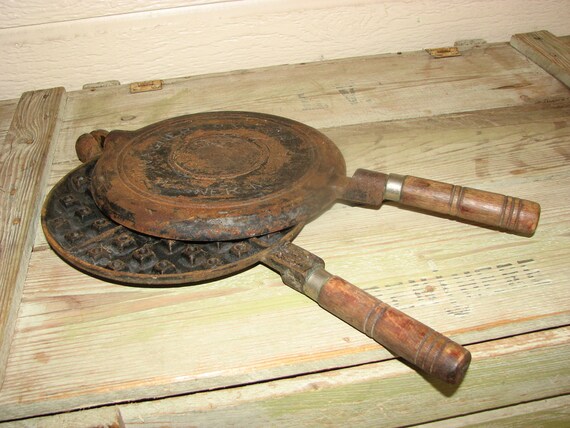
Below are various tidbits regarding waffle irons. Rather than copy lists of Essential Kitchen Utensils let me just say I saw the waffle iron mentioned in most lists. I also found they were sometimes listed under the heading of tin-ware for the kitchen, again a list of what most kitchens need. I've searched for an image of the waffle iron but haven't been able to find one from a 19th Century publication. My mom has one that is in much better shape than the picture I found on the internet but check this one out. It is made with cast iron and wooden handles. Here's the link to the photo.
A new waffle-iron is made of aluminum, and it appears to be one of the successes of that light and valuable metal, many of the possibilities of which are still a problem which the future must solve. This waffle-iron is upon the same principle as the fritter-mold, from whose products multitudes were fed at the German village in the World's Fair. The waffle-iron requires for accessories a pan of boiling lard on the stove, and a dish of batter conveniently close to it. The iron is dipped into the lard first, then plunged quickly halfway down into the batter, and immediately into the lard again. In less than a minute, with a slight tap on the back of the iron, the golden-brown, crisp and appetizing pastry is dropped on a plate.
Source: Home Furnishings Review ©1896
The wholesale price of waffle irons in 1884 was, No. 8, $7.20 per dozen; in 1890, $6.40; today they are sold at $5.60. Other goods have been reduced in the same ratio, and this reduction is not being checked by the McKinley bill being in force, which we expected would check the lower tendency. \Ve mean others thought so, not us, for it is as we expected.
Source: Bulletin-United States Congress ©1894
A new waffle-iron is made of aluminum, and it appears to be one of the successes of that light and valuable metal, many of the possibilities of which are still a problem which the future must solve. This waffle-iron is upon the same principle as the fritter-mold, from whose products multitudes were fed at the German village in the World's Fair. The waffle-iron requires for accessories a pan of boiling lard on the stove, and a dish of batter conveniently close to it. The iron is dipped into the lard first, then plunged quickly halfway down into the batter, and immediately into the lard again. In less than a minute, with a slight tap on the back of the iron, the golden-brown, crisp and appetizing pastry is dropped on a plate.
Source: Home Furnishings Review ©1896
The wholesale price of waffle irons in 1884 was, No. 8, $7.20 per dozen; in 1890, $6.40; today they are sold at $5.60. Other goods have been reduced in the same ratio, and this reduction is not being checked by the McKinley bill being in force, which we expected would check the lower tendency. \Ve mean others thought so, not us, for it is as we expected.
Source: Bulletin-United States Congress ©1894
Monday, December 28, 2015
1896 Society Building
Have you every come across a Society Building in your research? Well, today's post are the floor layouts of a Society Building. I found them interesting for not only my characters to attend a play or show but also if one of them were to work in an office.
 First Floor
 Second Floor
 Third Floor
 Fourth Floor
 Fifth Floor
 Roof
Roof

Also today I'm the host author on Heroes, Heroines & History Come check it out.


Also today I'm the host author on Heroes, Heroines & History Come check it out.
Thursday, December 17, 2015
Christmas Parties & Etiquette
Christmas party etiquette often has different rules for different areas, social class, etc. Below are some excerpts for you to browse when considering a Christmas Party for your historical Characters.
If it is a Christmas party the tree is the source of interest, and often a make-believe Santa Claus adds to the merriment of the occasion. The refreshments should be simple but fanciful. Make the table bright as possible—snowballs, cornucopias, lady-fingers, assorted cakes, love-knots, sandwiches (fancy), crystalized fruits, tarts, sliced tongue, pressed veal, thin bread and butter, rolled and tied, ice cream in molds, and one large heavily-frosted cake. A host of flowers, and the table is complete. Lemonade for a drink, or perhaps hot chocolate.
The good breeding learned, the opportunities of impressing upon children the beauty of self-denial and politeness, and of teaching them to dispense, and to receive hospitalities, and to restrain that tendency toward favoring certain playmates, so strong in childhood, will more than repay for the trouble of preparing the feast. Never permit the party to extend to late hours, and never overdress the little folks. White is always suitable for girls, and jacket suits for boys under the age for long trousers.
Source: Social Life ©1896
THE ETIQUETTE OF CHRISTMAS PARTIES.—Etiquette is less rigid at Christmas than at any other season of the year. Christmas parties, being intended for the re-union of relations and intimate friends, it would be a gross mistake to uphold those rigid laws of fashion which govern other entertainments. The good things provided by the host and hostess should be more homely than upon other occasions ; and there should be a marked heartiness in their demeanour towards those whom they entertain. Those who assemble may be more free in their intercourse than upon ordinary occasions, the good wishes of the season being upon every tongue. Dress should be less displayed now, than at the fashionable parties that will commence about the middle of January. At a Christmas party everybody should cheerfully join in the most simple pastimes. Old Age and Youth should shake hands and unite in the general mirth. A Christmas should be an era in everybody's history, and it should be our especial pleasure to contribute by each word and act to the happiness of those around us.
Source: The Corner Cupboard ©1858
This is a fun and different pov about hosting and attending Christmas parties.
If you have any intention of giving a Christmas party, now is the time to do it. The man who attempts to give a Christmas party in June will simply get left. Never arrange to give a Christmas party until you've done all you can to get invited to somebody else's, and have failed. If your next door neighbour is giving a party, and, after borrowing your other shirt and your wife's curl-papers, omits to invite you, don't allow yourself to cherish a spirit of resentment towards him on that account. Simply write him a nice little letter, and tell him you're jolly glad he hasn't asked you as you'd scorn to mix with a frowsy lot of friends like his. >.( your gentle rebuke fails to elicit a cordial invitation to come in and be one of the family, do what you can to circulate untruthful reports about his wife's relations, and express doubts as to the bona fdes of his Christmas sausages. If this fails, your only course is to go round to his guests and invite them to your house instead, and tell them that your party will be infinitely superior to his party, because there'll be more beer.
If you are invited out at Christmas time there are a few nice little poinis of etiquette that you ought to paste in your hat. Always take a couple of the children with you, and, if possible, the baby. If your host has a daughter, she will be glad the baby has come because she'll have to nurse it while you are at dinner, and it will break the monotony for her. If the baby should sit down to tabli with you, and should all at once grow peculiarly restless, break out into a cold perspiration, and m ike several ineffectual attempts to relieve its feelings by the use of profane expressions, it will probably be found that in the hurry of the moment the dear creature has inadvertently got seated on the hot pudding plates.
When the dinner is served, be especially careful to point out how much inferior it is to the dinner you had at Thompson's last year, and on no account omit to call the attention of the guests to the fact that the spoons and forks have been borrowed from the gentleman on your right, and that's the only reason why he was invited. If your host is indebted to you for a trifling loan, this is just the time to call across the table and ask when it will be convenient for him to pay it back. If during the evening one of the guests should feel a little faint, be prepared to render all the assistance possible. In the case of a gentleman, observe with sincere regret that it was a pity they let him sit so close to the spirits, and make a few general remarks on the sin of intemperance. In the case of a lady, observe sympathetically that you forgive her for overdoing it a little, as it is the only square meal she has had this year; and say that you've heard it's a good thing to let down her back hair and tickle her feet with the coal-scuttle.
Christmas is a lovely institution, and it is your duty to get all the fun you can out of it, whether you spend the peaceful, happy time in your own home or in jail.
Source: Pick-me-up ©1891
If it is a Christmas party the tree is the source of interest, and often a make-believe Santa Claus adds to the merriment of the occasion. The refreshments should be simple but fanciful. Make the table bright as possible—snowballs, cornucopias, lady-fingers, assorted cakes, love-knots, sandwiches (fancy), crystalized fruits, tarts, sliced tongue, pressed veal, thin bread and butter, rolled and tied, ice cream in molds, and one large heavily-frosted cake. A host of flowers, and the table is complete. Lemonade for a drink, or perhaps hot chocolate.
The good breeding learned, the opportunities of impressing upon children the beauty of self-denial and politeness, and of teaching them to dispense, and to receive hospitalities, and to restrain that tendency toward favoring certain playmates, so strong in childhood, will more than repay for the trouble of preparing the feast. Never permit the party to extend to late hours, and never overdress the little folks. White is always suitable for girls, and jacket suits for boys under the age for long trousers.
Source: Social Life ©1896
THE ETIQUETTE OF CHRISTMAS PARTIES.—Etiquette is less rigid at Christmas than at any other season of the year. Christmas parties, being intended for the re-union of relations and intimate friends, it would be a gross mistake to uphold those rigid laws of fashion which govern other entertainments. The good things provided by the host and hostess should be more homely than upon other occasions ; and there should be a marked heartiness in their demeanour towards those whom they entertain. Those who assemble may be more free in their intercourse than upon ordinary occasions, the good wishes of the season being upon every tongue. Dress should be less displayed now, than at the fashionable parties that will commence about the middle of January. At a Christmas party everybody should cheerfully join in the most simple pastimes. Old Age and Youth should shake hands and unite in the general mirth. A Christmas should be an era in everybody's history, and it should be our especial pleasure to contribute by each word and act to the happiness of those around us.
Source: The Corner Cupboard ©1858
This is a fun and different pov about hosting and attending Christmas parties.
If you have any intention of giving a Christmas party, now is the time to do it. The man who attempts to give a Christmas party in June will simply get left. Never arrange to give a Christmas party until you've done all you can to get invited to somebody else's, and have failed. If your next door neighbour is giving a party, and, after borrowing your other shirt and your wife's curl-papers, omits to invite you, don't allow yourself to cherish a spirit of resentment towards him on that account. Simply write him a nice little letter, and tell him you're jolly glad he hasn't asked you as you'd scorn to mix with a frowsy lot of friends like his. >.( your gentle rebuke fails to elicit a cordial invitation to come in and be one of the family, do what you can to circulate untruthful reports about his wife's relations, and express doubts as to the bona fdes of his Christmas sausages. If this fails, your only course is to go round to his guests and invite them to your house instead, and tell them that your party will be infinitely superior to his party, because there'll be more beer.
If you are invited out at Christmas time there are a few nice little poinis of etiquette that you ought to paste in your hat. Always take a couple of the children with you, and, if possible, the baby. If your host has a daughter, she will be glad the baby has come because she'll have to nurse it while you are at dinner, and it will break the monotony for her. If the baby should sit down to tabli with you, and should all at once grow peculiarly restless, break out into a cold perspiration, and m ike several ineffectual attempts to relieve its feelings by the use of profane expressions, it will probably be found that in the hurry of the moment the dear creature has inadvertently got seated on the hot pudding plates.
When the dinner is served, be especially careful to point out how much inferior it is to the dinner you had at Thompson's last year, and on no account omit to call the attention of the guests to the fact that the spoons and forks have been borrowed from the gentleman on your right, and that's the only reason why he was invited. If your host is indebted to you for a trifling loan, this is just the time to call across the table and ask when it will be convenient for him to pay it back. If during the evening one of the guests should feel a little faint, be prepared to render all the assistance possible. In the case of a gentleman, observe with sincere regret that it was a pity they let him sit so close to the spirits, and make a few general remarks on the sin of intemperance. In the case of a lady, observe sympathetically that you forgive her for overdoing it a little, as it is the only square meal she has had this year; and say that you've heard it's a good thing to let down her back hair and tickle her feet with the coal-scuttle.
Christmas is a lovely institution, and it is your duty to get all the fun you can out of it, whether you spend the peaceful, happy time in your own home or in jail.
Source: Pick-me-up ©1891
Monday, December 14, 2015
1896 Six Room City Cottage Floor Plans
Below you will find the floor plans for the 1896 Six Room City Cottage and the article written by a fellow concerned about some aspects of the plan. I've chosen to add these comments because it might give you as the author some information as to what your characters might be concerned about with regard to their home or the one they hope to build. Also, I've chosen these plans because you'll see the use of closets, bathrooms and a 19th Century modern kitchen. Another fun fact is these are the basic plans of the house my husband and I rented when he was a college student. The differences were that ours was a duplex (so it was double this floor plan for the entire house) and the right side was the left side in our portion of the duplex. It was a great old house and we have a lot of memories from living there.


Six-Boom Cottage for a City Lot.
From N. H. D., Newburg, N. Y.--I am an interested reader of the paper and in studying the plans of workingman’s cottages published from time to time I find some very good points, but the fault with the majority of the plans is that there is no stair hall proper for the two-story portion or else it starts in a cramped section of the building. The floor plan submitted by “ R. _B.” of Meriden, Conn, and published in the September issue is, in my opinion, very convenient. The shape of the bathroom as well as its location is exceedingly odd, as it cuts otf the square angles of the “kitchen and the two bedrooms, but necessitates two doors more than are necessary. The family bedroom is at the rear of the house, and I should like to inquire how the correspondent proposes to warm it. The sink is too far from the stove and the small room marked “entry " at the front of the house is of no use whatever. Another fault is that the cottage takes too much ground for the frontage. This is the fault I find with most of the plans submitted. They cannot be erected on a common city lot of a frontage of 25 feet, and it is well known that in the city a lot 25 feet front will cost anywhere from $200 upward. A house for such a lot is, in my opinion. the best for the workingman. I send herewith the floor plans for a two-story frame cottage. which I consider well adapted for a 25-foot lot. It can be built in a good manner for about $1000 and possibly less. It can. however, be made to cost more, according to the finish inside and out. The frontage is such that by building from 18 inches to 2 feet from the line on one side light are placed under the cables. and a composition consisting principally of plaster of paris and wood chips is poured on, the cables, thus being imbedded in the concrete mixture, which solidifies in a few minutes. The vertical part of the concrete inclosing the floor beams is supported by wire netting passed around the flanges of the beam. If a flat ceiling is required, iron bars are laid acrOsS the bottom would be given to the dining room and bedroom over it, and at the same time there would be a nice passageway to reach the rear of the house and yard. Again, no one could block the light and air from that side. The parlor has a bay window with arch and the dining room has two windows. The kitchen, it will be noticed from an inspection of the plans, may be entered from both hall and dining room, this arrangement giving direct communication between the kitchen and the front door. The pantry is conveniently located to both rooms, while the entry tends to keep the cold air from the kitchen in the winter. The sink is placed near the stove and is convenient for hot and cold water. On the second floor are three good sized sleeping rooms. a sewing room, four closets and a bathroom. The arrangement is such that the sleeping rooms and bathroom can be heated by stoves or other means as may be most convenient. The bathroom is so located that a direct connection is had for water and waste pipes from the sink in the kitchen. The plans show the position of the closets with regard to the


Six-Boom Cottage for a City Lot.
From N. H. D., Newburg, N. Y.--I am an interested reader of the paper and in studying the plans of workingman’s cottages published from time to time I find some very good points, but the fault with the majority of the plans is that there is no stair hall proper for the two-story portion or else it starts in a cramped section of the building. The floor plan submitted by “ R. _B.” of Meriden, Conn, and published in the September issue is, in my opinion, very convenient. The shape of the bathroom as well as its location is exceedingly odd, as it cuts otf the square angles of the “kitchen and the two bedrooms, but necessitates two doors more than are necessary. The family bedroom is at the rear of the house, and I should like to inquire how the correspondent proposes to warm it. The sink is too far from the stove and the small room marked “entry " at the front of the house is of no use whatever. Another fault is that the cottage takes too much ground for the frontage. This is the fault I find with most of the plans submitted. They cannot be erected on a common city lot of a frontage of 25 feet, and it is well known that in the city a lot 25 feet front will cost anywhere from $200 upward. A house for such a lot is, in my opinion. the best for the workingman. I send herewith the floor plans for a two-story frame cottage. which I consider well adapted for a 25-foot lot. It can be built in a good manner for about $1000 and possibly less. It can. however, be made to cost more, according to the finish inside and out. The frontage is such that by building from 18 inches to 2 feet from the line on one side light are placed under the cables. and a composition consisting principally of plaster of paris and wood chips is poured on, the cables, thus being imbedded in the concrete mixture, which solidifies in a few minutes. The vertical part of the concrete inclosing the floor beams is supported by wire netting passed around the flanges of the beam. If a flat ceiling is required, iron bars are laid acrOsS the bottom would be given to the dining room and bedroom over it, and at the same time there would be a nice passageway to reach the rear of the house and yard. Again, no one could block the light and air from that side. The parlor has a bay window with arch and the dining room has two windows. The kitchen, it will be noticed from an inspection of the plans, may be entered from both hall and dining room, this arrangement giving direct communication between the kitchen and the front door. The pantry is conveniently located to both rooms, while the entry tends to keep the cold air from the kitchen in the winter. The sink is placed near the stove and is convenient for hot and cold water. On the second floor are three good sized sleeping rooms. a sewing room, four closets and a bathroom. The arrangement is such that the sleeping rooms and bathroom can be heated by stoves or other means as may be most convenient. The bathroom is so located that a direct connection is had for water and waste pipes from the sink in the kitchen. The plans show the position of the closets with regard to the
Tuesday, November 24, 2015
A Change in Thanksgiving toward the end of the 19th Century.
Here's an excerpt from The Connecticut Magazine ©1896 from a story titled In Satan's Kitchen. This is toward the end of the 19th Century and the tidbit shows the change from the Traditional New England Thanksgiving celebration which was a day of fasting, prayers and sermons then followed with a meal.
"Thursday of that week came the time-honored festival of Thanksgiving, when, according to New England custom, Jane Maria cooked up " vittles " of certain sorts enough to last until the middle of March. The preparations began Tuesday night. A basket of apples was brought from the cellar, and Margaret was invited to join the " paring bee," which consisted of Aunt Jane, Uncle Reuben and herself, but the hapless girl cut her fingers, which bled so that she was unable to render much assistance, and, after a vigorous scolding for her carelessness, she was told she could go to bed, " kas yer aint no count here." Margaret gladly availed herself of the privilege, although it was early evening, and she wept far into the night, while down stairs the paring, halving, and quartering went on until an enormous chopping bowl, the proportions of which would astonish the housewives of to-day, was filled to its brim with meat which had been "biled " during the day, and with the apples pared during the night in preparation of the "mince-meat," which was to make the pies that were to last till the "middle of March."
Long before daybreak the next morning Margaret was wakened by the vigorous strokes of the chopping-knife, which announced the continuance of the active preparations for the occasion which, as it seemed to her, must awaken anything but sentiments of thanksgiving. Later, she was invited to lend a hand in the chopping while the pumpkin was prepared for more and other pies, all of which caused Margaret to wonder if their diet was to consist of pies until the middle of March. Jane Maria declared that Margaret's chopping " don't mount to no morn'n a baby's." But Margaret's arms, all unused to such labor, ached keenly, and by nightfall she was too tired to stand.
She had yet to learn, however, that " Thanksgiving" preparations were only just begun. As the darkness came on Uncle Reuben came hurrying in after his lantern. A big boiler of water was put to heat on the stove, and soon Margaret heard outside the shrieks and yells of the poor victims who die for humanity on "Thanksgiving Day." Uncle Reuben's later appearance with the headless fowls, which he threw upon the table to await the scalding and picking process, was more than Margaret could stand, and in the midst of it all she fainted and sank to the floor. She was promptly treated to a vigorous dash of cold water and packed off to bed by her irate aunt as soon as she " cum to." Margaret was on the point of giving up eating if it must be done at such a sacrifice of life as she had witnessed on two occasions.
What a contrast this to the quiet and happy celebration of " Thanksgiving" by the colony of New Englanders living in Oakland, gotten together to keep alive the remembrances of youth and home, and to perpetuate the time-honored day,— occasions when the abundance, variety, and freshness of Pacific coast fruits vied for prominence with the songs of New England. Margaret remembered one of these songs in particular."
"Thursday of that week came the time-honored festival of Thanksgiving, when, according to New England custom, Jane Maria cooked up " vittles " of certain sorts enough to last until the middle of March. The preparations began Tuesday night. A basket of apples was brought from the cellar, and Margaret was invited to join the " paring bee," which consisted of Aunt Jane, Uncle Reuben and herself, but the hapless girl cut her fingers, which bled so that she was unable to render much assistance, and, after a vigorous scolding for her carelessness, she was told she could go to bed, " kas yer aint no count here." Margaret gladly availed herself of the privilege, although it was early evening, and she wept far into the night, while down stairs the paring, halving, and quartering went on until an enormous chopping bowl, the proportions of which would astonish the housewives of to-day, was filled to its brim with meat which had been "biled " during the day, and with the apples pared during the night in preparation of the "mince-meat," which was to make the pies that were to last till the "middle of March."
Long before daybreak the next morning Margaret was wakened by the vigorous strokes of the chopping-knife, which announced the continuance of the active preparations for the occasion which, as it seemed to her, must awaken anything but sentiments of thanksgiving. Later, she was invited to lend a hand in the chopping while the pumpkin was prepared for more and other pies, all of which caused Margaret to wonder if their diet was to consist of pies until the middle of March. Jane Maria declared that Margaret's chopping " don't mount to no morn'n a baby's." But Margaret's arms, all unused to such labor, ached keenly, and by nightfall she was too tired to stand.
She had yet to learn, however, that " Thanksgiving" preparations were only just begun. As the darkness came on Uncle Reuben came hurrying in after his lantern. A big boiler of water was put to heat on the stove, and soon Margaret heard outside the shrieks and yells of the poor victims who die for humanity on "Thanksgiving Day." Uncle Reuben's later appearance with the headless fowls, which he threw upon the table to await the scalding and picking process, was more than Margaret could stand, and in the midst of it all she fainted and sank to the floor. She was promptly treated to a vigorous dash of cold water and packed off to bed by her irate aunt as soon as she " cum to." Margaret was on the point of giving up eating if it must be done at such a sacrifice of life as she had witnessed on two occasions.
What a contrast this to the quiet and happy celebration of " Thanksgiving" by the colony of New Englanders living in Oakland, gotten together to keep alive the remembrances of youth and home, and to perpetuate the time-honored day,— occasions when the abundance, variety, and freshness of Pacific coast fruits vied for prominence with the songs of New England. Margaret remembered one of these songs in particular."
Subscribe to:
Posts (Atom)