Continuing with the 19th Century details off various rooms of the house, today we're looking at the Dining Room.
The dining-room, in many houses, is the room in which the entire family is gathered, perhaps for the only time during the day. In this sense it is an assembly room. There is in this busy country a growing respect for the social value of the dining-room. In the family meetings at the table, there maybe an interchange of experiences that does not occur at other times, for the reason that there is no opportunity for it. After the meals the members of the family go to their various occupations, and probably do not come together until another meal.
These facts may be considered in the planning of a dining room.
We have thought of this room before in its mechanical sense; we have looked at it through housekeeping eyes. We have now to consider its artistic and social features. We look at it as one of the family rooms. It has its shape or proportion suggested to it from the table. It is oblong. The light coming into it should be ample, but subdued in tone. It is pleasant, as one enters a dining-room, to come into full view of a sideboard which is decorated with that which belongs to this room in a utilitarian way — its china, cut glass, and beautiful linen, than which nothing can be more attractive.
It is a pleasant thing to have a conservatory attached to one side or at a corner of the dining-room. The odor of flowers or plants may not be agreeable constantly in a sitting-room. The periodical occupation of the dining-room makes this pleasant rather than otherwise. Most of the plans which are shown will admit of the placing of a conservatory in connection with the dining-room in the manner indicated.
The old English dining-room was large in its general proportions, and heavy and rich as to its details; it was so large and impressive that there was an offshoot which took form in a breakfast-room. In our homes at this time we have the compromise. Our habits of living do not demand the breakfastroom: all come to breakfast together, and the requirement is the same as for other meals.
Where one wishes to have a wood ceiling panelled or with decorated beams, the dining-room, or the hall connecting with it, may be chosen as the proper place to be treated in this way. Where expense is not a great object, it is agreeable to have a large part of the walls finished in wood. A wood finish one-half to two-thirds the height of the wall, and a ceiling of wood above, with the intervening space finished in rough, tinted plaster, gives a very pleasing effect. Projecting from the top of the wood wall-finish may be a little shelf extending, say, five inches beyond the wall. It may have a simple moulded edge. In the top may be cut grooves; on the under edge may be arranged, at regular intervals, cup hooks, which may be used in part for suspending china, or, upon certain occasions, as a means of securing floral decorations — say, a little train of ivy or smilax. On the upper part of the shelf are placed pieces of china. This shelf may be placed in any dining-room; if not around the entire room, between two windows, or between the chimney breast and the adjacent wall. Six feet from the floor is a good height. If it is not overloaded, or if the idea is not generally overworked, the effect will be very satisfactory.
The coloring of a dining-room may be a little heavier and richer than that of the other rooms. A very pretty feature which may be introduced in a room of this kind is a china-closet, which opens into the dining-room as well as into the china-room adjoining. The dining-room side of the china-closet should be glazed with clear glass above its lower section, and the chinaroom or back side of the china-closet should be glazed with cathedral glass of a semi-transparent character. There are doors on hinges on each side. The drawers in the lower part, if provided, open from both sides. If doors are used they should be arranged in the same way, so that the lower shelves may be approached from both dining-room and china-room. The glass door on the dining-room side should not come down to the shelf at the top of the lower section, but should be arranged to leave an open space, as is indicated in the chapter on kitchens and pantries. However, the doors on the china-room side of this closet should come down, so as to cut off communication between dining-room and china-room at will. This space between the upper and lower section of the china-closet gives space in which to set a tray, and, by opening a door on the back, it acts as a slide between the china-room and diningroom. This arrangement is not only very beautiful, but very useful.
Source: Convenient Houses ©1889
Showing posts with label design. Show all posts
Showing posts with label design. Show all posts
Monday, August 3, 2015


Monday, June 15, 2015
The Sitting Room
Continuing the details from 19th century sources of various rooms, today we are highlighting the Sitting Room.
The sitting-room of the lower floor is more clearly defined by the term " living-room." It is a room with much more wall space than the reception-hall. It usually contains a grate and mantel; has a large window to the front, and one on the side. It is very nice if one of these windows can be arranged in the form of a bay, with or without a window-seat. In the latter case, it may serve the purpose of a conservatory in the winter and a window-seat in summer. The use of large quantities of stained glass in a sitting-room is objectionable. It is very well to have a certain amount of it in the upper sash of some of the windows. If the colors are mild, the effect upon the atmosphere of the room is pleasant indeed — the light coming through the soft amber or straw tints adds a mellowness and richness to the light of the room, which is opposed to the colder effects of light which comes through white glass. The mantel of the sitting-room may contain a large number of compartments in the form of small shelves, brackets, or cabinets, in which may be placed bric-a-brac of various forms. A little cabinet on each side of a mantel, with a high door, is a very pretty feature. A mirror between these cabinets gives a pleasing effect. This mantel, like the one in the reception-room, should be of wood with tile hearth and facings.
If this room is plastered in a gray finish, the walls may be tinted in fresco colors, and, if desired, certaki parts of it ornamented by stencilling or otherwise. Unless this ornamental work is done by an artist of recognized ability, it should be of the simplest character. One or two simple lines, or a series of short dashes, is much better than scrawling figures drawn by an untrained hand. The ordinary fresco done by the foreign artist is the ugliest, most ungraceful work possible. In the larger cities, there are usually a few artists who do very beautiful work, but the ordinary, cheap, conventional fresco stuff is barbarous. Plain tinted walls are preferable to such glaring monstrosities. There is not much risk, if one is careful in the selection of colors; the part above the picture moulding may be tinted differently from that below. There are very few people but feel themselves competent to select colors for the interior or exterior of a house. The fact is, there are very few who can do it with any assurance of success. It is well for those who have no special training in this line to pursue a safe plan in the selection of tints for the walls and ceilings. This may be done by choosing different shades of the same color for use in the room. Say one begins with a terra-cotta body for the part below the picture mould. That above the moulding may be a lighter terra-cotta with a tendency to a buff. Then the ceiling may be lighter still, or, to be entirely safe under almost any circumstances, a gray with a leaning towards the color of the wall. Other colors may be selected in the same way. Very light, vivid blues have frequently been selected for ceilings, presumably because of the supposed resemblance to the sky. It is certainly an illogical but by no means uncommon thought. Soft, undecided grays are much pleasanter to those of quiet tastes.' There may be variations in it according to the character of the wall decorations and surroundings. If one without special knowledge wishes something more ambitious, he should consult some one of acknowledged ability in this particular line. One cannot afford to try experiments. Extremely beautiful wall decorations are to be had in wall-paperings, and, while rather expensive, are entirely satisfactory if carefully selected.
Very little more may be said about the sitting-room, excepting to call to mind that a great deal depends upon the fittings and furnishings of the room, which, however, should not be glaring or rich. The quality of everything may be of the finest and best, yet this room should essentially be quieter in tone than the reception-hall or parlor, or even dining-room, which are not in constant use. Anything which is rich and in any way approaches the gorgeous is wearisome, and directly opposed to the idea of a sitting-room.
The sitting-room of the lower floor is more clearly defined by the term " living-room." It is a room with much more wall space than the reception-hall. It usually contains a grate and mantel; has a large window to the front, and one on the side. It is very nice if one of these windows can be arranged in the form of a bay, with or without a window-seat. In the latter case, it may serve the purpose of a conservatory in the winter and a window-seat in summer. The use of large quantities of stained glass in a sitting-room is objectionable. It is very well to have a certain amount of it in the upper sash of some of the windows. If the colors are mild, the effect upon the atmosphere of the room is pleasant indeed — the light coming through the soft amber or straw tints adds a mellowness and richness to the light of the room, which is opposed to the colder effects of light which comes through white glass. The mantel of the sitting-room may contain a large number of compartments in the form of small shelves, brackets, or cabinets, in which may be placed bric-a-brac of various forms. A little cabinet on each side of a mantel, with a high door, is a very pretty feature. A mirror between these cabinets gives a pleasing effect. This mantel, like the one in the reception-room, should be of wood with tile hearth and facings.
If this room is plastered in a gray finish, the walls may be tinted in fresco colors, and, if desired, certaki parts of it ornamented by stencilling or otherwise. Unless this ornamental work is done by an artist of recognized ability, it should be of the simplest character. One or two simple lines, or a series of short dashes, is much better than scrawling figures drawn by an untrained hand. The ordinary fresco done by the foreign artist is the ugliest, most ungraceful work possible. In the larger cities, there are usually a few artists who do very beautiful work, but the ordinary, cheap, conventional fresco stuff is barbarous. Plain tinted walls are preferable to such glaring monstrosities. There is not much risk, if one is careful in the selection of colors; the part above the picture moulding may be tinted differently from that below. There are very few people but feel themselves competent to select colors for the interior or exterior of a house. The fact is, there are very few who can do it with any assurance of success. It is well for those who have no special training in this line to pursue a safe plan in the selection of tints for the walls and ceilings. This may be done by choosing different shades of the same color for use in the room. Say one begins with a terra-cotta body for the part below the picture mould. That above the moulding may be a lighter terra-cotta with a tendency to a buff. Then the ceiling may be lighter still, or, to be entirely safe under almost any circumstances, a gray with a leaning towards the color of the wall. Other colors may be selected in the same way. Very light, vivid blues have frequently been selected for ceilings, presumably because of the supposed resemblance to the sky. It is certainly an illogical but by no means uncommon thought. Soft, undecided grays are much pleasanter to those of quiet tastes.' There may be variations in it according to the character of the wall decorations and surroundings. If one without special knowledge wishes something more ambitious, he should consult some one of acknowledged ability in this particular line. One cannot afford to try experiments. Extremely beautiful wall decorations are to be had in wall-paperings, and, while rather expensive, are entirely satisfactory if carefully selected.
Very little more may be said about the sitting-room, excepting to call to mind that a great deal depends upon the fittings and furnishings of the room, which, however, should not be glaring or rich. The quality of everything may be of the finest and best, yet this room should essentially be quieter in tone than the reception-hall or parlor, or even dining-room, which are not in constant use. Anything which is rich and in any way approaches the gorgeous is wearisome, and directly opposed to the idea of a sitting-room.
Monday, June 8, 2015
The Parlor
This week instead of detailed house plans I thought I'd share a detail description of the Parlor. I'll be taking a room over the next few weeks and filling in some of the details that floor plans leave out.
THE PARLOR
The parlor maybe merely a reception-room, — a room where a lady may receive her callers in the afternoon, or the more formal calls of ladies and gentlemen in the evening, or it may be one room in addition to the others in the lower part of the house. It may be the room which adds capacity to the lower floor during times of general entertaining. In some cases, particularly where the parlor is merely used as a reception-room, it need not be large. In such a case it is merely a place separated from the sitting-room, and in which to go for the purpose of receiving friends in a room somewhat removed from the slight confusion which may legitimately belong to a sitting-room. The parlor is made distinctive in its appearance from the sitting-room by its furnishings. It is not usual to have any great difference in the design of the woodwork in the different rooms of the lower floor. Generally speaking, the doors are of the same design, and likewise the casings, base, etc. The parlor belongs particularly to the society life of the occupants of the house. It is not generally a family room. It is removed from the ordinary home life except in so far as the general social conditions draw all together. The parlor, in its connection with the living-rooms of the house, and the house itself, is entirely legitimate. There is a good deal of sneering at the old parlor idea. This feeling has its origin in the memory of the parlors of a few years ago, — those which contained the one Brussels carpet, covered with red and green flowers, furnished with black hair-cloth furniture, chairs arranged around the wall in military style, a sofa — stiff of back and commanding an attitude — in a most conspicuous position; walls covered with coarse-figured, gilt paper, and rendered more offensive by cheap, family portraits in oil, and elaborately framed chromos.
The parlor of to-day is still a formal room; it does not greatly differ from the older one in idea; it is the execution of tjhe idea which has changed. There is a greater refinement in all the details; there is an artistic spirit which pervades everything. There is harmony of color, quietness in tone. The pictures are of a different character. The furniture is graceful and comfortable. It is rarely separated from the other part of the house. The doors leading into it are nearly always open. Oftentimes there are only portieres of tapestry or lace to separate this room from the others which lead to it. It is a room which is made necessary by the social life of the time.
The ideal parlor is a long room. — a large room. It is long in proportion to its width. Sometimes there is an archway near the middle, which suggests the division of the room into two parts. There is a mirror at the end, and, lending dignity to the room, there is the hall or library at one side. By its size, its arrangement, its dignity, it is inspiring to a congenial company. This is the ideal parlor, and the one of which the vulgarly furnished parlor of a few years ago was a corruption. The ideal parlor is shown in its completest original form in seme of the old mansions of the East and South. Some of the old Virginia and Maryland houses carry out this idea in the completest way. In Natchez, Miss., are houses built long before the war, and designed by the French architects, which contain parlors of splendid proportions and most artistic details. These were designed in the purest classic architecture. The ceilings were high, the paintings rich. All this is somewhat removed from the common idea of a parlor as carried out at this time. However, it is a pleasant thing to look back upon, or, when the opportunity and means are at hand, a proper thing to enjoy in the reality. The library, as now understood, is, in the ordinary house, a room for books, papers, and magazines, in which the members of the family may gather, who have use for that which it contains. It should be a room which may be isolated from the other parts of the house; a room in which one may study or read or write, and have the quiet which belongs to such occupations. A room which may be used as a passage from one part of the house to another cannot be dignified by the name of library. In such a room there must be quiet. There are very few homes to which such a room would not be a material and practical addition. There are times when nearly every one desires the quiet and freedom from interruption which a room of this kind affords.
It need not be a large room, but should contain all of the paraphernalia of work: a desk, conveniently arranged, bookshelves which are readily accessible, possibly portfolios arranged along the walls, drawers with proper compartments, cases for circulars and catalogues, and other " places for things." The nicest thing about book-cases is the books. Ornamental glass doors and rich trappings add nothing to the beauty of the library. People who make large use of books do not care to have them protected by glass cases. The other furnishings and fittings of a library should be quiet in tone, the chairs easy but not rich, the carpet of a neutral color, the wall decorations preferably without figured outlines, the pictures small and quiet. Sliding doors between the library and any other room of the house are not to be considered. Close-fitting doors on hinges are proper. They exclude the sound. Sliding doors permit the ready passage of sound, for the reason that they are more or less open at top, bottom, middle, and sides. A low ceiling in a library adds to the quiet and restful effect. One may have a low ceiling in a library, even if they are higher in other rooms, by studding down from above, — that is, putting in a false ceiling. The expense is light indeed, and by such means additional protection from the sounds above may be afforded.
Source: Convenient Houses ©1889
THE PARLOR
The parlor maybe merely a reception-room, — a room where a lady may receive her callers in the afternoon, or the more formal calls of ladies and gentlemen in the evening, or it may be one room in addition to the others in the lower part of the house. It may be the room which adds capacity to the lower floor during times of general entertaining. In some cases, particularly where the parlor is merely used as a reception-room, it need not be large. In such a case it is merely a place separated from the sitting-room, and in which to go for the purpose of receiving friends in a room somewhat removed from the slight confusion which may legitimately belong to a sitting-room. The parlor is made distinctive in its appearance from the sitting-room by its furnishings. It is not usual to have any great difference in the design of the woodwork in the different rooms of the lower floor. Generally speaking, the doors are of the same design, and likewise the casings, base, etc. The parlor belongs particularly to the society life of the occupants of the house. It is not generally a family room. It is removed from the ordinary home life except in so far as the general social conditions draw all together. The parlor, in its connection with the living-rooms of the house, and the house itself, is entirely legitimate. There is a good deal of sneering at the old parlor idea. This feeling has its origin in the memory of the parlors of a few years ago, — those which contained the one Brussels carpet, covered with red and green flowers, furnished with black hair-cloth furniture, chairs arranged around the wall in military style, a sofa — stiff of back and commanding an attitude — in a most conspicuous position; walls covered with coarse-figured, gilt paper, and rendered more offensive by cheap, family portraits in oil, and elaborately framed chromos.
The parlor of to-day is still a formal room; it does not greatly differ from the older one in idea; it is the execution of tjhe idea which has changed. There is a greater refinement in all the details; there is an artistic spirit which pervades everything. There is harmony of color, quietness in tone. The pictures are of a different character. The furniture is graceful and comfortable. It is rarely separated from the other part of the house. The doors leading into it are nearly always open. Oftentimes there are only portieres of tapestry or lace to separate this room from the others which lead to it. It is a room which is made necessary by the social life of the time.
The ideal parlor is a long room. — a large room. It is long in proportion to its width. Sometimes there is an archway near the middle, which suggests the division of the room into two parts. There is a mirror at the end, and, lending dignity to the room, there is the hall or library at one side. By its size, its arrangement, its dignity, it is inspiring to a congenial company. This is the ideal parlor, and the one of which the vulgarly furnished parlor of a few years ago was a corruption. The ideal parlor is shown in its completest original form in seme of the old mansions of the East and South. Some of the old Virginia and Maryland houses carry out this idea in the completest way. In Natchez, Miss., are houses built long before the war, and designed by the French architects, which contain parlors of splendid proportions and most artistic details. These were designed in the purest classic architecture. The ceilings were high, the paintings rich. All this is somewhat removed from the common idea of a parlor as carried out at this time. However, it is a pleasant thing to look back upon, or, when the opportunity and means are at hand, a proper thing to enjoy in the reality. The library, as now understood, is, in the ordinary house, a room for books, papers, and magazines, in which the members of the family may gather, who have use for that which it contains. It should be a room which may be isolated from the other parts of the house; a room in which one may study or read or write, and have the quiet which belongs to such occupations. A room which may be used as a passage from one part of the house to another cannot be dignified by the name of library. In such a room there must be quiet. There are very few homes to which such a room would not be a material and practical addition. There are times when nearly every one desires the quiet and freedom from interruption which a room of this kind affords.
It need not be a large room, but should contain all of the paraphernalia of work: a desk, conveniently arranged, bookshelves which are readily accessible, possibly portfolios arranged along the walls, drawers with proper compartments, cases for circulars and catalogues, and other " places for things." The nicest thing about book-cases is the books. Ornamental glass doors and rich trappings add nothing to the beauty of the library. People who make large use of books do not care to have them protected by glass cases. The other furnishings and fittings of a library should be quiet in tone, the chairs easy but not rich, the carpet of a neutral color, the wall decorations preferably without figured outlines, the pictures small and quiet. Sliding doors between the library and any other room of the house are not to be considered. Close-fitting doors on hinges are proper. They exclude the sound. Sliding doors permit the ready passage of sound, for the reason that they are more or less open at top, bottom, middle, and sides. A low ceiling in a library adds to the quiet and restful effect. One may have a low ceiling in a library, even if they are higher in other rooms, by studding down from above, — that is, putting in a false ceiling. The expense is light indeed, and by such means additional protection from the sounds above may be afforded.
Source: Convenient Houses ©1889
Monday, May 25, 2015
1895 Rural House Plans 4
Here are the two final posts on rural house plans. I have more but I'll save them for a later date.
House Plans 1


House Plans 2


House Plans 1


House Plans 2


Monday, May 18, 2015


Monday, May 11, 2015
1895 Rural House Plans 2
Continuing with the designs of rural house plans here are two more examples.
House Plans 1

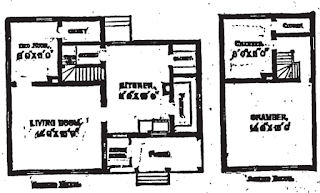
House Plans 2


House Plans 1


House Plans 2


Friday, May 8, 2015
Wall Pockets
I stumbled across these and thought they would add a different texture for our historical rooms. Having found these images below I thought I'd research a bit further and you'll find some descriptions on how to make various types of wall pockets. Another name for a wall pocket was a 'catch-all'.


Descriptions and Directions for wall pockets. (I didn't include the images but they are referenced in the excerpt.)
WALL-POCKET FOR LETTERS, CARDS, ETC.
Take a piece of white card-board, or better still, the lid of a large handkerchiefbox, with handsome plate; cut a piece of card-board of same width and half again as high; fasten together at bottom with muslin hinge, and pink entirely around, perforating each scallop with one or more holes. Make end-pieces of silk or reps, with elastic let into a shirred ruffle at the top and plaited closely at bottom. Obtain four of the pretty card-chromos of flowers or views, which pink entirely around, and making perforations at each side, tie them with bows of bright-colored ribbons to 'each side of top and front of pocket for the reception of cards; suspend by broad ribbons that match the bows
WALL-POCKET FOR DUSTERS, ETC.
Take a piece of heavy pasteboard, eight inches high and ten inches long, which cover neatly with brown linen, pasting colored paper-cambric upon the wrong side; cover another strip of the pasteboard, three inches longer and seven inches high, with the linen, embroidered with scarlet thread. Make a bag
a half yard long, and sufficiently wide to be gathered with a shirred ruffle around the case; gather at the bottom, closely, and finish with a long scarlet tassel made of zephyr; sew heavy, scarlet woolen cord around the case with tassels at each corner, and cord and tassels fastened at each end for suspension.
WALL-POCKET.—WITH A SMALL IRONING-BOARD.
Materials: Gray linen, white flannel, red worsted, medium-sized cord, worsted braid one and one-fifth inches wide; red zephyr worsted, and silk. A board, fourfifths of an inch thick, twenty inches long and eight inches wide. This pocket is exceedingly handy in a bed or dressing room, as it contains a little ironing-board on which little things, such as collars, cuffs, ribbons, etc., may be ironed. A
small pocket at the top contains an ironholder. Our model requires three pieces of linen, eleven and one-fifth inches wide, the one for the back part twenty-four and two-fifths inches high; that for the large pocket twenty inches high; that for the small pocket seven and three-fifths inches high. The upper corners of the back part and small pocket are slanted off, beginning at a distance of four inches from the top, and leaving it six inches wide. Both pockets are rounded at the top into a deep scallop, bound with braid, and edged with a rushing of braid. They are further braided with soutache, in the manner represented in the engraving. The small pocket is sewed to the back part first, and then the long one; the whole is then bound all around with braid, and decorated by a rushing of braid. Two loops of red cord, each one inch long, are fastened to each corner of the top, and serve to hang the pocket up. fig. 11 represents the ironing-board, and shows the manner in which a flannel cover, twenty-two and two-fifths inches long, ten and two-fifths inches wide, scalloped all round with red
Wall-Pocket with a Small Ironing worsted in button-hole stitch, is tied to Board.
the board. The iron-holder consists of a bag, five and three-fifths inches long, and four and two-fifths inches wide, stuffed with batting, and covered by a piece of flannel, scalloped all round with red worsted; the flannel must be cut three-fifths of an inch wider than the holder all around, and fastened to it with fine, invisible stitches.
VISITING-CARD POCKET..--- FRET-SAW WORK AND ORIENTAL EMBROIDERY.—FIG. 13.
Materials: Red merino, white, black, blue, green, brown, and yellow twist silk; fine gold cord, green silk, nine green crochet buttons, oblong steel spangles, crinoline, red moire paper, one brass ring, thick gum.
Source: Household Elegancies ©1877


Descriptions and Directions for wall pockets. (I didn't include the images but they are referenced in the excerpt.)
WALL-POCKET FOR LETTERS, CARDS, ETC.
Take a piece of white card-board, or better still, the lid of a large handkerchiefbox, with handsome plate; cut a piece of card-board of same width and half again as high; fasten together at bottom with muslin hinge, and pink entirely around, perforating each scallop with one or more holes. Make end-pieces of silk or reps, with elastic let into a shirred ruffle at the top and plaited closely at bottom. Obtain four of the pretty card-chromos of flowers or views, which pink entirely around, and making perforations at each side, tie them with bows of bright-colored ribbons to 'each side of top and front of pocket for the reception of cards; suspend by broad ribbons that match the bows
WALL-POCKET FOR DUSTERS, ETC.
Take a piece of heavy pasteboard, eight inches high and ten inches long, which cover neatly with brown linen, pasting colored paper-cambric upon the wrong side; cover another strip of the pasteboard, three inches longer and seven inches high, with the linen, embroidered with scarlet thread. Make a bag
a half yard long, and sufficiently wide to be gathered with a shirred ruffle around the case; gather at the bottom, closely, and finish with a long scarlet tassel made of zephyr; sew heavy, scarlet woolen cord around the case with tassels at each corner, and cord and tassels fastened at each end for suspension.
WALL-POCKET.—WITH A SMALL IRONING-BOARD.
Materials: Gray linen, white flannel, red worsted, medium-sized cord, worsted braid one and one-fifth inches wide; red zephyr worsted, and silk. A board, fourfifths of an inch thick, twenty inches long and eight inches wide. This pocket is exceedingly handy in a bed or dressing room, as it contains a little ironing-board on which little things, such as collars, cuffs, ribbons, etc., may be ironed. A
small pocket at the top contains an ironholder. Our model requires three pieces of linen, eleven and one-fifth inches wide, the one for the back part twenty-four and two-fifths inches high; that for the large pocket twenty inches high; that for the small pocket seven and three-fifths inches high. The upper corners of the back part and small pocket are slanted off, beginning at a distance of four inches from the top, and leaving it six inches wide. Both pockets are rounded at the top into a deep scallop, bound with braid, and edged with a rushing of braid. They are further braided with soutache, in the manner represented in the engraving. The small pocket is sewed to the back part first, and then the long one; the whole is then bound all around with braid, and decorated by a rushing of braid. Two loops of red cord, each one inch long, are fastened to each corner of the top, and serve to hang the pocket up. fig. 11 represents the ironing-board, and shows the manner in which a flannel cover, twenty-two and two-fifths inches long, ten and two-fifths inches wide, scalloped all round with red
Wall-Pocket with a Small Ironing worsted in button-hole stitch, is tied to Board.
the board. The iron-holder consists of a bag, five and three-fifths inches long, and four and two-fifths inches wide, stuffed with batting, and covered by a piece of flannel, scalloped all round with red worsted; the flannel must be cut three-fifths of an inch wider than the holder all around, and fastened to it with fine, invisible stitches.
VISITING-CARD POCKET..--- FRET-SAW WORK AND ORIENTAL EMBROIDERY.—FIG. 13.
Materials: Red merino, white, black, blue, green, brown, and yellow twist silk; fine gold cord, green silk, nine green crochet buttons, oblong steel spangles, crinoline, red moire paper, one brass ring, thick gum.
Source: Household Elegancies ©1877
Thursday, May 7, 2015
1889 Alphabet Etchings
I don't know about you but I love looking at the etchings you find in older books where the artist has made the first letter as a picture/design. Below is the entire alphabet done in a woodland type of design. Enjoy!


Monday, May 4, 2015
1895 Rural House Plans
For the next few weeks I'm going to be posting house plans from 1895 for Rural homes. Note that there is no bathroom in these plans because they were designed for a rural setting.
House Plans 1


House Plans 2


House Plans 1


House Plans 2


Monday, March 16, 2015
1897 Border Designs
Continuing with design elements from last week's wallpapers I have some selections of various borders. Some are paper and some are stencils.


Subscribe to:
Posts (Atom)