
Showing posts with label farm. Show all posts
Showing posts with label farm. Show all posts
Thursday, September 7, 2017
Farm Land for sale 1874
Here's an ad from American Agriculturalist ©1874 encouraging farmers to go out and settle the west. The price was $10 per acre. You didn't have to pay for the first four years. You can pay the note off early. All enticing the farmer to come and settle Nebraska.


Tuesday, December 6, 2016
The Homestead Strike
I came across this information while searching for Homestead information and found it to be a twist in what one would normally think of in terms of Homesteads. Homestead, Pa is a mill town that in 1892 strike that changed and hurt a lot of people including Steel magnate Andrew Carnegie. You can read a summary of the strike here from PBS American Experience but you can also read a more detailed account Homestead: A complete history of the struggle of July, 1892 by Arthur Gordon Burgoyne ©1893.
Monday, August 22, 2016
The Butternut Tree
From "The Youth's Companion or Historical Dictionary" by Ezra Sampson ©1816
BUTTERNUT-TREE, one of the valuable indigenous trees of the United States, which grows luxuriantly in many places, and is sometimes so large as to measure ten feet in circumference. The bark affords, by boiling in water, an extract that is found by experience, to possess a purgative quality. This is safe, gentle, and efficacious ; and when administered in doses, from fifteen to forty grains, operates downwards without griping. The nut of this tree is very rich, esculent and oily: the bark is used for dying cloths with various shades ot brown,—Dr. Mitchell. F 2
End quote
Today 90% of the trees have been killed. The Butternut Tree isn't listed as federally threatened by of "Special Concern" and in New York and Tennessee the are threatened.
BUTTERNUT-TREE, one of the valuable indigenous trees of the United States, which grows luxuriantly in many places, and is sometimes so large as to measure ten feet in circumference. The bark affords, by boiling in water, an extract that is found by experience, to possess a purgative quality. This is safe, gentle, and efficacious ; and when administered in doses, from fifteen to forty grains, operates downwards without griping. The nut of this tree is very rich, esculent and oily: the bark is used for dying cloths with various shades ot brown,—Dr. Mitchell. F 2
End quote
Today 90% of the trees have been killed. The Butternut Tree isn't listed as federally threatened by of "Special Concern" and in New York and Tennessee the are threatened.
Swine
From the Student's Reference Handbook by Charles Belden Beach © 1893
Swine are among the most important of food animals. For the wild boars from which swine are probably descended, see Boar. The word boar is now used of the male hog ; the female is termed sow—the young are called pigs, and when half-grown, shoats. A sow has two litters a year of from eight to twelve pigs each, or even more ; and it has been caculated that in ten generations the descendants of a single sow would number over 6,000,000. Pork is held to be unwholesome in warm countries, and the ancient Egyptians, as also the Jews and Mohammedans, did not use it. The wild hog is a clean animal, and the tame hog's bad habits are largely due to the way in which it is kept.
The Neapolitan hog is the finest of the Italian breeds; it is black, with a short snout, and upright ears. The Berkshire English swine are both black and white, and make fine bacon and hams. One of the most valuable of English breeds is the Essex, a black hog, which is easily fattened, and at 12 to 18 months furnishes from 250 to 400 pounds of dressed meat. Suffolk swine, though small, put on a large amount of fat for the food they eat. Chinese swine are easily fattened, but are chiefly used to cross with English breeds. Pork-
Eacking is one of the great branches of usiness in the United States. Its leading centers are Chicago, Cincinnati and Kansas City, in the order named. In 1890 the packing establishments put on the market 3,04'/,651,000 pounds of hog product, not counting hogs killed by farmers for their own use, or sold by them in towns and cities. This output was nearly three times that of 1873.
Swine are among the most important of food animals. For the wild boars from which swine are probably descended, see Boar. The word boar is now used of the male hog ; the female is termed sow—the young are called pigs, and when half-grown, shoats. A sow has two litters a year of from eight to twelve pigs each, or even more ; and it has been caculated that in ten generations the descendants of a single sow would number over 6,000,000. Pork is held to be unwholesome in warm countries, and the ancient Egyptians, as also the Jews and Mohammedans, did not use it. The wild hog is a clean animal, and the tame hog's bad habits are largely due to the way in which it is kept.
The Neapolitan hog is the finest of the Italian breeds; it is black, with a short snout, and upright ears. The Berkshire English swine are both black and white, and make fine bacon and hams. One of the most valuable of English breeds is the Essex, a black hog, which is easily fattened, and at 12 to 18 months furnishes from 250 to 400 pounds of dressed meat. Suffolk swine, though small, put on a large amount of fat for the food they eat. Chinese swine are easily fattened, but are chiefly used to cross with English breeds. Pork-
Eacking is one of the great branches of usiness in the United States. Its leading centers are Chicago, Cincinnati and Kansas City, in the order named. In 1890 the packing establishments put on the market 3,04'/,651,000 pounds of hog product, not counting hogs killed by farmers for their own use, or sold by them in towns and cities. This output was nearly three times that of 1873.
Thursday, April 21, 2016
Various Types of Hay
Naturally, where your story is set has a bearing on which kind of hay you would us but here's a short list of some of the types.
Clover hay has a higher feeding value ton for ton than meadow hay or corn-fodder. It is so much superior that I must be pardoned for illustrating it from Stewart's tables.
Source: The Breeder's Gazette ©1895
(I didn't include the table for this tidbit.)
Timothy hay is almost universally considered as the best of the long foods for horses. yet many hays from mixed grasses are used. and is some sections alfalfa hay. In recent years in some sections cut and shredded corn fodder has become very popular. and for many years corn blades have been preferred. in the South. by the keepers of race horses.
I prefer Orchard grass hay to timothy hay as it has more blades, timothy dies out in the course of a few years, while an Orchard grass sod will continue to get better each year for many years. One acre of Orchard grass will afford as much pasture as two of clover and timothy. I believe timothy to be an impoverisher of the land, while Orchard grass forms such an immense sod that for plowing under it is equal to a clover one.
Source Henderson's Handbook ©18 quote came from a man in VA.
Alfalfa hay is preferable to either clover or timothy for farm animals, and especially for swine, one acre being worth three of clover for hogs. It is also good for horses, and for oatile it is worth three times as much as red clover.
Source: Report of Kansas State Board of Agriculture ©1893
Oat Hay The results of the experiments indicate that the nutrients of oat hay are in the most digestible form when the heads are in milk. If cut in bloom there is a less yield of poorer composition and digestibility than when cut in milk. If the cutting is delayed till the oats are in the dough stage, the slightly larger yield is more than offset by the poor quality and lessened digestibility of the hay.
Source: Annual Report of Maine ©1898
Below is a list without descriptions of various hays:
Meadow Fescue Hay
Mountain Rye Grass Hay
Canary Reed Grass Hay
Salt Grass Hay
Lupine
White Lupine
Wild Oats Hay
Wheat Hay
Red Top Hay
Clover hay has a higher feeding value ton for ton than meadow hay or corn-fodder. It is so much superior that I must be pardoned for illustrating it from Stewart's tables.
Source: The Breeder's Gazette ©1895
(I didn't include the table for this tidbit.)
Timothy hay is almost universally considered as the best of the long foods for horses. yet many hays from mixed grasses are used. and is some sections alfalfa hay. In recent years in some sections cut and shredded corn fodder has become very popular. and for many years corn blades have been preferred. in the South. by the keepers of race horses.
I prefer Orchard grass hay to timothy hay as it has more blades, timothy dies out in the course of a few years, while an Orchard grass sod will continue to get better each year for many years. One acre of Orchard grass will afford as much pasture as two of clover and timothy. I believe timothy to be an impoverisher of the land, while Orchard grass forms such an immense sod that for plowing under it is equal to a clover one.
Source Henderson's Handbook ©18 quote came from a man in VA.
Alfalfa hay is preferable to either clover or timothy for farm animals, and especially for swine, one acre being worth three of clover for hogs. It is also good for horses, and for oatile it is worth three times as much as red clover.
Source: Report of Kansas State Board of Agriculture ©1893
Oat Hay The results of the experiments indicate that the nutrients of oat hay are in the most digestible form when the heads are in milk. If cut in bloom there is a less yield of poorer composition and digestibility than when cut in milk. If the cutting is delayed till the oats are in the dough stage, the slightly larger yield is more than offset by the poor quality and lessened digestibility of the hay.
Source: Annual Report of Maine ©1898
Below is a list without descriptions of various hays:
Meadow Fescue Hay
Mountain Rye Grass Hay
Canary Reed Grass Hay
Salt Grass Hay
Lupine
White Lupine
Wild Oats Hay
Wheat Hay
Red Top Hay
Thursday, April 14, 2016
Blueberries
Rather than give you recipes for blueberries I thought these little tidbits from various states might spark some thoughts for some of your stories. Enjoy!
Blueberries and cranberries. The blueberries and cranberries, of which there are about eleven varieties in the state, include some well-known forms. Here are to be classified the bog huckleberry, the dwarf bilberry, the thin-leafed bilberry, the tall bilberry, the tall blueberry, the Canada blueberry, the low blueberry, the mountain cranberry or cowberry, the deerberry, the small and the large cranberry. Most of these are found only in the northern part the state, especially along the international boundary and the north side of Lake Superior, extending, as so many northern plants do, down the valley of the St. Croix, through which in early days Lake Superior drained into the Mississippi river.
Blueberries. The different kinds of blueberries or bilberries are to be discriminated by their foliage and by the flavor of the berries. The one most common is the dwarf or low blueberry, gathered in large quantities for the market. Its fruits are blue with a whitish bloom and are of very pleasant flavor, enjoyed alike by the Indians and the whites. The plant is a low shrub, with pale green leaves, not evergreen. Its flowers are vase-shaped, small, and white or pink.
The deerberry, which resembles the blueberry in some respects, is considerably larger—three or four feet in height. The berries, shaped like the blueberries, are greenish or yellow and not edible. This variety is also called the squaw huckleberry.
The Canada blueberry, found growing in much moister soil than the ordinary form, has smaller berries, of a blue color, with a bloom. It may be distinguished by the entire margins of the leaves, quite different from the notched margins of the low blueberry. The bog blueberry has pink flowers and small ovate leaves. The cowberry may be recognized by the sour red berries and the evergreen leaves. The flowers and fruits are in structure altogether similar to those of the blueberries.
Source: Minnesota Plant Life ©1899
New Hampshire
The Benton Range.
In the W. part of the town of Benton, and running nearly N. and S., is the chain of peaks which includes Owl's Head, Blueberry Mt., Hogsback Mt., Sugar Loaf, and Black Mt. Though not remarkable for altitude or mass, these summits are otherwise picturesque and interesting, and may be visited without great labor. The same town also contains the famous Moosilauke, another Black Mt. (now called Mt. Clough), and a part of the Blue Ridge. There are no accommodations for tourists here, and people who wish to explore the Benton Range must start out from Warren, Haverhill, or Newbury. The hotels at the latter points are better than that at Warren, and the difference in distance is small. Benton has but 375 inhabitants, and is famous for its quartz crystals and other minerals and ores.
Owl's Head is a spur of Blueberry Mt. to the S. W., and is faced by a fine preoipice, several hundred ft. high, of purple and other dark-hued rocks. Thousands of bushels of blueberries are gathered yearly on this ridge. The ascent is made from the highway, near Warren Summit, and is steep, but short. A vague path conducts through the lower thickets, and along the face of the ridge which looks off on the cliffs. Large crystals of epidote are found about the cliff.
...
Blueberry Mountain is the name given to the fine peak N. of and above Owl's Head. It may be easily ascended from Owl's Head in less thaii an hour, although a quicker route for tourists who do not care to visit the latter summit is to go up the N.-Benton road to a point about 7 M. from Warren, and then strike up the E. flank. For about 1 M. from the summit the mountain is free from trees and is covered with alternate bands of carpet-like moss and granite ledges moderately inclined. The work of ascent and exploration is thus rendered easy and pleasant. There is but a slight depression between Owl's Head and Blueberry Mt., the former being a bold spur of the latter rather than a detached mountain. On the highest point of Blueberry Mt. is a signal-beacon of the U. S. Coast Survey (2,800 ft. above the sea).
Source: The White Mountains ©1876
Dwarf Blueberry, Low Blueberry. Six inches to two feet high, usually forming straggling masses in dry woods and old fields. Common, and well known throughout the southeastern parts of the state. Fruit abundant, blue or black. The earliest blueberry of the markets.
Canada Blueberry. A straggling shrub, stouter than the preceding, which it resembles. Leaves and branches downy. Berries often oval, blue, somewhat acid. Probably never seen in the markets. Northern part of state.
Half-high Blueberry. Sugar Blueberry. Two or three feet high, with upright, slender, yellowish-green branches. Fruit harder, and keeps longer than that of any other species; usually very round, bright blue, and spicy. It has the most limited range of any of our blueberries. It is common on pine barrens, and sparingly found very near the Connecticut river as far north as the rapids at White River.
High Blueberry. A shrub ten to fifteen feet high, with stems sometimes two inches in diameter. It grows in moist lands and swamps. The wood is hard and very closeSgrained, useful for the handles of small tools. No attempts have been made to cultivate it, although it doubtless could be cultivated to advantage.
Male Blueberry, Stagger Bush. Shrub three or four feet high, with yellowish bark. In the same situations and much resembling the high blueberry, but the fruit a dry, globular pod instead of a berry. Sometimes poisonous to cattle. Southern parts of the state.
Source: The Forests of Vermont ©1886
The culture and improvement of the blueberry is also receiving attention. There are large areas in the State which at present are practically worthless but which with a little attention and the planting of a few hundreds or thousands of blueberry bushes might, in our opinion, be made to yield profitable returns. Again, if the little dry, unsatisfactory June berry is worthy of culture in the garden, and it is cultivated to quite an extent, there certainly seems to be a field for work in developing improved varieties of the much more promising blueberry.
Source: Agriculture of Maine ©1895
Blueberries and cranberries. The blueberries and cranberries, of which there are about eleven varieties in the state, include some well-known forms. Here are to be classified the bog huckleberry, the dwarf bilberry, the thin-leafed bilberry, the tall bilberry, the tall blueberry, the Canada blueberry, the low blueberry, the mountain cranberry or cowberry, the deerberry, the small and the large cranberry. Most of these are found only in the northern part the state, especially along the international boundary and the north side of Lake Superior, extending, as so many northern plants do, down the valley of the St. Croix, through which in early days Lake Superior drained into the Mississippi river.
Blueberries. The different kinds of blueberries or bilberries are to be discriminated by their foliage and by the flavor of the berries. The one most common is the dwarf or low blueberry, gathered in large quantities for the market. Its fruits are blue with a whitish bloom and are of very pleasant flavor, enjoyed alike by the Indians and the whites. The plant is a low shrub, with pale green leaves, not evergreen. Its flowers are vase-shaped, small, and white or pink.
The deerberry, which resembles the blueberry in some respects, is considerably larger—three or four feet in height. The berries, shaped like the blueberries, are greenish or yellow and not edible. This variety is also called the squaw huckleberry.
The Canada blueberry, found growing in much moister soil than the ordinary form, has smaller berries, of a blue color, with a bloom. It may be distinguished by the entire margins of the leaves, quite different from the notched margins of the low blueberry. The bog blueberry has pink flowers and small ovate leaves. The cowberry may be recognized by the sour red berries and the evergreen leaves. The flowers and fruits are in structure altogether similar to those of the blueberries.
Source: Minnesota Plant Life ©1899
New Hampshire
The Benton Range.
In the W. part of the town of Benton, and running nearly N. and S., is the chain of peaks which includes Owl's Head, Blueberry Mt., Hogsback Mt., Sugar Loaf, and Black Mt. Though not remarkable for altitude or mass, these summits are otherwise picturesque and interesting, and may be visited without great labor. The same town also contains the famous Moosilauke, another Black Mt. (now called Mt. Clough), and a part of the Blue Ridge. There are no accommodations for tourists here, and people who wish to explore the Benton Range must start out from Warren, Haverhill, or Newbury. The hotels at the latter points are better than that at Warren, and the difference in distance is small. Benton has but 375 inhabitants, and is famous for its quartz crystals and other minerals and ores.
Owl's Head is a spur of Blueberry Mt. to the S. W., and is faced by a fine preoipice, several hundred ft. high, of purple and other dark-hued rocks. Thousands of bushels of blueberries are gathered yearly on this ridge. The ascent is made from the highway, near Warren Summit, and is steep, but short. A vague path conducts through the lower thickets, and along the face of the ridge which looks off on the cliffs. Large crystals of epidote are found about the cliff.
...
Blueberry Mountain is the name given to the fine peak N. of and above Owl's Head. It may be easily ascended from Owl's Head in less thaii an hour, although a quicker route for tourists who do not care to visit the latter summit is to go up the N.-Benton road to a point about 7 M. from Warren, and then strike up the E. flank. For about 1 M. from the summit the mountain is free from trees and is covered with alternate bands of carpet-like moss and granite ledges moderately inclined. The work of ascent and exploration is thus rendered easy and pleasant. There is but a slight depression between Owl's Head and Blueberry Mt., the former being a bold spur of the latter rather than a detached mountain. On the highest point of Blueberry Mt. is a signal-beacon of the U. S. Coast Survey (2,800 ft. above the sea).
Source: The White Mountains ©1876
Dwarf Blueberry, Low Blueberry. Six inches to two feet high, usually forming straggling masses in dry woods and old fields. Common, and well known throughout the southeastern parts of the state. Fruit abundant, blue or black. The earliest blueberry of the markets.
Canada Blueberry. A straggling shrub, stouter than the preceding, which it resembles. Leaves and branches downy. Berries often oval, blue, somewhat acid. Probably never seen in the markets. Northern part of state.
Half-high Blueberry. Sugar Blueberry. Two or three feet high, with upright, slender, yellowish-green branches. Fruit harder, and keeps longer than that of any other species; usually very round, bright blue, and spicy. It has the most limited range of any of our blueberries. It is common on pine barrens, and sparingly found very near the Connecticut river as far north as the rapids at White River.
High Blueberry. A shrub ten to fifteen feet high, with stems sometimes two inches in diameter. It grows in moist lands and swamps. The wood is hard and very closeSgrained, useful for the handles of small tools. No attempts have been made to cultivate it, although it doubtless could be cultivated to advantage.
Male Blueberry, Stagger Bush. Shrub three or four feet high, with yellowish bark. In the same situations and much resembling the high blueberry, but the fruit a dry, globular pod instead of a berry. Sometimes poisonous to cattle. Southern parts of the state.
Source: The Forests of Vermont ©1886
The culture and improvement of the blueberry is also receiving attention. There are large areas in the State which at present are practically worthless but which with a little attention and the planting of a few hundreds or thousands of blueberry bushes might, in our opinion, be made to yield profitable returns. Again, if the little dry, unsatisfactory June berry is worthy of culture in the garden, and it is cultivated to quite an extent, there certainly seems to be a field for work in developing improved varieties of the much more promising blueberry.
Source: Agriculture of Maine ©1895
Friday, March 4, 2016
Spring Planting or Fall Planting
Having grown up in the North, springtime is planting time for me. However, since I've been living in Florida for over 20 years, I've learned that planting season tends to be more common in the fall and late winter. You might be wondering why I've posted this tidbit however I'll share a couple of my reasons:
Is your character a farmer?
Is your character having bad fortune? And if so, could planting at the wrong time give him or her problems?
Is a secondary character an older individual who loves to share their knowledge with younger folks?
The opportunities to use some of these tidbits are endless and adds just a touch of color to your historical novel that you might have missed. Anyway, Enjoy!
Here's a little tidbit from Collier's Cyclopedia of Commercial and Social Information ©1882:
In northern locations spring planting is preferable Southward, fall is preferred No certain line of division can be fixed ; but we should say that, as a rule, all south of the latitude of Phila delphia, Columbus in Ohio, and Quincy in Illinois, may most safely plant in the fall, while north of those points it is better to plant in the spring.
Note: This is in reference to fruit tree planting.
If spring planting is preferred, begin as soon as the frost is out deep enough and the ground in good working condition. One year with another, the entire month of May can be devoted to planting forest trees in Minnesota or Dakota. The advantages of fall planting are chiefly in the fact that the ground becomes firmly packed among the roots of the young tree to the exclusion of the air, and that it is in better position to appropriate the moisture resulting from the winter snows and early spring rains, getting thereby such a "send-off " as to enable the young tree to successfully go through a dry spell that would be very damaging, if not fatal, to spring planting. Such dry spells do occasionally prevail all over tbe Northwest about planting time, and hang on unmercifully. On the other hand, an open winter with frequent or occasional thawing and freezing, occasionally proves fatal to fall planting, the action of frost heaving the fall-planted seedling or cutting nearly or quite out of the ground. Where well rooted young trees are used we overcome this trouble to a great extent by deep planting. While spring planting escapes this danger, it is in bad shape to withstand a protracted drowth, and right there is where fall planting has the inside track. But should your spring planting be followed up by occasional timely showers, the newly planted trees grow right along with great vigor. The tree planter must take his chances. I have for many years planted largely both spring and fall, and my experience does not yet justify me in bringing in a verdict either way. In fact I consider it one of the least important of the many conundrums of forestry.
Source: The Minnesota Horticulturist: Annual Report ©1883
NOW is the time at the north to prepare for planting trees next spring, for all planting north of the latitude of this city is most safely done at that time of the year. Furthensouth the long autumn enables trees planted when the leaves are ripe to push out new roots and establish themselves before the ground freezes. Where cold weather follows close after the early frosts a tree planted in the autumn has no opportunity to develop new roots and, therefore, loses not only the benefit it would have obtained in a more temperate climate in an early and vigorous spring growth, but is forced to go through the winter without the aid of roots in actual working condition. Trees planted in cold countries at this season of the year do not necessarily die, but they are more apt to suffer than those planted in the spring; they are often blown over unless carefully staked. and they are frequently upheaved by the frost or thrown out of the ground entirely. For all operations, however, connected with the planting and care of trees, except the mere setting in the ground, the autumn is the best time. At this season planting plans should be made and stock selected, and the ground should be made ready to receive the trees as soon as the frost leaves it in the spring. Spring in this latitude is so short and the rush of spring work is so pressing that it is impossible to properly prepare ground for planting unless _tt is done during the previous summer or autumn. This 18 the time, therefore, when northern planters should decide what trees they want to use next spring and where they will plant them ; it is the time to select and order nursery stock, and here it may be said that better results are always obtained by personal inspection and selection by the purchaser than by leaving it to the seller to fill his orders. If the planter has facilities for protecting plants through the winter in a cold cellar or pit, it is better to obtain them now than in the spring, when nurserymen are crowded with orders‘and too busy to devote proper time and attention to digging and packing their trees. The ground being prepared, the exact position of each plant determined on and the plants on hand, the mere operation of setting them in the ground takes but a short'time.
Source: Garden and Forest ©1897
Is your character a farmer?
Is your character having bad fortune? And if so, could planting at the wrong time give him or her problems?
Is a secondary character an older individual who loves to share their knowledge with younger folks?
The opportunities to use some of these tidbits are endless and adds just a touch of color to your historical novel that you might have missed. Anyway, Enjoy!
Here's a little tidbit from Collier's Cyclopedia of Commercial and Social Information ©1882:
In northern locations spring planting is preferable Southward, fall is preferred No certain line of division can be fixed ; but we should say that, as a rule, all south of the latitude of Phila delphia, Columbus in Ohio, and Quincy in Illinois, may most safely plant in the fall, while north of those points it is better to plant in the spring.
Note: This is in reference to fruit tree planting.
If spring planting is preferred, begin as soon as the frost is out deep enough and the ground in good working condition. One year with another, the entire month of May can be devoted to planting forest trees in Minnesota or Dakota. The advantages of fall planting are chiefly in the fact that the ground becomes firmly packed among the roots of the young tree to the exclusion of the air, and that it is in better position to appropriate the moisture resulting from the winter snows and early spring rains, getting thereby such a "send-off " as to enable the young tree to successfully go through a dry spell that would be very damaging, if not fatal, to spring planting. Such dry spells do occasionally prevail all over tbe Northwest about planting time, and hang on unmercifully. On the other hand, an open winter with frequent or occasional thawing and freezing, occasionally proves fatal to fall planting, the action of frost heaving the fall-planted seedling or cutting nearly or quite out of the ground. Where well rooted young trees are used we overcome this trouble to a great extent by deep planting. While spring planting escapes this danger, it is in bad shape to withstand a protracted drowth, and right there is where fall planting has the inside track. But should your spring planting be followed up by occasional timely showers, the newly planted trees grow right along with great vigor. The tree planter must take his chances. I have for many years planted largely both spring and fall, and my experience does not yet justify me in bringing in a verdict either way. In fact I consider it one of the least important of the many conundrums of forestry.
Source: The Minnesota Horticulturist: Annual Report ©1883
NOW is the time at the north to prepare for planting trees next spring, for all planting north of the latitude of this city is most safely done at that time of the year. Furthensouth the long autumn enables trees planted when the leaves are ripe to push out new roots and establish themselves before the ground freezes. Where cold weather follows close after the early frosts a tree planted in the autumn has no opportunity to develop new roots and, therefore, loses not only the benefit it would have obtained in a more temperate climate in an early and vigorous spring growth, but is forced to go through the winter without the aid of roots in actual working condition. Trees planted in cold countries at this season of the year do not necessarily die, but they are more apt to suffer than those planted in the spring; they are often blown over unless carefully staked. and they are frequently upheaved by the frost or thrown out of the ground entirely. For all operations, however, connected with the planting and care of trees, except the mere setting in the ground, the autumn is the best time. At this season planting plans should be made and stock selected, and the ground should be made ready to receive the trees as soon as the frost leaves it in the spring. Spring in this latitude is so short and the rush of spring work is so pressing that it is impossible to properly prepare ground for planting unless _tt is done during the previous summer or autumn. This 18 the time, therefore, when northern planters should decide what trees they want to use next spring and where they will plant them ; it is the time to select and order nursery stock, and here it may be said that better results are always obtained by personal inspection and selection by the purchaser than by leaving it to the seller to fill his orders. If the planter has facilities for protecting plants through the winter in a cold cellar or pit, it is better to obtain them now than in the spring, when nurserymen are crowded with orders‘and too busy to devote proper time and attention to digging and packing their trees. The ground being prepared, the exact position of each plant determined on and the plants on hand, the mere operation of setting them in the ground takes but a short'time.
Source: Garden and Forest ©1897
Tuesday, February 16, 2016
Sex of Eggs
Okay this is a rather strange tidbit but in Dr. Chase's Recipes ©1866 I found this tidbit:
The Sex Op Eggs.—Mr. Genin lately addressed the Academy des Sciences, France, on the subject of the sex of eggs. He affirms that he is now able, after having studied the subject for upwards of three years, to state with assurance that the eggs containing the germ of males, have wrinkles on their smaller ends, while female eggs are emooth at the extremities.
While on the subject of eggs, you will excuse me for putting in a couple of items more which appropriately belong to other departments:
The above tidbit had me searching for more information on this during the 19th Century. I came up with this next tidbit from "The Book of the Farm" ©1890:
Sex of Eggs.—It has been said that the position of the cell that contains the air in an egg determines the sex of the chick — if the cell occupies the exact apex of the end, which is always the large end, the chick will be a male; and if on one side of the apex, it will be a female. But this cannot be accepted as being reliable, nor can any of the other numerous supposed methods for predetermining the sex of eggs.
Hens are required to lay eggs for the dealers of eggs, and young cocks are required for the dealers of fowls, and for converting into capons. Both businesses are carried on by different persons, and .hence the utility of determining the sex of eggs. M. G6nin says, that as the female skeleton of a fowl contains smooth bone, and that of the male rough, so the male egg is wrinkled at the small end, and the female is smooth at both ends. This is the result after three years' experience.
But all the indulged notions as to determining the sex of eggs, and regulating sex in breeding, have, in the case of poultry as of other animals, been proved over and over again to be fallacious. We take it that this is a law wisely kept beyond the knowledge and control of man.
The matter of sex of the egg is of no importance on a farm, as good chickens of both sexes are valuable as an article of food.
I point out these two tidbits as a reason to search further, know your time period, know what was proven to be a fallacy or just an oddity. Then have fun with it.
The Sex Op Eggs.—Mr. Genin lately addressed the Academy des Sciences, France, on the subject of the sex of eggs. He affirms that he is now able, after having studied the subject for upwards of three years, to state with assurance that the eggs containing the germ of males, have wrinkles on their smaller ends, while female eggs are emooth at the extremities.
While on the subject of eggs, you will excuse me for putting in a couple of items more which appropriately belong to other departments:
The above tidbit had me searching for more information on this during the 19th Century. I came up with this next tidbit from "The Book of the Farm" ©1890:
Sex of Eggs.—It has been said that the position of the cell that contains the air in an egg determines the sex of the chick — if the cell occupies the exact apex of the end, which is always the large end, the chick will be a male; and if on one side of the apex, it will be a female. But this cannot be accepted as being reliable, nor can any of the other numerous supposed methods for predetermining the sex of eggs.
Hens are required to lay eggs for the dealers of eggs, and young cocks are required for the dealers of fowls, and for converting into capons. Both businesses are carried on by different persons, and .hence the utility of determining the sex of eggs. M. G6nin says, that as the female skeleton of a fowl contains smooth bone, and that of the male rough, so the male egg is wrinkled at the small end, and the female is smooth at both ends. This is the result after three years' experience.
But all the indulged notions as to determining the sex of eggs, and regulating sex in breeding, have, in the case of poultry as of other animals, been proved over and over again to be fallacious. We take it that this is a law wisely kept beyond the knowledge and control of man.
The matter of sex of the egg is of no importance on a farm, as good chickens of both sexes are valuable as an article of food.
I point out these two tidbits as a reason to search further, know your time period, know what was proven to be a fallacy or just an oddity. Then have fun with it.
Monday, October 19, 2015
1884 Farm Houses
A Farm House Costing $2,900
This plan of a farm-house embraces a commodious and convenient interior, with such external features as to clearly express its purpose. It will be recognized as at once adapted to rural situations and domestic life, providing much valuable space, and afiording a variety of pleasing and symmetrical outlines, with due economy in expense of construction. Perhaps the most striking fea' ture is the breadth of the front, which is 51 feet. (The average depth is 22 feet 7 inches.) As far as practicable, all prolonged vertical lines are avoided, leaving horizontal ones to prevail, as of more practical utility and value. Where opportunities abound for “ spreading out,” as in the-country, it would he obviously incompatible to build tall, or stilted houses, that would not comport with their surroundings, nor provide the conveniences desirable in all rural habitations.


A Stone House costing $2,900
These plans were designed for the substantial dwelling of a farmer in easy circumstances. The outside appearance truthfully expresses its rural and its domestic purpose. The interior accommodations are carefully arranged for comfort and convenience. The materials and method of construction insure permanency ; with little care, this _ building would last for many generations. *. . . EXTERIOR, (fig. 111.)—The elevation shows that this house was intended for the country—it looks like a farm-house—in fact it would be out of place anywhere else. Its peculiar solid, independent, and home-like character is due to the massive stone walls, large door and window openings, broad and steep slated roof, truncated gables, substantial chimneys, and heavy sheltering eaves, all arranged in simple, expressive, and harmonious combination. All superfluous ornamentation is avoided, as inconsistent with rural simplicity and truthfulness. Vines and creepers will be suggested by the rough stone walls and piazza posts ; and to their delicate tracery may be left the work of “ filling in ” their more appropriate and agreeable decomtions.


Monday, September 7, 2015
1893 Large Barn Plans
As the 19th Century progressed larger farms were being built. Below is an example of one such farm. David Lyman lived in Conn. and had this barn built. I've included what the author of the Barn Plans and Outbuildings author wrote.
THE BARN" OF MR. DAVID LYMAN.
 Among the many large and expensive barns now scattered through the country, there are few more thoroughly satisfactory to old school farmers with broad ideas, than one built by the late Mr. David Lyman, of Middlefleld, Connecticut. Mr. Lyman required a very large barn for his farm purposes simply, and built one, a front view and interior plans of which are here given. The elevation of the building, figure 1, shows entrances to its two main floors; there is a basement below.
 The Upper, Or Hay Floor.—This floor is shown in figure 2 ; all the hay, grain, and straw are stored here. It maintains the same level throughout. Two thrashing floors cross the building, and are entered from the high ground on the west by a very easy ascent. The main entrance crosses over an engine room, seen in figures 1 and this room is built of stone, arched above, and is roomy as well as secure.
By means of a hay fork and a number of travellers, the hay is taken from the loads and dropped in any part of the immense bays. The forks are worked by one horse, attached to a hoisting machine, of which there are two, placed near the great doors during the haying season, as indicated by the letters marked H, P, in the plan, figure 2.
 On the main floor are bins for grain and ground feed, provided with shutes connecting them with the feeding floor. There are hay scales, also—a fixture in one of the floors—which afford the means of being very accurate in many things, in regard to which guess work is ordinarily the rule. The great ventilators, so conspicuous in figure 1, pass from the feeding floor to the roof, and are furnished with doors at different elevations, quite to the top of the mow, thus forming convenient shutes to throw down hay or straw. A long flight of stairs passes from the principal barn floor to the cupola, from wl.ich a magnificent view is obtained of the whole farir. and surrounding country.
The Feeding Floor is entered by several doors. Two double doors open upon a spacious floor in the rear of the horse stalls, which extends through the middle of the main barn. The northwest corner, figure 3, is occupied by a large harness and tool room, with a chimney and a stove. On the right of the front entrance is the carriage room, which is closed by a sliding door, or partition. There is room on the open part of this floor, behind the horse stalls, and adjacent, to drive in three wagons at a time, and let the horses stand hitched. Between the ox stalls in the south wing, is a ten-foot passage way through which carts with roots or green feed may be driven, the stairs in the middle being hinged at the ceiling and fastened up. The stalls are seven feet wide, and arranged to tie up two cattle in each. A gutter to conduct off the urine runs along behind each range of stalls, and there are well secured traps, one in about every fifteen feet, through which the manure is dropped to the cellar. The letter C, wherever it occurs in figure 3, indicates a trap door of a- manure drop. The letter D is placed wherever there are doors which, in the engraving, might be taken for windows.
The cattle pass to the yards through doors in the ends of the wings. The south yard is nearly upon a level with the floor, sloping gradually away toward the south and east; but the large barn yard is on the level of the manure cellar, and an inclined way gives access to the yard on the east side, from the cow stalls. Three roomy, loose boxes are provided, one for horses, and two as lying-in stables for cows. Near the points marked W, and F, stands the hydrant for flowing water, and the trough for mixing feed, and here, too, the shutes for grain and cut feed discharge from the floor above.
Ventilation And Light.—Four immense ventilating trunks, four feet square, rise from the feeding floor straight to the roof. These are capped by good ventilators of the largest size, and cause a constant change of air in the stables, the draft being ordinarily sufficient to be felt like a fresh breeze, by holding the hand anywhere within a few feet of the openings. This keeps the air in the whole establishment sweeter and purer than in most dwellings. The windows on all sides of this floor are of large size, with double sashes, hung with weights.
 The Barn Cellar.—This is arranged for hogs, roots, and manure. The fixed partitions in the cellar are only two, one enclosing the root cellar, and the other, outside of that, shutting off a wide, cemented passage way, extending from the door at the northeast corner, around two sides of the root cellar, as shown in figure 4. The rest of the cellar is occupied by the manure, and hogs are enclosed in different parts of the cellar, according to convenience.
Size Of Bars'.—The building covers more than onefifth of an acre of land, and thus there is over three-fifths of an acre under a roof. The main barn is fifty-five by eighty feet. The wings are each fifty-six feet long, the south one being thirty-five wide, and the east wing thirtyone and one-half feet wide. The four leading points sought for and obtained were: first, economy of room under a given roof, second, plenty of light, third, plenty of air, and ventilation which would draw off all deleterious gas as fast as generated, and fourth, convenience to save labor. Saving of manure, and many other things were of course included. The windows are all hung with pulleys, and are lowered in warm days in winter, and closed in cold days. This is important.
THE BARN" OF MR. DAVID LYMAN.


By means of a hay fork and a number of travellers, the hay is taken from the loads and dropped in any part of the immense bays. The forks are worked by one horse, attached to a hoisting machine, of which there are two, placed near the great doors during the haying season, as indicated by the letters marked H, P, in the plan, figure 2.

The Feeding Floor is entered by several doors. Two double doors open upon a spacious floor in the rear of the horse stalls, which extends through the middle of the main barn. The northwest corner, figure 3, is occupied by a large harness and tool room, with a chimney and a stove. On the right of the front entrance is the carriage room, which is closed by a sliding door, or partition. There is room on the open part of this floor, behind the horse stalls, and adjacent, to drive in three wagons at a time, and let the horses stand hitched. Between the ox stalls in the south wing, is a ten-foot passage way through which carts with roots or green feed may be driven, the stairs in the middle being hinged at the ceiling and fastened up. The stalls are seven feet wide, and arranged to tie up two cattle in each. A gutter to conduct off the urine runs along behind each range of stalls, and there are well secured traps, one in about every fifteen feet, through which the manure is dropped to the cellar. The letter C, wherever it occurs in figure 3, indicates a trap door of a- manure drop. The letter D is placed wherever there are doors which, in the engraving, might be taken for windows.
The cattle pass to the yards through doors in the ends of the wings. The south yard is nearly upon a level with the floor, sloping gradually away toward the south and east; but the large barn yard is on the level of the manure cellar, and an inclined way gives access to the yard on the east side, from the cow stalls. Three roomy, loose boxes are provided, one for horses, and two as lying-in stables for cows. Near the points marked W, and F, stands the hydrant for flowing water, and the trough for mixing feed, and here, too, the shutes for grain and cut feed discharge from the floor above.
Ventilation And Light.—Four immense ventilating trunks, four feet square, rise from the feeding floor straight to the roof. These are capped by good ventilators of the largest size, and cause a constant change of air in the stables, the draft being ordinarily sufficient to be felt like a fresh breeze, by holding the hand anywhere within a few feet of the openings. This keeps the air in the whole establishment sweeter and purer than in most dwellings. The windows on all sides of this floor are of large size, with double sashes, hung with weights.

Size Of Bars'.—The building covers more than onefifth of an acre of land, and thus there is over three-fifths of an acre under a roof. The main barn is fifty-five by eighty feet. The wings are each fifty-six feet long, the south one being thirty-five wide, and the east wing thirtyone and one-half feet wide. The four leading points sought for and obtained were: first, economy of room under a given roof, second, plenty of light, third, plenty of air, and ventilation which would draw off all deleterious gas as fast as generated, and fourth, convenience to save labor. Saving of manure, and many other things were of course included. The windows are all hung with pulleys, and are lowered in warm days in winter, and closed in cold days. This is important.
Monday, August 24, 2015
1830 Farm Laborer's House Plans
Below are some illustrations for the construction of the laborers homes for farmlands. These are English in design but they will give you a good sense of what was in them.
The Labourer's Cottage cannot be too simple in its form, and it should be comprised in a very small compass. His wants are few, but his comforts should be carefully studied. The relative situation of doors and chimneys is of the greatest consequence to him, and it too frequently happens that this is little attended to, if at all. In rooms of very small dimensions this consideration must never be lost sight of, or the poor man's dwelling may be rendered a wretched habitation. In the Plan No. I. it will appear that the Bed Room, being within the Kitchen, must be warm, the Kitchen itself is defended by the Porch, while the Outhouse or Washhouse, containing the oven and copper, is quite independent of the other two apartments. The dwelling is only one story in height, and the rooms are kept to the smallest possible size.


For a Labourer's Cottage one story in height, explaining a design, comprehending the same number of apartments as No. I, under a different arrangement. These Cottages may be built of brick, and covered with tile, the whole being splashed, to produce the effect of age. In stone countries the roofs should be covered with rag. All the wood work should be painted in imitation of oak.


This Design presents a Labourer's Cottage in the Italian style. It is very small, comprehending only a Kitchen, Bed Room, and Outhouse, with an oven. The walls may be of brick or stone, and covered with tile, of the form so much seen in Italy, derived originally from the Greek. The windows are kept high from the ground, a peculiarity much to be observed in this character; and the simplicity of the whole effect is not unpleasing, as exhibited in the Perspective View.


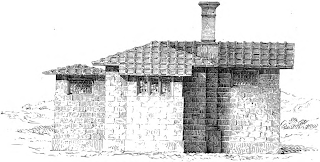

The Labourer's Cottage cannot be too simple in its form, and it should be comprised in a very small compass. His wants are few, but his comforts should be carefully studied. The relative situation of doors and chimneys is of the greatest consequence to him, and it too frequently happens that this is little attended to, if at all. In rooms of very small dimensions this consideration must never be lost sight of, or the poor man's dwelling may be rendered a wretched habitation. In the Plan No. I. it will appear that the Bed Room, being within the Kitchen, must be warm, the Kitchen itself is defended by the Porch, while the Outhouse or Washhouse, containing the oven and copper, is quite independent of the other two apartments. The dwelling is only one story in height, and the rooms are kept to the smallest possible size.


For a Labourer's Cottage one story in height, explaining a design, comprehending the same number of apartments as No. I, under a different arrangement. These Cottages may be built of brick, and covered with tile, the whole being splashed, to produce the effect of age. In stone countries the roofs should be covered with rag. All the wood work should be painted in imitation of oak.


This Design presents a Labourer's Cottage in the Italian style. It is very small, comprehending only a Kitchen, Bed Room, and Outhouse, with an oven. The walls may be of brick or stone, and covered with tile, of the form so much seen in Italy, derived originally from the Greek. The windows are kept high from the ground, a peculiarity much to be observed in this character; and the simplicity of the whole effect is not unpleasing, as exhibited in the Perspective View.


Tuesday, April 14, 2015
Egg Tidbits
Here are some interesting tidbits about the egg from the 19th Century perspective.
EGGS.
REMARKS. TO TEST. TO COLOR. CURIOUS FACTS. MODES OF COOKING.
EGGS are regarded by some as a great delicacy, by others as a prime article of food. But in either case, the mode of cooking has much to do with the satisfaction produced in the eating. The yolk is much more nutritious than the white.
To ascertain the freshness of an egg, hold it in the hand and look through it to the light. If it looks clear, there is tolerable assurance that it is good. Another test is to put them in a clear vessel of water. The good ones will lie on the side.
The eggs of the common hen are esteemed the best. They are much better when new-laid, than even a day or two afterwards.
Turkey eggs are almost equal to those of the hen—not quite so mild.
Goose eggs are large, and agreeable to the taste.
Duck eggs are richly flavored. The white is of a bluish tint, and will cook in less time than that of the hen.
Guinea-hen's eggs are smaller and more delicate than those of the common hen.
Eggs of wild fowl are usually colored, and often spotted. They frequently taste somewhat like the birds themselves.
Eggs of land birds, such as the plover, are much liked, but those of sea-fowl have a fishy taste that is disagreeable.
Turtle eggs are numerous, and have yolks only. The eggs of some varieties have no shell. They are very delicious. The turtle To Test. EGGS. Hard Boiled Eggs.
lays from i 50 to 200 at a time, and lays several times during the year.
Eggs contain a large amount of nutiment in a compact, quickly available form. It is stated as a fact that there is more nutriment in a dark than a white-shelled egg. The white in the latter is like limewater, while the former is gelatinous and will hold together if lifted a few inches and is a third more valuable for any culinary purpose.
TO TEST EGGS.
Put into water and a good egg will always lie on its side.
TO COLOR EGGS FOR EASTER.
Wind strips of bright-colored calico around the eggs, and then boil in lye; you will find them gayly colored. To color them yellow, boil with onion skins.
CURIOUS FACTS.
A curious fact about eggs is: A boiled egg will spin freely, while a raw egg can not be made to spin at all. Another curious fact is that the white is heavier than the yolk. A French gentleman hung up an egg in a little bag, lying on its side and marked the upper part of the shell with an X. In just one month he let the egg down, still enclosed in its bag, into a saucepan of boiling water. When hard he cut the egg open. The yolk he found adhering to the membrane, not of the lower, but of the upper shell, and thus was disproved the common belief that the yolk was heavier than the white or albumen.
Source: Mrs. Owens New Cook Book ©1897
EGGS.
REMARKS. TO TEST. TO COLOR. CURIOUS FACTS. MODES OF COOKING.
EGGS are regarded by some as a great delicacy, by others as a prime article of food. But in either case, the mode of cooking has much to do with the satisfaction produced in the eating. The yolk is much more nutritious than the white.
To ascertain the freshness of an egg, hold it in the hand and look through it to the light. If it looks clear, there is tolerable assurance that it is good. Another test is to put them in a clear vessel of water. The good ones will lie on the side.
The eggs of the common hen are esteemed the best. They are much better when new-laid, than even a day or two afterwards.
Turkey eggs are almost equal to those of the hen—not quite so mild.
Goose eggs are large, and agreeable to the taste.
Duck eggs are richly flavored. The white is of a bluish tint, and will cook in less time than that of the hen.
Guinea-hen's eggs are smaller and more delicate than those of the common hen.
Eggs of wild fowl are usually colored, and often spotted. They frequently taste somewhat like the birds themselves.
Eggs of land birds, such as the plover, are much liked, but those of sea-fowl have a fishy taste that is disagreeable.
Turtle eggs are numerous, and have yolks only. The eggs of some varieties have no shell. They are very delicious. The turtle To Test. EGGS. Hard Boiled Eggs.
lays from i 50 to 200 at a time, and lays several times during the year.
Eggs contain a large amount of nutiment in a compact, quickly available form. It is stated as a fact that there is more nutriment in a dark than a white-shelled egg. The white in the latter is like limewater, while the former is gelatinous and will hold together if lifted a few inches and is a third more valuable for any culinary purpose.
TO TEST EGGS.
Put into water and a good egg will always lie on its side.
TO COLOR EGGS FOR EASTER.
Wind strips of bright-colored calico around the eggs, and then boil in lye; you will find them gayly colored. To color them yellow, boil with onion skins.
CURIOUS FACTS.
A curious fact about eggs is: A boiled egg will spin freely, while a raw egg can not be made to spin at all. Another curious fact is that the white is heavier than the yolk. A French gentleman hung up an egg in a little bag, lying on its side and marked the upper part of the shell with an X. In just one month he let the egg down, still enclosed in its bag, into a saucepan of boiling water. When hard he cut the egg open. The yolk he found adhering to the membrane, not of the lower, but of the upper shell, and thus was disproved the common belief that the yolk was heavier than the white or albumen.
Source: Mrs. Owens New Cook Book ©1897
Friday, April 10, 2015
Moving the Hen House
I stumbled on this tidbit and could see all kinds of possibilities for my characters to run into trouble or have a bonding experience when moving chickens. When I was young my father and I raised chickens. We did not move our coup but when we had a season of no chickens the weeds grew over ten feet tall in the penned in area from all the manure. So when I stumbled over this I thought it was extremely practical. Enjoy!
Movable fowl-houses are used exclusively, with the exception of some large ones for hatching-rooms. By building small, light, and low, with strong sills made on purpose for runners, the houses may be moved every spring by an ordinary team, to the section tilled the previous summer. The distance traveled in transferring 100 fowl-houses, from one 6O-acre lot to_ another, is one-third of a mile for each building, and back with no load. The amount of labor is much less than would be involved in hauling the manure, mixed with dry earth, from the buildings. The moving is acoomplished systematically; the fowls belonging to a building being all moved in one flock in a large box made on purpose, in which they are quietly entrapped when attempting to leave their house in the morning by placing it adjoining, after which the box is darkened and drawn upon runners, on which it stands, to the new station. On arriving they are immediately allowed to escape into a spare house, shaped and colored like the one they left, placed before-hand, when they are ready to commence their day as usual, the whole operation of removal occupying only a few minutes.
Source: An Egg Farm ©1891
Referring to a "broody hen"
most hens will bear moving, nest and all, to a quiet place; but a great many will not like to be taken out of the chosen nest, and placed in another.
Source: Rural Life Described and Illustrated ©1868
Movable fowl-houses are used exclusively, with the exception of some large ones for hatching-rooms. By building small, light, and low, with strong sills made on purpose for runners, the houses may be moved every spring by an ordinary team, to the section tilled the previous summer. The distance traveled in transferring 100 fowl-houses, from one 6O-acre lot to_ another, is one-third of a mile for each building, and back with no load. The amount of labor is much less than would be involved in hauling the manure, mixed with dry earth, from the buildings. The moving is acoomplished systematically; the fowls belonging to a building being all moved in one flock in a large box made on purpose, in which they are quietly entrapped when attempting to leave their house in the morning by placing it adjoining, after which the box is darkened and drawn upon runners, on which it stands, to the new station. On arriving they are immediately allowed to escape into a spare house, shaped and colored like the one they left, placed before-hand, when they are ready to commence their day as usual, the whole operation of removal occupying only a few minutes.
Source: An Egg Farm ©1891
Referring to a "broody hen"
most hens will bear moving, nest and all, to a quiet place; but a great many will not like to be taken out of the chosen nest, and placed in another.
Source: Rural Life Described and Illustrated ©1868
Tuesday, March 31, 2015
Walnuts
Tidbits about the Walnut, scroll down to the bottom for an interesting recipe. Can you say ketcup?
The walnut-tree is a native of the Himalaya, Persia, and the southern provinces of the Caucasus. It was introduced into Greece and Italy some centuries before the Christian era. The walnut is now grown throughout temperate Europe.
Unripe walnut fruits, when the shell is still soft, make an excellent pickle; a delicate sweetmeat is prepared by boilingv them in sirup.
Walnuts contain a sweet oil much used in Southern Europe for food, and, under the name of nut-oi], for painting. The mate of walnut-kernels, or walnut-cake, is a good cattle food.
Walnuts in the shell yield one-third their weight (about 36 percent.) of peeled kernels, which are the crumpled cotyledons, or seed-leaves.
Storing Walnuts
During the summer shelled walnuts are kept in cold storage, but not ordinarily in large quantity. The in-shell stock seems to keep well enough in ordinary storage, particularly if fumigated occasionally against insects. Moreover, English buyers taking shelled walnuts from carryover stocks in September-October want the kernels to be freshly shelled just before shipment.
A product strange to Americans, but which accounts for sizable French tonnages, is the in-shell walnut in its fresh or green state. The crop is knocked off the trees as soon as the green hulls can be removed, and is rushed to market while the kernels are still moist and pliable. Western Europeans, particularly the English, relish these walnuts as a delicacy to be served with or in lieu of fruit at the end of a meal. They are cracked at the table and the moist pellicle, rather bitter at this stage, is peeled off before the pearlywhite and delicately flavored kernel is eaten.
The fresh walnut is a more important trade item in the Grenoble area than elsewhere, and large quantities, as much as 20 to 25 percent of the area's in-shell sales, are shipped to England, Belgium and the Netherlands, and Germany. The walnuts are bleached with sulfur, washed in a light chlorine solution (largely to check mold), size-graded, and packed in attractive 6-kilo burlap and 10-kilo mesh bags. They are then rushed to market through the fresh fruit and vegetable trade--entirely different channels from those through which dried walnuts are handled. Early in October 1955, wellgraded and packed fresh walnuts were quoted at 125 francs per kilo (about 16 cents per pound) f. o.b. packing plant, while dried walnuts of the same type were quoted at 190 francs (nearly 25 cents per pound).
Source: Filbert Bulletins ©1898
HARVESTING.
Harvesting the walnut is very simple, as most of the nuts do not have to be picked, for they, of their own accord, drop to the ground at maturity; yet considerable attention must be paid to the gathering of the crops so as to have clean, bright nuts that may command a high price and ready sale. The walnut harvest begins in September and ends in November. In some sections the crop comes in quite early and is gathered in September, overlapping into October; in others, the crop is not harvested so early; but October is the principal month, sometimes overlapping into November.
Some of the growers collect the nuts from the ground as they fall every day, others collect them every other day, and some every third day, until most of the crop has fallen of its own accord, and those remaining on the trees are knocked down by means of a pole. Boys and men are also employed to climb the trees and shake the nuts down; others agitate the limbs with a long pole having a hook at the end. The nuts that are ready to drop come down easily, and are picked up and dried on trays in the sun. It generally takes from three to four pickings to gather all the nuts from a tree. When the husk inclosing the nut shows no signs of cracking it is an indication that the nut is yet unripe, and when knocked down the kernels of many of these generally dry away and do not fill well. Then, again, if the nuts are allowed to hang on the trees or remain on the ground too long after falling, they absorb moisture and rapidly deteriorate in flavor, color, and keeping qualities. In the walnut sections along the coast damp fogs and dew prevail during the harvest time, rendering the husks quite moist, and the nuts contained inside become stained by the acid juice of the husks, which, if not removed, renders the nuts quite black, and lessens their market value. This acid is very strong and adhesive, and to remove it the nuts have to be washed and afterward dried. Hon. Ellwood Cooper, of Santa Barbara, has a most perfect apparatus for washing and drying the walnut, which is an invention of his own. It consists of an iron cylinder with a long opening on the top side, where the nuts are put in. When the nuts are washed the cylinder will turn with the opening down, thus letting the walnuts and water out. As with all other apparatus of this kind, it has to be seen to be appreciated. They are made by the Fulton Iron Works, of San Francisco, and cost from $125 to $140.
* "The 'hard' shells should and the 'soft' and 'paper' shells must be gathered as soon as possible after dropping from the trees, as it injures the quality and appearance of the nuts to remain long on the ground. They are usually dried on trays about 3 feet wide by 6 feet long, holding about one hundred pounds each. 'Soft' and 'paper' shells should be dried in the shade, and many of the growers have buildings for that purpose. After they are thoroughly dried they are bleached and then run over a screen with a one-inch mesh, into strong sacks of uniform size, each sack bearing the registered trademark of the 'Los Nietos and Eanchito Walnut Growers' Association,' and also the name of the individual grower, thereby settling the question of responsibility in case the nuts are not up to the required standard."
t "There are different modes of gathering: some clean the trees at once, and others go over them several times. I pick what has fallen without knocking. I then tap those limbs lightly on which the nuts are ripest, and the third time over I aim to clean the trees. The walnuts are picked up and put in sacks and barrels, so as to be easily
* A. Downer, of Rivera.
t Joseph Sexton, essay before Ninth State Fruit-Growers' Convention, 1888. handled, and hauled to a sunny place to dry, and should he placed on elevated platforms made of narrow boards, with spaces of one fourth of an inch between each board. The platform should be about 8 feet wide and 40 feet long, or as long as two men can handle a canvas to cover the beds, which should be done every night the dew falls. The nuts should be stirred in these beds once or twice each day, and with favorable weather they will dry sufficiently in three days, and are ready for market. I have always dried my walnuts by the sun and they have given good satisfaction, and for small orchards I think it is the cheapest and best way. Some dry by evaporation and claim it is preferable to the sun; that it sets the oil quickly and prevents the nut from becoming rancid. Others claim that it makes them so ; but be this as it may, those having large orchards cannot depend on drying all by natural heat, and the drier will have to be used, even if it is not so good for the nut."
*" In handling the nuts, I cure in dry-houses by artificial heat, heating sufficient to evaporate the water and set the oil of the nut. When this is done the nuts will keep sweet for an indefinite time. I have kept them as an experiment, in my store-house, which is of concrete, for five years, and at the end of that time they were as sweet as when first cured. With my facilities, I cure them in eight hours. In preparing them for market, I have a washing apparatus—invented by Mr. Cooper—which I use if the nuts are discolored, as they often are by coming in contact with leaves or shucks when there is dew or rain. Directly after washing they are thoroughly dried and cured in the dry-house."
t " In gathering soft-shells, the nuts should not be left long on the ground, as the sun and fog will cause the shell to crack and the nut to become ruined. They should not be left long in the gathering-sacks, as they will then sweat and turn black. If the nuts are to be washed it should be done as soon as emptied from the picking-sacks, as they will then clean much easier. After this, spread in trays for drying, if to be bleached they should be thoroughly dry before. We use trays 3 by 6 feet, with sides 4 or 6 inches high, and a slat bottom with J^-inch space between slats. For the past few years all walnuts grown in Rivera have been scoured by placing them in a wire cylinder, washing them and revolving it for five or ten minutes, or longer if necessary to make them clean, then throw on water enough to wash clean before taking out of washer. This greatly improves their appearance, removing all fiber and pieces of hull that might be sticking to them. It also gives them a much smoother appearance. Now place them in trays, and dry."
Source: California Walnut Industry ©1896
WALNUTS. Make a brine of salt and water, in the proportion of a quarter of a pound of salt to a quart of water; put the walnuts into this to soak for a week; or if you wish to soften them so that they may be soon ready for eating, run a larding pin through them in half a dozen places— this will allow the pickle to penetrate, and they will be much softer, and of better flavor, and ready much sooner than if not perforated: put them into a stewpan with such brine, and give them a gentle simmer; put them on a sieve to drain; then lay them on a fish plate, and let them stand in the air till they turn black—this may take a couple of days; put them into glass, or unglazed stone jars; fill these about three parts with the walnuts, and fill them up with the following pickle.
To each quart of the strongest vinegar put two ounces of black pepper, one of ginger, same of eschalots, same of salt, half an ounce of allspice, and half a drachm of cayenue. Put these into a stone jar; cover it with a bladder, wetted with pickle, tie over that some leather, and set the jar on a trivet by the side of the fire for three days, shaking it up three times a day, and then pour it while hot to the walnuts, and cover them down with bladder wetted with the pickle, leather, &c.
WALNUTS AND BUTTERNUTS. Gather them for pickling when the head of a pin will pierce them easily; run a large needle through them here and there, or score them on one side with a knife; lay them into a brine of salt-and-water for twelve days, changing the brine twice in that time; strain, and put them into a jar, and sprinkle a little salt over them. Boil four quarts of
vinegar for a hundred walnuts, allowing to each quart one ounce of whole pepper, and one of ginger, half an ounce each of sliced nutmeg and whole allspice, a table-spoonful of mustard seed, and one of scraped horseradish, one head of garlic, or a small onion; pour it boiling hot over the nuts, and put a plate on the jar; when cold, tie it closely down. Alter the nuts are used, the liquor may be boiled, strained, and bottled, to use as a pickle.
WALNUT KETCHUP. (1) Thoroughly well bruise one hundred and twenty young walnuts; put to them three quarters of a pound of salt, and a quart of good wine vinegar; stir them every day for a fortnight; then stram aitd squeeze the liquor from them through a cloth, and set it aside; put to the husks half a pint of vinegar, and let it stand all night; then strain and squeeze them as before, adding the liquor which is obtained from them to what was put aside the preceding day, and add to it one ounce and & quarter of whole black pepper, forty cloves, half an ounce of nutmegs bruised, or sliced, half an ounce of ginger, and five drachms of mace, and boil it lor half an hour; then strain it off-from the spices, and bottle it for use.
WALNUT KETCHUP. (2) Take six half-sieves of green walnut-shells, put them into a tub, mix them up well with common salt, (from two to three pounds,) let them stand fur six days, frequently heating and mashing them; by this time the shells become soft and pulpy; then by banking it up on one side of the tub, and at the same time by raising the tub on that side, the liquor will drain clear off to the other; then take that liquor out: the mashing and bankineup may be repeated as often as liquor ts found. The quantity will be about six quarts. When done, let it be simmered in an iron boiler as long as any scum arises; then bruise a quarter of a pound of ginger, a quarter of a pound of allspice, two ounces of long pepper, two ounces of cloves, with the above ingredients; let it slowly boil for half an hour; when bottled, let an equal quantity of the spice go into each bottle; when corked, let the bottles be filled quite up: cork them tight, seal them over, and put them into a cool and dry place for one year before they are used.
WALNUT KETCHUP, FOR FISH SAUCE. Take a quart of walnut pickle, add to it a quarter of a pound of anchovies and three-quarters of a pmt of red Port, and let it boil till reduced to one-third; then strain it, and when cold, put it into small bottles, and keep them closely corked.
WALNUT PICKLE. Put any quantity of the outside shells or green rinds of rtpe walnuts into a tub in which there is a tap-hole; sprinkle them with water, raise the tub on one side, that it may stand in a sloping direction, place another vessel under it to receive the juice as it drops from the tap-hole; this it will soon begin to do; and, when a sufficient quantity has been obtained, to one gallon of this black liquor add two large table-spoonfuls of salt, one large onion, a stick of horseradish, a bunch of sweet herbs, two bay leaves, a quarter of an ounce of black pepper, the same of allspice and of bruised ginger. Boil it slowly for twenty minutes; strain it, and, when cold, stir tt and bottle it for use, putting the spice info the bottles.
WALNUTS, TO PICKLE. Gather the nuts before the inside shell is hard, which may be known by trying them with a pin; lay them into salt and water nine days, changing the liquor every three days; then take them out, and dry them in the air on a sieve or mat; they should not touch each other, and they should be turned, that every side may become black alike; then put them into a jar. When half the nuts are in, put in an onion, with about thirty cloves stuck into it. and add the rest of the nuts. To one hundred walnuts allow half a pint of mustard seed, a quarter of an ounce of mace, half an ounce of peppercorns, and sixty bay leaves; boil all the spice in some good common vinegar, and pour it boiling upon the nuts, observing that they are entirely covered; stop the mouth of the jar with a cloth, and when cold, cover it with bladder or leather. In about six weeks they will be fit for use, when they should be examined, and if they have absorbed the vinegar so much as to leave any of the nuts dry, more should be added, but it need not be boiled.
Source: The Cook's Own Book ©1832
The walnut-tree is a native of the Himalaya, Persia, and the southern provinces of the Caucasus. It was introduced into Greece and Italy some centuries before the Christian era. The walnut is now grown throughout temperate Europe.
Unripe walnut fruits, when the shell is still soft, make an excellent pickle; a delicate sweetmeat is prepared by boilingv them in sirup.
Walnuts contain a sweet oil much used in Southern Europe for food, and, under the name of nut-oi], for painting. The mate of walnut-kernels, or walnut-cake, is a good cattle food.
Walnuts in the shell yield one-third their weight (about 36 percent.) of peeled kernels, which are the crumpled cotyledons, or seed-leaves.
Storing Walnuts
During the summer shelled walnuts are kept in cold storage, but not ordinarily in large quantity. The in-shell stock seems to keep well enough in ordinary storage, particularly if fumigated occasionally against insects. Moreover, English buyers taking shelled walnuts from carryover stocks in September-October want the kernels to be freshly shelled just before shipment.
A product strange to Americans, but which accounts for sizable French tonnages, is the in-shell walnut in its fresh or green state. The crop is knocked off the trees as soon as the green hulls can be removed, and is rushed to market while the kernels are still moist and pliable. Western Europeans, particularly the English, relish these walnuts as a delicacy to be served with or in lieu of fruit at the end of a meal. They are cracked at the table and the moist pellicle, rather bitter at this stage, is peeled off before the pearlywhite and delicately flavored kernel is eaten.
The fresh walnut is a more important trade item in the Grenoble area than elsewhere, and large quantities, as much as 20 to 25 percent of the area's in-shell sales, are shipped to England, Belgium and the Netherlands, and Germany. The walnuts are bleached with sulfur, washed in a light chlorine solution (largely to check mold), size-graded, and packed in attractive 6-kilo burlap and 10-kilo mesh bags. They are then rushed to market through the fresh fruit and vegetable trade--entirely different channels from those through which dried walnuts are handled. Early in October 1955, wellgraded and packed fresh walnuts were quoted at 125 francs per kilo (about 16 cents per pound) f. o.b. packing plant, while dried walnuts of the same type were quoted at 190 francs (nearly 25 cents per pound).
Source: Filbert Bulletins ©1898
HARVESTING.
Harvesting the walnut is very simple, as most of the nuts do not have to be picked, for they, of their own accord, drop to the ground at maturity; yet considerable attention must be paid to the gathering of the crops so as to have clean, bright nuts that may command a high price and ready sale. The walnut harvest begins in September and ends in November. In some sections the crop comes in quite early and is gathered in September, overlapping into October; in others, the crop is not harvested so early; but October is the principal month, sometimes overlapping into November.
Some of the growers collect the nuts from the ground as they fall every day, others collect them every other day, and some every third day, until most of the crop has fallen of its own accord, and those remaining on the trees are knocked down by means of a pole. Boys and men are also employed to climb the trees and shake the nuts down; others agitate the limbs with a long pole having a hook at the end. The nuts that are ready to drop come down easily, and are picked up and dried on trays in the sun. It generally takes from three to four pickings to gather all the nuts from a tree. When the husk inclosing the nut shows no signs of cracking it is an indication that the nut is yet unripe, and when knocked down the kernels of many of these generally dry away and do not fill well. Then, again, if the nuts are allowed to hang on the trees or remain on the ground too long after falling, they absorb moisture and rapidly deteriorate in flavor, color, and keeping qualities. In the walnut sections along the coast damp fogs and dew prevail during the harvest time, rendering the husks quite moist, and the nuts contained inside become stained by the acid juice of the husks, which, if not removed, renders the nuts quite black, and lessens their market value. This acid is very strong and adhesive, and to remove it the nuts have to be washed and afterward dried. Hon. Ellwood Cooper, of Santa Barbara, has a most perfect apparatus for washing and drying the walnut, which is an invention of his own. It consists of an iron cylinder with a long opening on the top side, where the nuts are put in. When the nuts are washed the cylinder will turn with the opening down, thus letting the walnuts and water out. As with all other apparatus of this kind, it has to be seen to be appreciated. They are made by the Fulton Iron Works, of San Francisco, and cost from $125 to $140.
* "The 'hard' shells should and the 'soft' and 'paper' shells must be gathered as soon as possible after dropping from the trees, as it injures the quality and appearance of the nuts to remain long on the ground. They are usually dried on trays about 3 feet wide by 6 feet long, holding about one hundred pounds each. 'Soft' and 'paper' shells should be dried in the shade, and many of the growers have buildings for that purpose. After they are thoroughly dried they are bleached and then run over a screen with a one-inch mesh, into strong sacks of uniform size, each sack bearing the registered trademark of the 'Los Nietos and Eanchito Walnut Growers' Association,' and also the name of the individual grower, thereby settling the question of responsibility in case the nuts are not up to the required standard."
t "There are different modes of gathering: some clean the trees at once, and others go over them several times. I pick what has fallen without knocking. I then tap those limbs lightly on which the nuts are ripest, and the third time over I aim to clean the trees. The walnuts are picked up and put in sacks and barrels, so as to be easily
* A. Downer, of Rivera.
t Joseph Sexton, essay before Ninth State Fruit-Growers' Convention, 1888. handled, and hauled to a sunny place to dry, and should he placed on elevated platforms made of narrow boards, with spaces of one fourth of an inch between each board. The platform should be about 8 feet wide and 40 feet long, or as long as two men can handle a canvas to cover the beds, which should be done every night the dew falls. The nuts should be stirred in these beds once or twice each day, and with favorable weather they will dry sufficiently in three days, and are ready for market. I have always dried my walnuts by the sun and they have given good satisfaction, and for small orchards I think it is the cheapest and best way. Some dry by evaporation and claim it is preferable to the sun; that it sets the oil quickly and prevents the nut from becoming rancid. Others claim that it makes them so ; but be this as it may, those having large orchards cannot depend on drying all by natural heat, and the drier will have to be used, even if it is not so good for the nut."
*" In handling the nuts, I cure in dry-houses by artificial heat, heating sufficient to evaporate the water and set the oil of the nut. When this is done the nuts will keep sweet for an indefinite time. I have kept them as an experiment, in my store-house, which is of concrete, for five years, and at the end of that time they were as sweet as when first cured. With my facilities, I cure them in eight hours. In preparing them for market, I have a washing apparatus—invented by Mr. Cooper—which I use if the nuts are discolored, as they often are by coming in contact with leaves or shucks when there is dew or rain. Directly after washing they are thoroughly dried and cured in the dry-house."
t " In gathering soft-shells, the nuts should not be left long on the ground, as the sun and fog will cause the shell to crack and the nut to become ruined. They should not be left long in the gathering-sacks, as they will then sweat and turn black. If the nuts are to be washed it should be done as soon as emptied from the picking-sacks, as they will then clean much easier. After this, spread in trays for drying, if to be bleached they should be thoroughly dry before. We use trays 3 by 6 feet, with sides 4 or 6 inches high, and a slat bottom with J^-inch space between slats. For the past few years all walnuts grown in Rivera have been scoured by placing them in a wire cylinder, washing them and revolving it for five or ten minutes, or longer if necessary to make them clean, then throw on water enough to wash clean before taking out of washer. This greatly improves their appearance, removing all fiber and pieces of hull that might be sticking to them. It also gives them a much smoother appearance. Now place them in trays, and dry."
Source: California Walnut Industry ©1896
WALNUTS. Make a brine of salt and water, in the proportion of a quarter of a pound of salt to a quart of water; put the walnuts into this to soak for a week; or if you wish to soften them so that they may be soon ready for eating, run a larding pin through them in half a dozen places— this will allow the pickle to penetrate, and they will be much softer, and of better flavor, and ready much sooner than if not perforated: put them into a stewpan with such brine, and give them a gentle simmer; put them on a sieve to drain; then lay them on a fish plate, and let them stand in the air till they turn black—this may take a couple of days; put them into glass, or unglazed stone jars; fill these about three parts with the walnuts, and fill them up with the following pickle.
To each quart of the strongest vinegar put two ounces of black pepper, one of ginger, same of eschalots, same of salt, half an ounce of allspice, and half a drachm of cayenue. Put these into a stone jar; cover it with a bladder, wetted with pickle, tie over that some leather, and set the jar on a trivet by the side of the fire for three days, shaking it up three times a day, and then pour it while hot to the walnuts, and cover them down with bladder wetted with the pickle, leather, &c.
WALNUTS AND BUTTERNUTS. Gather them for pickling when the head of a pin will pierce them easily; run a large needle through them here and there, or score them on one side with a knife; lay them into a brine of salt-and-water for twelve days, changing the brine twice in that time; strain, and put them into a jar, and sprinkle a little salt over them. Boil four quarts of
vinegar for a hundred walnuts, allowing to each quart one ounce of whole pepper, and one of ginger, half an ounce each of sliced nutmeg and whole allspice, a table-spoonful of mustard seed, and one of scraped horseradish, one head of garlic, or a small onion; pour it boiling hot over the nuts, and put a plate on the jar; when cold, tie it closely down. Alter the nuts are used, the liquor may be boiled, strained, and bottled, to use as a pickle.
WALNUT KETCHUP. (1) Thoroughly well bruise one hundred and twenty young walnuts; put to them three quarters of a pound of salt, and a quart of good wine vinegar; stir them every day for a fortnight; then stram aitd squeeze the liquor from them through a cloth, and set it aside; put to the husks half a pint of vinegar, and let it stand all night; then strain and squeeze them as before, adding the liquor which is obtained from them to what was put aside the preceding day, and add to it one ounce and & quarter of whole black pepper, forty cloves, half an ounce of nutmegs bruised, or sliced, half an ounce of ginger, and five drachms of mace, and boil it lor half an hour; then strain it off-from the spices, and bottle it for use.
WALNUT KETCHUP. (2) Take six half-sieves of green walnut-shells, put them into a tub, mix them up well with common salt, (from two to three pounds,) let them stand fur six days, frequently heating and mashing them; by this time the shells become soft and pulpy; then by banking it up on one side of the tub, and at the same time by raising the tub on that side, the liquor will drain clear off to the other; then take that liquor out: the mashing and bankineup may be repeated as often as liquor ts found. The quantity will be about six quarts. When done, let it be simmered in an iron boiler as long as any scum arises; then bruise a quarter of a pound of ginger, a quarter of a pound of allspice, two ounces of long pepper, two ounces of cloves, with the above ingredients; let it slowly boil for half an hour; when bottled, let an equal quantity of the spice go into each bottle; when corked, let the bottles be filled quite up: cork them tight, seal them over, and put them into a cool and dry place for one year before they are used.
WALNUT KETCHUP, FOR FISH SAUCE. Take a quart of walnut pickle, add to it a quarter of a pound of anchovies and three-quarters of a pmt of red Port, and let it boil till reduced to one-third; then strain it, and when cold, put it into small bottles, and keep them closely corked.
WALNUT PICKLE. Put any quantity of the outside shells or green rinds of rtpe walnuts into a tub in which there is a tap-hole; sprinkle them with water, raise the tub on one side, that it may stand in a sloping direction, place another vessel under it to receive the juice as it drops from the tap-hole; this it will soon begin to do; and, when a sufficient quantity has been obtained, to one gallon of this black liquor add two large table-spoonfuls of salt, one large onion, a stick of horseradish, a bunch of sweet herbs, two bay leaves, a quarter of an ounce of black pepper, the same of allspice and of bruised ginger. Boil it slowly for twenty minutes; strain it, and, when cold, stir tt and bottle it for use, putting the spice info the bottles.
WALNUTS, TO PICKLE. Gather the nuts before the inside shell is hard, which may be known by trying them with a pin; lay them into salt and water nine days, changing the liquor every three days; then take them out, and dry them in the air on a sieve or mat; they should not touch each other, and they should be turned, that every side may become black alike; then put them into a jar. When half the nuts are in, put in an onion, with about thirty cloves stuck into it. and add the rest of the nuts. To one hundred walnuts allow half a pint of mustard seed, a quarter of an ounce of mace, half an ounce of peppercorns, and sixty bay leaves; boil all the spice in some good common vinegar, and pour it boiling upon the nuts, observing that they are entirely covered; stop the mouth of the jar with a cloth, and when cold, cover it with bladder or leather. In about six weeks they will be fit for use, when they should be examined, and if they have absorbed the vinegar so much as to leave any of the nuts dry, more should be added, but it need not be boiled.
Source: The Cook's Own Book ©1832
Monday, March 30, 2015
When to Plant?
March 21st was the first day of Spring this year. I was up north and it snowed. However, down in Florida it hit the low 80's so planting is dependent on the area your story is set. Below you'll find a couple excerpts about when to plant. Most planting is done in the spring but it is amazing how many items were planted in the fall.
3655. The seasons for planting are autumn and spring; the former when the soil and situation are moderately good, and the plants large; and the latter, for bleak situations. Necessity, however, is more frequently the guide here than choice, and in extensive designs, the operation is generally performed in all moderately dry open weather from October to April inclusive. "In an extensive plantation," Sang observes, " it will hardly happen but there will be variety of soil, some parts moist and heavy, and others dry and light. The lighest parts may be planted in December or January; and the more moist, or damp parts, in February or March. It must be observed, however, that if the ground be not in a proper case for planting, the operation had better be delayed. The plants will be injured, either by being committed to the ground when it is in a sour and wet, or in a dry parched state. At a time when the soil is neither wet nor dry, the operation of planting is most successfully performed. The mould does not then adhere to the spade, nor does It run in; it divides well, and is made to intermingle with the fibres of the plants with little trouble; and in treading and setting the plant upright, the soil is not worked into mortar, which it necessarily must be, if in a wet state, evidently to the great detriment of the plants. It is therefore improper to plant on a retentive soil in the time of rain, or even perhaps for some days afterwards, or after a fall of snow, until it has for some days disappeared. Whereas, on a dry absorbent soil, it may be proper to plant in the time of gentle showers, immediately after heavy rains, or as soon as the snow is dissolved." (Plant. Kai. 157.)
3656. Pontey is a decided advocate for autumn preparation of the soil, and spring planting. "Autumn planting," he says, " is advisable only in few cases, while spring planting may properly apply to all."
3657. According to Sang, the proper time for planting the pine and fir tribes, and all evergreens, is April, or even the first fortnight in May. "Attention should be paid, that no greater number of plants be lifted from the nursury than can be conveniently planted on the same day. Damp weather is the best. When very dry, and the plants rise destitute of earth at their roots, their roots should be dipped in mud (puddle) so as to be coated over by it. In all cases, care should be taken not to shake off any adhering earth from plants at the time of planting." (Plant. KaL 341.)
Source: An Encyclopedia of Agriculture ©1825
When to plant—There is much difference of opinion as to the relative merits of fall and spring planting1 My own opinion is that fall planting is generally preferable to spring planting upon thoroughly drained soils, particularly for the hardy tree fruits, like apples, pears and plums ; and if the ground is in good condition and the stock well matured, peaches can sometimes be set in October with success1 The advantages of fall planting are several1 The trees become established during the open weather of fall and they usually make a start in spring before the ground is hard enough to allow of spring planting1 This early start not only means a better growth the first season, but,'what is more important, trees which get a very early hold upon the soil endure the drouths of midsummer much better than trees planted in spring1 Planting is nearly always better done in the settled weather and workable soil of fall than in the capricious days and in the hurry of springtime ; and the orchardist is free to begin cultivation at a time when he would otherwise be planting his trees1 Again, it is generally better to buy trees in the fall, when the stock of varieties is full and when the best trees are yet unsold : these trees must be kept until planting time, and it is about as cheap and fully as safe to plant them directly as to heel them in until spring.
Source: Hints on the planting of Orchards ©1894
3655. The seasons for planting are autumn and spring; the former when the soil and situation are moderately good, and the plants large; and the latter, for bleak situations. Necessity, however, is more frequently the guide here than choice, and in extensive designs, the operation is generally performed in all moderately dry open weather from October to April inclusive. "In an extensive plantation," Sang observes, " it will hardly happen but there will be variety of soil, some parts moist and heavy, and others dry and light. The lighest parts may be planted in December or January; and the more moist, or damp parts, in February or March. It must be observed, however, that if the ground be not in a proper case for planting, the operation had better be delayed. The plants will be injured, either by being committed to the ground when it is in a sour and wet, or in a dry parched state. At a time when the soil is neither wet nor dry, the operation of planting is most successfully performed. The mould does not then adhere to the spade, nor does It run in; it divides well, and is made to intermingle with the fibres of the plants with little trouble; and in treading and setting the plant upright, the soil is not worked into mortar, which it necessarily must be, if in a wet state, evidently to the great detriment of the plants. It is therefore improper to plant on a retentive soil in the time of rain, or even perhaps for some days afterwards, or after a fall of snow, until it has for some days disappeared. Whereas, on a dry absorbent soil, it may be proper to plant in the time of gentle showers, immediately after heavy rains, or as soon as the snow is dissolved." (Plant. Kai. 157.)
3656. Pontey is a decided advocate for autumn preparation of the soil, and spring planting. "Autumn planting," he says, " is advisable only in few cases, while spring planting may properly apply to all."
3657. According to Sang, the proper time for planting the pine and fir tribes, and all evergreens, is April, or even the first fortnight in May. "Attention should be paid, that no greater number of plants be lifted from the nursury than can be conveniently planted on the same day. Damp weather is the best. When very dry, and the plants rise destitute of earth at their roots, their roots should be dipped in mud (puddle) so as to be coated over by it. In all cases, care should be taken not to shake off any adhering earth from plants at the time of planting." (Plant. KaL 341.)
Source: An Encyclopedia of Agriculture ©1825
When to plant—There is much difference of opinion as to the relative merits of fall and spring planting1 My own opinion is that fall planting is generally preferable to spring planting upon thoroughly drained soils, particularly for the hardy tree fruits, like apples, pears and plums ; and if the ground is in good condition and the stock well matured, peaches can sometimes be set in October with success1 The advantages of fall planting are several1 The trees become established during the open weather of fall and they usually make a start in spring before the ground is hard enough to allow of spring planting1 This early start not only means a better growth the first season, but,'what is more important, trees which get a very early hold upon the soil endure the drouths of midsummer much better than trees planted in spring1 Planting is nearly always better done in the settled weather and workable soil of fall than in the capricious days and in the hurry of springtime ; and the orchardist is free to begin cultivation at a time when he would otherwise be planting his trees1 Again, it is generally better to buy trees in the fall, when the stock of varieties is full and when the best trees are yet unsold : these trees must be kept until planting time, and it is about as cheap and fully as safe to plant them directly as to heel them in until spring.
Source: Hints on the planting of Orchards ©1894
Monday, September 22, 2014
Horses & Summer
A couple weeks ago, I posted some info on horses, this continues that thread. Below are some bits of information on the care of horses during the summer.
HORSES IN SUMMER
From the beginning of the spring work until the sowing of turnip-seed has been completed, the farm-horses have enjoyed no rest; and in the long hours of labour during a period from 15 to 18 weeks, they require a liberal allowance of good food to maintain their strength and condition. A little green food may be obtained for them before the sowing of the root crops is finished; but with this exception, the farm-horses, until the completion of the hard work of root-sowing, are fed just as they were fed while working hard in winter and spring.
Summer Leisure.-—With the conclusion of the root-sowing comes the summer holiday for the horses. In some parts they spend this time of leisure in the cattle-courts and in others on the pasture fields.
Pasturing Work-horses.—On many farms, especially in Scotland, the rule is still to graze the horses. As soon as the warm weather of summer has fully set in, the horses lie out in a pasture field all night, and get cut grass between the yokings in the stable. When the first yoking is over, they are put on pasture until taken up for the afternoon yoking at 1 o'clock, which saves the trouble of cutting grass. Work - horses are liable to suffer much from chilly nights, cold often laying the foundation of diseases—such as rheumatism, costiveness, stiffness of the limbs. The aftermath is good pasture in the interval of work at noon, and the second cutting of clover may last for suppers until the time to betake to the stable altogether.
Soiling Horses.—Many farmers disapprove of pasturing farm-horses, and support them at the steading upon forage. Where there are hammels or courts which could be easily divided, we would adopt this plan at once, but we are doubtful of its advantage in a stable. The heat of a stable in summer—and the doors cannot be left open — with the evaporation of the increased issue of urine from the green food, cannot fail to vitiate the air. The cattle - courts are more open; and if they can be divided so that each pair of horses may have a compartment to themselves, they will thrive admirably here. In the tillage districts of England this system of summering horses in the cattle-courts is extensively pursued. Many farmers, indeed, maintain that there is no better or cheaper method of keeping draughthorses in summer than in the courts, fed with green vetches or other similar succulent food, and dry hay, with perhaps a littlo bruised oats. Very often the grain is omitted. Still it is a good plan to give the horses a week or two of the fresh air in an open pasture field.
Pasturing Young Horses.—Young horses are put to pasture during the day as soon as they can obtain a bite. They should be brought at night into their hammels until the grass has passed through them; after which they should lie out all night in a field which offers them the protection of a shed or other shelter. Work-horses do not care for a shed on pasture, being too much occupied with eating during night to mind it. In rainy weather young horses should be kept in the hammel on cut grass, and not exposed to rain in the field overnight.
The farmer's saddle-horse should have grass in summer, as the best course of physic it can have. But it is more convenient to give it cut grass in a court or hammel than to send it to pasture, in which it may be with considerable difficulty caught when wanted.
Peculiarities of the Horse in Grazing.— It is surprising with what constancy a work-horse will eat at pasture. His stomach being small in proportion to the bulk of his body, the food requires to be well masticated before it is swallowed; and as long as that process is proceeded with while the grass is cropped, no large quantity can pass into the stomach at a time. The horse, like all herbivorous animals, grazes with a progressive motion onwards, and smells the grass before he crops it. His mobile lips seize and gather the stems and leaves of the grass, which the incisors in both jaws bite through with the assistance of a lateral twitch of the head. When grass is rank, he crops the upper part first; and when short, bites very close to the ground. Horses should not graze amongst sheep, as both bite close to the ground; and work-horses often injure sheep that come in their way, either by a sly kick or by seizing the wool with their teeth.
It is proverbial that horses do not graze well upon many of the very best bullock pastures. Horses often do better on rough pasture than on land which has been altered in its herbage by thorough drainage.
Horses Injured by Green Food.— Care must be exercised in beginning horses with green food every year. If allowed to gorge themselves too freely at the outset, serious illness may follow. Begin them sparingly with it, and if it should be wet or very succulent at any time during the season, it will be all the better to be accompanied or mixed with a little dry food such as hay.
Source: The Book of the Farm ©1891
HORSES IN SUMMER
From the beginning of the spring work until the sowing of turnip-seed has been completed, the farm-horses have enjoyed no rest; and in the long hours of labour during a period from 15 to 18 weeks, they require a liberal allowance of good food to maintain their strength and condition. A little green food may be obtained for them before the sowing of the root crops is finished; but with this exception, the farm-horses, until the completion of the hard work of root-sowing, are fed just as they were fed while working hard in winter and spring.
Summer Leisure.-—With the conclusion of the root-sowing comes the summer holiday for the horses. In some parts they spend this time of leisure in the cattle-courts and in others on the pasture fields.
Pasturing Work-horses.—On many farms, especially in Scotland, the rule is still to graze the horses. As soon as the warm weather of summer has fully set in, the horses lie out in a pasture field all night, and get cut grass between the yokings in the stable. When the first yoking is over, they are put on pasture until taken up for the afternoon yoking at 1 o'clock, which saves the trouble of cutting grass. Work - horses are liable to suffer much from chilly nights, cold often laying the foundation of diseases—such as rheumatism, costiveness, stiffness of the limbs. The aftermath is good pasture in the interval of work at noon, and the second cutting of clover may last for suppers until the time to betake to the stable altogether.
Soiling Horses.—Many farmers disapprove of pasturing farm-horses, and support them at the steading upon forage. Where there are hammels or courts which could be easily divided, we would adopt this plan at once, but we are doubtful of its advantage in a stable. The heat of a stable in summer—and the doors cannot be left open — with the evaporation of the increased issue of urine from the green food, cannot fail to vitiate the air. The cattle - courts are more open; and if they can be divided so that each pair of horses may have a compartment to themselves, they will thrive admirably here. In the tillage districts of England this system of summering horses in the cattle-courts is extensively pursued. Many farmers, indeed, maintain that there is no better or cheaper method of keeping draughthorses in summer than in the courts, fed with green vetches or other similar succulent food, and dry hay, with perhaps a littlo bruised oats. Very often the grain is omitted. Still it is a good plan to give the horses a week or two of the fresh air in an open pasture field.
Pasturing Young Horses.—Young horses are put to pasture during the day as soon as they can obtain a bite. They should be brought at night into their hammels until the grass has passed through them; after which they should lie out all night in a field which offers them the protection of a shed or other shelter. Work-horses do not care for a shed on pasture, being too much occupied with eating during night to mind it. In rainy weather young horses should be kept in the hammel on cut grass, and not exposed to rain in the field overnight.
The farmer's saddle-horse should have grass in summer, as the best course of physic it can have. But it is more convenient to give it cut grass in a court or hammel than to send it to pasture, in which it may be with considerable difficulty caught when wanted.
Peculiarities of the Horse in Grazing.— It is surprising with what constancy a work-horse will eat at pasture. His stomach being small in proportion to the bulk of his body, the food requires to be well masticated before it is swallowed; and as long as that process is proceeded with while the grass is cropped, no large quantity can pass into the stomach at a time. The horse, like all herbivorous animals, grazes with a progressive motion onwards, and smells the grass before he crops it. His mobile lips seize and gather the stems and leaves of the grass, which the incisors in both jaws bite through with the assistance of a lateral twitch of the head. When grass is rank, he crops the upper part first; and when short, bites very close to the ground. Horses should not graze amongst sheep, as both bite close to the ground; and work-horses often injure sheep that come in their way, either by a sly kick or by seizing the wool with their teeth.
It is proverbial that horses do not graze well upon many of the very best bullock pastures. Horses often do better on rough pasture than on land which has been altered in its herbage by thorough drainage.
Horses Injured by Green Food.— Care must be exercised in beginning horses with green food every year. If allowed to gorge themselves too freely at the outset, serious illness may follow. Begin them sparingly with it, and if it should be wet or very succulent at any time during the season, it will be all the better to be accompanied or mixed with a little dry food such as hay.
Source: The Book of the Farm ©1891
Monday, February 24, 2014
1875 Advertisements and Story Starters
From time to time, I'll be looking through historical newspapers and I love reading the advertisements for a variety of reasons. Below are a few. These all come from the Holt County Sentinel, Oregon, Mo. Dec. 17th 1875
 Here's 1875 American Stock Journal That was mentioned in the ad.
Farm for Sale

Flour Advertisement

Train Routes East

Possible Story Idea


Farm for Sale

Flour Advertisement

Train Routes East

Possible Story Idea

Subscribe to:
Posts (Atom)