Below is a chapter from The Modern American Pistol and Revolver ©1888. I thought this information might be handy to several of you who are adding a touch of suspense to your novels. I love the fact that this book included great graphics. Of course, I'm a visual learner.
SINGLE-SHOT PISTOLS.
A Number of years ago, when gentlemen sought to vindicate their honor by duels with pistols, it was the custom to provide themselves with a pair of duelling-pistols. These were generally of large calibre, often .50 or y2 inch, generally of smooth bore and flint-lock. These and even larger calibres were made for cavalrymen in the service. Then came the percussion pistol, various styles of duelling-pistols, both smooth bore and rifled, and to-day many Southern gentlemen have in their possession a pair of these ancient arms handed down to them by their ancestors. They are used chiefly, at the present time, for decorative purposes, as their days of usefulness are past; the modern revolver has superseded them as an arm of defence, and the single-shot breech-loading pistol, possessing much greater accuracy, far more convenient to load, and more economical to use, has taken the place of the duelling-pistol for target work, stage-shooting, and exhibition work. The single-shot pistol is used almost wholly for short-range target practice, generally in-doors, at a distance of from five to fifty yards, or for small-game shooting. Therefore, it is unusual to find at the present time these pistols larger in bore than .32 calibre ; they are generally of .22 calibre. The .22 calibre is very accurate up to fifty yards. Our experiments, compared with others, lead us to believe the small calibre is fully as accurate as the larger, and beyond a doubt, with good weather conditions, the larger bore possesses no advantages over the small bore up to fifty yards in point of accuracy. The fact that the cost of the .22-calibre ammunition is so much less, is more compact, allowing a large number of cartridges to be carried about, and the knowledge that the tiny bore can be shot so many times without cleaning, makes it the favorite calibre, in single-shot pistols, for target and smallgame shooting within the distance named.
Any shooting at a distance beyond fifty yards with a pistol is almost unheard of in America; but it is believed that before long the experts who become so proficient with the pistol at this range will shoot at much longer distances, and we shall not be surprised to see matches shot up to 200 yards, and perhaps at a longer distance, as the officers in the European armies practice up to 400 paces and secure good results. When the shooting is done at long distances with a pistol, it will probably be with a single-shot arm of calibre from .32 to .40; but until then the calibres will probably be the .22 and .32.
The Stevens single-shot pistols are deservedly very popular; they are manufactured by the J. Stevens Arms and Tool Co., at Chicopee Falls, Mass. They are made in various styles, as follows:
Conlin model, 10-inch barrel, .22-cal., weight, 2^ pounds. Lord model, 10-inch barrel, .22 cal., weight, 3 pounds. Diamond model, 10-inch barrel, .22-cal., weight, 11 ounces. Also, the new 6-inch barrel, .22-cal., Target pistol.
The barrels are carefully bored and rifled and fitted into a steel frame in the Lord model, and composition of gun-metal in the Conlin and Diamond models. A spring is so arranged under the barrel that when a projecting stud on the side is pressed it releases a catch on the opposite side and the spring forces the rear part of the barrel up and the forward part down, this action acting on the shell-ejector, forcing out the shell of the exploded cartridge; the pistol is then reloaded and barrel closed. The frame permits of barrels of different calibres being fitted into one action, in the Lord or Conlin model. There are several varieties of sights for these pistols to suit the different demands. The triggers are the side-covered trigger in the smaller models, and the guard-covered trigger in the Lord model.
The Lord and Conlin models are very popular among professional and expert pistol-shots. They have been tested and found very reliable, and possess a degree of accuracy unsurpassed by any arm of its kind in the world, if properly used.
The Lord model is preferred by persons of THE STEVENS SINGLE-SHOT PISTOL (New Model.) herculean frame or possessing great strength in their arms, it weighing 3 pounds. The Conlin model is generally selected by those possessing less physical strength; both pistols have handles of sufficient length to permit of their being grasped properly.
The trigger on the Lord model is preferred by a majority of pistol-shots, and, to suit those desiring this style of a trigger in the Conlin model, the manufacturers have commenced making them in that manner, and can now supply either style of triggers.
The weight of the Lord model is in its favor, for those who can hold it secure an advantage in less liability to pull the pistol to one side or upwards when pressing the trigger, — an error one who uses a light pistol is quite liable to make. Such experts as Chevalier Ira Paine and Frank Lord, and even some of the gentler sex, who have astonished the shooting world by their seemingly impossible feats of marksmanship with the pistol, unhesitatingly select this heavy pistol, and declare it more reliable, for the reasons mentioned, than the lighter ones, and as some of the professional shooters perform hazardous feats when inaccuracies with the arm would peril the lives of those who assist them in their performances, it is likely that they have given the matter the fullest investigation. But the person desiring to select a Stevens pistol for fine work should examine both models.
and be governed by his own judgment is the matter.
The other pistols made by this company are intended for pocket-pistols; they are accurate and reliable, but being more compact, with shorter barrels and lighter, they are more difficult to shoot accurately than those fashioned after the shape of
the duelling-pistol. One quickly becomes accustomed to their use, and, if fond of pistol-shooting, they are a source of great pleasure when carried on a fishing trip or on a tramp when small-game can be shot.
A gentleman who makes an annual trip into the woods informed the writer that he never went without his Stevens pistol, and always killed considerable small-game for the table with it.
The Remington single-action pistol is a much less elegant piece of workmanship than the Stevens pistol, but there are excellent points about the arm which will be apparent to the inspector as he examines it. It possesses great strength and wearing qualities, is accurate, and, although not particularly symmetrical, it is so well-balanced and has such an excellent handle, that, when grasped, there is a feeling of firmness and steadiness which is verified when the shooter attempts to sight it on a small object. The pistol is made in .22 and .32 calibres; it has a barrel 8 inches long. The action is similar to the old-model Remington rifle. The hammer is brought to a full-cock, a breech block rolled back, which permits of the barrel, which is screwed into a solid frame, being inspected from the rear, and easy to be cleaned. All attempts to procure discharges from this arm with action improperly closed have been unsuccessful, and we can see no reason why it is not as safe as it is accurate. Its unusual strength would make it a desirable arm for long-range pistol-practice, as it would doubtless stand a much heavier charge than would ever be required for shooting at any range.
The Wesson single-shot pistol is manufactured by Frank Wesson, at Worcester, Mass. It is operated as follows: the hammer is slightly raised and held by a pin pressed in from the side; a projecting stud is pressed at the bottom of the receiver, and the barrel turned over to one side,— the shell of the exploded cartridge thrown out by the extractor. The arm is well-balanced, fitted with good sights of different styles, and accurate.
The Colt's Patent Fire-Arms Manufacturing Co. manufactures three styles of single-shot Deringers, one of which is illustrated. To operate this arm set the hammer at half-cock, grasp the stock in the right hand and drawing back the steel button with the forefinger, rotate the barrel toward you with the left hand. Holding the barrel thus turned aside, introduce the cartridge and then rotate it to its original position. After firing, the empty shell may be ejected by rotating the barrel as directed for loading.
The weight of the No. 2 is 10 oz., calibre .41. It is a powerful pistol, intended for a weapon of defence at short range.
The 19th century was full of innovation, exploration and is one of the most popular eras for writing historical fiction. This blog is dedicated to tiny tidbits of information that will help make your novel seem more real to the time period.
Showing posts with label Weapons. Show all posts
Tuesday, August 22, 2017
Friday, July 28, 2017
1851 Pistol Gallery
Okay today I have an advertisement from the Burlington Free Press Oct. 3, 1851 edition. At first glance I was thinking that a pistol gallery was an early name for bowling alley. But as I researched further I'm wondering if it was in fact a pistol gallery. Here's the ad, let me know what you think it is:
Thursday, March 23, 2017
The Prairie Traveler, Arms
Below is an excerpt from "The Prairie Traveler" ©1859 regarding the types of arms one should bring on a trip across the plains and prairies. Along with some basic instruction of where to keep the weapons handy.
ARMS.
Every man who goes into the Indian country should be armed with a rifle and revolver, and he should never, either in camp or out of it, lose sight of them. When not on the march, they should be placed in such a position that they can be seized at an instant's warning; and when moving about outside the camp, the revolver should invariably be worn in the belt, as the person does not know at what moment they may have a use for it.
A great diversity of opinion obtains regarding the kind of rifle that is the most efficient and best adapted to Indian warfare, and the question is perhaps as yet from being settled to the satisfaction of all. A large majority of men prefer the breech-loading arm, but there are those who still adhere tenaciously to the old-fashioned muzzle-loading rifle as preferable to any of the modern inventions. Among these may be mentioned the border hunters and mountaineers, who can not be persuaded to use any other than the Hawkins rifle, for the reason that they know nothing about the merits of any others. My own experience has forced me to the conclusion that the breech-loading arm possesses great advantages over the muzzle-loading, for the reason that it can be charged and fired with much greater rapidity.
Colt's revolving pistol is very generally admitted, both in Europe and America, to be the most efficient arm of its kind known at the present day. As the same principles are involved in the fabrication of his breech-loading rifle as are found in the pistol, the conviction to me is irresistible, that, if one arm is worthy of consideration, the other is equally so. For my own part, I look upon Colt's new patent rifles as a most excellent arm for border services. It gives six shots in more rapid succession than any other rifle I know of, and these, if properly expended, are oftentimes sufficient to decide a contest; moreover, it is the most reliable and certain weapon to fire that I have ever used, and I can not resist the force of my conviction that, if I were alone upon the prairies, and expected an attack from a body of Indians, I am not acquainted with any arm I would as soon have in my hands as this.
The army and navy revolvers have both been used in our army, but the officers are not united in opinion in regard to their relative merits. I prefer the large army size, for reasons which will be given hereafter.
Below is a picture of an 1855 Colt Revolver the original picture comes from an antique arms dealers website. I'd also search for other Colt revolvers, it is more than likely that in 1859 the traveler would use a gun he or she purchased prior to the year they are traveling. Just my two cents.
ARMS.
Every man who goes into the Indian country should be armed with a rifle and revolver, and he should never, either in camp or out of it, lose sight of them. When not on the march, they should be placed in such a position that they can be seized at an instant's warning; and when moving about outside the camp, the revolver should invariably be worn in the belt, as the person does not know at what moment they may have a use for it.
A great diversity of opinion obtains regarding the kind of rifle that is the most efficient and best adapted to Indian warfare, and the question is perhaps as yet from being settled to the satisfaction of all. A large majority of men prefer the breech-loading arm, but there are those who still adhere tenaciously to the old-fashioned muzzle-loading rifle as preferable to any of the modern inventions. Among these may be mentioned the border hunters and mountaineers, who can not be persuaded to use any other than the Hawkins rifle, for the reason that they know nothing about the merits of any others. My own experience has forced me to the conclusion that the breech-loading arm possesses great advantages over the muzzle-loading, for the reason that it can be charged and fired with much greater rapidity.
Colt's revolving pistol is very generally admitted, both in Europe and America, to be the most efficient arm of its kind known at the present day. As the same principles are involved in the fabrication of his breech-loading rifle as are found in the pistol, the conviction to me is irresistible, that, if one arm is worthy of consideration, the other is equally so. For my own part, I look upon Colt's new patent rifles as a most excellent arm for border services. It gives six shots in more rapid succession than any other rifle I know of, and these, if properly expended, are oftentimes sufficient to decide a contest; moreover, it is the most reliable and certain weapon to fire that I have ever used, and I can not resist the force of my conviction that, if I were alone upon the prairies, and expected an attack from a body of Indians, I am not acquainted with any arm I would as soon have in my hands as this.
The army and navy revolvers have both been used in our army, but the officers are not united in opinion in regard to their relative merits. I prefer the large army size, for reasons which will be given hereafter.
Below is a picture of an 1855 Colt Revolver the original picture comes from an antique arms dealers website. I'd also search for other Colt revolvers, it is more than likely that in 1859 the traveler would use a gun he or she purchased prior to the year they are traveling. Just my two cents.
Friday, September 23, 2016
Gatling Gun
From what I can see, the Gatling Gun was created and patented in 1861 by Dr. Richard Gatling during the Civil war. It was the first machine gun since it was crank-perated and multi-barreled. In 1862 the gun used steel chambers and percussion caps. In 1866 or 67 (I've seen both dates) Gatling redesigned the gun and this version was purchased by the U.S. army. The Gatling gun was obsolete in 1911 after 45 years of service with the army.
Below is a copy of the patent Gatling presented in 1865
Dr. Gatlin describes the gun:
The gun consists of a series of barrels in combination with a grooved carrier and lock cylinder. All these several parts are rigidly secured upon a main shaft. There are as many grooves in the carrier, and as many holes in the lock cylinder, as there are barrels. Each barrel is furnished with one lock, so that a gun with ten barrels has ten locks. The locks work in the holes formed in the lock cylinder on a line with the axis of the barrels. The lock cylinder, which contains the lock, is surrounded by a casing, which is fastened to a frame, to which trimmers are attached. There is a partition in the casing, through which there is an opening, and into which the main shaft, which carries the lock cylinder, carrier, and barrels, is journaled. The main shaft is also at its front end journaled in the front part of the frame. In front of the partition in the casing is placed a cam, provided with spiral surfaces or inclined planes.
" This cam is rigidly fastened to the casing, and is used to impart a reciprocating motion to the locks when the gun is rotated. There is also in the front part of the casing a cocking ring which surrounds the lock cylinder, is attached to the casing, and has on its rear surface an inclined plane with an abrupt shoulder. This ring and its projection are used for cocking and firing the gun. This ring, the spiral cam, and the locks make up the loading and firing mechanism.
" On the rear end of the main shaft, in rear of the partition in the casing, is located a gear-wheel, which works to a Kinion on the crank-shaft. The rear of the casing is closed by the cascable plate. There is hinged to the frame in front of the breech-casing a curved plate, covering partially the grooved carrier, into which is formed a hopper or opening, through which the cartridges are fed to the gun from feed-cases. The frame which supports the gun is mounted upon the carriage used for the transportation of the gun.
" The operation of the gun is very simple. One man places a feed-case filled with cartridges into the hopper; another man turns the crank, which, by the agency of the gearing, revolves the main shaft, carrying with it the lock cylinder, carrier, barrels, and locks. As the gun is rotated, the cartridges, one by one, drop into the grooves of the carrier from the feedcases, and instantly the lock, by its impingement on the spiral cam surfaces, moves forward to load the cartridge, and when the butt-end of the lock gets on the highest projection of the cam, the charge is fired, through the agency of the cocking device, which at this point liberates the lock, spring, and hammer, and explodes the cartridge. As soon as the charge is fired, the lock, as the gun is revolved, is drawn back by the agency of the spiral surface in the cam acting on a lug of the lock, bringing with it the shell of the cartridge after it has been fired, which is dropped on the ground. Thus, it will be seen, when the gun is rotated, the locks in rapid succession move forward to load and fire, and return to extract the cartridge-shells. In other words, the whole operation of loading, closing the breech, discharging, and expelling the empty cartridge-shells is conducted while the barrels are kept in continuous revolving movement. It must be borne in mind that while the locks revolve with the barrels, they have also, in their line of travel, a spiral reciprocating movement ; that is, each lock revolves once and moves forward and back at each revolution of the gun.
"The gun is so novel in its construction and operation that it is almost impossible to describe it minutely without the aid of drawings. Its main features may be summed up thus : ist.—Each barrel in the gun is provided with its own independent lock or firing mechanism. 2nd.—All the locks revolve simultaneously with the barrels, carrier, and inner breech, when thel,Tin is in operation. The locks also have, as stated, a reciprocating motion when the gun is rotated. The gun cannot be fired when either the barrels or locks are at rest.
There is a beautiful mechanical principle developed in the gun, viz., that while the gun itself is under uniform constant rotary motion, the locks rotate with the barrels and breech, and at the same time have a longitudinal reciprocating motion, performing the consecutive operations of loading, cocking, and firing without any pause whatever in the several and continuous operations.
The small Gatling is supplied with another improvement called the "drum feed." This case is divided into sixteen sections, each of which contains twenty-five cartridges, and is placed on a vertical axis on the top of the gun. As fast as one section is discharged, it rotates, and brings another section over the feed aperture, until the whole 400 charges are expended.
Below is a copy of the patent Gatling presented in 1865
Dr. Gatlin describes the gun:
The gun consists of a series of barrels in combination with a grooved carrier and lock cylinder. All these several parts are rigidly secured upon a main shaft. There are as many grooves in the carrier, and as many holes in the lock cylinder, as there are barrels. Each barrel is furnished with one lock, so that a gun with ten barrels has ten locks. The locks work in the holes formed in the lock cylinder on a line with the axis of the barrels. The lock cylinder, which contains the lock, is surrounded by a casing, which is fastened to a frame, to which trimmers are attached. There is a partition in the casing, through which there is an opening, and into which the main shaft, which carries the lock cylinder, carrier, and barrels, is journaled. The main shaft is also at its front end journaled in the front part of the frame. In front of the partition in the casing is placed a cam, provided with spiral surfaces or inclined planes.
" This cam is rigidly fastened to the casing, and is used to impart a reciprocating motion to the locks when the gun is rotated. There is also in the front part of the casing a cocking ring which surrounds the lock cylinder, is attached to the casing, and has on its rear surface an inclined plane with an abrupt shoulder. This ring and its projection are used for cocking and firing the gun. This ring, the spiral cam, and the locks make up the loading and firing mechanism.
" On the rear end of the main shaft, in rear of the partition in the casing, is located a gear-wheel, which works to a Kinion on the crank-shaft. The rear of the casing is closed by the cascable plate. There is hinged to the frame in front of the breech-casing a curved plate, covering partially the grooved carrier, into which is formed a hopper or opening, through which the cartridges are fed to the gun from feed-cases. The frame which supports the gun is mounted upon the carriage used for the transportation of the gun.
" The operation of the gun is very simple. One man places a feed-case filled with cartridges into the hopper; another man turns the crank, which, by the agency of the gearing, revolves the main shaft, carrying with it the lock cylinder, carrier, barrels, and locks. As the gun is rotated, the cartridges, one by one, drop into the grooves of the carrier from the feedcases, and instantly the lock, by its impingement on the spiral cam surfaces, moves forward to load the cartridge, and when the butt-end of the lock gets on the highest projection of the cam, the charge is fired, through the agency of the cocking device, which at this point liberates the lock, spring, and hammer, and explodes the cartridge. As soon as the charge is fired, the lock, as the gun is revolved, is drawn back by the agency of the spiral surface in the cam acting on a lug of the lock, bringing with it the shell of the cartridge after it has been fired, which is dropped on the ground. Thus, it will be seen, when the gun is rotated, the locks in rapid succession move forward to load and fire, and return to extract the cartridge-shells. In other words, the whole operation of loading, closing the breech, discharging, and expelling the empty cartridge-shells is conducted while the barrels are kept in continuous revolving movement. It must be borne in mind that while the locks revolve with the barrels, they have also, in their line of travel, a spiral reciprocating movement ; that is, each lock revolves once and moves forward and back at each revolution of the gun.
"The gun is so novel in its construction and operation that it is almost impossible to describe it minutely without the aid of drawings. Its main features may be summed up thus : ist.—Each barrel in the gun is provided with its own independent lock or firing mechanism. 2nd.—All the locks revolve simultaneously with the barrels, carrier, and inner breech, when thel,Tin is in operation. The locks also have, as stated, a reciprocating motion when the gun is rotated. The gun cannot be fired when either the barrels or locks are at rest.
There is a beautiful mechanical principle developed in the gun, viz., that while the gun itself is under uniform constant rotary motion, the locks rotate with the barrels and breech, and at the same time have a longitudinal reciprocating motion, performing the consecutive operations of loading, cocking, and firing without any pause whatever in the several and continuous operations.
The small Gatling is supplied with another improvement called the "drum feed." This case is divided into sixteen sections, each of which contains twenty-five cartridges, and is placed on a vertical axis on the top of the gun. As fast as one section is discharged, it rotates, and brings another section over the feed aperture, until the whole 400 charges are expended.
History of the Gatlin Gun Detachment at Santiago
Below is the Preface of a book about the use of the Gatling Gun Detachment written the Teddy Roosevelt. The book is the story about an event in history of July 1, 1898. It's an account of the use of the Gatling Gun Detachment at Santiago, how the unit prepared, their travel from Florida to Calf. and how the battle was fought once they arrived there. You might want to check out the book at Google Books, it has pictures as well as a detailed account of the training and pictures taken in 1898. Enjoy!
History of the Gatling Gun Detachment Fifth Army Corps at Santiago, With a Few Unvarnished Truths Concerning that Expedition by John H. Parker, 1st Lieunt. 13th Inf. ©1898
Preface
On the morning of July 1st, the dismounted cavalry, including my regiment, stormed Kettle Hill, driving the Spaniards from their trenches. After taking the crest, I made the men under me turn and begin volley-firing at the San Juan Blockhouse and intrenchments against which Hawkins' and Kent's Infantry were advancing. While thus firing, there suddenly smote on our ears a peculiar drumming sound. One or two of the men cried out, "The Spanish machine guns!" but, after listening a moment, I leaped to my feet and called, "It's the Gatlings, men! It's our Gatlings!" Immediately the troopers began to cheer lustily, for the sound was most inspiring. Whenever the drumming stopped, it was only to open again a little nearer the front. Our artillery, using black powder, had not been able to stand within range of the Spanish rifles, but it was perfectly evident that the Gatlings were troubled by no such consideration, for they were advancing all the while.
Soon the infantry took San Juan Hill, and, after one false start, we in turn rushed the next line of block-houses and intrenchments, and then swung to the left and took the chain of hills immediately fronting Santiago. Here I found myself on the extreme front, in command of the fragments of all six regiments of the cavalry division. I received orders to halt where I was, but to hold the hill at all hazards. The Spaniards were heavily reinforced and they opened a tremendous fire upon us from their batteries and trenches. We laid down just behind the gentle crest of the hill, firing as we got the chance, but, for the most part, taking the fire without responding. As the afternoon wore on, however, the Spaniards became bolder, and made an attack upon the position. They did not push it home, but they did advance, their firing being redoubled. We at once ran forward to the crest and opened on them, and, as we did so, the unmistakable drumming of the Gatlings opened abreast of us, to our right, and the men cheered again. As soon as the attack was definitely repulsed, I strolled over to find out about the Gatlings, and there I found Lieut. Parker with two of his guns right on our left, abreast of our men, who at that time were closer to the Spaniards than any others.
From thence on, Parker's Gatlings were our inseparable companions throughout the siege. They were right up at the front. When we dug our trenches, he took off the wheels of his guns and put them in the trenches. His men and ours slept in the same bomb-proofs and shared with one another whenever either side got a supply of beans or coffee and sugar. At no hour of the day or night was Parker anywhere but where we wished him to be, in the event of an attack. If a troop of my regiment was sent off to guard some road or some break in the lines, we were almost certain to get Parker to send a Gatling along, and, whether the change was made by day or by night, the Gatling went. Sometimes we took the initiative and started to quell the fire of the Spanish trenches; sometimes they opened upon us; but, at whatever hour of the twenty-four the fighting began, the drumming of the Gatlings was soon heard through the cracking of our own carbines.
I have had too little experience to make my judgment final; but certainly, if I were to command either a regiment or a brigade, whether of cavalry or infantry, I would try to get a Gatling battery—under a good man—with me. I feel sure that the greatest possible assistance would be rendered, under almost all circumstances, by such a Gatling battery, if well handled; for I believe that it could be pushed fairly to the front of the firing-line. At any rate, this is the way that Lieut. Parker used his battery when he went into action at San Juan, and when he kept it in the trenches beside the Rough Riders before Santiago.
Theodore Roosevelt.
History of the Gatling Gun Detachment Fifth Army Corps at Santiago, With a Few Unvarnished Truths Concerning that Expedition by John H. Parker, 1st Lieunt. 13th Inf. ©1898
Preface
On the morning of July 1st, the dismounted cavalry, including my regiment, stormed Kettle Hill, driving the Spaniards from their trenches. After taking the crest, I made the men under me turn and begin volley-firing at the San Juan Blockhouse and intrenchments against which Hawkins' and Kent's Infantry were advancing. While thus firing, there suddenly smote on our ears a peculiar drumming sound. One or two of the men cried out, "The Spanish machine guns!" but, after listening a moment, I leaped to my feet and called, "It's the Gatlings, men! It's our Gatlings!" Immediately the troopers began to cheer lustily, for the sound was most inspiring. Whenever the drumming stopped, it was only to open again a little nearer the front. Our artillery, using black powder, had not been able to stand within range of the Spanish rifles, but it was perfectly evident that the Gatlings were troubled by no such consideration, for they were advancing all the while.
Soon the infantry took San Juan Hill, and, after one false start, we in turn rushed the next line of block-houses and intrenchments, and then swung to the left and took the chain of hills immediately fronting Santiago. Here I found myself on the extreme front, in command of the fragments of all six regiments of the cavalry division. I received orders to halt where I was, but to hold the hill at all hazards. The Spaniards were heavily reinforced and they opened a tremendous fire upon us from their batteries and trenches. We laid down just behind the gentle crest of the hill, firing as we got the chance, but, for the most part, taking the fire without responding. As the afternoon wore on, however, the Spaniards became bolder, and made an attack upon the position. They did not push it home, but they did advance, their firing being redoubled. We at once ran forward to the crest and opened on them, and, as we did so, the unmistakable drumming of the Gatlings opened abreast of us, to our right, and the men cheered again. As soon as the attack was definitely repulsed, I strolled over to find out about the Gatlings, and there I found Lieut. Parker with two of his guns right on our left, abreast of our men, who at that time were closer to the Spaniards than any others.
From thence on, Parker's Gatlings were our inseparable companions throughout the siege. They were right up at the front. When we dug our trenches, he took off the wheels of his guns and put them in the trenches. His men and ours slept in the same bomb-proofs and shared with one another whenever either side got a supply of beans or coffee and sugar. At no hour of the day or night was Parker anywhere but where we wished him to be, in the event of an attack. If a troop of my regiment was sent off to guard some road or some break in the lines, we were almost certain to get Parker to send a Gatling along, and, whether the change was made by day or by night, the Gatling went. Sometimes we took the initiative and started to quell the fire of the Spanish trenches; sometimes they opened upon us; but, at whatever hour of the twenty-four the fighting began, the drumming of the Gatlings was soon heard through the cracking of our own carbines.
I have had too little experience to make my judgment final; but certainly, if I were to command either a regiment or a brigade, whether of cavalry or infantry, I would try to get a Gatling battery—under a good man—with me. I feel sure that the greatest possible assistance would be rendered, under almost all circumstances, by such a Gatling battery, if well handled; for I believe that it could be pushed fairly to the front of the firing-line. At any rate, this is the way that Lieut. Parker used his battery when he went into action at San Juan, and when he kept it in the trenches beside the Rough Riders before Santiago.
Theodore Roosevelt.
Tuesday, September 20, 2016
Bullet Speeds with Black Powder
Below is a chart of the Bullet Speeds with Black Powder. First Column is the Lead, 2nd Powder and third the speed.
In order to calculate bullet speed you'll need to know this formula.
With black powder and ogival head bullet, length between 2 and 3 diameters, a powder charge of one third the weight of the bullet gives a first second speed of about 1,600 ft. To find the velocity of any other charge, multiply the powder weight by 3, divide by weight of bullet, and multiply the sq. root of the quotient by 1600. The product will be the space covered by the bullet in the first second.
Lead . . . Powder . . . Speed, f.s.
1 . . . . . . . . . 1 . . . . . . . . .2570
1.5 . . . . . . . . 1. . . . . . . . . 2325
2 . . . . . . . . . 1 . . . . . . . . .2135
2.5 . . . . . . . . 1. . . . . . . . . 1975
3 . . . . . . . . ..1. . . . . . . . . 1850
5 . . . . . . . . ..1. . . . . . . . . 1535
10. . . . . . . . . 1. . . . . . . . . 1035
In order to calculate bullet speed you'll need to know this formula.
With black powder and ogival head bullet, length between 2 and 3 diameters, a powder charge of one third the weight of the bullet gives a first second speed of about 1,600 ft. To find the velocity of any other charge, multiply the powder weight by 3, divide by weight of bullet, and multiply the sq. root of the quotient by 1600. The product will be the space covered by the bullet in the first second.
Lead . . . Powder . . . Speed, f.s.
1 . . . . . . . . . 1 . . . . . . . . .2570
1.5 . . . . . . . . 1. . . . . . . . . 2325
2 . . . . . . . . . 1 . . . . . . . . .2135
2.5 . . . . . . . . 1. . . . . . . . . 1975
3 . . . . . . . . ..1. . . . . . . . . 1850
5 . . . . . . . . ..1. . . . . . . . . 1535
10. . . . . . . . . 1. . . . . . . . . 1035
Saturday, August 13, 2016
The Artemus Wheeler
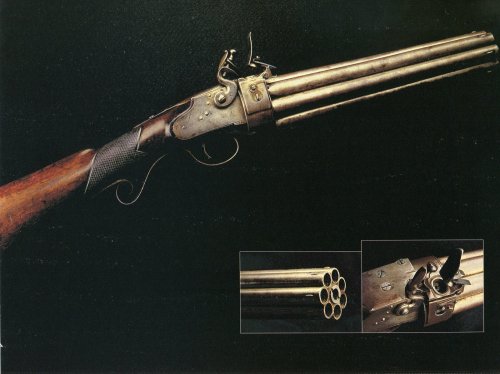
The first revolver was patented and sold to the military in 1820, the Artemus Wheeler.
Here's a link to a webpage with pictures of this revolver as well as the basic information about it. Link
It's a neat gun and as far as I could tell the first "real" revolver to be used during the 19th century. Other guns were developed during the 19th century and admittedly this one wasn't all that common. Since it was used by the military, my character had to have some background or connection with the Navy. Be realistic with the weapons you choose. I found this to be a terrifying weapon to look down the barrel of, so I used it.
Here's a link to a webpage with pictures of this revolver as well as the basic information about it. Link
It's a neat gun and as far as I could tell the first "real" revolver to be used during the 19th century. Other guns were developed during the 19th century and admittedly this one wasn't all that common. Since it was used by the military, my character had to have some background or connection with the Navy. Be realistic with the weapons you choose. I found this to be a terrifying weapon to look down the barrel of, so I used it.
Subscribe to:
Posts (Atom)