Below is a brief outline over the 19th century for the treatment of Hepatitis. As I was preparing this list I couldn't help but thank the Lord that I was born in this time period than back in that one. If your characters develop this disease, I sure do pity them.
In the American Journal of Medical Sciences Vol. 8 ©1830 the treatment for hepatitis was the use of leeches and bleeding.
I found a reference in the Medical Examiner ©1839 that mentions the use of the "blue pill" but also the use of the leeches.
Leeches and Bleeding is still standard course of treatment in 1845 cited in the Half-yearly abstract of the medical sciences. It also states a light diet is in order.
In 1871 Beeton's Medical Dictionary it states that blood letting is not recommended now except in severe cases. It mentions the most common treatment is to try to an support the system during the course of the disease. It also mentions the possibility of using Mercury.
In 1885 A Revised and Enlarged Edition of Clark's new system of electrical medication we find the use of electricity as the practice of apply the current to 'as much as the patient can bear' for 20 minutes once or twice a day.
In 1899 The Practitioner's manual, by Charles Allen acknowledges that the treatment is symptomatic, in other words it only treats the symptoms not the cause of the disease.
Showing posts with label 1830. Show all posts
Showing posts with label 1830. Show all posts
Friday, June 23, 2017


Monday, March 13, 2017
Corsets
In the Herald of Health there is an interesting article about the problems of corsets and the harm they can do to the body. The article came out in 1869. The use of a corset during the 19th century changes from place to place and decade to decade. Also, corsets came in a variety of styles and in the amount of restriction it causes the body. They were front laced and a few back laced. The back laced corset is what we've seen through the eyes of Hollywood. The front laced was more practical for the single woman, or the frontier and farm woman. This article shows that by 1869 there was concern about the health issues from wearing a corset.
Below is the excerpt from Herald of Health©1869
And now for the corsets! Why are they worn? To improve the figure, many say. And yet some of the finest forms I have ever seen wore no corsets, but were supposed to do so because of the fine bust. In reference to these, I have been asked what corsets or shoulder braces they wore, the inquirer wishing to secure the same, because the chest was so complete in its contour. Now, the peculiarity with these very young ladies was that they had never worn corsets or been compressed, padded, or braced in any way, but had dressed loosely and taken gymnastics,
which aro better than corsets to improve the bust.
And Encyclopaedia Americana ©1830 has this interesting set of recommendations about wearing corsets.
We may conclude what we have to say on the use of the corset, by imbodying the whole in a few plain, general rules:—1st. Corsets should be made of smooth, soft, elastic materials. 2d. They should be accurately fitted and modified to suit the peculiarities of figure of each wearer. 3d. No other stiffening should be used but that of quilting or padding ; the bones, steel, &c., should be left to the deformed or diseased, for whom they were originally intended. 4th. Corsets should never be drawn so tight as to impede regular, natural breathing, as, under all circumstances, the improvement of figure is insufficient to compensate for the air of awkward restraint caused by such lacing. 5th. They should never be worn, either loosely or tightly, during the hours appropriated to sleep, as, by impeding respiration, and accumulating the heat of the system improperly, they invariably injure. 6th. The corset for young persons should be of the simplest character, and worn in the lightest and easiest manner, allowing their lungs full play, and giving the form its fullest opportumty for expansion.
If one wishes a fine figure, do not encase it in whalebone, so as to limit muscular motion, but rather encourage the free development of every organ within and without by appropriate action; that is, take in the most air possible, so as to make lungs full and free; throw shoulders back so as to make the chest broad and erect; give free play to all tho muscles, so that they will grow strong and support the body well without artificial aid.
Below is the excerpt from Herald of Health©1869
And now for the corsets! Why are they worn? To improve the figure, many say. And yet some of the finest forms I have ever seen wore no corsets, but were supposed to do so because of the fine bust. In reference to these, I have been asked what corsets or shoulder braces they wore, the inquirer wishing to secure the same, because the chest was so complete in its contour. Now, the peculiarity with these very young ladies was that they had never worn corsets or been compressed, padded, or braced in any way, but had dressed loosely and taken gymnastics,
which aro better than corsets to improve the bust.
And Encyclopaedia Americana ©1830 has this interesting set of recommendations about wearing corsets.
We may conclude what we have to say on the use of the corset, by imbodying the whole in a few plain, general rules:—1st. Corsets should be made of smooth, soft, elastic materials. 2d. They should be accurately fitted and modified to suit the peculiarities of figure of each wearer. 3d. No other stiffening should be used but that of quilting or padding ; the bones, steel, &c., should be left to the deformed or diseased, for whom they were originally intended. 4th. Corsets should never be drawn so tight as to impede regular, natural breathing, as, under all circumstances, the improvement of figure is insufficient to compensate for the air of awkward restraint caused by such lacing. 5th. They should never be worn, either loosely or tightly, during the hours appropriated to sleep, as, by impeding respiration, and accumulating the heat of the system improperly, they invariably injure. 6th. The corset for young persons should be of the simplest character, and worn in the lightest and easiest manner, allowing their lungs full play, and giving the form its fullest opportumty for expansion.
If one wishes a fine figure, do not encase it in whalebone, so as to limit muscular motion, but rather encourage the free development of every organ within and without by appropriate action; that is, take in the most air possible, so as to make lungs full and free; throw shoulders back so as to make the chest broad and erect; give free play to all tho muscles, so that they will grow strong and support the body well without artificial aid.
Saturday, December 3, 2016
Chocolate Recipes
AS I mentioned earlier I would have another post on Chocolate from an earlier source. This one comes from The Italian Confectioner ©1829 Chocolate came to America as a beverage in 1755, however the confection that most of us think of when referring to chocolate many sources say happened in 1830. However this Italian recipe book points to a year earlier. It is also said that Queen Victoria and Prince Albert introduced the American people to the confection in 1851 at The Exposition in London.
Chocolate. lOlbs. of Cocoa, l0lbs. Sugar,
Take lOlbs. of cocoa, prepared as in the preceding number, have a cast-iron mortar, and warm it by filling it with live charcoal; when very hot, wipe it out well, that there may be no dust; pound your cocoa nuts with the iron pestle till you have reduced them to an oily paste, which you will ascertain by the pestle sinking into it by its own weight; add to the paste seven pounds and a half of fine powdered sugar, and continue to pound it till perfectly mixed ; then take out the paste, put it into a pan, and place it on one side in your stove (see plate I. fig. 13), having a charcoal fire on the other side to heat the stone, which must be very flat and smooth, eighteen inches wide and thirty long. Take about a pound of the paste, and grind it with an iron roller, till, upon tasting it, it will melt in your mouth like butter, without leaving any sediment. Put this into another pan, and continue to roll the remainder; the stone should be so heated as scarcely to bear your hand on it. When the several parcels are thus prepared, make the whole into one mass on the stone, lessen the degree of heat, mix it well, and divide it into quantities of two ounces; put them into moulds of tin (see plate I. fig. 14), place the moulds on a board, and on shaking the board your chocolate must become flat in the moulds, and shine; let it cool, and take it out of the moulds. To make the vanilla chocolate, you must pulverise two ounces of vanilla with one part of sugar, and add it to the gross quantity of paste when finished.
No. 103. Chocolate Drops, with Nonpareils.
Take a quantity of chocolate, warm a small cast-iron or metal mortar, and pound your chocolate in it till it becomes malleable; divide it into small balls, and place them on square pieces of paper, about three quarters of an inch from one another ; shake the paper to flatten them, and pass over them some white nonpareils, entirely to cover their surface; when cold take them off the papers.
No. 104. Chocolate Drops in Moulds.
To make these you must have two sorts of moulds ; one sort of thin copper, tinned inside, about the eighth of an inch deep, representing some object, coat of arms, or device ; the other flat, a simple sheet of metal the size of the first mould, having likewise some device upon it, and also tinned; the hollow mould to receive a small ball of prepared chocolate, and the flat one to cover it, which, being flattened between the two pieces, takes the form and impression on both sides; when the drop is cold it comes out easily: it must be well impressed and shining.
No. 105. Vanilla Chocolate Drops.
18 pods of Vanilla, 8 1/2 drachms of Cinnamon, 8 Cloves, 2 grains of Ambergris, and 3 pounds of Sugar in powder.
Pound the above articles in a metal mortar with half a pound of sugar ; sift the whole through a silk sieve, and mix it with the remainder of the sugar; put four pounds of chocolate in an iron or metal mortar, first warmed, and pound it till it is melted, and your pestle sinks into it by its own weight; then add your other ingredients, and pound and mix the whole; the drops are to be dropped on paper, as in No. 103, except that they are to be small, as the drop No. 71, and without nonpareils.
No. 106. Cocoa Nuts in Sugar.
Take cocoa kernels, roasted as in No. 101. Then moisten with orange-flower water, or clear water,into which essence of cinnamon has been dropped, a sufficient quantity of powdered sugar to form a paste for drops. (See No. 71.)— Wrap the nuts in the paste, as pistachios (see No. 99), with or without nonpareils; they are also put in papers, cut at both ends.
Chocolate. lOlbs. of Cocoa, l0lbs. Sugar,
Take lOlbs. of cocoa, prepared as in the preceding number, have a cast-iron mortar, and warm it by filling it with live charcoal; when very hot, wipe it out well, that there may be no dust; pound your cocoa nuts with the iron pestle till you have reduced them to an oily paste, which you will ascertain by the pestle sinking into it by its own weight; add to the paste seven pounds and a half of fine powdered sugar, and continue to pound it till perfectly mixed ; then take out the paste, put it into a pan, and place it on one side in your stove (see plate I. fig. 13), having a charcoal fire on the other side to heat the stone, which must be very flat and smooth, eighteen inches wide and thirty long. Take about a pound of the paste, and grind it with an iron roller, till, upon tasting it, it will melt in your mouth like butter, without leaving any sediment. Put this into another pan, and continue to roll the remainder; the stone should be so heated as scarcely to bear your hand on it. When the several parcels are thus prepared, make the whole into one mass on the stone, lessen the degree of heat, mix it well, and divide it into quantities of two ounces; put them into moulds of tin (see plate I. fig. 14), place the moulds on a board, and on shaking the board your chocolate must become flat in the moulds, and shine; let it cool, and take it out of the moulds. To make the vanilla chocolate, you must pulverise two ounces of vanilla with one part of sugar, and add it to the gross quantity of paste when finished.
No. 103. Chocolate Drops, with Nonpareils.
Take a quantity of chocolate, warm a small cast-iron or metal mortar, and pound your chocolate in it till it becomes malleable; divide it into small balls, and place them on square pieces of paper, about three quarters of an inch from one another ; shake the paper to flatten them, and pass over them some white nonpareils, entirely to cover their surface; when cold take them off the papers.
No. 104. Chocolate Drops in Moulds.
To make these you must have two sorts of moulds ; one sort of thin copper, tinned inside, about the eighth of an inch deep, representing some object, coat of arms, or device ; the other flat, a simple sheet of metal the size of the first mould, having likewise some device upon it, and also tinned; the hollow mould to receive a small ball of prepared chocolate, and the flat one to cover it, which, being flattened between the two pieces, takes the form and impression on both sides; when the drop is cold it comes out easily: it must be well impressed and shining.
No. 105. Vanilla Chocolate Drops.
18 pods of Vanilla, 8 1/2 drachms of Cinnamon, 8 Cloves, 2 grains of Ambergris, and 3 pounds of Sugar in powder.
Pound the above articles in a metal mortar with half a pound of sugar ; sift the whole through a silk sieve, and mix it with the remainder of the sugar; put four pounds of chocolate in an iron or metal mortar, first warmed, and pound it till it is melted, and your pestle sinks into it by its own weight; then add your other ingredients, and pound and mix the whole; the drops are to be dropped on paper, as in No. 103, except that they are to be small, as the drop No. 71, and without nonpareils.
No. 106. Cocoa Nuts in Sugar.
Take cocoa kernels, roasted as in No. 101. Then moisten with orange-flower water, or clear water,into which essence of cinnamon has been dropped, a sufficient quantity of powdered sugar to form a paste for drops. (See No. 71.)— Wrap the nuts in the paste, as pistachios (see No. 99), with or without nonpareils; they are also put in papers, cut at both ends.
Wednesday, November 30, 2016
Astronomy from Literary Gazette 1830
Celestial Phenomena from 1830 to 1836
To stimulate recent subscribers to the Literary Gazette to commence with the year the study of astronomy, a brief sketch is subjoined of the aost remarkable phenomena that will occur mm 1830 to 1836, inclusive. Some of these are connected with questions and predictions to the solution and fulfilment of which philosophers are looking forward with considerable interest; more particularly to the return of the three comets, whose periods are supposed to be kaown with some degree of certainty; namely, lbs cnmets of Encke, Biela, and Halley.
1830—Four visible occultations of Aldebarsn, one of which will be attended with singular circumstances connected with terrestrial position—to one part of the British Isles it will prove only an appulse of the star, and to another part an occultation. A total eclipse of the moon, the duration of which will be almost the longest possible, as the centre of the moon will pass very near the centre of the earth's shadow: about the middle of the eclipse the saoon will be in conjunction with a star in Aquarius, which conjunction will, in some places be an occultation. An occultation of Venus by the moon.
1831 An eclipse of the moon. Mars will pass over a star in Taurus. An occultation of Japiter by the moon. Mercury eclipsed by the san. An occultation of Saturn by the moon.
1832—This year will be remarkably replete with interesting phenomena. The comet of Eacke will return in the spring, and the comet «f Biela in the autumn of the year. A transit rf Mercury across the sun's disc. An eclipse rf the sun. An occultation of Saturn by the 2UOB. Three of the satellites of Jupiter sizxltaneou&ly eclipsed.
1833 An eclipse of the sun.
1834 and 1835—The comet of Halley will ae expected; it last passed its perihelion on the -3th of March, 1759: it is calculated to reach iie same point again 16th of March, 1835. A Sanaa t of Mercury across the sun's disc.
1836 A considerable solar eclipse.
end of quote
Note they didn't put in the 1833 Leonoids meteor storm. Coined "The Night It Rained Fire."
To stimulate recent subscribers to the Literary Gazette to commence with the year the study of astronomy, a brief sketch is subjoined of the aost remarkable phenomena that will occur mm 1830 to 1836, inclusive. Some of these are connected with questions and predictions to the solution and fulfilment of which philosophers are looking forward with considerable interest; more particularly to the return of the three comets, whose periods are supposed to be kaown with some degree of certainty; namely, lbs cnmets of Encke, Biela, and Halley.
1830—Four visible occultations of Aldebarsn, one of which will be attended with singular circumstances connected with terrestrial position—to one part of the British Isles it will prove only an appulse of the star, and to another part an occultation. A total eclipse of the moon, the duration of which will be almost the longest possible, as the centre of the moon will pass very near the centre of the earth's shadow: about the middle of the eclipse the saoon will be in conjunction with a star in Aquarius, which conjunction will, in some places be an occultation. An occultation of Venus by the moon.
1831 An eclipse of the moon. Mars will pass over a star in Taurus. An occultation of Japiter by the moon. Mercury eclipsed by the san. An occultation of Saturn by the moon.
1832—This year will be remarkably replete with interesting phenomena. The comet of Eacke will return in the spring, and the comet «f Biela in the autumn of the year. A transit rf Mercury across the sun's disc. An eclipse rf the sun. An occultation of Saturn by the 2UOB. Three of the satellites of Jupiter sizxltaneou&ly eclipsed.
1833 An eclipse of the sun.
1834 and 1835—The comet of Halley will ae expected; it last passed its perihelion on the -3th of March, 1759: it is calculated to reach iie same point again 16th of March, 1835. A Sanaa t of Mercury across the sun's disc.
1836 A considerable solar eclipse.
end of quote
Note they didn't put in the 1833 Leonoids meteor storm. Coined "The Night It Rained Fire."
Saturday, November 5, 2016
Mary Had a Little Lamb
Well, we all know the nursery rhyme and most of us have taught it to our children. Did you know it was written May 24, 1830 by Sarah Josepha Hale. At the time she was a widow and had come to work as an editor for Ladies' Magazine in Boston. The title of the poem was originally Mary's Lamb.
Godey's purchased the Ladies Magazine in 1837 and she continued to work for Godey's Lady's Book and stayed in Boston while her youngest son finished college at Harvard.
She retired in 1877 at the age of 89. Another interesting tidbit, that same year, Alexander Graham Bell recorded the first phonograph speaking the first lines of Mary's Lamb.
She believed in higher education for women and helped form Vassar College. She published nearly 50 volumes of work in her lifetime.
Who would have thought a nursery rhyme would lead to such a prominent life in the 19th century?
Godey's purchased the Ladies Magazine in 1837 and she continued to work for Godey's Lady's Book and stayed in Boston while her youngest son finished college at Harvard.
She retired in 1877 at the age of 89. Another interesting tidbit, that same year, Alexander Graham Bell recorded the first phonograph speaking the first lines of Mary's Lamb.
She believed in higher education for women and helped form Vassar College. She published nearly 50 volumes of work in her lifetime.
Who would have thought a nursery rhyme would lead to such a prominent life in the 19th century?
Monday, October 3, 2016
Map of 1830 Canals
Below is a link to David Rumsey's web site of maps. It's probably the best site on the web for old maps. The software is great for zooming in on locations. The link below is to a particular map that will help you to see where canals had been built by 1830. Believe it or not, there were some already ceasing function for newer canals with straighter routes to ports or destinations.
1830 Map of Internal Transportation of the United States. Please note this map is for all of the canals in the U.S. at that time. It's a great map. imho
Note that the yellow lines are proposed canals. The red lines are current canals and the red lines with black track marks within it are railroad lines. Green are proposed railroads.
Personally, I love old maps, I have ever since I was a kid. I had quite a collection at one time. The older the better for me. But unfortunately I hit my teen years and didn't have much use for maps. Thankfully, David Rumsey has put his entire collection online and it doesn't take up room on my walls. Enjoy!
1830 Map of Internal Transportation of the United States. Please note this map is for all of the canals in the U.S. at that time. It's a great map. imho
Note that the yellow lines are proposed canals. The red lines are current canals and the red lines with black track marks within it are railroad lines. Green are proposed railroads.
Personally, I love old maps, I have ever since I was a kid. I had quite a collection at one time. The older the better for me. But unfortunately I hit my teen years and didn't have much use for maps. Thankfully, David Rumsey has put his entire collection online and it doesn't take up room on my walls. Enjoy!
Saturday, October 1, 2016
Soda
Hi all,
You might find this topic a little strange but the fact is that the soda we drink today had it's roots in the 19th century. It was actually at the tail of the previous century when the term "soda water" was coined. (1798)
And the first soda fountain was patented in 1819 by Samuel Fahnestock.
But the idea of adding flavoring to the soda water came from the Ingenuity of Eugene Roussel in Philadelphia in 1830 at his perfume shop. His customers could buy a glass of this soda water and had a choice of orange, cherry, lemon, teaberry, ginger, peach and root beer syrups. He did so well that in no time there were fifty other competitors in the city selling flavored soda water.
By the end of the Civil War soda fountains had become a mainstay. By the end of the century ice cream parlors and soda shops were popping up all over. In New York City by 1900 Soda Shops and Ice Cream Parlors out numbered saloons.
And the number one soda in America, Coke, was invented in 1886 by Dr. John Pemberton.
So for those of you who are writers of historical fiction who are following this blog, when your characters need something different to do, you might have them go out for a soda.
You might find this topic a little strange but the fact is that the soda we drink today had it's roots in the 19th century. It was actually at the tail of the previous century when the term "soda water" was coined. (1798)
And the first soda fountain was patented in 1819 by Samuel Fahnestock.
But the idea of adding flavoring to the soda water came from the Ingenuity of Eugene Roussel in Philadelphia in 1830 at his perfume shop. His customers could buy a glass of this soda water and had a choice of orange, cherry, lemon, teaberry, ginger, peach and root beer syrups. He did so well that in no time there were fifty other competitors in the city selling flavored soda water.
By the end of the Civil War soda fountains had become a mainstay. By the end of the century ice cream parlors and soda shops were popping up all over. In New York City by 1900 Soda Shops and Ice Cream Parlors out numbered saloons.
And the number one soda in America, Coke, was invented in 1886 by Dr. John Pemberton.
So for those of you who are writers of historical fiction who are following this blog, when your characters need something different to do, you might have them go out for a soda.
Wednesday, August 24, 2016
Census
In researching family genealogies I've discovered the valuable uses of censuses. But in the 19th century there were very new. The first census in the U.S. was in 1790.
2nd 1800 It counted Men under 10, M10 & Under 16, M 16 & under 26, M 26 & Under 45, M 45 & up as well as the same for Females. It also listed the Names of Heads of families
3rd 1810
4th 1820
5th 1830
6th 1840
7th 1850 This census marked a change they attempted to count every member of the household including women, children & slaves.
8th 1860 This census counted American Indians
9th 1870
10th 1880 This census allowed women to be enumerators.
11th 1890 Announced that the frontier region of the U.S. no longer existed. So, it was no longer needed to track westward migration. This census was also notable for the use of the tabulating machine, reducing the time to tabulate the census from 7 years to 2.5.
2nd 1800 It counted Men under 10, M10 & Under 16, M 16 & under 26, M 26 & Under 45, M 45 & up as well as the same for Females. It also listed the Names of Heads of families
3rd 1810
4th 1820
5th 1830
6th 1840
7th 1850 This census marked a change they attempted to count every member of the household including women, children & slaves.
8th 1860 This census counted American Indians
9th 1870
10th 1880 This census allowed women to be enumerators.
11th 1890 Announced that the frontier region of the U.S. no longer existed. So, it was no longer needed to track westward migration. This census was also notable for the use of the tabulating machine, reducing the time to tabulate the census from 7 years to 2.5.
Saturday, August 6, 2016
Matches, Strikables & Flexibles
While working on a historical novel, I believe it was "Raining Fire" set in 1833, I started to write that the hero took out a match to light the fire. I paused wondering if a match had been invented by then. Well, they had but they hadn't made there way to a woodsman in America. Here's a brief account of the history of a match during the 1800's.
In 1827, John Walker, English chemist and apothecary, discovered that if he coated the end of a stick with certain chemicals and let them dry, he could start a fire by striking the stick anywhere. These were the first friction matches. He called them strikables.
In 1830, the French chemist, Charles Sauria, created a match made with white phosphorous. White phosphorous is poisonous.
In 1855, safety matches were patented by Johan Edvard Lundstrom of Sweden. Lundstrom put red phosphorus on the sandpaper outside the box and the other ingredients on the match head.
In 1889, Joshua Pusey invented the matchbook, he called his matchbook matches "Flexibles".
And just to fill out a bit the remainder of the history I'm including a couple events in the 1900's.
In 1910, the Diamond Match Company patented the first nonpoisonous match in the U.S.
January 28, 1911 United States President William H. Taft publicly asked Diamond Match to release their patent for the good of mankind. They did then congress placed a high tax on matches made with white phosphorous.
In 1827, John Walker, English chemist and apothecary, discovered that if he coated the end of a stick with certain chemicals and let them dry, he could start a fire by striking the stick anywhere. These were the first friction matches. He called them strikables.
In 1830, the French chemist, Charles Sauria, created a match made with white phosphorous. White phosphorous is poisonous.
In 1855, safety matches were patented by Johan Edvard Lundstrom of Sweden. Lundstrom put red phosphorus on the sandpaper outside the box and the other ingredients on the match head.
In 1889, Joshua Pusey invented the matchbook, he called his matchbook matches "Flexibles".
And just to fill out a bit the remainder of the history I'm including a couple events in the 1900's.
In 1910, the Diamond Match Company patented the first nonpoisonous match in the U.S.
January 28, 1911 United States President William H. Taft publicly asked Diamond Match to release their patent for the good of mankind. They did then congress placed a high tax on matches made with white phosphorous.
Wednesday, November 18, 2015
1830 Fashions
These are English November fashions from 1830 original source. Thanksgiving wasn't a part of English traditions so whether or not these were worn in the USA in the fall of 1830 I leave to your imagination. Followed by the descriptions given in the magazine.
 Evenino Dress.
A Dress composed of pale lemon coloured gaze popeline, over a white satin one. The corsage, cut very low, is open before and behind; the lappets are embroidered in a light but rich pattern in white floize silk. The unde+corsage is made square, and arranged in small longitudinal plaits: the sleeves form two bouffants, one immediately above the elbow; the other reaching half way to the wrist, where it terminates in a deep tight cuff of the material of the dress. The skirt is decorated with a single flounce, which comes as high as the knee, and is finished round the border in an embroidery of detached sprigs of foliage in white floize silk. An embroidery also in white silk, of light bouquets, surmounts the flounce. The head-dress is a crape hat: the colour, a new shade of rose noisette. The inside of the brim is decorated with a noeud of gauze ribbon to correspond, on the left side, and with cogues on the right; two very large noeuds of ribbon are placed, one at the top of the crown in front, on the right side, the other at the bottom upon the brim. A bouquet, consisting of light sprigs of flowers, is inserted at the side between the knots. Necklace, gold and emeralds; ear-rings and bracelets, gold finely wrought.
Dinner Dress.
A Crimson satin dress, the corsage, cut very low round the bust, is disposed in front in drapery folds, which meet in the centre, and form a demi losunge. A gold enamelled pin, beautifully wrought, fastens the folds in the centre of the bosom. Long and very wide sleeves of gaze de soie, over short ones of crimson satin; the sleeve is terminated by a mani-hette a la A'hion of the same material. The head-dress is a beret, composed of shaded blue gauze: it is of a very light
and novel form, and ornamented only with a very broad gauze ribbon to correspond, which is fastened in two short bows, with ends that fall nearly to the knee, on the left side. Ear-rings of massive gold, of the pear form. The bracelets are, one of black velvet with a gold clasp, the other of gold chains.

A Dress composed of pale lemon coloured gaze popeline, over a white satin one. The corsage, cut very low, is open before and behind; the lappets are embroidered in a light but rich pattern in white floize silk. The unde+corsage is made square, and arranged in small longitudinal plaits: the sleeves form two bouffants, one immediately above the elbow; the other reaching half way to the wrist, where it terminates in a deep tight cuff of the material of the dress. The skirt is decorated with a single flounce, which comes as high as the knee, and is finished round the border in an embroidery of detached sprigs of foliage in white floize silk. An embroidery also in white silk, of light bouquets, surmounts the flounce. The head-dress is a crape hat: the colour, a new shade of rose noisette. The inside of the brim is decorated with a noeud of gauze ribbon to correspond, on the left side, and with cogues on the right; two very large noeuds of ribbon are placed, one at the top of the crown in front, on the right side, the other at the bottom upon the brim. A bouquet, consisting of light sprigs of flowers, is inserted at the side between the knots. Necklace, gold and emeralds; ear-rings and bracelets, gold finely wrought.
Dinner Dress.
A Crimson satin dress, the corsage, cut very low round the bust, is disposed in front in drapery folds, which meet in the centre, and form a demi losunge. A gold enamelled pin, beautifully wrought, fastens the folds in the centre of the bosom. Long and very wide sleeves of gaze de soie, over short ones of crimson satin; the sleeve is terminated by a mani-hette a la A'hion of the same material. The head-dress is a beret, composed of shaded blue gauze: it is of a very light
and novel form, and ornamented only with a very broad gauze ribbon to correspond, which is fastened in two short bows, with ends that fall nearly to the knee, on the left side. Ear-rings of massive gold, of the pear form. The bracelets are, one of black velvet with a gold clasp, the other of gold chains.
Friday, October 2, 2015
The Dark Knight by Henry G. Bell
This isn't the kind of a poem I would normally read or post but as I skim through some of the references in Google books about the Dark Knight this 1830 poem (It could have been published before that date but that is the earliest I found it.) seems to have influenced a far amount of writings during the 19th Century. This 1830 poem was printed in "The Edinburgh Literary Journal." The following year, Bell published a book of poems "Summer and Winter Hours." in which he included this poem.

THE DARK KNIGHT A BALLAD.
By Henry G. Bell
There came a dark knight from a far countrie,
And no one ever saw his face, for he
Wore his black vizor down continuallie.
He came to a gay bridal, where the bride
Stood, in rich robes, her destined lord beside,
Who gazed upon her with a joyful pride.
And there was music in the sunny sky,
And mirthful voices made a glad reply,—
And there was music in the young bride's eye.
Yet ever and anon her look would fall
On the dark knight who stood apart from all,—
Dark as his shadow, moveless on the wall.
The words were spoken, and the bridal o'er,
And now the mirth grew louder than before;
Why stands the dark knight silent at the door?
The hour grows late, and one by one depart
The guests, with bounding step and merry heart,—
Methought I saw that new-wed ladie start.
N'one in her father's hall are left but she
And her young bridegroom, who, as none may see,
Hath twined his arm around her lovinglie.
Yes,—there is still a third—the vizor'd knight,—
Mark you the glancing of his corslet bright,
Mark you his eye that glares with such strange light?
He moves on slowly through the lofty room,
And as he moves there falls a deeper gloom,—
That heavy tread, why sounds it of the tomb?
And through the castle there was stillness deep,
A drearier stillness than the calm of sleep,—
Closer, in silent awe, the lovers creep.
—A shriek was heard at midnight, such as broke
On every ear, like the first pealing stroke
Of the alarm bell, and the sleepers woke!
In the old hall where fitful moonlight shone,
There lay the bridegroom and the bride alone,
Pale, dead, and cold as monumental stone,—
A vizor'd helm was near, but the dark knight was gone.

THE DARK KNIGHT A BALLAD.
By Henry G. Bell
There came a dark knight from a far countrie,
And no one ever saw his face, for he
Wore his black vizor down continuallie.
He came to a gay bridal, where the bride
Stood, in rich robes, her destined lord beside,
Who gazed upon her with a joyful pride.
And there was music in the sunny sky,
And mirthful voices made a glad reply,—
And there was music in the young bride's eye.
Yet ever and anon her look would fall
On the dark knight who stood apart from all,—
Dark as his shadow, moveless on the wall.
The words were spoken, and the bridal o'er,
And now the mirth grew louder than before;
Why stands the dark knight silent at the door?
The hour grows late, and one by one depart
The guests, with bounding step and merry heart,—
Methought I saw that new-wed ladie start.
N'one in her father's hall are left but she
And her young bridegroom, who, as none may see,
Hath twined his arm around her lovinglie.
Yes,—there is still a third—the vizor'd knight,—
Mark you the glancing of his corslet bright,
Mark you his eye that glares with such strange light?
He moves on slowly through the lofty room,
And as he moves there falls a deeper gloom,—
That heavy tread, why sounds it of the tomb?
And through the castle there was stillness deep,
A drearier stillness than the calm of sleep,—
Closer, in silent awe, the lovers creep.
—A shriek was heard at midnight, such as broke
On every ear, like the first pealing stroke
Of the alarm bell, and the sleepers woke!
In the old hall where fitful moonlight shone,
There lay the bridegroom and the bride alone,
Pale, dead, and cold as monumental stone,—
A vizor'd helm was near, but the dark knight was gone.
Monday, August 24, 2015
1830 Farm Laborer's House Plans
Below are some illustrations for the construction of the laborers homes for farmlands. These are English in design but they will give you a good sense of what was in them.
The Labourer's Cottage cannot be too simple in its form, and it should be comprised in a very small compass. His wants are few, but his comforts should be carefully studied. The relative situation of doors and chimneys is of the greatest consequence to him, and it too frequently happens that this is little attended to, if at all. In rooms of very small dimensions this consideration must never be lost sight of, or the poor man's dwelling may be rendered a wretched habitation. In the Plan No. I. it will appear that the Bed Room, being within the Kitchen, must be warm, the Kitchen itself is defended by the Porch, while the Outhouse or Washhouse, containing the oven and copper, is quite independent of the other two apartments. The dwelling is only one story in height, and the rooms are kept to the smallest possible size.


For a Labourer's Cottage one story in height, explaining a design, comprehending the same number of apartments as No. I, under a different arrangement. These Cottages may be built of brick, and covered with tile, the whole being splashed, to produce the effect of age. In stone countries the roofs should be covered with rag. All the wood work should be painted in imitation of oak.


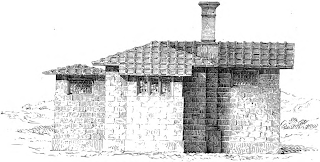
This Design presents a Labourer's Cottage in the Italian style. It is very small, comprehending only a Kitchen, Bed Room, and Outhouse, with an oven. The walls may be of brick or stone, and covered with tile, of the form so much seen in Italy, derived originally from the Greek. The windows are kept high from the ground, a peculiarity much to be observed in this character; and the simplicity of the whole effect is not unpleasing, as exhibited in the Perspective View.



The Labourer's Cottage cannot be too simple in its form, and it should be comprised in a very small compass. His wants are few, but his comforts should be carefully studied. The relative situation of doors and chimneys is of the greatest consequence to him, and it too frequently happens that this is little attended to, if at all. In rooms of very small dimensions this consideration must never be lost sight of, or the poor man's dwelling may be rendered a wretched habitation. In the Plan No. I. it will appear that the Bed Room, being within the Kitchen, must be warm, the Kitchen itself is defended by the Porch, while the Outhouse or Washhouse, containing the oven and copper, is quite independent of the other two apartments. The dwelling is only one story in height, and the rooms are kept to the smallest possible size.


For a Labourer's Cottage one story in height, explaining a design, comprehending the same number of apartments as No. I, under a different arrangement. These Cottages may be built of brick, and covered with tile, the whole being splashed, to produce the effect of age. In stone countries the roofs should be covered with rag. All the wood work should be painted in imitation of oak.


This Design presents a Labourer's Cottage in the Italian style. It is very small, comprehending only a Kitchen, Bed Room, and Outhouse, with an oven. The walls may be of brick or stone, and covered with tile, of the form so much seen in Italy, derived originally from the Greek. The windows are kept high from the ground, a peculiarity much to be observed in this character; and the simplicity of the whole effect is not unpleasing, as exhibited in the Perspective View.


Friday, September 26, 2014
American Ladies Magazine
During the early part of the 19th Century there was a magazine called "American Ladies Magazine." The first volume was actually titled "Ladies Magazine." Below is a list of links to Google Books for several volumes. The editor of this project is Sarah Josepha Hale, the author of Mary Had a little Lamb. By clicking the author's name you will be taken to the Wikipedia page about her. In 1837 the magazine was purchased by Godey and merged it with his Godey's Lady's Book.
Ladies Magazine Vol. 1 1828
Ladies Magazine Vol. 2 1829
Ladies Magazine Vol. 3 1830
Ladies Magazine Vol. 4 1831
Ladies Magazine Vol.5 1832
American Ladies Magazine Vol.6 1833. This link is not to Google Books and you can download a copy for your research pleasure.
American Ladies Magazine Vol. 7 1834
One more note, I've listed what is now available on Google books for free. However, other volumes are available for a substantial fee from Amazon, Barnes & Noble, etc. So if you're interested in these volumes I recommend that you download and keep your own personal copy of them.
Ladies Magazine Vol. 1 1828
Ladies Magazine Vol. 2 1829
Ladies Magazine Vol. 3 1830
Ladies Magazine Vol. 4 1831
Ladies Magazine Vol.5 1832
American Ladies Magazine Vol.6 1833. This link is not to Google Books and you can download a copy for your research pleasure.
American Ladies Magazine Vol. 7 1834
One more note, I've listed what is now available on Google books for free. However, other volumes are available for a substantial fee from Amazon, Barnes & Noble, etc. So if you're interested in these volumes I recommend that you download and keep your own personal copy of them.
Subscribe to:
Posts (Atom)