Do you know the difference between a Chair and a Chaise? I'm not talking furniture, I'm talking about carriages & wagons. Well, the truth is I'm still working on the differences between the two but I have come up with a few distinctions, although the terms were often used interchangeably. Chaise is the French word for chair and some speculate that the first chair wagons were simple a chair placed on a platform with an axle and a couple of wagon wheels.
Chairs tend to be lower to the ground than a chaise. A chaise tends to have a top. A Chair is ofte for only one person. A Chaise is often made for two.
There are a variety of Chairs and Chaises throughout the 19th century. The Windsor Chair is still in my researching mode. I've run across the term but excluding all the furniture pieces has made the search for a carriage known as a Windsor Chair very difficult. I found a post from the Sun Inn in Bethlehem, PA speaking of the arrival of "August 12—A gentleman in a Windsor chair."
Of course we can add to this mix Gigs, Shays and Sulkies but that will be for another day's discussion.
Showing posts with label Carriages. Show all posts
Showing posts with label Carriages. Show all posts
Friday, August 18, 2017


Wednesday, August 16, 2017
Different Buggy Topper
Below is a advertisement I found in the Hub magazine ©1895. I found it very different from other hoods for buggies. It basically looks like an umbrella. This is not the normal hood for a buggy, in all my research of Carriages & Wagons for the 19th century, I believe this is the first time I've run across such a design. I don't know how much they sold for, nor do I know how popular they became, if at all. But they would make quite the conversation piece if one strolled into town, I would have a lot of fun with this in a novel setting.


Wednesday, June 28, 2017
American Buggy
Today's post includes a quote from 1795-1895 One Hundred Years of Commerence ©1895 as well as 4 images from the 1859-1860 New York Carriage Makers Magazine. There are many different styles of buggies so I've selected only four to give you some variety.
To sum up the American Buggy in terms of the 19th century:
"The buggy is purely American in its origin, and is without doubt the greatest achievement of American carriage-makers. The body may be of any form, but the running part is always of the same, or nearly the same, type. Its common-sense construction is wholly unlike the work of any other country. It is simpler, lighter, stronger, and cheaper than any other style of vehicle, and is so admirable in all respects that it is not likely to go out of use for at least another century."
Below are a two sketches of the American Buggy.

 This is probably the most common shape of the American Buggy, as I've scene so far from my research.
 This design is larger than other's I've found as well. There is a smaller buggy for one person used for hunting as well.

To sum up the American Buggy in terms of the 19th century:
"The buggy is purely American in its origin, and is without doubt the greatest achievement of American carriage-makers. The body may be of any form, but the running part is always of the same, or nearly the same, type. Its common-sense construction is wholly unlike the work of any other country. It is simpler, lighter, stronger, and cheaper than any other style of vehicle, and is so admirable in all respects that it is not likely to go out of use for at least another century."
Below are a two sketches of the American Buggy.


Wednesday, March 22, 2017
The Brett
While researching for my non-fiction book 19th Century Carriages & Wagons for today's writer, I discovered the carriage that was considered the RV of the 19th century. It was called 'The Brett." What made this wagon so effective was it had a long body and the seats were generally cushions or blankets. Some folks would set them on top of their luggage to sit up during travel, others would simply sit down with the cushion under the bottoms and across their backs. The driver would sit in front of the body and passengers could sit facing one another. At night they could spread out and sleep lengthwise because of the long body of the carriage.
Here are some pictures of a Brett.


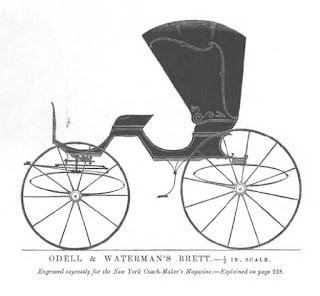


Here are some pictures of a Brett.


Wednesday, March 15, 2017
Vis-a-vis
The term means face to face in French. It is also the term used for a carriage built in the 19th century, originating in France, where the passengers sat face to face. In America these carriages found their way into Urban areas. They weren't as useful in the country or on the farms. They needed well developed roads for the type of wheels and suspension. Farm and country roads were rough and rugged and needed a different type of wheel and suspension for their wagons and carriages. Here is a link to Carolina Carriages with a Vis-a-vis you could hire today. In the later part of the 19th century they often sat up to 6 passengers plus the driver and for an extra seat one could sit next to the driver. However in the earlier part of the century they were a narrow carriage and could only sit two. The advantage to this was the passengers weren't jolted against one another and it tended to be warmer than larger coaches. It fell out of fashion for a few years around the mid-century then the reconstructed ones were larger and interest in them gained once again.
It's a great carriage to use in an Urban setting.
It's a great carriage to use in an Urban setting.
Friday, February 17, 2017
Manners for Men
I found a book entitled "Manners for men" by Mrs. C. E. Humphry ©1897 written toward the end of the 19th century. In it the author goes into great detail on how a man is to behave if he is a gentleman. The first thing that caught my eye was the title of a chapter, entitled "The Ideal Man." I had to chuckle at that. I do not believe there is an ideal man nor is there an ideal woman. I do however believe that there is an ideal man for me, and I'm fortunate enough to have married him but as much as I love my husband he is not perfect, neither am I. It's a rather fun book to read but today I'm going to share an excerpt that also goes to my current writing project of a non-fiction book on 19th century Carriages & Wagons.
Manners for Men in escorting Ladies into a Hansom Cab.
IN A HANSOM.
In handing a lady into a hansom care must be taken to protect her dress from the muddy wheel. The gentleman asks if she would like the glasses down, and conveys her instructions to the driver, then raises his hat as she drives away. Should he be accompanying her in the hansom, she seats herself at when accom- the nearest side to the pavelady. ment, so that when he enters he will not have to go round a corner, as it were. In this case he gives the cabman instructions across the roof of the cab, and if his companion wishes the glasses to be lowered, he asks for them through the trap-door at the top of the cab. He must never smoke when the glasses are let down— to do so would render the atmosphere unbearable to almost any woman. But if he knows his partner in the drive sufficiently well, he can ask permission to smoke, should the glasses not be required.
Manners for Men in escorting Ladies into a Hansom Cab.
IN A HANSOM.
In handing a lady into a hansom care must be taken to protect her dress from the muddy wheel. The gentleman asks if she would like the glasses down, and conveys her instructions to the driver, then raises his hat as she drives away. Should he be accompanying her in the hansom, she seats herself at when accom- the nearest side to the pavelady. ment, so that when he enters he will not have to go round a corner, as it were. In this case he gives the cabman instructions across the roof of the cab, and if his companion wishes the glasses to be lowered, he asks for them through the trap-door at the top of the cab. He must never smoke when the glasses are let down— to do so would render the atmosphere unbearable to almost any woman. But if he knows his partner in the drive sufficiently well, he can ask permission to smoke, should the glasses not be required.
Thursday, April 9, 2015
Axle Grease
Here's some practical information regarding axle grease. It's something most of us don't need to use today but very important for our 19th Century characters. Below the most recent tidbit you'll find a link to a previous post on Axle Grease for Wagons.
Axle-grease for very heavy wagons. No. 1, for winter: Tallow, 420 parts; palm oil, 840; soda, 140; water, 4200.
No. 2, for summer: Tallow, 420 parts; palm oil, 490; soda, 35; water, 2300.
The above lubricants are calculated for a low temperature in winter and a hot one in summer. For a moderate winter climate, the quantity of soda may be somewhat reduced, and that of palm oil increased.
Axle grease for heavy wagons. Palm oil, 210 parts; tallow, 85; soda lye, 65; water, 920.
Melt the palm oil and tallow together, and after making the mixture homogeneous by stirring, add the soda lye. The latter is prepared by dissolving soda in sufficient hot water for the cooled fluid to show 20° or 21° Be. After adding and stirring in the soda lye, the water is added, and the whole stirred to a homogeneous mass, which is ladled into vessels and allowed to congeal.
Grease for wooden machinery. Tallow, 30 parts; palm oil, 20; train oil, 10; graphite, 20.
After melting the fats at a moderate heat, intimately mix the graphite, previously pulverized and elutriated, with the mass by stirring.
Source: A Practical Treatise on animal and vegetable fats and oils ©1896
Here's the link to the previous post. Axle Grease For Your Wagon or Carriage
Axle-grease for very heavy wagons. No. 1, for winter: Tallow, 420 parts; palm oil, 840; soda, 140; water, 4200.
No. 2, for summer: Tallow, 420 parts; palm oil, 490; soda, 35; water, 2300.
The above lubricants are calculated for a low temperature in winter and a hot one in summer. For a moderate winter climate, the quantity of soda may be somewhat reduced, and that of palm oil increased.
Axle grease for heavy wagons. Palm oil, 210 parts; tallow, 85; soda lye, 65; water, 920.
Melt the palm oil and tallow together, and after making the mixture homogeneous by stirring, add the soda lye. The latter is prepared by dissolving soda in sufficient hot water for the cooled fluid to show 20° or 21° Be. After adding and stirring in the soda lye, the water is added, and the whole stirred to a homogeneous mass, which is ladled into vessels and allowed to congeal.
Grease for wooden machinery. Tallow, 30 parts; palm oil, 20; train oil, 10; graphite, 20.
After melting the fats at a moderate heat, intimately mix the graphite, previously pulverized and elutriated, with the mass by stirring.
Source: A Practical Treatise on animal and vegetable fats and oils ©1896
Here's the link to the previous post. Axle Grease For Your Wagon or Carriage
Friday, January 9, 2015
Sulky A type of Carriage
Below is a page from my 19th Century Carriages & Wagons Resource Guide for Writers Book. If you're interested in purchasing the book click the title for a link.
SULKY
DESCRIPTION: A light two-wheeled carriage for a single person, drawn by one horse, used as a pleasure-carriage and for trials of speed between trotting-horses.
Defined by The Imperial Dictionary ©1883
Wooden wheels with iron rims built wide to travel over most roads in the earlier days. Built on elipticle springs. When racing became the primary use for the sulky then it had thinner wheels.
NUMBER OF PASSENGERS: 1
YEARS BUILT AND/OR IN SERVICE: This has been hard to tie down.
Online entomology dictionary has 1756
They aren't listed in the tax roles I found for 1800. But I did find them in the tax 1813 tax laws for PA.
The racing sulky industry reports they were first built in the mid-1800's.
What this means is they were probably in Europe before the United States and we know they were here before 1820 because they were taxed.
LOCATION & ORIGIN OF DESIGN: America
PRINCIPLE REGION(S) OF USE: Country and City
POWERED BY: 1 horse or colt.
Today they also use dogs for racing sulkies.
WHERE DRIVER & PASSENGERS SAT: On the single seat
COSTS: 1834 cost $70-$80
ADDITIONAL INFORMATION
An old saying:
A bachelor is a person who enjoys everything and pays for nothing; a married man is one that pays for everything and enjoys nothing. The one drives a sulky through life, and is not expected to take care of any one but himself: the other keeps a carriage, which is always too full to afford him a comfortable spot. Be cautious then how you exchange your sulky for a carriage.
Etiquette for Gentlemen ©1847
HOW TO HITCH A HORSE IN A SULKY
Lead him to and around it; let him look at it, touch it with his nose, and stand by it till he does not care for it; then pull the shafts a little to the left, and stand your horse in front of the off wheel. Let some one stand on the right side of the horse, and hold him by the bit, while you stand on the left side, facing the sulky. This will keep him straight. Run your left hand back, and let it rest on his hip, and lay hold of the shafts with your right, bringing them up very gently to the left hand, which still remains stationary. Do not let anything but your arm touch his back, and as soon as you have the shafts square over him, let the person on the opposite side take hold of one of them, and lower them very gently to the shaft-bearers. Be very slow and deliberate about hitching; the longer time you take the better, as a general thing. When you have the shafts placed, shake them slightly, so that he will feel them against each side. As soon as he will bear them without scaring, fasten your braces, etc, and start him along very slowly. Let one man lead the horse, to keep him gentle, while the other gradually works back with the lines till he can get behind and drive him. After you have driven him in this way a short distance, you can get into the sulky, and all will go right. It is very important to have your horse go gently when you first hitch him. After you have walked him awhile, there is not half so much danger of his scaling. Men do very wrong to jump up behind a horse to drive him as soon as they have him hitched. There are too many things for him to comprehend all at once. The shafts, the lines, the harness, and the rattling of the Bulky, all tend to scare him, and he must be made familiar with them by degrees. If your horse is very wild, I would advise you to put up one foot the first time you drive him.
The Modern art of taming Horses ©1858


SULKY
DESCRIPTION: A light two-wheeled carriage for a single person, drawn by one horse, used as a pleasure-carriage and for trials of speed between trotting-horses.
Defined by The Imperial Dictionary ©1883
Wooden wheels with iron rims built wide to travel over most roads in the earlier days. Built on elipticle springs. When racing became the primary use for the sulky then it had thinner wheels.
NUMBER OF PASSENGERS: 1
YEARS BUILT AND/OR IN SERVICE: This has been hard to tie down.
Online entomology dictionary has 1756
They aren't listed in the tax roles I found for 1800. But I did find them in the tax 1813 tax laws for PA.
The racing sulky industry reports they were first built in the mid-1800's.
What this means is they were probably in Europe before the United States and we know they were here before 1820 because they were taxed.
LOCATION & ORIGIN OF DESIGN: America
PRINCIPLE REGION(S) OF USE: Country and City
POWERED BY: 1 horse or colt.
Today they also use dogs for racing sulkies.
WHERE DRIVER & PASSENGERS SAT: On the single seat
COSTS: 1834 cost $70-$80
ADDITIONAL INFORMATION
An old saying:
A bachelor is a person who enjoys everything and pays for nothing; a married man is one that pays for everything and enjoys nothing. The one drives a sulky through life, and is not expected to take care of any one but himself: the other keeps a carriage, which is always too full to afford him a comfortable spot. Be cautious then how you exchange your sulky for a carriage.
Etiquette for Gentlemen ©1847
HOW TO HITCH A HORSE IN A SULKY
Lead him to and around it; let him look at it, touch it with his nose, and stand by it till he does not care for it; then pull the shafts a little to the left, and stand your horse in front of the off wheel. Let some one stand on the right side of the horse, and hold him by the bit, while you stand on the left side, facing the sulky. This will keep him straight. Run your left hand back, and let it rest on his hip, and lay hold of the shafts with your right, bringing them up very gently to the left hand, which still remains stationary. Do not let anything but your arm touch his back, and as soon as you have the shafts square over him, let the person on the opposite side take hold of one of them, and lower them very gently to the shaft-bearers. Be very slow and deliberate about hitching; the longer time you take the better, as a general thing. When you have the shafts placed, shake them slightly, so that he will feel them against each side. As soon as he will bear them without scaring, fasten your braces, etc, and start him along very slowly. Let one man lead the horse, to keep him gentle, while the other gradually works back with the lines till he can get behind and drive him. After you have driven him in this way a short distance, you can get into the sulky, and all will go right. It is very important to have your horse go gently when you first hitch him. After you have walked him awhile, there is not half so much danger of his scaling. Men do very wrong to jump up behind a horse to drive him as soon as they have him hitched. There are too many things for him to comprehend all at once. The shafts, the lines, the harness, and the rattling of the Bulky, all tend to scare him, and he must be made familiar with them by degrees. If your horse is very wild, I would advise you to put up one foot the first time you drive him.
The Modern art of taming Horses ©1858


Subscribe to:
Posts (Atom)