Okay I know it is August and it's still in the 90's here in Florida but...winter is coming. I stumped upon this article from Harper's Bazar, Nov. 1867 and thought I'd share a little bit with all of you.
WINTER GARDENING
"And who can sing the songs of spring
In dull and drear December?"
We purpose to give a few easy directions to those who desire to possess at light cost and little trouble a blooming winter garden in their homes, that can be attended to in the worst weather without soiling the hands or wetting the feet.
The hyacinth must rank first in our list as being almost the easiest flower to cultivate.
Hyacinths may be grown in water, in pots, in moss, and in prepared cocoa-fibre and charcoal. The last is the best for hyacinths indoors, in the numerous choices which are used for this purpose. In order to cultivate the hyacinth in the sitting-room in prepared cocoa-fibre and charcoal, place at the bottom or the jardinet, etc., a handful or so of rough charcoal, and fill up with the preparation; plant the hyacinths thickly, associating with them snow-drops, scilla sibirica, early flowering crocus, and, if the space will admit, a few pompon hyacinths; cover the bulbs with the preparation, and neatly cover the surface with nice green carpet moss; the freshness of the moss will be prolonged by occasionally damping it with a wet sponge. Sprinkle the plants overhead with tepid water two or three times a week.
This preparation is free from impurities and possesses a gentle stimulus; the bulbs root freely into it and produce fine spikes of bloom. Another important recommendation the prepared cocoa=fibre and charcoal possesses is its retention of moisture for a long time. Unless in a very hot room two or three good waterings will be sufficient from the time of planting till the bulbs are in bloom, so that the amateur is relieved from the daily anxiety lest his favorite group of forthcoming flowers should suffer from want of water.
. . .
The article continues to point out how to grow hyacinth in water, moss and pots. If you would like to finish the article it can be found here.
Showing posts with label 1867. Show all posts
Showing posts with label 1867. Show all posts
Monday, August 21, 2017


Tuesday, July 18, 2017
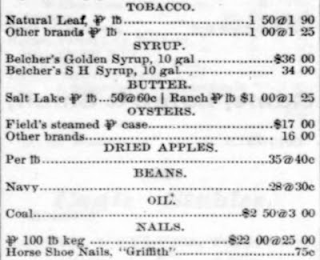
1867 Costs in Montana
The information below comes from "The Montana Post" (Virginia City, Montana Territory Jan. 5, 1867 newspaper. What I found is a market report of the costs of various products. They state theprices in gold or large lots from first hands, unless otherwise stated, and that in filling orders, higher rates have to be paid. I've enlarged the column and it is in several parts.




Wednesday, May 3, 2017
Fashion Harper's Bazar
Harper's Bazar began publishing in 1867 and is still a leading magazine regarding fashion. What is extremely valuable, to people like me, is the images that produced in their magazine whether they were clothing or hair styles. It gives folks like me a visual of what they are referring to. So, I'm going to share one of the most valuable resources I've found for Harper's Bazaar Magazine with images of the entire magazine from 1867 to 1900. I believe you'll also find this a valuable resource.
Hearth Home Page
Enjoy!
Hearth Home Page
Enjoy!
Friday, February 10, 2017
Broom Making
Below is the reprint of a blog post from Sept, 2010. Of all my posts this one has brought about a fair amount of attention. However, I want to add to this post with a link to Youtube where Jack Martin shows how they make an 1850 Shaker Style broom.
Brooms have been around for eons, the question I've been trying to answer is when did the first broom factories start in America.
In 1841 in Sussex I find the listing of 65 broom-makers
A list of immigration to Missouri in 1867 listed several boom-makers
I found a disabled soldiers Broom-factory in 1875
1881 I found an expense report that line item a broom factory in a Missouri Penitentiary in 1880
And I found a grocery store owner in 1888 took payment of a broom making machine in exchange for food, then proceeded to have a very successful broom factory in the late 19th century into the 20th century. In fact, the business is still in operations today.
So, as of this moment, I do not know when the first broom factory developed in America. If you have a source with additional information, I'd love to hear it.
Below is a list of Broom & Brush Factory jobs, from the "Classified index of occupations by the United States," © 1921
Binder, broom or brush factory.
Borer, broom or brush factory.
Box maker, broom or brush factory.
Broom or brush maker, broom or brush
factory.
Broom or brush maker (not in factory).
Broom or brush maker (n. s.).
Buffer, broom or brush factory.
Buncher, broom or brush factory.
Comber, broom or brush factory.
Cutter, broom or brush factory.
Drawer, broom or brush factory.
Brooms have been around for eons, the question I've been trying to answer is when did the first broom factories start in America.
In 1841 in Sussex I find the listing of 65 broom-makers
A list of immigration to Missouri in 1867 listed several boom-makers
I found a disabled soldiers Broom-factory in 1875
1881 I found an expense report that line item a broom factory in a Missouri Penitentiary in 1880
And I found a grocery store owner in 1888 took payment of a broom making machine in exchange for food, then proceeded to have a very successful broom factory in the late 19th century into the 20th century. In fact, the business is still in operations today.
So, as of this moment, I do not know when the first broom factory developed in America. If you have a source with additional information, I'd love to hear it.
Below is a list of Broom & Brush Factory jobs, from the "Classified index of occupations by the United States," © 1921
Binder, broom or brush factory.
Borer, broom or brush factory.
Box maker, broom or brush factory.
Broom or brush maker, broom or brush
factory.
Broom or brush maker (not in factory).
Broom or brush maker (n. s.).
Buffer, broom or brush factory.
Buncher, broom or brush factory.
Comber, broom or brush factory.
Cutter, broom or brush factory.
Drawer, broom or brush factory.
Saturday, December 3, 2016
Broom Factories & Broom Makers
Brooms have been around for eons, the question I've been trying to answer is when did the first broom factories start in America.
In 1841 in Sussex I find the listing of 65 broom-makers
A list of immigration to Missouri in 1867 listed several boom-makers
I found a disabled soldiers Broom-factory in 1875
1881 I found an expense report that line item a broom factory in a Missouri Penitentiary in 1880
And I found a grocery store owner in 1888 took payment of a broom making machine in exchange for food, then proceeded to have a very successful broom factory in the late 19th century into the 20th century. In fact, the business is still in operations today.
So, as of this moment, I do not know when the first broom factory developed in America. If you have a source with additional information, I'd love to hear it.
Below is a list of Broom & Brush Factory jobs, from the "Classified index of occupations by the United States," © 1921
Binder, broom or brush factory.
Borer, broom or brush factory.
Box maker, broom or brush factory.
Broom or brush maker, broom or brush
factory.
Broom or brush maker (not in factory).
Broom or brush maker (n. s.).
Buffer, broom or brush factory.
Buncher, broom or brush factory.
Comber, broom or brush factory.
Cutter, broom or brush factory.
Drawer, broom or brush factory.
In 1841 in Sussex I find the listing of 65 broom-makers
A list of immigration to Missouri in 1867 listed several boom-makers
I found a disabled soldiers Broom-factory in 1875
1881 I found an expense report that line item a broom factory in a Missouri Penitentiary in 1880
And I found a grocery store owner in 1888 took payment of a broom making machine in exchange for food, then proceeded to have a very successful broom factory in the late 19th century into the 20th century. In fact, the business is still in operations today.
So, as of this moment, I do not know when the first broom factory developed in America. If you have a source with additional information, I'd love to hear it.
Below is a list of Broom & Brush Factory jobs, from the "Classified index of occupations by the United States," © 1921
Binder, broom or brush factory.
Borer, broom or brush factory.
Box maker, broom or brush factory.
Broom or brush maker, broom or brush
factory.
Broom or brush maker (not in factory).
Broom or brush maker (n. s.).
Buffer, broom or brush factory.
Buncher, broom or brush factory.
Comber, broom or brush factory.
Cutter, broom or brush factory.
Drawer, broom or brush factory.
Wednesday, November 30, 2016
Stenographic Notes
I stumbled on this phrase while researching the railroads and while I thought I knew what the writer was saying, I wanted to double check. What I found was an interesting tidbit.
First the quote from the article I was reading:
My friends of the Railroad Gazette informed me that in such event they would have stenographic notes taken for a report that would appear in their paper.
Naturally I presumed shorthand. Which the writer was intending. Wikipedia shows there were several varieties of short hand in the 19th Century. Here's a link to view the Lord's Prayer in several of those forms.
A basic timeline of shorthand in the 19th century.
Pitman shorthand introduced in 1837
Graham shorthand introduced in 1854 (credited with perfecting Pitman's shorthand)
Munson shorthand introduced in 1867
Gregg Shorthand introduced in 1888
First the quote from the article I was reading:
My friends of the Railroad Gazette informed me that in such event they would have stenographic notes taken for a report that would appear in their paper.
Naturally I presumed shorthand. Which the writer was intending. Wikipedia shows there were several varieties of short hand in the 19th Century. Here's a link to view the Lord's Prayer in several of those forms.

A basic timeline of shorthand in the 19th century.
Pitman shorthand introduced in 1837
Graham shorthand introduced in 1854 (credited with perfecting Pitman's shorthand)
Munson shorthand introduced in 1867
Gregg Shorthand introduced in 1888
Friday, November 11, 2016
Memorial Day
Memorial day originally started as Decoration day in the 1867 but was officially proclaimed in 1868 by Gen. John A. Logan.
Here's a link with a brief history Memorial Day History
Google Books also has a viewable document of "The National Memorial Day" ©1870 that gives a detail of the services for Memorial Day
Memorial Day was originally to recognize Union troops who fought in the Civil War. It wasn't until 1898 and President McKinley delivered a speech in GA that urged the US government to take care of Confederate graves. In 1900 Arlington National Cemetery began this process, a much needed event in the reconciliation of the North & South.
Today is actually Armistice Day but that didn't happen until Nov. 11, 1918.
Here's a link with a brief history Memorial Day History
Google Books also has a viewable document of "The National Memorial Day" ©1870 that gives a detail of the services for Memorial Day
Memorial Day was originally to recognize Union troops who fought in the Civil War. It wasn't until 1898 and President McKinley delivered a speech in GA that urged the US government to take care of Confederate graves. In 1900 Arlington National Cemetery began this process, a much needed event in the reconciliation of the North & South.
Today is actually Armistice Day but that didn't happen until Nov. 11, 1918.
Thursday, October 20, 2016
Saddles
Below you'll find an excerpt from The Handy Horse Book ©1867 This book is great for tidbits on how the animals were looked at during the 19th century. In most cases you'll find that horses were considered tools in much the same way we consider a car today. They had extreme value and were a very important part of people's lives during the 19th century. Here's a tidbit about saddling a horse.
SADDLING.
A Saddle should be made to fit the horse for which it is intended, and requires as much variation in shape, especially in the stuffing, as there is variety in the shapes of horses' backs.* An animal may be fairly shaped in the back, and yet a saddle that fits another horse will always go out on this one's withers. The saddle having been made to fit your horse, let it be placed gently upon him, and shifted till its proper berth be found. When in its right place, the action of the upper part of the shoulder-'blade should be quite free from any confinement or pressure by what saddlers call the " gullet" of the saddle under the pommel when the animal is in motion. It stands to reason that any interference with the action of the shoulder-blade must, after a time, indirectly if not directly, cause a horse to falter in his movement.
N.B.—A horse left in the stable with his saddle on, with or without a bridle, ought always to have his head fastened up, to prevent his lying down on the saddle .and injuring it.
Girths.—When girthing a horse, which is always done upon the near or left-hand side, the girth should be first drawn tightly towards you under the belly of the horse, so as to bring the saddle rather to the off side on the back of the beast. This is seldom done by grooms ; and though a gentleman is not supposed to girth his horse, information on this as well as on other points may happen to be of essential service to him; for the consequence of the attendant's usual method is, that when the girths are tightened up, the saddle, instead of being in the centre of the horse's back, is inclined to the near or left-hand side, to which it is still farther drawn by the act of mounting, so that when a man has mounted he fancies that one stirrup is longer than the other—the near-side stirrup invariably the longest. To remedy this he forces down his foot in the right stirrup, which brings the saddle to the centre of the animal's back.
All this would be obviated by care being taken, in the process of girthing, to place the left hand on the middle of the saddle, drawing the first or under girth with the right hand till the girth-holder reaches the buckle, the left hand being then disengaged to assist in bracing up the girth. The outer girth must go through the same process, being drawn under the belly of the horse from the off side tightly before it is attached to the girth-holder.
With ladies' saddles most particular attention should be paid to the girthing.
(It must be observed that, with some horses having the knack of swelling themselves out during the process of girthing, the girths may be tightened before leaving the stable so as to appear almost too tight, but which, when the horse has been walked about for ten minutes, will seem comparatively loose, and quite so when the rider's weight is placed in the saddle.)
Stirrup-Irons should invariably be of wrought steel. A man should never be induced knowingly to ride in a cast-metal stirrup, any more than he ought to attempt to do so with a cast-metal bit.
Stirrup-irons should be selected to suit the size of the rider's foot; those with two or three narrow bars at the bottom are decidedly preferable, for the simple reason, that in cold weather it is a tax on a man's endurance to have a single broad bar like an icicle in the ball of his foot, and in wet weather a similar argument may apply as regards damp ; besides, with the double bar, the foot has a better hold in the stirrup, the rings being, of course, indented (rasp-like), as they usually are, to prevent the foot from slipping in them.
This description of stirrup, with an instep-pad, is preferable for ladies to the slipper, which is decidedly obsolete.
Latchford's* ladies' patent safety stirrup seems to combine every precaution for the security of fair equestrians.
A balance-strap to a side-saddle is very desirable, and in general use.
Where expense is no object, stirrups that open at the side with a spring are, no doubt, the safest for gentlemen in case of any accident.
With regard to Stirrup-Leathers, saddlers generally turn the right or dressed side out for appearance ; but as the dressing causes a tightness on that side of the leather, the undressed side, which admits of more expansion, should be outside—because, after a little wear, the leather is susceptible of cracks, and the already extended side will crack the soonest. The leather will break in the most insidious place, either in the D under the stirrup-iron, where no one but the servant who cleans it can see it; or else, perhaps, where the buckle wears it under the flap of the saddle. Stirrupleathers broken in this manner have caused many accidents.
Invariably adjust your stirrup-leathers before mounting.
To measure the length of the stirrup-leathers of a new saddle, place the fingers of the right hand against the bar to which the leathers are attached, and, measuring from the bottom bar of the stirrup up to the armpit, make the length of the leathers and stirrups equal to the length of your arm, from the tips of the fingers to the armpit. Before entering the field, in hunting or crossing country, draw up the leathers two or three holes shorter on each side; and when starting on a long journey it is as well to do the same, to ease both yourself and your bearer.
SADDLING.
A Saddle should be made to fit the horse for which it is intended, and requires as much variation in shape, especially in the stuffing, as there is variety in the shapes of horses' backs.* An animal may be fairly shaped in the back, and yet a saddle that fits another horse will always go out on this one's withers. The saddle having been made to fit your horse, let it be placed gently upon him, and shifted till its proper berth be found. When in its right place, the action of the upper part of the shoulder-'blade should be quite free from any confinement or pressure by what saddlers call the " gullet" of the saddle under the pommel when the animal is in motion. It stands to reason that any interference with the action of the shoulder-blade must, after a time, indirectly if not directly, cause a horse to falter in his movement.
N.B.—A horse left in the stable with his saddle on, with or without a bridle, ought always to have his head fastened up, to prevent his lying down on the saddle .and injuring it.
Girths.—When girthing a horse, which is always done upon the near or left-hand side, the girth should be first drawn tightly towards you under the belly of the horse, so as to bring the saddle rather to the off side on the back of the beast. This is seldom done by grooms ; and though a gentleman is not supposed to girth his horse, information on this as well as on other points may happen to be of essential service to him; for the consequence of the attendant's usual method is, that when the girths are tightened up, the saddle, instead of being in the centre of the horse's back, is inclined to the near or left-hand side, to which it is still farther drawn by the act of mounting, so that when a man has mounted he fancies that one stirrup is longer than the other—the near-side stirrup invariably the longest. To remedy this he forces down his foot in the right stirrup, which brings the saddle to the centre of the animal's back.
All this would be obviated by care being taken, in the process of girthing, to place the left hand on the middle of the saddle, drawing the first or under girth with the right hand till the girth-holder reaches the buckle, the left hand being then disengaged to assist in bracing up the girth. The outer girth must go through the same process, being drawn under the belly of the horse from the off side tightly before it is attached to the girth-holder.
With ladies' saddles most particular attention should be paid to the girthing.
(It must be observed that, with some horses having the knack of swelling themselves out during the process of girthing, the girths may be tightened before leaving the stable so as to appear almost too tight, but which, when the horse has been walked about for ten minutes, will seem comparatively loose, and quite so when the rider's weight is placed in the saddle.)
Stirrup-Irons should invariably be of wrought steel. A man should never be induced knowingly to ride in a cast-metal stirrup, any more than he ought to attempt to do so with a cast-metal bit.
Stirrup-irons should be selected to suit the size of the rider's foot; those with two or three narrow bars at the bottom are decidedly preferable, for the simple reason, that in cold weather it is a tax on a man's endurance to have a single broad bar like an icicle in the ball of his foot, and in wet weather a similar argument may apply as regards damp ; besides, with the double bar, the foot has a better hold in the stirrup, the rings being, of course, indented (rasp-like), as they usually are, to prevent the foot from slipping in them.
This description of stirrup, with an instep-pad, is preferable for ladies to the slipper, which is decidedly obsolete.
Latchford's* ladies' patent safety stirrup seems to combine every precaution for the security of fair equestrians.
A balance-strap to a side-saddle is very desirable, and in general use.
Where expense is no object, stirrups that open at the side with a spring are, no doubt, the safest for gentlemen in case of any accident.
With regard to Stirrup-Leathers, saddlers generally turn the right or dressed side out for appearance ; but as the dressing causes a tightness on that side of the leather, the undressed side, which admits of more expansion, should be outside—because, after a little wear, the leather is susceptible of cracks, and the already extended side will crack the soonest. The leather will break in the most insidious place, either in the D under the stirrup-iron, where no one but the servant who cleans it can see it; or else, perhaps, where the buckle wears it under the flap of the saddle. Stirrupleathers broken in this manner have caused many accidents.
Invariably adjust your stirrup-leathers before mounting.
To measure the length of the stirrup-leathers of a new saddle, place the fingers of the right hand against the bar to which the leathers are attached, and, measuring from the bottom bar of the stirrup up to the armpit, make the length of the leathers and stirrups equal to the length of your arm, from the tips of the fingers to the armpit. Before entering the field, in hunting or crossing country, draw up the leathers two or three holes shorter on each side; and when starting on a long journey it is as well to do the same, to ease both yourself and your bearer.
Friday, September 23, 2016
Gatling Gun
From what I can see, the Gatling Gun was created and patented in 1861 by Dr. Richard Gatling during the Civil war. It was the first machine gun since it was crank-perated and multi-barreled. In 1862 the gun used steel chambers and percussion caps. In 1866 or 67 (I've seen both dates) Gatling redesigned the gun and this version was purchased by the U.S. army. The Gatling gun was obsolete in 1911 after 45 years of service with the army.
Below is a copy of the patent Gatling presented in 1865

Dr. Gatlin describes the gun:
The gun consists of a series of barrels in combination with a grooved carrier and lock cylinder. All these several parts are rigidly secured upon a main shaft. There are as many grooves in the carrier, and as many holes in the lock cylinder, as there are barrels. Each barrel is furnished with one lock, so that a gun with ten barrels has ten locks. The locks work in the holes formed in the lock cylinder on a line with the axis of the barrels. The lock cylinder, which contains the lock, is surrounded by a casing, which is fastened to a frame, to which trimmers are attached. There is a partition in the casing, through which there is an opening, and into which the main shaft, which carries the lock cylinder, carrier, and barrels, is journaled. The main shaft is also at its front end journaled in the front part of the frame. In front of the partition in the casing is placed a cam, provided with spiral surfaces or inclined planes.
" This cam is rigidly fastened to the casing, and is used to impart a reciprocating motion to the locks when the gun is rotated. There is also in the front part of the casing a cocking ring which surrounds the lock cylinder, is attached to the casing, and has on its rear surface an inclined plane with an abrupt shoulder. This ring and its projection are used for cocking and firing the gun. This ring, the spiral cam, and the locks make up the loading and firing mechanism.
" On the rear end of the main shaft, in rear of the partition in the casing, is located a gear-wheel, which works to a Kinion on the crank-shaft. The rear of the casing is closed by the cascable plate. There is hinged to the frame in front of the breech-casing a curved plate, covering partially the grooved carrier, into which is formed a hopper or opening, through which the cartridges are fed to the gun from feed-cases. The frame which supports the gun is mounted upon the carriage used for the transportation of the gun.
" The operation of the gun is very simple. One man places a feed-case filled with cartridges into the hopper; another man turns the crank, which, by the agency of the gearing, revolves the main shaft, carrying with it the lock cylinder, carrier, barrels, and locks. As the gun is rotated, the cartridges, one by one, drop into the grooves of the carrier from the feedcases, and instantly the lock, by its impingement on the spiral cam surfaces, moves forward to load the cartridge, and when the butt-end of the lock gets on the highest projection of the cam, the charge is fired, through the agency of the cocking device, which at this point liberates the lock, spring, and hammer, and explodes the cartridge. As soon as the charge is fired, the lock, as the gun is revolved, is drawn back by the agency of the spiral surface in the cam acting on a lug of the lock, bringing with it the shell of the cartridge after it has been fired, which is dropped on the ground. Thus, it will be seen, when the gun is rotated, the locks in rapid succession move forward to load and fire, and return to extract the cartridge-shells. In other words, the whole operation of loading, closing the breech, discharging, and expelling the empty cartridge-shells is conducted while the barrels are kept in continuous revolving movement. It must be borne in mind that while the locks revolve with the barrels, they have also, in their line of travel, a spiral reciprocating movement ; that is, each lock revolves once and moves forward and back at each revolution of the gun.
"The gun is so novel in its construction and operation that it is almost impossible to describe it minutely without the aid of drawings. Its main features may be summed up thus : ist.—Each barrel in the gun is provided with its own independent lock or firing mechanism. 2nd.—All the locks revolve simultaneously with the barrels, carrier, and inner breech, when thel,Tin is in operation. The locks also have, as stated, a reciprocating motion when the gun is rotated. The gun cannot be fired when either the barrels or locks are at rest.
There is a beautiful mechanical principle developed in the gun, viz., that while the gun itself is under uniform constant rotary motion, the locks rotate with the barrels and breech, and at the same time have a longitudinal reciprocating motion, performing the consecutive operations of loading, cocking, and firing without any pause whatever in the several and continuous operations.
The small Gatling is supplied with another improvement called the "drum feed." This case is divided into sixteen sections, each of which contains twenty-five cartridges, and is placed on a vertical axis on the top of the gun. As fast as one section is discharged, it rotates, and brings another section over the feed aperture, until the whole 400 charges are expended.
Below is a copy of the patent Gatling presented in 1865

Dr. Gatlin describes the gun:
The gun consists of a series of barrels in combination with a grooved carrier and lock cylinder. All these several parts are rigidly secured upon a main shaft. There are as many grooves in the carrier, and as many holes in the lock cylinder, as there are barrels. Each barrel is furnished with one lock, so that a gun with ten barrels has ten locks. The locks work in the holes formed in the lock cylinder on a line with the axis of the barrels. The lock cylinder, which contains the lock, is surrounded by a casing, which is fastened to a frame, to which trimmers are attached. There is a partition in the casing, through which there is an opening, and into which the main shaft, which carries the lock cylinder, carrier, and barrels, is journaled. The main shaft is also at its front end journaled in the front part of the frame. In front of the partition in the casing is placed a cam, provided with spiral surfaces or inclined planes.
" This cam is rigidly fastened to the casing, and is used to impart a reciprocating motion to the locks when the gun is rotated. There is also in the front part of the casing a cocking ring which surrounds the lock cylinder, is attached to the casing, and has on its rear surface an inclined plane with an abrupt shoulder. This ring and its projection are used for cocking and firing the gun. This ring, the spiral cam, and the locks make up the loading and firing mechanism.
" On the rear end of the main shaft, in rear of the partition in the casing, is located a gear-wheel, which works to a Kinion on the crank-shaft. The rear of the casing is closed by the cascable plate. There is hinged to the frame in front of the breech-casing a curved plate, covering partially the grooved carrier, into which is formed a hopper or opening, through which the cartridges are fed to the gun from feed-cases. The frame which supports the gun is mounted upon the carriage used for the transportation of the gun.
" The operation of the gun is very simple. One man places a feed-case filled with cartridges into the hopper; another man turns the crank, which, by the agency of the gearing, revolves the main shaft, carrying with it the lock cylinder, carrier, barrels, and locks. As the gun is rotated, the cartridges, one by one, drop into the grooves of the carrier from the feedcases, and instantly the lock, by its impingement on the spiral cam surfaces, moves forward to load the cartridge, and when the butt-end of the lock gets on the highest projection of the cam, the charge is fired, through the agency of the cocking device, which at this point liberates the lock, spring, and hammer, and explodes the cartridge. As soon as the charge is fired, the lock, as the gun is revolved, is drawn back by the agency of the spiral surface in the cam acting on a lug of the lock, bringing with it the shell of the cartridge after it has been fired, which is dropped on the ground. Thus, it will be seen, when the gun is rotated, the locks in rapid succession move forward to load and fire, and return to extract the cartridge-shells. In other words, the whole operation of loading, closing the breech, discharging, and expelling the empty cartridge-shells is conducted while the barrels are kept in continuous revolving movement. It must be borne in mind that while the locks revolve with the barrels, they have also, in their line of travel, a spiral reciprocating movement ; that is, each lock revolves once and moves forward and back at each revolution of the gun.
"The gun is so novel in its construction and operation that it is almost impossible to describe it minutely without the aid of drawings. Its main features may be summed up thus : ist.—Each barrel in the gun is provided with its own independent lock or firing mechanism. 2nd.—All the locks revolve simultaneously with the barrels, carrier, and inner breech, when thel,Tin is in operation. The locks also have, as stated, a reciprocating motion when the gun is rotated. The gun cannot be fired when either the barrels or locks are at rest.
There is a beautiful mechanical principle developed in the gun, viz., that while the gun itself is under uniform constant rotary motion, the locks rotate with the barrels and breech, and at the same time have a longitudinal reciprocating motion, performing the consecutive operations of loading, cocking, and firing without any pause whatever in the several and continuous operations.
The small Gatling is supplied with another improvement called the "drum feed." This case is divided into sixteen sections, each of which contains twenty-five cartridges, and is placed on a vertical axis on the top of the gun. As fast as one section is discharged, it rotates, and brings another section over the feed aperture, until the whole 400 charges are expended.
Monday, August 15, 2016
Statehood of States in the United States
When the 19th century began there were 16 states to the union by the end of the century there were 45.
In the columns below you'll see the number in which the state joined the union, the state and then the date.
17 Ohio Mar. 1, 1803
18 Louisiana Apr. 30, 1812
19 Indiana Dec. 11, 1816
20 Mississippi Dec. 10, 1817
21 Illinois Dec. 3, 1818
22 Alabama Dec. 14, 1819
23 Maine Mar. 15, 1820
24 Missouri Aug. 10, 1821
25 Arkansas Jun 15, 1836
26 Michigan Jan. 26, 1837
27 Florida Mar. 3, 1845
28 Texas Dec. 29, 1845
29 Iowa Dec. 28, 1846
30 Wisconsin May 29, 1848
31 California Sep. 9, 1850
32 Minnesota May 11, 1858
33 Oregon Feb. 14, 1859
34 Kansas Jan. 29, 1861
35 West Virginia Jun. 20, 1863
36 Nevada Oct. 31, 1864
37 Nebraska Mar. 1. 1867
38 Colorado Aug. 1, 1876
39 North Dakota Nov. 2, 1889
40 South Dakota Nov. 2, 1889
41 Montana Nov. 8, 1889
42 Washington Nov. 11, 1889
43 Idaho Jul. 3, 1890
44 Wyoming Jul. 10, 1890
45 Utah Jan. 4, 1896
In the columns below you'll see the number in which the state joined the union, the state and then the date.
17 Ohio Mar. 1, 1803
18 Louisiana Apr. 30, 1812
19 Indiana Dec. 11, 1816
20 Mississippi Dec. 10, 1817
21 Illinois Dec. 3, 1818
22 Alabama Dec. 14, 1819
23 Maine Mar. 15, 1820
24 Missouri Aug. 10, 1821
25 Arkansas Jun 15, 1836
26 Michigan Jan. 26, 1837
27 Florida Mar. 3, 1845
28 Texas Dec. 29, 1845
29 Iowa Dec. 28, 1846
30 Wisconsin May 29, 1848
31 California Sep. 9, 1850
32 Minnesota May 11, 1858
33 Oregon Feb. 14, 1859
34 Kansas Jan. 29, 1861
35 West Virginia Jun. 20, 1863
36 Nevada Oct. 31, 1864
37 Nebraska Mar. 1. 1867
38 Colorado Aug. 1, 1876
39 North Dakota Nov. 2, 1889
40 South Dakota Nov. 2, 1889
41 Montana Nov. 8, 1889
42 Washington Nov. 11, 1889
43 Idaho Jul. 3, 1890
44 Wyoming Jul. 10, 1890
45 Utah Jan. 4, 1896
Saturday, August 13, 2016
Gold
Below is a picture taken from page 30 of Houghtaling's Handbook. It's the high and low of the value of gold for each month over a sixteen year period. Since many write historical novels during that time period I thought it might be of value to some of you.

Here's the link to an enlarged image of the page. Link

Here's the link to an enlarged image of the page. Link

Wednesday, September 30, 2015
Bridal Attire
Earlier this week I shared some Wedding dresses from the 19th Century on Heroes, Heroines & History. There's a link at the bottom of this post. However, I have a couple other Wedding Attire Tidbits to share with all of you.
1840

1860 Hair Style For Bride

1866 Bridal Head Dress

1867

1870

Bridal Veils & Bodices

Bride & Bridesmaids Toilets

1871 Bridal Veils

1876 Bridal Head Dress

The post I mentioned about was simply wedding gowns. Here's a link Tidbits of 19th Century Wedding Gowns Get them out, if you haven't already.
1840

1860 Hair Style For Bride

1866 Bridal Head Dress

1867

1870

Bridal Veils & Bodices

Bride & Bridesmaids Toilets

1871 Bridal Veils

1876 Bridal Head Dress

The post I mentioned about was simply wedding gowns. Here's a link Tidbits of 19th Century Wedding Gowns Get them out, if you haven't already.
Wednesday, August 13, 2014
1867 Fashions
It's Historical Fashion Wednesday again and today we're highlighting mostly women's clothing but there is an everyday outfit and some children's outfits on the bottom. Enjoy!
WALKING DRESS


HOUSE DRESS

CARRIAGE DRESS


DRESSES


EVERYDAY OUTFITS

CHILDREN

WALKING DRESS


HOUSE DRESS

CARRIAGE DRESS


DRESSES


EVERYDAY OUTFITS

CHILDREN

Monday, June 16, 2014
Beverages
Below are several recipes and instructions for making various common beverages from 1867. Along with details about coffee, the beans and some of the various types known then.
TO MAKE PUNCH.
For a gallon of punch take six fresh Sicily lemons; rub the outsides of them well over with lumps of double-refined loaf-sugar, until they become quite yellow; throw the lumps into the bowl; roll your lemons well on a clean plate or table; cut them in half and squeeze them with a proper instrument over the sugar; bruise the sugar, and continue to add fresh portions of it, mixing the lemon pulp and juice well with it. Much of the goodness of the punch will dc]>end upon this. The quantity of sugar to be added should be great enough to render the mixture without water pleasant to the palate even of a child. When this is obtained, add gradually a small quantity of hot water, just enough to render the syrup thin enough to pass through the strainer. Mix all well together, strain it, and try if there be sugar enough; if at all sour add more. When cold put in a little cold water, and equal quantities of the best cogniac brandy and old Jamaica rum, testing its strength by that infallible guide the palate, A glass of calves'-foot jelly added to the syrup when warm will not injure its qualities.
The great secret of making good punch may be given in a few words: a great deal of fre>h lemonjuice— more than enough of good sugar — a fair proportion of brandy and rum, and very little water.
To make Nectar.
Put half a pound of loaf sugar into a large porcelain jug; add one pint of cold water; bruise and stir the sugar till it is completely dissolve:!; pour over it half a bottle^of hock and one bottle of Madeira. Mix them well together, and grate in half a nutmeg, with a drop or two of tbe essence of lemon. Set the jug in a bucket of ice tor one hour.
TO MAKE COFFEE.
Tbe best coffee is imported from Mocha. It is said to owe much of its superior quality to being
kept lone. Attention to the following eircumItances is likewise necessary. 1. The plant should be grown in a dry situation and climate. 2. 1 be berries ought to be thoroughly ripe before they are gathered. 3. They ought to be well dried in the sun: and 4. Kept at a distance from any substance (as spirits, spices, dried 8sh, etc.) by which the taste and flavor of the berry may be injured.
To drink coffee perfection, it should be made from the best Mocha or Java, or both mixed, carefully roasted, and after cooling for a few minutes, reduced to powder, and immediately infused; the decoction will then be of a superior description. But for ordinary use, Java, Laguayra, Maraeaibo, Bio and other grades of coffee may be used. An equal mixture of Mocha, Java and Laguayra make an excellent flavor. We have been recently shown (1865) some samples of Afrioan ooffoe from Liberia, which is said to possess a very superior flavor. The following mode or preparing it may be adopted:
1. The berries should be oarefully roasted, by a gradual application of heat, browning, but not burning them. .
2 Grinding the coffee is preferable to pounding, because the latter process is thought to press out and leave on the sides of the mortar some of the richer oily substances, which are not lost by filtrating tin or silver pot, with double Bides, between which hot water must be poured, to prevent the coffee from eooling, as practised in Germany, is good. 8imple decoction, in this implement, with boiling water, is all that is required to make a cup of good coffee; and the use of isinglass, the white of eggs, etc., to fine the liquor, is quite unnecessary. By this means, also, ooffee is made quicker than tea.
Generally, too little powder of the berry is given It requires about one small cup of ground coffee to make four cups of decoction lor the table. This is at the rate of an ounce of good powder to four common coffee cups. When the powder is put in the bag, as many cups of boiling water are poured over it as may be wanted, and if the quantity wanted is very small, so that after it is filtrated it does not reach the lower end of the bag, the liquor must be poured back three or four times till it has acquired the necessary strength. Another Method.—Pour a pint of boiling water on an ounce of coffee; let it boil five or six minutes then pour out a cupful two or three times, and'return it again; put two or three isinglass chips into it, or a lump or two of fine sugar; boll it five minutes longer. Set the pot by tbo fire to keep hot for ten minutes, and the coffee will be beautifully clear. Some like a small bit of vanilla. Cream or boiled milk should always be served with coffee.
In Egypt, coffee is made by pouring boiling water upon ground coffee in the cup; to which only sugar is added. For these who like it extremely strong, make only eight cups from three ounces. If not fresh roasted, lay it before a fire till hot and dry; or put the smallest bit of fresh batter into a preserving-pan; when hot throw the coffee into it, and toss it about till it be fresh coffee most certainly promotes wakefulness, or, in other words, it suspends the inclination to sleep.
A very small cup of coffee, holding about a wineelassfull, called by the French une demi tane, drunk after dinner very strong, without cream or milk, is apt to promote digestion.
Persons afflicted with asthma have found great relief, and even a cure, from drinking very strong «offee, and those of a phlogmatio habit would do
well to take it for breakfast It is of a rather drying nature, and with corpulent nanus it would also be advisable to take it for breakfast.
Arabian Method of Preparing Coffee.
The Arabians, when they take their coffee off the fire, immediately wrap the vessel in a wet cloth, which fines the liquor instantly, makes it cream at the top, and occasions a more pungent steam, which they take great pleasure in snuffing up as the coffee is pouring into the cups. They, like all other nations of the East, drink their coffee without sugar.
People of the first fashion use nothing but Sultana coffee, which is prepared in the following manner: Bruise the outward husk or dried pulp, and put it into an iron or earthen pan, which is placed upon a charcoal fire; then keep stirring it to and fro, until it becomes a little brown, but not of so deep a color as common coffee; then throw it into boiling water, adding at least the fourth part of the inward husks, which is then boiled together in the manner of other coffee. The husks must be kept in a very dry place, and parked up very dose, for the least humidity spoils the flavor. The liquor prepared in this manner is esteemed preferable to any other. The French, when they were at the court of the king of --emen, saw no other coffee drank, and they found the flavor of it very delicate and agreeable. There was no occasion to use sugar, as it had no bitter taste to correct. Coffee is less unwholesome in tropical than in other climates.
In all probability the Sultana ooffee can only be made where the tree grows; for, as .he husks have little substance if they are much dried, in order to send them to other countrios, the agreeable flavor they had when fresh is greatly impaired. Improvement in making Coffee. The process consists in simmering over a small but steady flame of a lamp. To accomplish this a vessel of peculiar construction is requisite. It should be a straiglit-sidod pot, as wide at the top as at the bottom, and inclosed in a case of similar shape, to which it must bo soldered air-tight at the top. The case to be above an inch wider than the pot, and descending somewhat less than an inch below it. It should be entirely open at the bottom, thus admitting and confining » body of hot air round and underneath the pot. The lid to be double, and the vessel, of course, furnished with a convenient handle and spout.
The extract may be made either with hot water or cold. If wanted for speedy use, hot water, not actually boiling, will be proper, and the powdered eoffee being added, close the lid tight, stop the spout with a cork, and place the vessel over the lamp. It will soon begin to simmer, and may remain unattended, till the coffee is wanted. It may then he strained through a bag of stout, close linen, which will transmit the liquid so perfectly clear as not to contain the smallest particle ol the
powder.
Though a fountain lamp is preferable, any or the common small lamps, seen in every tin shop, will answer the purpose. Aloohol, pure sporniaocti oil, or some of the recent preparations of petroleum are best, and if the wick be too high, or the oil not good, the consequence will be smoke, soot, and extinction of the aroma. The wick should be little more tbiiD one-eighth of an inch high. In this process, no trimming is required. It may be left to simmer, and will continue simmering all night without boiling over, and without any sensible diminution of quantity. Paritian Method of making Coffee. In the first placo, let ooffee be of the prime quality, grain small, roand, bard, and clear; perfectly dry and sweet; and at least three years old—let it be gently roasted until it be of a light brown color; avoid burning, for a single scorched grain will spoil a pound. Let this operation be performed at the moment the coffee is to be used; then grind it while it is yet warm, and take of the powder an ounce for each cup intended to be made; put this along with a small quantity of shredded saffron into the upper part of the machine, called a grecque or biggin ; that is, alnrge coffee-pot with an upper receptacle made to fit close into it, the bottom of which is perforated with small holes, and containing in its interior two movable metal strainers, over the second of which ihe powder is to be placed, and immediately under the third ; upon this upper strainer pour boiling water, and continue doing so gently until it bubbles up through the strainer; then shut the cover of the machine cW>sc down, place it near the tire, and so soon as the water has drained through the coffee, repeat the operation until the whole intended quantity be passed. Thus all the fragrnnce of its perfume will be retained with all the balsamic ana stimulating powers of its essence: and in a few moments will be obtained — without tho aid of isinglass, whites of eggs, or any of the substances with which, in the comtnon mode of preparation, it is mixed—a beverage for the gods. This is the truo Parisian mode of preparing coffee; the invention of it is due to M. de Belloy, nephew to the Cardinal of the same name.
A coffee-pot upon an entirely new plan, called the Old Dominion, and made in Philadelphia, Pa., is very much liked by some Perhaps, however, the old mode of boiling and clearing with egg, or the French mode, with the biggin or strainer, is the beyt.
Sufficient attention is not, however, paid to the proper roasting of the berry, which is of the utmost importance; to have the berry done just enough and not a grain burnt. It is customary now in most large cities for grocers to keep coffee ready roasted, which they have done in large wire cylinders, and generally well done, but not always fresh.
TO MAKE PUNCH.
For a gallon of punch take six fresh Sicily lemons; rub the outsides of them well over with lumps of double-refined loaf-sugar, until they become quite yellow; throw the lumps into the bowl; roll your lemons well on a clean plate or table; cut them in half and squeeze them with a proper instrument over the sugar; bruise the sugar, and continue to add fresh portions of it, mixing the lemon pulp and juice well with it. Much of the goodness of the punch will dc]>end upon this. The quantity of sugar to be added should be great enough to render the mixture without water pleasant to the palate even of a child. When this is obtained, add gradually a small quantity of hot water, just enough to render the syrup thin enough to pass through the strainer. Mix all well together, strain it, and try if there be sugar enough; if at all sour add more. When cold put in a little cold water, and equal quantities of the best cogniac brandy and old Jamaica rum, testing its strength by that infallible guide the palate, A glass of calves'-foot jelly added to the syrup when warm will not injure its qualities.
The great secret of making good punch may be given in a few words: a great deal of fre>h lemonjuice— more than enough of good sugar — a fair proportion of brandy and rum, and very little water.
To make Nectar.
Put half a pound of loaf sugar into a large porcelain jug; add one pint of cold water; bruise and stir the sugar till it is completely dissolve:!; pour over it half a bottle^of hock and one bottle of Madeira. Mix them well together, and grate in half a nutmeg, with a drop or two of tbe essence of lemon. Set the jug in a bucket of ice tor one hour.
TO MAKE COFFEE.
Tbe best coffee is imported from Mocha. It is said to owe much of its superior quality to being
kept lone. Attention to the following eircumItances is likewise necessary. 1. The plant should be grown in a dry situation and climate. 2. 1 be berries ought to be thoroughly ripe before they are gathered. 3. They ought to be well dried in the sun: and 4. Kept at a distance from any substance (as spirits, spices, dried 8sh, etc.) by which the taste and flavor of the berry may be injured.
To drink coffee perfection, it should be made from the best Mocha or Java, or both mixed, carefully roasted, and after cooling for a few minutes, reduced to powder, and immediately infused; the decoction will then be of a superior description. But for ordinary use, Java, Laguayra, Maraeaibo, Bio and other grades of coffee may be used. An equal mixture of Mocha, Java and Laguayra make an excellent flavor. We have been recently shown (1865) some samples of Afrioan ooffoe from Liberia, which is said to possess a very superior flavor. The following mode or preparing it may be adopted:
1. The berries should be oarefully roasted, by a gradual application of heat, browning, but not burning them. .
2 Grinding the coffee is preferable to pounding, because the latter process is thought to press out and leave on the sides of the mortar some of the richer oily substances, which are not lost by filtrating tin or silver pot, with double Bides, between which hot water must be poured, to prevent the coffee from eooling, as practised in Germany, is good. 8imple decoction, in this implement, with boiling water, is all that is required to make a cup of good coffee; and the use of isinglass, the white of eggs, etc., to fine the liquor, is quite unnecessary. By this means, also, ooffee is made quicker than tea.
Generally, too little powder of the berry is given It requires about one small cup of ground coffee to make four cups of decoction lor the table. This is at the rate of an ounce of good powder to four common coffee cups. When the powder is put in the bag, as many cups of boiling water are poured over it as may be wanted, and if the quantity wanted is very small, so that after it is filtrated it does not reach the lower end of the bag, the liquor must be poured back three or four times till it has acquired the necessary strength. Another Method.—Pour a pint of boiling water on an ounce of coffee; let it boil five or six minutes then pour out a cupful two or three times, and'return it again; put two or three isinglass chips into it, or a lump or two of fine sugar; boll it five minutes longer. Set the pot by tbo fire to keep hot for ten minutes, and the coffee will be beautifully clear. Some like a small bit of vanilla. Cream or boiled milk should always be served with coffee.
In Egypt, coffee is made by pouring boiling water upon ground coffee in the cup; to which only sugar is added. For these who like it extremely strong, make only eight cups from three ounces. If not fresh roasted, lay it before a fire till hot and dry; or put the smallest bit of fresh batter into a preserving-pan; when hot throw the coffee into it, and toss it about till it be fresh coffee most certainly promotes wakefulness, or, in other words, it suspends the inclination to sleep.
A very small cup of coffee, holding about a wineelassfull, called by the French une demi tane, drunk after dinner very strong, without cream or milk, is apt to promote digestion.
Persons afflicted with asthma have found great relief, and even a cure, from drinking very strong «offee, and those of a phlogmatio habit would do
well to take it for breakfast It is of a rather drying nature, and with corpulent nanus it would also be advisable to take it for breakfast.
Arabian Method of Preparing Coffee.
The Arabians, when they take their coffee off the fire, immediately wrap the vessel in a wet cloth, which fines the liquor instantly, makes it cream at the top, and occasions a more pungent steam, which they take great pleasure in snuffing up as the coffee is pouring into the cups. They, like all other nations of the East, drink their coffee without sugar.
People of the first fashion use nothing but Sultana coffee, which is prepared in the following manner: Bruise the outward husk or dried pulp, and put it into an iron or earthen pan, which is placed upon a charcoal fire; then keep stirring it to and fro, until it becomes a little brown, but not of so deep a color as common coffee; then throw it into boiling water, adding at least the fourth part of the inward husks, which is then boiled together in the manner of other coffee. The husks must be kept in a very dry place, and parked up very dose, for the least humidity spoils the flavor. The liquor prepared in this manner is esteemed preferable to any other. The French, when they were at the court of the king of --emen, saw no other coffee drank, and they found the flavor of it very delicate and agreeable. There was no occasion to use sugar, as it had no bitter taste to correct. Coffee is less unwholesome in tropical than in other climates.
In all probability the Sultana ooffee can only be made where the tree grows; for, as .he husks have little substance if they are much dried, in order to send them to other countrios, the agreeable flavor they had when fresh is greatly impaired. Improvement in making Coffee. The process consists in simmering over a small but steady flame of a lamp. To accomplish this a vessel of peculiar construction is requisite. It should be a straiglit-sidod pot, as wide at the top as at the bottom, and inclosed in a case of similar shape, to which it must bo soldered air-tight at the top. The case to be above an inch wider than the pot, and descending somewhat less than an inch below it. It should be entirely open at the bottom, thus admitting and confining » body of hot air round and underneath the pot. The lid to be double, and the vessel, of course, furnished with a convenient handle and spout.
The extract may be made either with hot water or cold. If wanted for speedy use, hot water, not actually boiling, will be proper, and the powdered eoffee being added, close the lid tight, stop the spout with a cork, and place the vessel over the lamp. It will soon begin to simmer, and may remain unattended, till the coffee is wanted. It may then he strained through a bag of stout, close linen, which will transmit the liquid so perfectly clear as not to contain the smallest particle ol the
powder.
Though a fountain lamp is preferable, any or the common small lamps, seen in every tin shop, will answer the purpose. Aloohol, pure sporniaocti oil, or some of the recent preparations of petroleum are best, and if the wick be too high, or the oil not good, the consequence will be smoke, soot, and extinction of the aroma. The wick should be little more tbiiD one-eighth of an inch high. In this process, no trimming is required. It may be left to simmer, and will continue simmering all night without boiling over, and without any sensible diminution of quantity. Paritian Method of making Coffee. In the first placo, let ooffee be of the prime quality, grain small, roand, bard, and clear; perfectly dry and sweet; and at least three years old—let it be gently roasted until it be of a light brown color; avoid burning, for a single scorched grain will spoil a pound. Let this operation be performed at the moment the coffee is to be used; then grind it while it is yet warm, and take of the powder an ounce for each cup intended to be made; put this along with a small quantity of shredded saffron into the upper part of the machine, called a grecque or biggin ; that is, alnrge coffee-pot with an upper receptacle made to fit close into it, the bottom of which is perforated with small holes, and containing in its interior two movable metal strainers, over the second of which ihe powder is to be placed, and immediately under the third ; upon this upper strainer pour boiling water, and continue doing so gently until it bubbles up through the strainer; then shut the cover of the machine cW>sc down, place it near the tire, and so soon as the water has drained through the coffee, repeat the operation until the whole intended quantity be passed. Thus all the fragrnnce of its perfume will be retained with all the balsamic ana stimulating powers of its essence: and in a few moments will be obtained — without tho aid of isinglass, whites of eggs, or any of the substances with which, in the comtnon mode of preparation, it is mixed—a beverage for the gods. This is the truo Parisian mode of preparing coffee; the invention of it is due to M. de Belloy, nephew to the Cardinal of the same name.
A coffee-pot upon an entirely new plan, called the Old Dominion, and made in Philadelphia, Pa., is very much liked by some Perhaps, however, the old mode of boiling and clearing with egg, or the French mode, with the biggin or strainer, is the beyt.
Sufficient attention is not, however, paid to the proper roasting of the berry, which is of the utmost importance; to have the berry done just enough and not a grain burnt. It is customary now in most large cities for grocers to keep coffee ready roasted, which they have done in large wire cylinders, and generally well done, but not always fresh.
Friday, June 13, 2014
Wounds
This medical information is great for writing historicals because of the concise information.
Of Wounds.
Wounds are of three kinds, viz., incised, punctured, and contused: among the latter are included gun-shot wounds. The first step in all wounds, is
To Stop the Bleeding.
If the flow of blood is but trifling, draw the edges of the wound together with your hand, and hold them in that position some time, when it will frequently Btop. If, on the contrary, it is large, of a bright red color, flowing in spirts or with a jerk, clap your finger on the spot it springs from, and hold it there with a firm pressure, while you direct some one to pass a handkerchief round the limb (supposing the wound to be in one) above the cut, and to tie its two ends together in a hard knot. A cane, whip-handle, or stick of any kind, must now be passed under the knot (between the upper surface of the limb and the handkerchief), and turned round and round until the stick is brought down to the thigh, so as to make the handkerchief encircle it with considerable tightness. You may then take off your finger; if the blood still flows, tighten the handkerchief by a turn or two of the stick, until it ceases. The patient may now be removed (taking care to secure the stick in its position) without running any risk of bleeding to death by the way.
As this apparatus cannot bo left on for any length of time, without destroying the life of the parts, endeavor as soon as possible to secure the bleeding vessels, and take it off. Having waxed together three or four threads of a sufficient length, out the ligature they form into as many pieces as you think there are vessels to be taken up, each piece being about a foot long. Wash the parts with warm water, and then with a sharp hook, or a slender pair of pincers in your hand, fix your eye steadfastly upon the wound, and direct the handkerchief to be relaxed by a turn or two of the stick; you will now see the mouth of the artery from which the blood springs, seize it with your hook or pincers, draw it a little out, while some one passes a ligature round it, and ties it uptight with a double knot. In this way take up in succession every bleeding vessel you can see or get hold of.
If the wound is too high up in a limb to apply the handkerchief, don't lose your presence of mind, the bleeding can still be commanded. If it is tho thigh, press firmly in the groin; if in the arm, with the hand end or ring of a common door key, make pressure above the collar bone, and about its middle against the first rib which lies under it. The pressure is to be continued until assistance is procured, and the vessel tied up.
If the wound is on the head, press your finger firmly on it, until a compress can be brought, which must be bound firmly over the artery by a bandage. If the wound is in the face, or so situated that pressure canuut be effectually made, or you cannot get hold of (he vessel, and the blood flows
fast, place a piece of ice directly over the wound, and let it remain there till the blood coagulate*, when it may be removed, and a compress and bandage be applied.
Incised Wounds.
Of Wounds.
Wounds are of three kinds, viz., incised, punctured, and contused: among the latter are included gun-shot wounds. The first step in all wounds, is
To Stop the Bleeding.
If the flow of blood is but trifling, draw the edges of the wound together with your hand, and hold them in that position some time, when it will frequently Btop. If, on the contrary, it is large, of a bright red color, flowing in spirts or with a jerk, clap your finger on the spot it springs from, and hold it there with a firm pressure, while you direct some one to pass a handkerchief round the limb (supposing the wound to be in one) above the cut, and to tie its two ends together in a hard knot. A cane, whip-handle, or stick of any kind, must now be passed under the knot (between the upper surface of the limb and the handkerchief), and turned round and round until the stick is brought down to the thigh, so as to make the handkerchief encircle it with considerable tightness. You may then take off your finger; if the blood still flows, tighten the handkerchief by a turn or two of the stick, until it ceases. The patient may now be removed (taking care to secure the stick in its position) without running any risk of bleeding to death by the way.
As this apparatus cannot bo left on for any length of time, without destroying the life of the parts, endeavor as soon as possible to secure the bleeding vessels, and take it off. Having waxed together three or four threads of a sufficient length, out the ligature they form into as many pieces as you think there are vessels to be taken up, each piece being about a foot long. Wash the parts with warm water, and then with a sharp hook, or a slender pair of pincers in your hand, fix your eye steadfastly upon the wound, and direct the handkerchief to be relaxed by a turn or two of the stick; you will now see the mouth of the artery from which the blood springs, seize it with your hook or pincers, draw it a little out, while some one passes a ligature round it, and ties it uptight with a double knot. In this way take up in succession every bleeding vessel you can see or get hold of.
If the wound is too high up in a limb to apply the handkerchief, don't lose your presence of mind, the bleeding can still be commanded. If it is tho thigh, press firmly in the groin; if in the arm, with the hand end or ring of a common door key, make pressure above the collar bone, and about its middle against the first rib which lies under it. The pressure is to be continued until assistance is procured, and the vessel tied up.
If the wound is on the head, press your finger firmly on it, until a compress can be brought, which must be bound firmly over the artery by a bandage. If the wound is in the face, or so situated that pressure canuut be effectually made, or you cannot get hold of (he vessel, and the blood flows
fast, place a piece of ice directly over the wound, and let it remain there till the blood coagulate*, when it may be removed, and a compress and bandage be applied.
Incised Wounds.
Monday, June 9, 2014
Odd and Various Tidbits
Here are a bunch of odd but useful tidbits we can use with our historical characters.
Substitute for a Corkscrew.
A convenient substitute for a corkscrew, when the latter is not at hand, may be found in the use of a common screw, with an attached string to pull the cork.
Another. — Stick two forks vertically into the cork on opposite sides, not too near the edge. Run the blade of a knife through the two, and give a twist.
Another.—Fill the hollow at the bottom of the bottle with a handkerchief or towel; grasp the neck with one hand, and strike firmly and steadily with the other upon the handkerchief.
To send Messages in Cypher.
Any document written in cypher, by which signs are substituted for letters, or even for words, is liable to be decyphered. The following plans are free from such objection: The correspondents select two copies of the same edition of a book, the word to be used is designated by figures referring to the page, line, and number of the word in the line; or the message may be written on a slip of paper wound spirally around a rod of wood ; these can only be decyphered by bringing them into their original position, by wrapping around a second rod of the same size.
Castor Oil as a Dressing for Leather.
Castor oil, besides being an excellent dressing for leathor, renders it vermin-proof; it should be mixed, say half and half, with tallow or other oil. Neither rats, roaches, nor other vermin will attack leather so prepared.
To Prevent Haystacks from Taking Fire.
When there is nny reason to fear that the bay which is intended to be boused or stacked is not sufficiently dry, let a few nandfuls of common salt be scattered between each Inyer. This, by absorbing the humidity of the hay, not only prevents the fermentation, and consequent inflammation of it, but adds a taste to it, which stimulate? the appetites of cattle and preserves them from many diseases.
To Prevent Cold Feet at Night.
Draw off the stocking, just before undressing, and rub the ankles and feet with the hand as hard as can be borne for 5 or 10 minutes. This will diffuse a pleasurable glow, and those who do so will never have to complain of cold feet in bed. Frequent washing and rubbing them thoroughly dry with a linen cloth or flannel, is useful for the same purpose.
To Bring Horses out of a Stable on Fire.
Throw the harness or saddles to which they may have been accustomed, over the backs of the horses in this predicament, and they will come out of the stable as tractably as usual.
Horses Pulling at the Halter.
Many remedies have been proposed for curing this bad habit, but a simple and effective one is to discard the common halter, and get a brotid, strung lenther strap to buckle around the neck fur a few inches below the oars. A horse may pull at this, but wilt soon give it up.
Substitute for a Corkscrew.
A convenient substitute for a corkscrew, when the latter is not at hand, may be found in the use of a common screw, with an attached string to pull the cork.
Another. — Stick two forks vertically into the cork on opposite sides, not too near the edge. Run the blade of a knife through the two, and give a twist.
Another.—Fill the hollow at the bottom of the bottle with a handkerchief or towel; grasp the neck with one hand, and strike firmly and steadily with the other upon the handkerchief.
To send Messages in Cypher.
Any document written in cypher, by which signs are substituted for letters, or even for words, is liable to be decyphered. The following plans are free from such objection: The correspondents select two copies of the same edition of a book, the word to be used is designated by figures referring to the page, line, and number of the word in the line; or the message may be written on a slip of paper wound spirally around a rod of wood ; these can only be decyphered by bringing them into their original position, by wrapping around a second rod of the same size.
Castor Oil as a Dressing for Leather.
Castor oil, besides being an excellent dressing for leathor, renders it vermin-proof; it should be mixed, say half and half, with tallow or other oil. Neither rats, roaches, nor other vermin will attack leather so prepared.
To Prevent Haystacks from Taking Fire.
When there is nny reason to fear that the bay which is intended to be boused or stacked is not sufficiently dry, let a few nandfuls of common salt be scattered between each Inyer. This, by absorbing the humidity of the hay, not only prevents the fermentation, and consequent inflammation of it, but adds a taste to it, which stimulate? the appetites of cattle and preserves them from many diseases.
To Prevent Cold Feet at Night.
Draw off the stocking, just before undressing, and rub the ankles and feet with the hand as hard as can be borne for 5 or 10 minutes. This will diffuse a pleasurable glow, and those who do so will never have to complain of cold feet in bed. Frequent washing and rubbing them thoroughly dry with a linen cloth or flannel, is useful for the same purpose.
To Bring Horses out of a Stable on Fire.
Throw the harness or saddles to which they may have been accustomed, over the backs of the horses in this predicament, and they will come out of the stable as tractably as usual.
Horses Pulling at the Halter.
Many remedies have been proposed for curing this bad habit, but a simple and effective one is to discard the common halter, and get a brotid, strung lenther strap to buckle around the neck fur a few inches below the oars. A horse may pull at this, but wilt soon give it up.
Friday, June 6, 2014
Fractures
This information on fractures comes from Mackenzie's Ten Thousand Receipts ©1867 What I like about this is the concise nature of the information given because it is not a medical book but simply a book of useful information and the kind of information my historical characters would be aware of. It's a fairly long excerpt but well worth the research read, imho.
OF Fractures.
The signs by which fractures may be known having been already pointed out with sufficient minuteness, it will be unnecessary to dwell thereon; it will be well, however, to recollect this general rule: In cases where, from the accompanying circumstances and symptoms, a strong suspicion exists that the bone is fractured, it is proper to act as though it were positively ascertained to be so.
Fracture of the Bone of the Nose.
The bones of the nose from their exposed situation are frequently forced in. Any smooth article that will pass into the nostril should be immediately introduced with one hand, to raise the depressed portions to the proper level, while the other is employed in moulding them into the required shape. If violent inflammation follow, bleed, purge, and live on a low diet.
Fracture of the Lower Jaw.
This accident is easily discovered by looking
into the mouth, and is to be remedied by keeping the lower jaw firmly pressed against the upper one by means of a bandage passed under the chin and over the head. If it is broken near the angle, or that part nearest the ear, place a cushion or roll of linen in the hollow behind it, over which the bandage must pass, so as to make it push that part of the bone forward. The parts are to be confined in this way for twenty days, during which time all the nourishment that is taken should be sucked between the teeth. If, in consequence of the blow, a tooth is loosened, do not meddle with it, for if let alone, it will grow fast again.
Fracture of the Collar-Bone.
This accident is a very common occurrence, and is known at once by passing the finger along it, and by the swelling, etc. To reduce it, seat the patient in a chair, without any shirt, and place a pretty stout compress of linen, made in the shape of a wedge, under his arm, the thick end of which should press against the arm-pit. His arm, bent to a right angle at the elbow, is now to be brought down to his side, and secured in that position by a long bandage, which passes over the arm of the affected side and round the body. The forearm is to be supported across the breast by a sling. It takes from four to five weeks to re-unite.
Fracture of the Arm.
Seat the patient on a chair, or the side of a bed. Let one assistant hold the sound arm, while another grasps the wrist of the broken one and steadily extends it in an opposite direction, bending the forearm a little, to serve as a lever. Yon can now place the bones in their proper situation. Two splints of shingle or stout pasteboard, long enough to reach from below the shoulder to near the elbow, must be then well covered with tow or cotton, and laid along each side of the arm, and kept in that position by a bandage. The forearm is to be supported in a sling. Two small splints may, for better security, be laid between the first ones, that is, one on top and the other underneath the arm, to be secured by the bandage in the same way as the others.
Fracture of the Bone of the Forearm.
These are to be reduced precisely in the same way, excepting the mode of keeping the upper portion of it steady, which is done by grasping the arm above the elbow. Apply two splints, one extending to the palm and one to the back of the hand, and over them a bandage. When the splints and bandage are applied, support it in a sling.
Fracture of the Wrist.
This accident is of rare occurrence. When it does happen the injury is often so great as to require amputation. If you think the hand can be saved, lay it on a splint well covered with tow; this extends beyond the fingers. Plaoc another splint opposite to it, lined with the same soft material, and secure them by a bandage. The hand is to be carried in a sling.
The bones of the hand are sometimes broken. When this is the case fill the palm with soft compresses or tow, and then lay a splint on it long enough to extend from the elbow to beyond the ends of the fingers, to be secured by a bandage, as usual.
When a finger is broken, extend the end of it until it becomes straight, place the fractured portion in its place, and then apply two small pasteboard splints, one below and the other above, to be secured by a narrow bandage or adhesive straps. The top splint should extend from the end of the finger over the back or the hand. It may sometimes be proper to have two additional splint for the sides of the finger.
Fracture of the Rib.
When, after a fall or blow, the patient complains of a pricking in his hide, we may suspect a rib is broken. It is ascertained by placing the tips of two or three fingers on the spot where the pain is, and desiring the patient to cough, when the grating sensation will be felt All that is necessary is to pass a broad bandage round the ehest, so tight as to prevent the motion of the ribs in breathing, and to observe a low diet Fracture* of the Tkigk.
This bone is frequently broken, and hitherto has been considered the most difficult of all fractures to manage. To the ingenuity, however, of the late Dr. J. Harts borne, of this city, the world is indebted for an apparatus which does away the greatest impediments that have been found to exist in treating it, so as to leave a straight limb, without lameness or deformity. Nor is it the least of its merits, that any man of common sense can apply it nearly as well as a surgeon.
Fractured thighs and legs generally reunite in six or eight weeks; in old men, however, they are three or four months.
In cases of fracture of the thigh or leg, the patient should always, if possible, be laid on a mattress, supported by boards instead of the sacking, which, from its elasticity and the yielding of
the eords, is apt to derange the posstion of the limb.
Fraetures of the Knee-pan.
This aeeident is easily aseertained on inspeetion. It may he hroken in any direetion, hut is most generally so aeross or transversely. It is redueed hy hringing the fragments together, and keeping them in thut position hy a long handage passed earefully round the leg, from the ankle to the knee, then pressing the upper fragment down so as to meet its fellow (the leg heing extended), and plaeing a thiek eompress of linen ahove it, over whieh the handage is to he eontinued.
The extended limb is now to he laid on a hroad splint, extending from the huttoek to the heel, thiekly eovered with tow to fill up the inequalities of the leg. For additional seeurity, two strips of muslin may he nailed to the middle of the splint, and one on eaeh side, and passed ahove the joint, the one helow, the other ahove, so as to form a figure of eight. In twenty or thirty days the limh should he moved a little to prevent stiffness. But it usually requires two or three months for perfeet union of this hone.
If the fraeture is through its length, hring the parts together, plaee a eompress on eneh side, and keep them together with a handage, leaving the limh extended and at rest . Any inflammation in this or other fraeture is to he eomhated hy hleeding, low diet, etc., etc.
Fraetures of the Leg.
From the thinness of the parts eovering the prineipal hone of the leg, it is easy to aseertain if it he hroken ohliquely. If, however, the fraeture he direetly aeross, no displaeement will oeeur, hut the pain, swelling, and the grating sensation will suffieiently deeide the nature of the aeeident .
If the fraeture is ohlique, let two assistants extend the limh, while the hroken parts are plaeed hy the hand in their natural position. Two splints, that reaeh from a little ahove the knee to nine or ton inehes helow the foot, having near the upper end of eaeh four holes, and a vertieal mortiee near the lower end, into whieh is fitted a eross-pieee, are now to he applied as follows:—Lay two pieees of tape ahout a foot long on eaeh side of the leg, just helow the knee-joint, and seeure them there hy several turns of a handage; pass a silk handkerehief round the ankle, eross it on the instep, and tie it under the sole of the foot. The two splints are now plaeed one on eaeh side of the leg, the four ends of the pieees of tape passed through the four holes and firmly tied, and the eross-pieee plaeed in the mortiee. By tying the ends of the handkerehief to this eross-pieee the husiness is finished.
If the fraeture is aeross, and no displaeement exists, apply two splints of stout pastehoard, reaehing from the heel to the knee, and well eovered with tow, one on eaeh side of the leg, seeuring them hy a handage passing round the limh, and outside the splints. Instead of splints, however, a fraeture-hox is often used, made hy fastening, with hinges, to a hottom-pieee rather longer than the leg, two side-pieees ahout six inehes high, and reaehing ahove the knee. The leg may rest in this on a pillow. A foothoard fastened to the hottom-pieee may serve to fix the foot hy the aid of a handage.
In cases of ohlique fracture of the leg close to the knee.
Fractures of the Bones of the Foot. The bone of the heel is sometimes, though rarely, broken. It is known by a crack at the moment of the accident, a diffieulty in standing, by the swelling, and by the grating noise on moving the heel. To reduee, take a long handage, lay the end of it on the top of the foot, earry it over the toes under the sole, and then by several turns secure it in that position.
The foot heing extended as mueh as possihle, earry the handage along the haek of the leg ahove the knee, where it is to he seeured hy several turns, and then hrought down on the front of the leg, to whieh it is seeured hy eireular turns. In this way the hroken pieees will he kept in eontaet, and in the eourse of a month or six weeks will he united.
Fraetures of the foot, toes, ete., are to he treated like those of the hand and fingers.
OF Fractures.
The signs by which fractures may be known having been already pointed out with sufficient minuteness, it will be unnecessary to dwell thereon; it will be well, however, to recollect this general rule: In cases where, from the accompanying circumstances and symptoms, a strong suspicion exists that the bone is fractured, it is proper to act as though it were positively ascertained to be so.
Fracture of the Bone of the Nose.
The bones of the nose from their exposed situation are frequently forced in. Any smooth article that will pass into the nostril should be immediately introduced with one hand, to raise the depressed portions to the proper level, while the other is employed in moulding them into the required shape. If violent inflammation follow, bleed, purge, and live on a low diet.
Fracture of the Lower Jaw.
This accident is easily discovered by looking
into the mouth, and is to be remedied by keeping the lower jaw firmly pressed against the upper one by means of a bandage passed under the chin and over the head. If it is broken near the angle, or that part nearest the ear, place a cushion or roll of linen in the hollow behind it, over which the bandage must pass, so as to make it push that part of the bone forward. The parts are to be confined in this way for twenty days, during which time all the nourishment that is taken should be sucked between the teeth. If, in consequence of the blow, a tooth is loosened, do not meddle with it, for if let alone, it will grow fast again.
Fracture of the Collar-Bone.
This accident is a very common occurrence, and is known at once by passing the finger along it, and by the swelling, etc. To reduce it, seat the patient in a chair, without any shirt, and place a pretty stout compress of linen, made in the shape of a wedge, under his arm, the thick end of which should press against the arm-pit. His arm, bent to a right angle at the elbow, is now to be brought down to his side, and secured in that position by a long bandage, which passes over the arm of the affected side and round the body. The forearm is to be supported across the breast by a sling. It takes from four to five weeks to re-unite.
Fracture of the Arm.
Seat the patient on a chair, or the side of a bed. Let one assistant hold the sound arm, while another grasps the wrist of the broken one and steadily extends it in an opposite direction, bending the forearm a little, to serve as a lever. Yon can now place the bones in their proper situation. Two splints of shingle or stout pasteboard, long enough to reach from below the shoulder to near the elbow, must be then well covered with tow or cotton, and laid along each side of the arm, and kept in that position by a bandage. The forearm is to be supported in a sling. Two small splints may, for better security, be laid between the first ones, that is, one on top and the other underneath the arm, to be secured by the bandage in the same way as the others.
Fracture of the Bone of the Forearm.
These are to be reduced precisely in the same way, excepting the mode of keeping the upper portion of it steady, which is done by grasping the arm above the elbow. Apply two splints, one extending to the palm and one to the back of the hand, and over them a bandage. When the splints and bandage are applied, support it in a sling.
Fracture of the Wrist.
This accident is of rare occurrence. When it does happen the injury is often so great as to require amputation. If you think the hand can be saved, lay it on a splint well covered with tow; this extends beyond the fingers. Plaoc another splint opposite to it, lined with the same soft material, and secure them by a bandage. The hand is to be carried in a sling.
The bones of the hand are sometimes broken. When this is the case fill the palm with soft compresses or tow, and then lay a splint on it long enough to extend from the elbow to beyond the ends of the fingers, to be secured by a bandage, as usual.
When a finger is broken, extend the end of it until it becomes straight, place the fractured portion in its place, and then apply two small pasteboard splints, one below and the other above, to be secured by a narrow bandage or adhesive straps. The top splint should extend from the end of the finger over the back or the hand. It may sometimes be proper to have two additional splint for the sides of the finger.
Fracture of the Rib.
When, after a fall or blow, the patient complains of a pricking in his hide, we may suspect a rib is broken. It is ascertained by placing the tips of two or three fingers on the spot where the pain is, and desiring the patient to cough, when the grating sensation will be felt All that is necessary is to pass a broad bandage round the ehest, so tight as to prevent the motion of the ribs in breathing, and to observe a low diet Fracture* of the Tkigk.
This bone is frequently broken, and hitherto has been considered the most difficult of all fractures to manage. To the ingenuity, however, of the late Dr. J. Harts borne, of this city, the world is indebted for an apparatus which does away the greatest impediments that have been found to exist in treating it, so as to leave a straight limb, without lameness or deformity. Nor is it the least of its merits, that any man of common sense can apply it nearly as well as a surgeon.
Fractured thighs and legs generally reunite in six or eight weeks; in old men, however, they are three or four months.
In cases of fracture of the thigh or leg, the patient should always, if possible, be laid on a mattress, supported by boards instead of the sacking, which, from its elasticity and the yielding of
the eords, is apt to derange the posstion of the limb.
Fraetures of the Knee-pan.
This aeeident is easily aseertained on inspeetion. It may he hroken in any direetion, hut is most generally so aeross or transversely. It is redueed hy hringing the fragments together, and keeping them in thut position hy a long handage passed earefully round the leg, from the ankle to the knee, then pressing the upper fragment down so as to meet its fellow (the leg heing extended), and plaeing a thiek eompress of linen ahove it, over whieh the handage is to he eontinued.
The extended limb is now to he laid on a hroad splint, extending from the huttoek to the heel, thiekly eovered with tow to fill up the inequalities of the leg. For additional seeurity, two strips of muslin may he nailed to the middle of the splint, and one on eaeh side, and passed ahove the joint, the one helow, the other ahove, so as to form a figure of eight. In twenty or thirty days the limh should he moved a little to prevent stiffness. But it usually requires two or three months for perfeet union of this hone.
If the fraeture is through its length, hring the parts together, plaee a eompress on eneh side, and keep them together with a handage, leaving the limh extended and at rest . Any inflammation in this or other fraeture is to he eomhated hy hleeding, low diet, etc., etc.
Fraetures of the Leg.
From the thinness of the parts eovering the prineipal hone of the leg, it is easy to aseertain if it he hroken ohliquely. If, however, the fraeture he direetly aeross, no displaeement will oeeur, hut the pain, swelling, and the grating sensation will suffieiently deeide the nature of the aeeident .
If the fraeture is ohlique, let two assistants extend the limh, while the hroken parts are plaeed hy the hand in their natural position. Two splints, that reaeh from a little ahove the knee to nine or ton inehes helow the foot, having near the upper end of eaeh four holes, and a vertieal mortiee near the lower end, into whieh is fitted a eross-pieee, are now to he applied as follows:—Lay two pieees of tape ahout a foot long on eaeh side of the leg, just helow the knee-joint, and seeure them there hy several turns of a handage; pass a silk handkerehief round the ankle, eross it on the instep, and tie it under the sole of the foot. The two splints are now plaeed one on eaeh side of the leg, the four ends of the pieees of tape passed through the four holes and firmly tied, and the eross-pieee plaeed in the mortiee. By tying the ends of the handkerehief to this eross-pieee the husiness is finished.
If the fraeture is aeross, and no displaeement exists, apply two splints of stout pastehoard, reaehing from the heel to the knee, and well eovered with tow, one on eaeh side of the leg, seeuring them hy a handage passing round the limh, and outside the splints. Instead of splints, however, a fraeture-hox is often used, made hy fastening, with hinges, to a hottom-pieee rather longer than the leg, two side-pieees ahout six inehes high, and reaehing ahove the knee. The leg may rest in this on a pillow. A foothoard fastened to the hottom-pieee may serve to fix the foot hy the aid of a handage.
In cases of ohlique fracture of the leg close to the knee.
Fractures of the Bones of the Foot. The bone of the heel is sometimes, though rarely, broken. It is known by a crack at the moment of the accident, a diffieulty in standing, by the swelling, and by the grating noise on moving the heel. To reduee, take a long handage, lay the end of it on the top of the foot, earry it over the toes under the sole, and then by several turns secure it in that position.
The foot heing extended as mueh as possihle, earry the handage along the haek of the leg ahove the knee, where it is to he seeured hy several turns, and then hrought down on the front of the leg, to whieh it is seeured hy eireular turns. In this way the hroken pieees will he kept in eontaet, and in the eourse of a month or six weeks will he united.
Fraetures of the foot, toes, ete., are to he treated like those of the hand and fingers.
Friday, May 16, 2014
Fort Pulaski, Savannah, GA.
The reason for this tidbit has to do with Savannah, Gray Bricks. They were unique and are not able to be replicated today. Fort Pulaski was constructed with this very hard brick and it has a unique history during the American Revolution and Civil Wars.
Fort Pulaski.—This fort is erected on Cockspar Island, at the mouth of the Savannah River in Georgia. It was named in honor of Count Pulaski, the distinguished Polish general who espoused the cause of American freedom in the Revolution. It effectually guards the main entrance to the river. All vessels of any size have to pass under its guns. Cockspur Island B separated from Tybee Island by a narrow carve of the sea. It is an irregular pentagon, with the base line or curtain face inland, and the other faces casemated and bearing upon the approaches. The curtain, which is simply crenellated, is covered by a redan, surrounded by a deep ditch, inside the parapet of which are granite platforms ready for the reception of guns. The parapet is thick, and the counterscarp is faced with solid masonry. Sandbag traverses guard the magazine door, and every thing is in as good trim. The walls are exceedingly solid, and well-built of hard gray brick, upwards of six feet in thickness, the casemates and bombproofs being lofty and capacious. A full garrison of the fort is 650 men. The work is intended for 128 guns. They are long 82's, with a few 42's and colnmbiads. The 10-inch columbiads are en barhette. There are three furnaces for heating red-hot shot.
This fort was seized by order of Governor Brown on the 3d of January. At the time, this was stated to have been done to prevent its seizure by a spontaneous uprising of the people. Subsequently, however, the apprehensions which led to this seizure proved to be groundless. They were excited by fabulous telegraphic despatches sent from the city of Washington. At the time of its seizure there wero sixty guns moan ted. It cost the Government $988,859.
Previously it had been in the care of two men, who were employed in keeping the grassed surfaces free from weeds and in taking care of the property.
Source: Appleton's Annual Cyclopaedia and Register of Important Information ©1867
Fort Pulaski.—This fort is erected on Cockspar Island, at the mouth of the Savannah River in Georgia. It was named in honor of Count Pulaski, the distinguished Polish general who espoused the cause of American freedom in the Revolution. It effectually guards the main entrance to the river. All vessels of any size have to pass under its guns. Cockspur Island B separated from Tybee Island by a narrow carve of the sea. It is an irregular pentagon, with the base line or curtain face inland, and the other faces casemated and bearing upon the approaches. The curtain, which is simply crenellated, is covered by a redan, surrounded by a deep ditch, inside the parapet of which are granite platforms ready for the reception of guns. The parapet is thick, and the counterscarp is faced with solid masonry. Sandbag traverses guard the magazine door, and every thing is in as good trim. The walls are exceedingly solid, and well-built of hard gray brick, upwards of six feet in thickness, the casemates and bombproofs being lofty and capacious. A full garrison of the fort is 650 men. The work is intended for 128 guns. They are long 82's, with a few 42's and colnmbiads. The 10-inch columbiads are en barhette. There are three furnaces for heating red-hot shot.
This fort was seized by order of Governor Brown on the 3d of January. At the time, this was stated to have been done to prevent its seizure by a spontaneous uprising of the people. Subsequently, however, the apprehensions which led to this seizure proved to be groundless. They were excited by fabulous telegraphic despatches sent from the city of Washington. At the time of its seizure there wero sixty guns moan ted. It cost the Government $988,859.
Previously it had been in the care of two men, who were employed in keeping the grassed surfaces free from weeds and in taking care of the property.
Source: Appleton's Annual Cyclopaedia and Register of Important Information ©1867
Wednesday, April 30, 2014
1867 Fashions Part 2
Continuing with 1867 Fashions today on Historical Fashion Wednesdays.
Walking Dresses


House Dress

Carriage Dresses


Dresses


Everyday Clothing

Children

Past Historical Fashion Posts
Walking Dresses


House Dress

Carriage Dresses


Dresses


Everyday Clothing

Children

Past Historical Fashion Posts
Wednesday, April 23, 2014
1867 Historical Fashions
It's Historical Fashion Wednesday and today's post is of 1867 clothing.


Historical Fashions Posts List


Historical Fashions Posts List
Subscribe to:
Posts (Atom)