Do you know the difference between a Chair and a Chaise? I'm not talking furniture, I'm talking about carriages & wagons. Well, the truth is I'm still working on the differences between the two but I have come up with a few distinctions, although the terms were often used interchangeably. Chaise is the French word for chair and some speculate that the first chair wagons were simple a chair placed on a platform with an axle and a couple of wagon wheels.
Chairs tend to be lower to the ground than a chaise. A chaise tends to have a top. A Chair is ofte for only one person. A Chaise is often made for two.
There are a variety of Chairs and Chaises throughout the 19th century. The Windsor Chair is still in my researching mode. I've run across the term but excluding all the furniture pieces has made the search for a carriage known as a Windsor Chair very difficult. I found a post from the Sun Inn in Bethlehem, PA speaking of the arrival of "August 12—A gentleman in a Windsor chair."
Of course we can add to this mix Gigs, Shays and Sulkies but that will be for another day's discussion.
Showing posts with label Wagons. Show all posts
Showing posts with label Wagons. Show all posts
Friday, August 18, 2017


Wednesday, August 16, 2017
Different Buggy Topper
Below is a advertisement I found in the Hub magazine ©1895. I found it very different from other hoods for buggies. It basically looks like an umbrella. This is not the normal hood for a buggy, in all my research of Carriages & Wagons for the 19th century, I believe this is the first time I've run across such a design. I don't know how much they sold for, nor do I know how popular they became, if at all. But they would make quite the conversation piece if one strolled into town, I would have a lot of fun with this in a novel setting.


Wednesday, March 22, 2017
The Brett
While researching for my non-fiction book 19th Century Carriages & Wagons for today's writer, I discovered the carriage that was considered the RV of the 19th century. It was called 'The Brett." What made this wagon so effective was it had a long body and the seats were generally cushions or blankets. Some folks would set them on top of their luggage to sit up during travel, others would simply sit down with the cushion under the bottoms and across their backs. The driver would sit in front of the body and passengers could sit facing one another. At night they could spread out and sleep lengthwise because of the long body of the carriage.
Here are some pictures of a Brett.


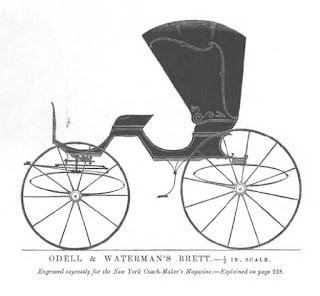


Here are some pictures of a Brett.


Monday, January 30, 2017
Conestoga Wagon
Below is a brief excerpt from Development of Transportation systems in the United States. ©1888 As some of you are aware I'm currently working on a non-fiction resource book for Historical Fiction writers revolving around the Carriage and Wagon industry of the 19th century. In my research I've found the Conestoga wagon was the foundation for the birth of the well known Prairie Schooner. There are differences between the two wagons but the Conestoga is the earlier wagon.
CONESTOGA TEAMS AND WAGONS.
The primitive condition of carts and wagons could scarcely have remained unimproved during a very protracted period in any of the numerous communities in which a blacksmith and a wheelwright were established and busily engaged in prosecuting their labors. As compared with the other colonics the early industrial development of Pennsylvania necessitated extra efforts to utilize wheeled vehicles, on account of the absence of tidewater, except along a small portion of her south-eastern boundary, and the great extent to which interior regions were traversed by mountainous systems. The presence of a large German population in interior localities where they would have been shut off from access to markets for surplus produce if roads had not been constructed and carts or wagons used, also gave an impetus to progress which had as one of its results the invention or construction of the Conestoga wagon. It was regarded for a considerable period as the highest type of a commodious freight vehicle in the country, especially for traversing hilly or mountainous roads, and was first used about 1750. One of its peculiarities was a decided curve in the bottom, analogous to that of a canoe, the object of which was to prevent freight from slipping too far to the front when wagons were going down hill, or too far to the rear when they were going up hill. By this device a gain in effective power in movements over the mountains was attained. The Conestoga wagon received that title either because the four, five, or six horses by which it was drawn were usually of the breed of heavy draft horses that had been developed in the Conestoga valley of Lancaster county, Pennsylvania, or because the wagon itself was first constructed there, or because the teams came most frequently from that locality. Although the use of Conestoga wagons gradually extended to a number of sections, the farmers of the Conestoga valley owned an exceptionally large number of them during their period of special usefulness, which was that preceding the construction of canals and railways over important interior routes of trade. Hon. John Strohm, in an article on the Conestoga horse, contributed to the United States Agricultural Report for 1803, says that "the immigration to and settling of the western states created a demand for the transportation of large quantities of dry goods and groceries to supply the wants of those engaged in opening up and settling these new countries; and many farmers in the Conestoga valley occasionally employed their teams in hauling 'store goods' from Philadelphia to Pittsburgh, the latter place being the terminus beyond which eastern teams seldom went. During the war of 1812 these noble teams rendered essential service to the country in the transportation of arms and ammunition, and supplies to the army on the frontier. Long lines of these teams were frequently seen wending their weary way to the theatre of action, and contributing greatly to the comfort of the army and the defense of the country. Their usual route of travel was from Philadelphia through Lancaster, crossing the Susquehanna at Columbia or Marietta, and thence over the mountains to Pittsburgh, and sometimes northward to lake Erie. The capacious wagons which the Conestoga farmers then had in use, and the heavy teams of large, fat, sleek horses attached thereto, were the best means of land transportation which the times and circumstances of the country then afforded. These wagons and teams attracted attention and commanded admi ration wherever they appeared; and hence the origin, as I conceive, of the horse and wagon to which the appellation of 'Conestoga' has been attached. The farmers of those days seemed fully to appreciate the importance of these teams, and evinced considerable taste and no little pride in their style of fitting them out. The harness "was constructed of the best materials, with an eye to show as well as utility. In the harness and trimmings of these teams they frequently indulged in expenses that approached to extravagance. In addition to what was indispensably necessary, articles that by some were deemed decorations were sometimes appended, and served to increase the admiration which the noble animals to which they were attached so universally attracted. It was, indeed, an' animating sight to see five or six highly-fed horses, half covered with heavy bear skins, or decorated with gaudily-fringed housings, surmounted with a set of finely-toned bells, their bridles adorned with loops of red trimming, and moving over the ground with a brisk elastic step, snorting disdainfully at surrounding objects, as if half conscious of their superior appearance, and participating in the pride that swelled the bosom of their master and driver."
CONESTOGA TEAMS AND WAGONS.
The primitive condition of carts and wagons could scarcely have remained unimproved during a very protracted period in any of the numerous communities in which a blacksmith and a wheelwright were established and busily engaged in prosecuting their labors. As compared with the other colonics the early industrial development of Pennsylvania necessitated extra efforts to utilize wheeled vehicles, on account of the absence of tidewater, except along a small portion of her south-eastern boundary, and the great extent to which interior regions were traversed by mountainous systems. The presence of a large German population in interior localities where they would have been shut off from access to markets for surplus produce if roads had not been constructed and carts or wagons used, also gave an impetus to progress which had as one of its results the invention or construction of the Conestoga wagon. It was regarded for a considerable period as the highest type of a commodious freight vehicle in the country, especially for traversing hilly or mountainous roads, and was first used about 1750. One of its peculiarities was a decided curve in the bottom, analogous to that of a canoe, the object of which was to prevent freight from slipping too far to the front when wagons were going down hill, or too far to the rear when they were going up hill. By this device a gain in effective power in movements over the mountains was attained. The Conestoga wagon received that title either because the four, five, or six horses by which it was drawn were usually of the breed of heavy draft horses that had been developed in the Conestoga valley of Lancaster county, Pennsylvania, or because the wagon itself was first constructed there, or because the teams came most frequently from that locality. Although the use of Conestoga wagons gradually extended to a number of sections, the farmers of the Conestoga valley owned an exceptionally large number of them during their period of special usefulness, which was that preceding the construction of canals and railways over important interior routes of trade. Hon. John Strohm, in an article on the Conestoga horse, contributed to the United States Agricultural Report for 1803, says that "the immigration to and settling of the western states created a demand for the transportation of large quantities of dry goods and groceries to supply the wants of those engaged in opening up and settling these new countries; and many farmers in the Conestoga valley occasionally employed their teams in hauling 'store goods' from Philadelphia to Pittsburgh, the latter place being the terminus beyond which eastern teams seldom went. During the war of 1812 these noble teams rendered essential service to the country in the transportation of arms and ammunition, and supplies to the army on the frontier. Long lines of these teams were frequently seen wending their weary way to the theatre of action, and contributing greatly to the comfort of the army and the defense of the country. Their usual route of travel was from Philadelphia through Lancaster, crossing the Susquehanna at Columbia or Marietta, and thence over the mountains to Pittsburgh, and sometimes northward to lake Erie. The capacious wagons which the Conestoga farmers then had in use, and the heavy teams of large, fat, sleek horses attached thereto, were the best means of land transportation which the times and circumstances of the country then afforded. These wagons and teams attracted attention and commanded admi ration wherever they appeared; and hence the origin, as I conceive, of the horse and wagon to which the appellation of 'Conestoga' has been attached. The farmers of those days seemed fully to appreciate the importance of these teams, and evinced considerable taste and no little pride in their style of fitting them out. The harness "was constructed of the best materials, with an eye to show as well as utility. In the harness and trimmings of these teams they frequently indulged in expenses that approached to extravagance. In addition to what was indispensably necessary, articles that by some were deemed decorations were sometimes appended, and served to increase the admiration which the noble animals to which they were attached so universally attracted. It was, indeed, an' animating sight to see five or six highly-fed horses, half covered with heavy bear skins, or decorated with gaudily-fringed housings, surmounted with a set of finely-toned bells, their bridles adorned with loops of red trimming, and moving over the ground with a brisk elastic step, snorting disdainfully at surrounding objects, as if half conscious of their superior appearance, and participating in the pride that swelled the bosom of their master and driver."
Friday, November 25, 2016
Oregon Trail Outfits
The excerpt below is from "The Journal of Travels over the Rocky Mountains" by Joel Palmer ©1847 In this book he gives a good description on the type of wagon one should take on their trip.
FOR BURTHEN WAGONS, LIGHT FOUR HORSE OR HEAVY TWO horse wagons are the size commonly used. They should be made of the best material, well seasoned, and should in all cases have falling tongues. The tire should not be less than one and three fourth inches wide, but may be advantageously used three inches; two inches, however, is the most common width. In fastening on the tire, bolts should be used instead of nails; it should be at least 5/8 or 3/4 inches thick. Hub boxes for the hubs should be about four inches. The skeins should be well steeled. The Mormon fashioned wagon bed is the best. They are usually made straight, with side boards about 16 inches wide, and a projection outward of four inches on each side, and then another side board of ten or twelve inches; in this last, set the bows for covers, which should always be double. Boxes for carrying effects should be so constructed as to correspond in height with the offset in the wagon bed, as this gives a smooth surface to sleep upon.
Ox teams are more extensively used than any others. Oxen stand the trip much better, and are not so liable to be stolen by the Indians, and are much less trouble. Cattle are generally allowed to go at large, when not hitched to the wagons; whilst horses and mules must always be staked up at night. Oxen can procure food in many places where horses cannot, and in much less time. Cattle that have been raised in Illinois or Missouri, stand the trip better than those raised in Indiana or Ohio; as they have been accustomed to eating the prairie grass, upon which they must wholly rely while on the road. Great care should be taken in selecting cattlle; they should be from four to six years old, tight and heavy made.
For those who fit out but one wagon, it is not safe to start with less than four yoke of oxen, as they are liable to get lame, have sore necks, or to stray away. One team thus fitted up may start from Missouri with twenty-five hundred pounds and as each day's rations make the load that much lighter, before they reach any rough road, their loading is much reduced. Persons should recollect that every thing in the outfit should be as light as the required strength will permit; no useless trumpery should be taken. The loading should consist of provisions and apparel, a necessary supply of cooking fixtures, a few tools, &c. No great speculation can be made in buying cattle and driving them through to sell; but as the prices of oxen and cows are much higher in Oregon than in the States, nothing is lost in having a good supply of them, which will enable the emigrant to wagon through many articles that ae difficult to be obtained in Oregon. Each family should have a few cows, as the milk can be used the entire route, and they are often convenient to put to the wagon to relieve oxen. They should be so selected that portions of them would come in fresh upon the road. Sheep can also be advantageously driven. American horses and mares always command high prices, and with careful usage can be taken through; but if used to wagons or carriages, their loading should be light. Each family should be provided with a sheet-iron stove, with boiler; a platform can easily be constructed for carrying it at the hind end of the wagon; and as it is frequently quite windy, and there is often a acarcity of wood, the stove is very convenient. Each family should also be provided with a tent, and to it should be attached good strong cords to fasten it down.
FOR BURTHEN WAGONS, LIGHT FOUR HORSE OR HEAVY TWO horse wagons are the size commonly used. They should be made of the best material, well seasoned, and should in all cases have falling tongues. The tire should not be less than one and three fourth inches wide, but may be advantageously used three inches; two inches, however, is the most common width. In fastening on the tire, bolts should be used instead of nails; it should be at least 5/8 or 3/4 inches thick. Hub boxes for the hubs should be about four inches. The skeins should be well steeled. The Mormon fashioned wagon bed is the best. They are usually made straight, with side boards about 16 inches wide, and a projection outward of four inches on each side, and then another side board of ten or twelve inches; in this last, set the bows for covers, which should always be double. Boxes for carrying effects should be so constructed as to correspond in height with the offset in the wagon bed, as this gives a smooth surface to sleep upon.
Ox teams are more extensively used than any others. Oxen stand the trip much better, and are not so liable to be stolen by the Indians, and are much less trouble. Cattle are generally allowed to go at large, when not hitched to the wagons; whilst horses and mules must always be staked up at night. Oxen can procure food in many places where horses cannot, and in much less time. Cattle that have been raised in Illinois or Missouri, stand the trip better than those raised in Indiana or Ohio; as they have been accustomed to eating the prairie grass, upon which they must wholly rely while on the road. Great care should be taken in selecting cattlle; they should be from four to six years old, tight and heavy made.
For those who fit out but one wagon, it is not safe to start with less than four yoke of oxen, as they are liable to get lame, have sore necks, or to stray away. One team thus fitted up may start from Missouri with twenty-five hundred pounds and as each day's rations make the load that much lighter, before they reach any rough road, their loading is much reduced. Persons should recollect that every thing in the outfit should be as light as the required strength will permit; no useless trumpery should be taken. The loading should consist of provisions and apparel, a necessary supply of cooking fixtures, a few tools, &c. No great speculation can be made in buying cattle and driving them through to sell; but as the prices of oxen and cows are much higher in Oregon than in the States, nothing is lost in having a good supply of them, which will enable the emigrant to wagon through many articles that ae difficult to be obtained in Oregon. Each family should have a few cows, as the milk can be used the entire route, and they are often convenient to put to the wagon to relieve oxen. They should be so selected that portions of them would come in fresh upon the road. Sheep can also be advantageously driven. American horses and mares always command high prices, and with careful usage can be taken through; but if used to wagons or carriages, their loading should be light. Each family should be provided with a sheet-iron stove, with boiler; a platform can easily be constructed for carrying it at the hind end of the wagon; and as it is frequently quite windy, and there is often a acarcity of wood, the stove is very convenient. Each family should also be provided with a tent, and to it should be attached good strong cords to fasten it down.
Friday, August 21, 2015
Ambulance Tidbits
Below is a report from a Harford, CT. Report based on 1899. I find these tidbits helpful in a couple of ways. One, is the mileage the ambulance travels, the amount of calls it went out on in one year and the costs. Anyway, see what you might use to spark research for your own writing.
HARTFORD, Conn., March 5, 1900. To the Honorable Court of Common Council:
The Board of Police Commissioners of the City of Hartford would respectfully call your attention to the disadvantages under which they are operating the ambulance service, and to the great burden, and to the obstruction of other work in the department such as a Police department is ordinarily organized for.
To make it more evident to you what amount of service is performed for ambulance calls alone, we have requested the Chief of Police to tabulate the number of box calls, telephone calls, and ambulance calls; also the number of miles traveled by the patrol wagon, number of miles by the Black Maria, and the number of miles by the ambulance. All of these are for the past two years, each tabulated separately. Such information is submitted herewith.
In the year ending March 31, 1899, the number of ambulance calls were 561, and the miles traveled by the ambulance were 1683, as against 1799 patrol wagon calls and 1148 miles traveled by patrol wagon.
The appropriations for Ambulance service, during the past year was $1500.
In order to eflect this service properly, the drivers of the department are obliged not only to be subject to the calls for the patrol wagon, but also for service on the Black Maria, and to be subject to immediate call for ambulance service. We have, as you are aware, only two drivers, one for day duty and one for night duty.' During the past year, these two drivers have been obliged to respond to a total of 2468 calls, of which 544 were for ambulance service, or twenty per cent. of the total number of calls.
In order to effect this service, we have been obliged to traverse 4671 miles, of which 1635 were by the ambulance, or more than thirty per cent; and the number of miles traversed for ambulance service were 1635 as against 1192 for patrol wagon service. And to efl'ect this service we have only two pairs of horses.
In responding to ambulance calls we use only one 'horse, which is obliged to draw a heavy ambulance and in addition to the service on the patrol wagon and Black Maria, with the pair. This service wears out the horses exceedingly fast, and prevents them from being in good condition to make swift trips with the patrol wagon, which is very desirable. We would ask your comparison of this work, by two pairs of horses. both as to number of miles and number of calls, with any two pairs of horses now in use by the Fire Department. One pair of horses is in such condition now that they will not be adequate for our service for more than a month or so longer, at the utmost.
The annual allowance given to us is 81500. As against this, we would call your attention to the fact that we are constantly employing two men at a salary of $1001). each to maintain this service. Our repairs, and the services of ambulance surgeons, amount to 8252. Also, should be taken into consideration : wear and tear of horses; horse shoeing made necessary by this extra service; fodder; straw; harness and frequent renewals thereof, blankets and their cleaning and renewals; and many other items which, though they enter into our expenses as a department, are not adequately provided for in the appropriation.
In additiOn to this, the drivers are practically obliged to take care of their own horses; and immediately on return from a call, and before the horses are put into condition, they are almost inevitably called out again for other services.
In no other city, as far as we can discover, is the ambulance maintained by the Police Department. It is always a subject of care by the hospitals, by whom it is maintained either by voluntary contributions or by an appropriation from the municipal government, or, in a few cases, maintained by the Charities Departments.
We have conferred with the authorities at the Hartford Hospital, and they seem willing to assume (although they have not positively stated that they will do so) the care and maintenance of the ambulance, provided a reasonable appropriation is made for the same by the City government. But they state that such service cannot be maintained for less than 82500. a year. '
The feed bills, harness bills, horse shoeing bills, and other bills for repairs, have been largely increased by services rendered in the ambulance department; and we have found it very difficult to keep wllhin our appropriation, and especially this year when we were obliged to make many additional improvements in the Police Station, taken out of our regular appropriation for police service.
We respectfully represent that this service is: First, unusual. Second, that it is very onerous and burdensome. Third, that it over-works the drivers. Fourth, that it over-works the horses. Fifth, that it incurs an expense which cannot be made apparent to the Ways and Means committee in making their estimates for our general appropriation.
The calls made by this service are from the hospitals, from the railroads, from individuals, and from calls by the police themselves. In fact the ambulance seems to be subject tO‘the service of everyone who may choose to call upon it.
Our force is at present not adequate to cover the territory which we are obliged to patrol. It leaves us with only one officer in the station besides the Chief and a driver.
The oflice man is frequently called away on this ambulance duty, and when the driver is out with the patrol wagon it leaves the station in charge of the Chief without a single extra man, who is subject to outside calls in cases of emergency.
We, therefore, respectfully request that you consider our petition to withdraw from us the ambulance service, and place it in charge of either the Hartford Hospital or the Charities Department. It is understood, however, that if the Hartford Hospital assumes this service that they are willing to answer allc alls from St. Francis’ Hospital, from the Charities Department, from the Alms House, and for any general service, and also furnish the ambulance surgeons. .
Respectfully submitted,
HARTFORD, Conn., March 5, 1900. To the Honorable Court of Common Council:
The Board of Police Commissioners of the City of Hartford would respectfully call your attention to the disadvantages under which they are operating the ambulance service, and to the great burden, and to the obstruction of other work in the department such as a Police department is ordinarily organized for.
To make it more evident to you what amount of service is performed for ambulance calls alone, we have requested the Chief of Police to tabulate the number of box calls, telephone calls, and ambulance calls; also the number of miles traveled by the patrol wagon, number of miles by the Black Maria, and the number of miles by the ambulance. All of these are for the past two years, each tabulated separately. Such information is submitted herewith.
In the year ending March 31, 1899, the number of ambulance calls were 561, and the miles traveled by the ambulance were 1683, as against 1799 patrol wagon calls and 1148 miles traveled by patrol wagon.
The appropriations for Ambulance service, during the past year was $1500.
In order to eflect this service properly, the drivers of the department are obliged not only to be subject to the calls for the patrol wagon, but also for service on the Black Maria, and to be subject to immediate call for ambulance service. We have, as you are aware, only two drivers, one for day duty and one for night duty.' During the past year, these two drivers have been obliged to respond to a total of 2468 calls, of which 544 were for ambulance service, or twenty per cent. of the total number of calls.
In order to effect this service, we have been obliged to traverse 4671 miles, of which 1635 were by the ambulance, or more than thirty per cent; and the number of miles traversed for ambulance service were 1635 as against 1192 for patrol wagon service. And to efl'ect this service we have only two pairs of horses.
In responding to ambulance calls we use only one 'horse, which is obliged to draw a heavy ambulance and in addition to the service on the patrol wagon and Black Maria, with the pair. This service wears out the horses exceedingly fast, and prevents them from being in good condition to make swift trips with the patrol wagon, which is very desirable. We would ask your comparison of this work, by two pairs of horses. both as to number of miles and number of calls, with any two pairs of horses now in use by the Fire Department. One pair of horses is in such condition now that they will not be adequate for our service for more than a month or so longer, at the utmost.
The annual allowance given to us is 81500. As against this, we would call your attention to the fact that we are constantly employing two men at a salary of $1001). each to maintain this service. Our repairs, and the services of ambulance surgeons, amount to 8252. Also, should be taken into consideration : wear and tear of horses; horse shoeing made necessary by this extra service; fodder; straw; harness and frequent renewals thereof, blankets and their cleaning and renewals; and many other items which, though they enter into our expenses as a department, are not adequately provided for in the appropriation.
In additiOn to this, the drivers are practically obliged to take care of their own horses; and immediately on return from a call, and before the horses are put into condition, they are almost inevitably called out again for other services.
In no other city, as far as we can discover, is the ambulance maintained by the Police Department. It is always a subject of care by the hospitals, by whom it is maintained either by voluntary contributions or by an appropriation from the municipal government, or, in a few cases, maintained by the Charities Departments.
We have conferred with the authorities at the Hartford Hospital, and they seem willing to assume (although they have not positively stated that they will do so) the care and maintenance of the ambulance, provided a reasonable appropriation is made for the same by the City government. But they state that such service cannot be maintained for less than 82500. a year. '
The feed bills, harness bills, horse shoeing bills, and other bills for repairs, have been largely increased by services rendered in the ambulance department; and we have found it very difficult to keep wllhin our appropriation, and especially this year when we were obliged to make many additional improvements in the Police Station, taken out of our regular appropriation for police service.
We respectfully represent that this service is: First, unusual. Second, that it is very onerous and burdensome. Third, that it over-works the drivers. Fourth, that it over-works the horses. Fifth, that it incurs an expense which cannot be made apparent to the Ways and Means committee in making their estimates for our general appropriation.
The calls made by this service are from the hospitals, from the railroads, from individuals, and from calls by the police themselves. In fact the ambulance seems to be subject tO‘the service of everyone who may choose to call upon it.
Our force is at present not adequate to cover the territory which we are obliged to patrol. It leaves us with only one officer in the station besides the Chief and a driver.
The oflice man is frequently called away on this ambulance duty, and when the driver is out with the patrol wagon it leaves the station in charge of the Chief without a single extra man, who is subject to outside calls in cases of emergency.
We, therefore, respectfully request that you consider our petition to withdraw from us the ambulance service, and place it in charge of either the Hartford Hospital or the Charities Department. It is understood, however, that if the Hartford Hospital assumes this service that they are willing to answer allc alls from St. Francis’ Hospital, from the Charities Department, from the Alms House, and for any general service, and also furnish the ambulance surgeons. .
Respectfully submitted,
Thursday, April 9, 2015
Axle Grease
Here's some practical information regarding axle grease. It's something most of us don't need to use today but very important for our 19th Century characters. Below the most recent tidbit you'll find a link to a previous post on Axle Grease for Wagons.
Axle-grease for very heavy wagons. No. 1, for winter: Tallow, 420 parts; palm oil, 840; soda, 140; water, 4200.
No. 2, for summer: Tallow, 420 parts; palm oil, 490; soda, 35; water, 2300.
The above lubricants are calculated for a low temperature in winter and a hot one in summer. For a moderate winter climate, the quantity of soda may be somewhat reduced, and that of palm oil increased.
Axle grease for heavy wagons. Palm oil, 210 parts; tallow, 85; soda lye, 65; water, 920.
Melt the palm oil and tallow together, and after making the mixture homogeneous by stirring, add the soda lye. The latter is prepared by dissolving soda in sufficient hot water for the cooled fluid to show 20° or 21° Be. After adding and stirring in the soda lye, the water is added, and the whole stirred to a homogeneous mass, which is ladled into vessels and allowed to congeal.
Grease for wooden machinery. Tallow, 30 parts; palm oil, 20; train oil, 10; graphite, 20.
After melting the fats at a moderate heat, intimately mix the graphite, previously pulverized and elutriated, with the mass by stirring.
Source: A Practical Treatise on animal and vegetable fats and oils ©1896
Here's the link to the previous post. Axle Grease For Your Wagon or Carriage
Axle-grease for very heavy wagons. No. 1, for winter: Tallow, 420 parts; palm oil, 840; soda, 140; water, 4200.
No. 2, for summer: Tallow, 420 parts; palm oil, 490; soda, 35; water, 2300.
The above lubricants are calculated for a low temperature in winter and a hot one in summer. For a moderate winter climate, the quantity of soda may be somewhat reduced, and that of palm oil increased.
Axle grease for heavy wagons. Palm oil, 210 parts; tallow, 85; soda lye, 65; water, 920.
Melt the palm oil and tallow together, and after making the mixture homogeneous by stirring, add the soda lye. The latter is prepared by dissolving soda in sufficient hot water for the cooled fluid to show 20° or 21° Be. After adding and stirring in the soda lye, the water is added, and the whole stirred to a homogeneous mass, which is ladled into vessels and allowed to congeal.
Grease for wooden machinery. Tallow, 30 parts; palm oil, 20; train oil, 10; graphite, 20.
After melting the fats at a moderate heat, intimately mix the graphite, previously pulverized and elutriated, with the mass by stirring.
Source: A Practical Treatise on animal and vegetable fats and oils ©1896
Here's the link to the previous post. Axle Grease For Your Wagon or Carriage
Friday, January 9, 2015
Sulky A type of Carriage
Below is a page from my 19th Century Carriages & Wagons Resource Guide for Writers Book. If you're interested in purchasing the book click the title for a link.
SULKY
DESCRIPTION: A light two-wheeled carriage for a single person, drawn by one horse, used as a pleasure-carriage and for trials of speed between trotting-horses.
Defined by The Imperial Dictionary ©1883
Wooden wheels with iron rims built wide to travel over most roads in the earlier days. Built on elipticle springs. When racing became the primary use for the sulky then it had thinner wheels.
NUMBER OF PASSENGERS: 1
YEARS BUILT AND/OR IN SERVICE: This has been hard to tie down.
Online entomology dictionary has 1756
They aren't listed in the tax roles I found for 1800. But I did find them in the tax 1813 tax laws for PA.
The racing sulky industry reports they were first built in the mid-1800's.
What this means is they were probably in Europe before the United States and we know they were here before 1820 because they were taxed.
LOCATION & ORIGIN OF DESIGN: America
PRINCIPLE REGION(S) OF USE: Country and City
POWERED BY: 1 horse or colt.
Today they also use dogs for racing sulkies.
WHERE DRIVER & PASSENGERS SAT: On the single seat
COSTS: 1834 cost $70-$80
ADDITIONAL INFORMATION
An old saying:
A bachelor is a person who enjoys everything and pays for nothing; a married man is one that pays for everything and enjoys nothing. The one drives a sulky through life, and is not expected to take care of any one but himself: the other keeps a carriage, which is always too full to afford him a comfortable spot. Be cautious then how you exchange your sulky for a carriage.
Etiquette for Gentlemen ©1847
HOW TO HITCH A HORSE IN A SULKY
Lead him to and around it; let him look at it, touch it with his nose, and stand by it till he does not care for it; then pull the shafts a little to the left, and stand your horse in front of the off wheel. Let some one stand on the right side of the horse, and hold him by the bit, while you stand on the left side, facing the sulky. This will keep him straight. Run your left hand back, and let it rest on his hip, and lay hold of the shafts with your right, bringing them up very gently to the left hand, which still remains stationary. Do not let anything but your arm touch his back, and as soon as you have the shafts square over him, let the person on the opposite side take hold of one of them, and lower them very gently to the shaft-bearers. Be very slow and deliberate about hitching; the longer time you take the better, as a general thing. When you have the shafts placed, shake them slightly, so that he will feel them against each side. As soon as he will bear them without scaring, fasten your braces, etc, and start him along very slowly. Let one man lead the horse, to keep him gentle, while the other gradually works back with the lines till he can get behind and drive him. After you have driven him in this way a short distance, you can get into the sulky, and all will go right. It is very important to have your horse go gently when you first hitch him. After you have walked him awhile, there is not half so much danger of his scaling. Men do very wrong to jump up behind a horse to drive him as soon as they have him hitched. There are too many things for him to comprehend all at once. The shafts, the lines, the harness, and the rattling of the Bulky, all tend to scare him, and he must be made familiar with them by degrees. If your horse is very wild, I would advise you to put up one foot the first time you drive him.
The Modern art of taming Horses ©1858


SULKY
DESCRIPTION: A light two-wheeled carriage for a single person, drawn by one horse, used as a pleasure-carriage and for trials of speed between trotting-horses.
Defined by The Imperial Dictionary ©1883
Wooden wheels with iron rims built wide to travel over most roads in the earlier days. Built on elipticle springs. When racing became the primary use for the sulky then it had thinner wheels.
NUMBER OF PASSENGERS: 1
YEARS BUILT AND/OR IN SERVICE: This has been hard to tie down.
Online entomology dictionary has 1756
They aren't listed in the tax roles I found for 1800. But I did find them in the tax 1813 tax laws for PA.
The racing sulky industry reports they were first built in the mid-1800's.
What this means is they were probably in Europe before the United States and we know they were here before 1820 because they were taxed.
LOCATION & ORIGIN OF DESIGN: America
PRINCIPLE REGION(S) OF USE: Country and City
POWERED BY: 1 horse or colt.
Today they also use dogs for racing sulkies.
WHERE DRIVER & PASSENGERS SAT: On the single seat
COSTS: 1834 cost $70-$80
ADDITIONAL INFORMATION
An old saying:
A bachelor is a person who enjoys everything and pays for nothing; a married man is one that pays for everything and enjoys nothing. The one drives a sulky through life, and is not expected to take care of any one but himself: the other keeps a carriage, which is always too full to afford him a comfortable spot. Be cautious then how you exchange your sulky for a carriage.
Etiquette for Gentlemen ©1847
HOW TO HITCH A HORSE IN A SULKY
Lead him to and around it; let him look at it, touch it with his nose, and stand by it till he does not care for it; then pull the shafts a little to the left, and stand your horse in front of the off wheel. Let some one stand on the right side of the horse, and hold him by the bit, while you stand on the left side, facing the sulky. This will keep him straight. Run your left hand back, and let it rest on his hip, and lay hold of the shafts with your right, bringing them up very gently to the left hand, which still remains stationary. Do not let anything but your arm touch his back, and as soon as you have the shafts square over him, let the person on the opposite side take hold of one of them, and lower them very gently to the shaft-bearers. Be very slow and deliberate about hitching; the longer time you take the better, as a general thing. When you have the shafts placed, shake them slightly, so that he will feel them against each side. As soon as he will bear them without scaring, fasten your braces, etc, and start him along very slowly. Let one man lead the horse, to keep him gentle, while the other gradually works back with the lines till he can get behind and drive him. After you have driven him in this way a short distance, you can get into the sulky, and all will go right. It is very important to have your horse go gently when you first hitch him. After you have walked him awhile, there is not half so much danger of his scaling. Men do very wrong to jump up behind a horse to drive him as soon as they have him hitched. There are too many things for him to comprehend all at once. The shafts, the lines, the harness, and the rattling of the Bulky, all tend to scare him, and he must be made familiar with them by degrees. If your horse is very wild, I would advise you to put up one foot the first time you drive him.
The Modern art of taming Horses ©1858


Subscribe to:
Posts (Atom)