
Showing posts with label transportation. Show all posts
Showing posts with label transportation. Show all posts
Wednesday, September 6, 2017
Crescent Bicycles
Last week I posted 5 ads for different types of bicycles. Below is a copy of an advertisement for Crescent Bicycles the prices reflect the costs of 1895. Note that I also saw a Monarch Bicycle ad reflecting higher costs of $85 to $100.


Friday, September 1, 2017
1853 Fares
I stumbled on this while working on my 19th Century Carriages & Wagons Resource Book. Below is a list of fares published in Disturnell's American & European Railroad & Steamship Guide ©1853.
FOR ONE PERSON, FROM THE HOTELS, TO THE RAILBOAD DEPOTS, AND STEAMBOAT WHARVES.
BOSTON.
Coach fare, with baggage, 25 cents
NEW YORK.
Coach and Cab fare, with baggage, 25 cents
Carman's fees, 25 cents
Porter's fees, 18 ½ cents
PHILADELPHIA.
Coach fare,* with baggage, 50 cents
Porter's fees, 25 cents
BALTIMORE.
Coach fare, with baggage 50 cents
Porter's fees, 25 cents
WASHINGTON.
Coach fare, with baggage. . . 25 cents
(CT For further information, see the laws relating to Hackney Coaches, &c., which can usually be found in the carriages, as required by law.
* The law allows 50 cents for one or two passengers.
N. B. The best mode to reduce the coach fare in Philadelphia and Baltimore, where it is too high, is not to employ them at present rates.
FOR ONE PERSON, FROM THE HOTELS, TO THE RAILBOAD DEPOTS, AND STEAMBOAT WHARVES.
BOSTON.
Coach fare, with baggage, 25 cents
NEW YORK.
Coach and Cab fare, with baggage, 25 cents
Carman's fees, 25 cents
Porter's fees, 18 ½ cents
PHILADELPHIA.
Coach fare,* with baggage, 50 cents
Porter's fees, 25 cents
BALTIMORE.
Coach fare, with baggage 50 cents
Porter's fees, 25 cents
WASHINGTON.
Coach fare, with baggage. . . 25 cents
(CT For further information, see the laws relating to Hackney Coaches, &c., which can usually be found in the carriages, as required by law.
* The law allows 50 cents for one or two passengers.
N. B. The best mode to reduce the coach fare in Philadelphia and Baltimore, where it is too high, is not to employ them at present rates.
Wednesday, August 30, 2017
Bicycles
We are all aware but I admit I haven't seen too many bicycles in fiction. Below are some examples of bicycles being advertised in The Ladies' Home Journal ©June 1894. All of the ads below were found on a single page in the magazine. Take a look at the Hickory Bicycle ad, the wheels were made of wood, which after a moment of thought on the matter, made sense since wagon wheels were also made of wood. Enjoy!


Friday, August 18, 2017
Chair & Chaise Carriages
Do you know the difference between a Chair and a Chaise? I'm not talking furniture, I'm talking about carriages & wagons. Well, the truth is I'm still working on the differences between the two but I have come up with a few distinctions, although the terms were often used interchangeably. Chaise is the French word for chair and some speculate that the first chair wagons were simple a chair placed on a platform with an axle and a couple of wagon wheels.
Chairs tend to be lower to the ground than a chaise. A chaise tends to have a top. A Chair is ofte for only one person. A Chaise is often made for two.
There are a variety of Chairs and Chaises throughout the 19th century. The Windsor Chair is still in my researching mode. I've run across the term but excluding all the furniture pieces has made the search for a carriage known as a Windsor Chair very difficult. I found a post from the Sun Inn in Bethlehem, PA speaking of the arrival of "August 12—A gentleman in a Windsor chair."
Of course we can add to this mix Gigs, Shays and Sulkies but that will be for another day's discussion.
Chairs tend to be lower to the ground than a chaise. A chaise tends to have a top. A Chair is ofte for only one person. A Chaise is often made for two.
There are a variety of Chairs and Chaises throughout the 19th century. The Windsor Chair is still in my researching mode. I've run across the term but excluding all the furniture pieces has made the search for a carriage known as a Windsor Chair very difficult. I found a post from the Sun Inn in Bethlehem, PA speaking of the arrival of "August 12—A gentleman in a Windsor chair."
Of course we can add to this mix Gigs, Shays and Sulkies but that will be for another day's discussion.
Wednesday, August 16, 2017
Different Buggy Topper
Below is a advertisement I found in the Hub magazine ©1895. I found it very different from other hoods for buggies. It basically looks like an umbrella. This is not the normal hood for a buggy, in all my research of Carriages & Wagons for the 19th century, I believe this is the first time I've run across such a design. I don't know how much they sold for, nor do I know how popular they became, if at all. But they would make quite the conversation piece if one strolled into town, I would have a lot of fun with this in a novel setting.


Wednesday, June 28, 2017
American Buggy
Today's post includes a quote from 1795-1895 One Hundred Years of Commerence ©1895 as well as 4 images from the 1859-1860 New York Carriage Makers Magazine. There are many different styles of buggies so I've selected only four to give you some variety.
To sum up the American Buggy in terms of the 19th century:
"The buggy is purely American in its origin, and is without doubt the greatest achievement of American carriage-makers. The body may be of any form, but the running part is always of the same, or nearly the same, type. Its common-sense construction is wholly unlike the work of any other country. It is simpler, lighter, stronger, and cheaper than any other style of vehicle, and is so admirable in all respects that it is not likely to go out of use for at least another century."
Below are a two sketches of the American Buggy.

 This is probably the most common shape of the American Buggy, as I've scene so far from my research.
 This design is larger than other's I've found as well. There is a smaller buggy for one person used for hunting as well.

To sum up the American Buggy in terms of the 19th century:
"The buggy is purely American in its origin, and is without doubt the greatest achievement of American carriage-makers. The body may be of any form, but the running part is always of the same, or nearly the same, type. Its common-sense construction is wholly unlike the work of any other country. It is simpler, lighter, stronger, and cheaper than any other style of vehicle, and is so admirable in all respects that it is not likely to go out of use for at least another century."
Below are a two sketches of the American Buggy.


Tuesday, June 27, 2017
1871 Cruises to Florida
Charleston S.C. was a busy port and in 1871 there were many ships headed to Florida from Charleston. Below is an ad from The Charleston Daily News July 17, 1871. What I find interesting from this ad is it lists when you depart and when you would return give us a great example of the time involved in steam travel on the lower east coast.


Tuesday, June 13, 2017
1877 Railroad Strike
For a good overview of the strike, I recommend starting with Wikipedia.
Another source would be History of the United States from the Compromise of 1850: 1877-1896 by James Ford Rhodes.
The strike was fueled by several things, one the decrease of the wages being paid to the employees and the 1873 depression. It probably became as violent as it was because of Taft and how he won the election. But all of that is speculating, which our characters might do in conversation. If you choose to use the strike in your novel be sure of the dates and the time it entered your area.
Another source would be History of the United States from the Compromise of 1850: 1877-1896 by James Ford Rhodes.
The strike was fueled by several things, one the decrease of the wages being paid to the employees and the 1873 depression. It probably became as violent as it was because of Taft and how he won the election. But all of that is speculating, which our characters might do in conversation. If you choose to use the strike in your novel be sure of the dates and the time it entered your area.
Monday, June 5, 2017
Railroad Overview
The railroads played an important part in the expansion and history of the 19th century. Today's tidbit I'm sharing a link to a book that was printed in 1901 but is a cyclopedia of all kinds of terms used when referring to the railroads. As a writer, this is a helpful tool to keep in your pile of reference books imho.
A Railroad Pocket Book
A Railroad Pocket Book
Friday, April 28, 2017
Hot Air Balloons
I've mentioned hot air balloons before on this blog but today I'm sharing the beginning of an excerpt that came out in 1822. The reason I'm posting this blog because of the science involved and the date of this publication. The 19th century is filled with science, which was built upon in the next century. The source of this excerpt is Elements of science and art: being a familiar introduction to...Vol. 1 pg 162. You can finish reading the excerpt here.
OF AIR BALLOONS.
The air-balloon is a machine, consisting of a bag i filled with air, so light, that it, together with the bag, forms a mass which is specifically lighter than the common air of the atmosphere. A cubic foot of common air is found to weigh above 554> grains, and to be expanded by every degree of heat marked on Fahrenheit's thermometers, about l-50th part of the whole. By heating a quantity of air, therefore, to 200 degrees Fahr., you will just double its bulk, when the thermometer stands at 54 in the open air, and in the same proportion you will diminish its weight; and if such a quantity of this hot air be inclosed in a bag, that the excess of the weight of an equal bulk of common air, weighs more than the bag with the air contained in it, both the bag and the air will rise into the atmosphere, and continue to do so till they arrive at a place where the external air is naturally so much rarefied, that the weight becomes equal, and here the whole will float.
The power by which hot air is impelled upwards, may be shown by the following experiment. RolL up a sheet of paper in a conical form, and by thrusting a pin into it near the apex, prevent it from ur rolling. Fasten it then by its apex, under one of the scales of a balance, by means of a thread; and having properly counterpoised it by weights put into the opposite scale, apply the flame of a candle underneath, and you will instantly see the cone rise; and it will not be brought into equilibrium with the other, but by a much greater weight than those who have never seen the experiment would believe.
If the magnitude of a balloon be increased, its power of ascension, or the difference between the weight of the included air and an equal bulk of common air, will be augmented in the same proportion. For its thickness being supposed the same, it is as the surface it covers, or only as the square of the diameter. This is the reason why balloons cannot be made to ascend, if under a given magnitude, when composed of cloth, or materials of the same thickness.
OF AIR BALLOONS.
The air-balloon is a machine, consisting of a bag i filled with air, so light, that it, together with the bag, forms a mass which is specifically lighter than the common air of the atmosphere. A cubic foot of common air is found to weigh above 554> grains, and to be expanded by every degree of heat marked on Fahrenheit's thermometers, about l-50th part of the whole. By heating a quantity of air, therefore, to 200 degrees Fahr., you will just double its bulk, when the thermometer stands at 54 in the open air, and in the same proportion you will diminish its weight; and if such a quantity of this hot air be inclosed in a bag, that the excess of the weight of an equal bulk of common air, weighs more than the bag with the air contained in it, both the bag and the air will rise into the atmosphere, and continue to do so till they arrive at a place where the external air is naturally so much rarefied, that the weight becomes equal, and here the whole will float.
The power by which hot air is impelled upwards, may be shown by the following experiment. RolL up a sheet of paper in a conical form, and by thrusting a pin into it near the apex, prevent it from ur rolling. Fasten it then by its apex, under one of the scales of a balance, by means of a thread; and having properly counterpoised it by weights put into the opposite scale, apply the flame of a candle underneath, and you will instantly see the cone rise; and it will not be brought into equilibrium with the other, but by a much greater weight than those who have never seen the experiment would believe.
If the magnitude of a balloon be increased, its power of ascension, or the difference between the weight of the included air and an equal bulk of common air, will be augmented in the same proportion. For its thickness being supposed the same, it is as the surface it covers, or only as the square of the diameter. This is the reason why balloons cannot be made to ascend, if under a given magnitude, when composed of cloth, or materials of the same thickness.
Monday, April 17, 2017
Sinking John L. Avery
Disasters add conflict to a story and conflict is necessary to keep your reader turning the pages. Below is a real life account of the Sinking of the John L. Avery. The account gives the basics about the situation but there are gems in this account for me to learn from with regard to 'writing" and 'creating" a disaster for my characters. Such as, how many people were affected, the actual physical descriptions of the boat and the process of sinking. How the captain reacted, the passengers, etc. Enjoy.
The J. L. Avery, J. L. Robertson commander, was a new boat, built in the most substantial manner, and furnished with every necessary equipment for a first class passenger boat, being designed as a regular packet between New Orleans and Natchex. She left New Orleans, on her customary trip up the river, on March 7th, 1854. She stopped at Point Coupee and took in a large quantity of sugar and molasses; and on the 9th of the same month she passed the steamer Sultana, off Black Hawk point, forty miles below Natchez; and having left the Sultana, (with which she appears to have been racing,) about a mile astern, she struck what was supposed to be a tree washed from the shore by a recent freshet. A very large leak in the bottom of the boat was the consequence of this accident, and although the pilot immediately steered for the shore, the steamer sunk before she could get near enough to land the passengers. Mr. J. Y. Guthrie, an engineer, and the carpenter, were standing just forward of the boilers when they heard the crash—the boat at the same time making a sudden surge to one side. The carpenter immediately lifted the scuttle-hatch and leaped into the hold, but finding the water pouring in too fast to admit of any attempt at repairing the damage, he made haste to get out again, at the same time giving notice to the engineer that the boat had nagged. Mr. Guthrie, perceiving that the boat was going down, hastened to the engine, but before he got there, he was up to his knees in water. The cabin passengers were hurried up to the hurricane-deck. Soon after, the boat righted, and the hull separated from the cabin and sunk in sixty feet of water.
As the hull parted from the upper works, the surging of the waters caused the cabin floor to rise up against the hurricane roof, and six persons who remained in the cabin were dragged out through the skylights by Capt. Robertson and his two clerks. Mrs. Parmin, one of the six passengers rescued from that perilous situation, had her eldest child in her arms at the time, and was with difficulty prevented from plunging in again, as her babe was left asleep on the bed. But the situation of the deck passengers was the most calamitous; there was a large number of them crowded in their allotted place, where they were walled in by hogsheads of sugar, which would have prevented their escape, if escape had been otherwise possible. These unfortunate people were nearly all drowned.
There were many Irish emigrants on board, whose names were unregistered, and there is a great deal of uncertainty respecting the number of those who perished. Eye-witnesses testify that a large number of men, women and children could be seen drowning at one time. Of the twenty firemen on board, twelve were drowned. The second mate and another person launched the life-boat, but it was almost itnmedidiately upset, probably by the eager and ill-directed efforts of tho drowning people to get into it. The steamer Sultana, with which the Avery had been racing, promptly camo to the rescuo of the drowning crew and passengers, and was the means of saving some of them; but the number lost is believed to be at least eighty or ninety.
Mrs. Seymour, one of the cabin passengers who escaped, relates the following incidents of the wreck: party accounted for by stating that some unusual means had been used to get up extra steam, as the officers of the Avery were resolved to outrun the rival steamer, Sultana. Mrs. Seymour had retired to her state room for an afternoon nap, from which she was aroused by the concussion when the boat struck; and soon after, she found herself in the water. She was drawn up into the floating cabin by one of the waiters, named John Anderson, who, as Mrs. Seymour testifies, was instrumental in saving the lives of several other passengers. She states that her pocket-book, containing nine hundred dollars, which had been placed under her pillow, was lost. She also lost a manuscript which she was preparing for the press, and which she valued still more highly than her pocket-book.
Mrs. Seymour continues :—I cast my eyes upon the water, which was covered with fragments of the cabin. To these frail supports human hands were clinging, while many human voices were crying, "Save me ! oh, save me!" The water at first was dotted with human heads, sinking and rising, and then sinking to rise no more. A sudden splash drew my attention to the side of the boat, and I saw that a young lady, who had been drawn from the inundated cabin through the sky-light and placed in safety on the floating deck, in the delirium of the moment had plunged again into the water, from which she never again emerged. Several others followed her example, but appearing again on the surface, they were rescued by the waiter Anderson and two or three others of the boat's crew, who never slackened in their efforts to save human life. Two or three gentlemen leaped into the water and swam to land. A fine Texan poney, belonging to Mrs. Emerson, escaped from the deck, and endeavored to save himself by swimming. He reached the shore, but not being able to climb the bank, he fell back into the water and was drowned. In a faint but earnest tone, I heard a female voice say, " Oh, William, do save her!" On directing my gaze to the place from whence the voice came, I saw a woman sinking in the river. At the same time a child's voice exclaimed, "Oh, mother, he cannot save me!" I saw her fair hair, all wet, fall back from her young face as her little arms loosened their grasp on the neck of her brother, and the mother and her two children sank together.
Source: Fifty Years on the Mississippi ©1889
The J. L. Avery, J. L. Robertson commander, was a new boat, built in the most substantial manner, and furnished with every necessary equipment for a first class passenger boat, being designed as a regular packet between New Orleans and Natchex. She left New Orleans, on her customary trip up the river, on March 7th, 1854. She stopped at Point Coupee and took in a large quantity of sugar and molasses; and on the 9th of the same month she passed the steamer Sultana, off Black Hawk point, forty miles below Natchez; and having left the Sultana, (with which she appears to have been racing,) about a mile astern, she struck what was supposed to be a tree washed from the shore by a recent freshet. A very large leak in the bottom of the boat was the consequence of this accident, and although the pilot immediately steered for the shore, the steamer sunk before she could get near enough to land the passengers. Mr. J. Y. Guthrie, an engineer, and the carpenter, were standing just forward of the boilers when they heard the crash—the boat at the same time making a sudden surge to one side. The carpenter immediately lifted the scuttle-hatch and leaped into the hold, but finding the water pouring in too fast to admit of any attempt at repairing the damage, he made haste to get out again, at the same time giving notice to the engineer that the boat had nagged. Mr. Guthrie, perceiving that the boat was going down, hastened to the engine, but before he got there, he was up to his knees in water. The cabin passengers were hurried up to the hurricane-deck. Soon after, the boat righted, and the hull separated from the cabin and sunk in sixty feet of water.
As the hull parted from the upper works, the surging of the waters caused the cabin floor to rise up against the hurricane roof, and six persons who remained in the cabin were dragged out through the skylights by Capt. Robertson and his two clerks. Mrs. Parmin, one of the six passengers rescued from that perilous situation, had her eldest child in her arms at the time, and was with difficulty prevented from plunging in again, as her babe was left asleep on the bed. But the situation of the deck passengers was the most calamitous; there was a large number of them crowded in their allotted place, where they were walled in by hogsheads of sugar, which would have prevented their escape, if escape had been otherwise possible. These unfortunate people were nearly all drowned.
There were many Irish emigrants on board, whose names were unregistered, and there is a great deal of uncertainty respecting the number of those who perished. Eye-witnesses testify that a large number of men, women and children could be seen drowning at one time. Of the twenty firemen on board, twelve were drowned. The second mate and another person launched the life-boat, but it was almost itnmedidiately upset, probably by the eager and ill-directed efforts of tho drowning people to get into it. The steamer Sultana, with which the Avery had been racing, promptly camo to the rescuo of the drowning crew and passengers, and was the means of saving some of them; but the number lost is believed to be at least eighty or ninety.
Mrs. Seymour, one of the cabin passengers who escaped, relates the following incidents of the wreck: party accounted for by stating that some unusual means had been used to get up extra steam, as the officers of the Avery were resolved to outrun the rival steamer, Sultana. Mrs. Seymour had retired to her state room for an afternoon nap, from which she was aroused by the concussion when the boat struck; and soon after, she found herself in the water. She was drawn up into the floating cabin by one of the waiters, named John Anderson, who, as Mrs. Seymour testifies, was instrumental in saving the lives of several other passengers. She states that her pocket-book, containing nine hundred dollars, which had been placed under her pillow, was lost. She also lost a manuscript which she was preparing for the press, and which she valued still more highly than her pocket-book.
Mrs. Seymour continues :—I cast my eyes upon the water, which was covered with fragments of the cabin. To these frail supports human hands were clinging, while many human voices were crying, "Save me ! oh, save me!" The water at first was dotted with human heads, sinking and rising, and then sinking to rise no more. A sudden splash drew my attention to the side of the boat, and I saw that a young lady, who had been drawn from the inundated cabin through the sky-light and placed in safety on the floating deck, in the delirium of the moment had plunged again into the water, from which she never again emerged. Several others followed her example, but appearing again on the surface, they were rescued by the waiter Anderson and two or three others of the boat's crew, who never slackened in their efforts to save human life. Two or three gentlemen leaped into the water and swam to land. A fine Texan poney, belonging to Mrs. Emerson, escaped from the deck, and endeavored to save himself by swimming. He reached the shore, but not being able to climb the bank, he fell back into the water and was drowned. In a faint but earnest tone, I heard a female voice say, " Oh, William, do save her!" On directing my gaze to the place from whence the voice came, I saw a woman sinking in the river. At the same time a child's voice exclaimed, "Oh, mother, he cannot save me!" I saw her fair hair, all wet, fall back from her young face as her little arms loosened their grasp on the neck of her brother, and the mother and her two children sank together.
Source: Fifty Years on the Mississippi ©1889
Tuesday, April 4, 2017
Hot Air Balloons
Hot Air Balloons were invented before the 19th century. In fact the first recorded launch was in 1783. However a lot of history was covered during the 19th century with regard to improvements and air travel. With that in mind, I've selected a tidbit from "The Literary Digest" ©1898. On a completely different note, take note of the lack of punctuation at the end of each paragraph. This publication was produced by Funk & Wagnalls Company in NY.
IMPROVEMENTS IN BALLOONS.
WHILE hosts of inventors are trying to make a flying-machine that will travel through the air without the aid of the ascensional force of a rarefied medium, others are experimenting to see whether the old-fashioned balloon is not susceptible of improvement. Some of the plans proposed for making ascensions cheaper and giving the balloonist better control of his craft are mentioned in an article contributed to the Revue Scitntifique (Paris, September 10) by M. H. de Graffigny. Says this writer:
"The greatest part of the expense of a free ascension is due to the high price of the gas used for inflation, whose density is also quite great. The Paris company charges aeronauts ao centimes a cubic meter [about 4 cents a cubic yard] for gas from its works at La Villette, and this gas has an ascensive force of not more than 700 grams to the meter [i^ pounds to the cubic yard], under the most favorable conditions. It has been*impossible, up to the present time, to get any improvement in these conditions, . . . and the result is that balloon trips are necessarily few
"Some investigators, finding hydrogen too costly, are talking of a return to the old Montgolfier balloon, filled only with rarefied air or with water vapor at high pressure. These methods have the advantage of being very economical, and we even have reason to ask why they were ever abandoned. Information on this subject is not easily to be found, and to form an opinion we have been obliged to question specialists and repeat several experiments to base theory and calculation on reality."
M. Regnault thus finds that the old hot-air balloons were very economical, that they were inflated more rapidly than the gas balloon, and that some of the most remarkable ascensions in the history of ballooning were made with them; but that they were forbidden by police-regulation in 1785 on account of the danger from fire, and that more recent experiments with them have not been successful, altho methods have been devised by several inventors for keeping the air hot within the balloon without running much risk of setting fire to it. After a mathematical calculation, the author concludes that a long trip in a hot-air balloon is impossible unless some method be devised for preventing the enormous loss of heat that at present takes place by radiation from the surface of the envelope. The hot-air balloon costs only about one third as much as the gas-balloon and can be made much lighter, but it offers a larger surface to the wind, and is more susceptible to atmospheric conditions, without speaking of the dpnger of firewhich never can be entirely eliminated. This danger, which always attends the hot-air balloon, has suggested the so-called "thermosphere" of M. Emmanuel Aim6, which is described by its inventor in the following terms:
"The thermosphere is nothing else than a balloon partially filled with gas and heated by steam.
"Suppose an impermeable envelope into which is introduced a quantity of gas whose ascensional force is insufficient to raise the balloon with its contents, even on the supposition of a maximum dilatation under the influence of the most intense solar radiation. In the basket is placed a Serpollet steam-generator, heated by a petroleum burrer, whose flame is enclosed, like that of a miner's lamp, in metal gauze, to avoid all risk of fire.
"The steam is conducted into the interior of the thermosphere by a tube with an automatic valve. It produces a double effect: it dilates the gas by its heat and it increases its volume by becoming itself part of the mixture.
"When the quantity of steam thus introduced is sufficient to saturate the gas it condenses on the interior surface and the water runs back through a tube into the reservoir. . . . Thus, as liquid and vapor alternately, the water passes around a closed cyclecarrying heat to the gas and thus converting into mechanical work the energy set free by the combustion of the petroleum
"To start the balloon, we have only to introduce steam, and to descend, we have only to shut it off. In no case is the aeronaut at the mercy of his gas, as in an ordinary balloon, since the gas alone is unable to lift him without the aid of the steam. It is thus possible to travel at any height between the level of the earth's surface and a superior limit which is about 6,000 feet, and that, too, without losing gas. . . . The equilibrium depends only on the turn of a valve; when the sun is shining the steam is turned off a little; when it goes under a cloud the steam is turned on again
"To sum up, the use of steam to give ascending force and as a regulator of equilibrium enables the aeronaut to rise and descend at his will. He can choose and maintain a given altitude, without other loss than that of his fuel, of which he can obtain a fresh supply by descending to the ground. Provided he keeps over inhabited regions, he may take indefinitely long trips. Finally, he may hope to direct his craft by rising or falling till he finds himself in a favorable air-current."
Of these claims, M. de Graffigny speaks, in closing, as follows:
"We shall say nothing further of this plan, for the near future will show whether its claims are just or unfounded, but our conclusion is that there still remains much to do before we shall obtain the ideal balloon that inventors dream of. Nevertheless, many minds are working on this difficult problem, improvements in detail will be worked out little by little, and we do not doubt that in the next century aerostation will be a mode of locomotion, or at least as popular a sport as automobilism is at present."— Translated Jor The Literary Digest.
IMPROVEMENTS IN BALLOONS.
WHILE hosts of inventors are trying to make a flying-machine that will travel through the air without the aid of the ascensional force of a rarefied medium, others are experimenting to see whether the old-fashioned balloon is not susceptible of improvement. Some of the plans proposed for making ascensions cheaper and giving the balloonist better control of his craft are mentioned in an article contributed to the Revue Scitntifique (Paris, September 10) by M. H. de Graffigny. Says this writer:
"The greatest part of the expense of a free ascension is due to the high price of the gas used for inflation, whose density is also quite great. The Paris company charges aeronauts ao centimes a cubic meter [about 4 cents a cubic yard] for gas from its works at La Villette, and this gas has an ascensive force of not more than 700 grams to the meter [i^ pounds to the cubic yard], under the most favorable conditions. It has been*impossible, up to the present time, to get any improvement in these conditions, . . . and the result is that balloon trips are necessarily few
"Some investigators, finding hydrogen too costly, are talking of a return to the old Montgolfier balloon, filled only with rarefied air or with water vapor at high pressure. These methods have the advantage of being very economical, and we even have reason to ask why they were ever abandoned. Information on this subject is not easily to be found, and to form an opinion we have been obliged to question specialists and repeat several experiments to base theory and calculation on reality."
M. Regnault thus finds that the old hot-air balloons were very economical, that they were inflated more rapidly than the gas balloon, and that some of the most remarkable ascensions in the history of ballooning were made with them; but that they were forbidden by police-regulation in 1785 on account of the danger from fire, and that more recent experiments with them have not been successful, altho methods have been devised by several inventors for keeping the air hot within the balloon without running much risk of setting fire to it. After a mathematical calculation, the author concludes that a long trip in a hot-air balloon is impossible unless some method be devised for preventing the enormous loss of heat that at present takes place by radiation from the surface of the envelope. The hot-air balloon costs only about one third as much as the gas-balloon and can be made much lighter, but it offers a larger surface to the wind, and is more susceptible to atmospheric conditions, without speaking of the dpnger of firewhich never can be entirely eliminated. This danger, which always attends the hot-air balloon, has suggested the so-called "thermosphere" of M. Emmanuel Aim6, which is described by its inventor in the following terms:
"The thermosphere is nothing else than a balloon partially filled with gas and heated by steam.
"Suppose an impermeable envelope into which is introduced a quantity of gas whose ascensional force is insufficient to raise the balloon with its contents, even on the supposition of a maximum dilatation under the influence of the most intense solar radiation. In the basket is placed a Serpollet steam-generator, heated by a petroleum burrer, whose flame is enclosed, like that of a miner's lamp, in metal gauze, to avoid all risk of fire.
"The steam is conducted into the interior of the thermosphere by a tube with an automatic valve. It produces a double effect: it dilates the gas by its heat and it increases its volume by becoming itself part of the mixture.
"When the quantity of steam thus introduced is sufficient to saturate the gas it condenses on the interior surface and the water runs back through a tube into the reservoir. . . . Thus, as liquid and vapor alternately, the water passes around a closed cyclecarrying heat to the gas and thus converting into mechanical work the energy set free by the combustion of the petroleum
"To start the balloon, we have only to introduce steam, and to descend, we have only to shut it off. In no case is the aeronaut at the mercy of his gas, as in an ordinary balloon, since the gas alone is unable to lift him without the aid of the steam. It is thus possible to travel at any height between the level of the earth's surface and a superior limit which is about 6,000 feet, and that, too, without losing gas. . . . The equilibrium depends only on the turn of a valve; when the sun is shining the steam is turned off a little; when it goes under a cloud the steam is turned on again
"To sum up, the use of steam to give ascending force and as a regulator of equilibrium enables the aeronaut to rise and descend at his will. He can choose and maintain a given altitude, without other loss than that of his fuel, of which he can obtain a fresh supply by descending to the ground. Provided he keeps over inhabited regions, he may take indefinitely long trips. Finally, he may hope to direct his craft by rising or falling till he finds himself in a favorable air-current."
Of these claims, M. de Graffigny speaks, in closing, as follows:
"We shall say nothing further of this plan, for the near future will show whether its claims are just or unfounded, but our conclusion is that there still remains much to do before we shall obtain the ideal balloon that inventors dream of. Nevertheless, many minds are working on this difficult problem, improvements in detail will be worked out little by little, and we do not doubt that in the next century aerostation will be a mode of locomotion, or at least as popular a sport as automobilism is at present."— Translated Jor The Literary Digest.
Wednesday, March 22, 2017
The Brett
While researching for my non-fiction book 19th Century Carriages & Wagons for today's writer, I discovered the carriage that was considered the RV of the 19th century. It was called 'The Brett." What made this wagon so effective was it had a long body and the seats were generally cushions or blankets. Some folks would set them on top of their luggage to sit up during travel, others would simply sit down with the cushion under the bottoms and across their backs. The driver would sit in front of the body and passengers could sit facing one another. At night they could spread out and sleep lengthwise because of the long body of the carriage.
Here are some pictures of a Brett.


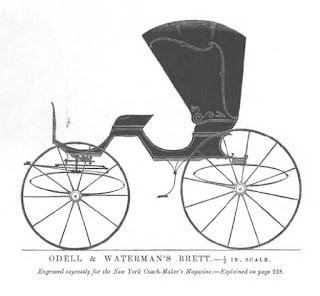


Here are some pictures of a Brett.


Wednesday, March 15, 2017
Vis-a-vis
The term means face to face in French. It is also the term used for a carriage built in the 19th century, originating in France, where the passengers sat face to face. In America these carriages found their way into Urban areas. They weren't as useful in the country or on the farms. They needed well developed roads for the type of wheels and suspension. Farm and country roads were rough and rugged and needed a different type of wheel and suspension for their wagons and carriages. Here is a link to Carolina Carriages with a Vis-a-vis you could hire today. In the later part of the 19th century they often sat up to 6 passengers plus the driver and for an extra seat one could sit next to the driver. However in the earlier part of the century they were a narrow carriage and could only sit two. The advantage to this was the passengers weren't jolted against one another and it tended to be warmer than larger coaches. It fell out of fashion for a few years around the mid-century then the reconstructed ones were larger and interest in them gained once again.
It's a great carriage to use in an Urban setting.
It's a great carriage to use in an Urban setting.
Thursday, February 9, 2017
Niagara Falls Suspension Bridge
The bridge was built for the railroad and commerce between Canada and the U.S. A temporary bridge went up in 1848 then the completed bridge in 1855. However it wasn't limited to trains, a toll was established for horse & carriage and carriage passengers. In 1860 daily trains crossed the bridge. It was closed in 1897 and dismantled. An interesting tidbit was that the cables were found to not have deteriorate of the course of 50 years of use.
Houghtaling's Handbook of Useful Information ©1884 has this to say:
Railway Suspension Bridge, Niagara Falls.
Engineer. John A. Roebling. Height of towers on American side, 88 feet. Height of towers on Canada side, 78 feet. Length of bridge, 800 feet. Width of bridge, 24 feet. Height Lbove the river, 250 feet. Number of cables, 4. Diameter of cables, 10 inches, containing about 4,000 miles of wire. Ultimate capacity of the 4 cables, 12,400 tons. Total weight of bridge, 800 tons. Distance between railway track and carriage road below, 28 feet. Cost of construction, 500.000 dollars. Bridge first opened for railway traffic, March 8, 1855. Estimated depth of water in the channel beneath the bridge, 250 feet. Velocity of current,30 miles per hour. Velocity of Whirlpool Rapids,27 miles per hour Quantity of water passing through the gorge per minute, 1,500,000,000 cubic feet.
In Burke's descriptive guide for Niagara ©1850 we find even more tidbits about the bridge and it's original construction.
THE SUSPENSION BRIDGE?
This truly fairy-like work was commenced in February, 1849, under the suprintendence of Charles Ellet, Jr., Esq., of Philadelphia, an Engineer of good previous reputation, and who, in this work, added much to his fame.
The bridge was contracted to be built for the " Niagara Falls Suspension Bridge Company," on the Canada side, and " The Niagara Falls International Bridge Company," on the American side conjointly ; a bill for the purpose being passed by the Legislature of each country.
The manner in which the first line of connection was formed, was at once simple, yet ingenious. A kite was procured, to the tail of which was a string, and by flying this on the one side, and letting it out until it was over the other side, the gorge was spanned by the string, by which a cord was drawn Awful catastrophe.
across, and by means of this cord, a rope of sufficient strength to draw a cable, which latter, being well secured on both sides, was the means of transit for the first wire-cable of 36 strands, No. 10 wire, which was 1160 feet in length. Towers had now been erected on each bank, 800 feet apart, by which this wire-cable was secured, and on the 13th of March, just one month from the commencement, Mr. Ellet crossed in an iron basket, suspended from the cable. This conveyance was used constantly by the workmen in constructing the bridge. And even many persons paid for the novelty of a trip across in this frail track.
A foot-bridge, three feet in width, was soon constructed, and over this a great number of persons passed, each paying 25 cents to the contractor. A similar foot-bridge was now formed parallel to this, and the basket-cable in the middle.
A terrific scene occurred just about this time. Whilst the workmen were busy at the second footbridge, which was constructed about 250 feet from the American side, and about 150 from the British, a tornado from the s. w., struck it, turning it quite over. Six men were at work upon the flooring of the bridge at this awful moment, two of whom in a most unaccountable manner made their way to the shore upon fragments of boards. The unfinished structure was torn and wafted backwards and forwards like the broken web of a spider, and four helpless human beings, 200 feet from the shore, supported by two strands of No. 10 wire, were in constant expectation of a headlong fall and plunge into the rapids below ! Oh, who can fathom those men's thoughts just then ? But the tiny thread which held them to existence, proved strong enough to outlast the gale. On the first cessation of the tornado's force, a brave fellow-workman manned the iron basket, and with a ladder proceeded amid the pelting of the furious rain to save the sufferers. He reached the wreck ; he placed his ladder in communication with it, and the basket thus affording a means by which all were brought back safe to terra-firma, uninjured in person, but well nigh scared to death.
On the 26th of July following, Mr. Ellet drove a span of horses and a heavy carriage over and back, accompanied by his lady.
A disagreement, which had for some time existed between the directors and Mr. Ellet, now came to an open rupture, and the work was discontinued for some time.
The bridge, which we see, is not the structure Height of the Bridge.
originally intended. This being merely preparatory to the great structure, which was to have been suspended from stone towers, 70 feet high, and which would have been 10 feet higher than the present bridge, and wholly independent of it
The present bridge was at first economically formed of very slight materials, it not being expected to last longer than, until the great bridge was constructed, about a year and a half. It has, however, been strengthened materially, and is now capable of sustaining 250 tons, and is in use as a thoroughfare, unshaken by the greatest pressure.
The floor of the bridge is 230 feet above the river, and the depth of the river immediately under the bridge is 250 feet
Houghtaling's Handbook of Useful Information ©1884 has this to say:
Railway Suspension Bridge, Niagara Falls.
Engineer. John A. Roebling. Height of towers on American side, 88 feet. Height of towers on Canada side, 78 feet. Length of bridge, 800 feet. Width of bridge, 24 feet. Height Lbove the river, 250 feet. Number of cables, 4. Diameter of cables, 10 inches, containing about 4,000 miles of wire. Ultimate capacity of the 4 cables, 12,400 tons. Total weight of bridge, 800 tons. Distance between railway track and carriage road below, 28 feet. Cost of construction, 500.000 dollars. Bridge first opened for railway traffic, March 8, 1855. Estimated depth of water in the channel beneath the bridge, 250 feet. Velocity of current,30 miles per hour. Velocity of Whirlpool Rapids,27 miles per hour Quantity of water passing through the gorge per minute, 1,500,000,000 cubic feet.
In Burke's descriptive guide for Niagara ©1850 we find even more tidbits about the bridge and it's original construction.
THE SUSPENSION BRIDGE?
This truly fairy-like work was commenced in February, 1849, under the suprintendence of Charles Ellet, Jr., Esq., of Philadelphia, an Engineer of good previous reputation, and who, in this work, added much to his fame.
The bridge was contracted to be built for the " Niagara Falls Suspension Bridge Company," on the Canada side, and " The Niagara Falls International Bridge Company," on the American side conjointly ; a bill for the purpose being passed by the Legislature of each country.
The manner in which the first line of connection was formed, was at once simple, yet ingenious. A kite was procured, to the tail of which was a string, and by flying this on the one side, and letting it out until it was over the other side, the gorge was spanned by the string, by which a cord was drawn Awful catastrophe.
across, and by means of this cord, a rope of sufficient strength to draw a cable, which latter, being well secured on both sides, was the means of transit for the first wire-cable of 36 strands, No. 10 wire, which was 1160 feet in length. Towers had now been erected on each bank, 800 feet apart, by which this wire-cable was secured, and on the 13th of March, just one month from the commencement, Mr. Ellet crossed in an iron basket, suspended from the cable. This conveyance was used constantly by the workmen in constructing the bridge. And even many persons paid for the novelty of a trip across in this frail track.
A foot-bridge, three feet in width, was soon constructed, and over this a great number of persons passed, each paying 25 cents to the contractor. A similar foot-bridge was now formed parallel to this, and the basket-cable in the middle.
A terrific scene occurred just about this time. Whilst the workmen were busy at the second footbridge, which was constructed about 250 feet from the American side, and about 150 from the British, a tornado from the s. w., struck it, turning it quite over. Six men were at work upon the flooring of the bridge at this awful moment, two of whom in a most unaccountable manner made their way to the shore upon fragments of boards. The unfinished structure was torn and wafted backwards and forwards like the broken web of a spider, and four helpless human beings, 200 feet from the shore, supported by two strands of No. 10 wire, were in constant expectation of a headlong fall and plunge into the rapids below ! Oh, who can fathom those men's thoughts just then ? But the tiny thread which held them to existence, proved strong enough to outlast the gale. On the first cessation of the tornado's force, a brave fellow-workman manned the iron basket, and with a ladder proceeded amid the pelting of the furious rain to save the sufferers. He reached the wreck ; he placed his ladder in communication with it, and the basket thus affording a means by which all were brought back safe to terra-firma, uninjured in person, but well nigh scared to death.
On the 26th of July following, Mr. Ellet drove a span of horses and a heavy carriage over and back, accompanied by his lady.
A disagreement, which had for some time existed between the directors and Mr. Ellet, now came to an open rupture, and the work was discontinued for some time.
The bridge, which we see, is not the structure Height of the Bridge.
originally intended. This being merely preparatory to the great structure, which was to have been suspended from stone towers, 70 feet high, and which would have been 10 feet higher than the present bridge, and wholly independent of it
The present bridge was at first economically formed of very slight materials, it not being expected to last longer than, until the great bridge was constructed, about a year and a half. It has, however, been strengthened materially, and is now capable of sustaining 250 tons, and is in use as a thoroughfare, unshaken by the greatest pressure.
The floor of the bridge is 230 feet above the river, and the depth of the river immediately under the bridge is 250 feet
Monday, January 30, 2017
Conestoga Wagon
Below is a brief excerpt from Development of Transportation systems in the United States. ©1888 As some of you are aware I'm currently working on a non-fiction resource book for Historical Fiction writers revolving around the Carriage and Wagon industry of the 19th century. In my research I've found the Conestoga wagon was the foundation for the birth of the well known Prairie Schooner. There are differences between the two wagons but the Conestoga is the earlier wagon.
CONESTOGA TEAMS AND WAGONS.
The primitive condition of carts and wagons could scarcely have remained unimproved during a very protracted period in any of the numerous communities in which a blacksmith and a wheelwright were established and busily engaged in prosecuting their labors. As compared with the other colonics the early industrial development of Pennsylvania necessitated extra efforts to utilize wheeled vehicles, on account of the absence of tidewater, except along a small portion of her south-eastern boundary, and the great extent to which interior regions were traversed by mountainous systems. The presence of a large German population in interior localities where they would have been shut off from access to markets for surplus produce if roads had not been constructed and carts or wagons used, also gave an impetus to progress which had as one of its results the invention or construction of the Conestoga wagon. It was regarded for a considerable period as the highest type of a commodious freight vehicle in the country, especially for traversing hilly or mountainous roads, and was first used about 1750. One of its peculiarities was a decided curve in the bottom, analogous to that of a canoe, the object of which was to prevent freight from slipping too far to the front when wagons were going down hill, or too far to the rear when they were going up hill. By this device a gain in effective power in movements over the mountains was attained. The Conestoga wagon received that title either because the four, five, or six horses by which it was drawn were usually of the breed of heavy draft horses that had been developed in the Conestoga valley of Lancaster county, Pennsylvania, or because the wagon itself was first constructed there, or because the teams came most frequently from that locality. Although the use of Conestoga wagons gradually extended to a number of sections, the farmers of the Conestoga valley owned an exceptionally large number of them during their period of special usefulness, which was that preceding the construction of canals and railways over important interior routes of trade. Hon. John Strohm, in an article on the Conestoga horse, contributed to the United States Agricultural Report for 1803, says that "the immigration to and settling of the western states created a demand for the transportation of large quantities of dry goods and groceries to supply the wants of those engaged in opening up and settling these new countries; and many farmers in the Conestoga valley occasionally employed their teams in hauling 'store goods' from Philadelphia to Pittsburgh, the latter place being the terminus beyond which eastern teams seldom went. During the war of 1812 these noble teams rendered essential service to the country in the transportation of arms and ammunition, and supplies to the army on the frontier. Long lines of these teams were frequently seen wending their weary way to the theatre of action, and contributing greatly to the comfort of the army and the defense of the country. Their usual route of travel was from Philadelphia through Lancaster, crossing the Susquehanna at Columbia or Marietta, and thence over the mountains to Pittsburgh, and sometimes northward to lake Erie. The capacious wagons which the Conestoga farmers then had in use, and the heavy teams of large, fat, sleek horses attached thereto, were the best means of land transportation which the times and circumstances of the country then afforded. These wagons and teams attracted attention and commanded admi ration wherever they appeared; and hence the origin, as I conceive, of the horse and wagon to which the appellation of 'Conestoga' has been attached. The farmers of those days seemed fully to appreciate the importance of these teams, and evinced considerable taste and no little pride in their style of fitting them out. The harness "was constructed of the best materials, with an eye to show as well as utility. In the harness and trimmings of these teams they frequently indulged in expenses that approached to extravagance. In addition to what was indispensably necessary, articles that by some were deemed decorations were sometimes appended, and served to increase the admiration which the noble animals to which they were attached so universally attracted. It was, indeed, an' animating sight to see five or six highly-fed horses, half covered with heavy bear skins, or decorated with gaudily-fringed housings, surmounted with a set of finely-toned bells, their bridles adorned with loops of red trimming, and moving over the ground with a brisk elastic step, snorting disdainfully at surrounding objects, as if half conscious of their superior appearance, and participating in the pride that swelled the bosom of their master and driver."
CONESTOGA TEAMS AND WAGONS.
The primitive condition of carts and wagons could scarcely have remained unimproved during a very protracted period in any of the numerous communities in which a blacksmith and a wheelwright were established and busily engaged in prosecuting their labors. As compared with the other colonics the early industrial development of Pennsylvania necessitated extra efforts to utilize wheeled vehicles, on account of the absence of tidewater, except along a small portion of her south-eastern boundary, and the great extent to which interior regions were traversed by mountainous systems. The presence of a large German population in interior localities where they would have been shut off from access to markets for surplus produce if roads had not been constructed and carts or wagons used, also gave an impetus to progress which had as one of its results the invention or construction of the Conestoga wagon. It was regarded for a considerable period as the highest type of a commodious freight vehicle in the country, especially for traversing hilly or mountainous roads, and was first used about 1750. One of its peculiarities was a decided curve in the bottom, analogous to that of a canoe, the object of which was to prevent freight from slipping too far to the front when wagons were going down hill, or too far to the rear when they were going up hill. By this device a gain in effective power in movements over the mountains was attained. The Conestoga wagon received that title either because the four, five, or six horses by which it was drawn were usually of the breed of heavy draft horses that had been developed in the Conestoga valley of Lancaster county, Pennsylvania, or because the wagon itself was first constructed there, or because the teams came most frequently from that locality. Although the use of Conestoga wagons gradually extended to a number of sections, the farmers of the Conestoga valley owned an exceptionally large number of them during their period of special usefulness, which was that preceding the construction of canals and railways over important interior routes of trade. Hon. John Strohm, in an article on the Conestoga horse, contributed to the United States Agricultural Report for 1803, says that "the immigration to and settling of the western states created a demand for the transportation of large quantities of dry goods and groceries to supply the wants of those engaged in opening up and settling these new countries; and many farmers in the Conestoga valley occasionally employed their teams in hauling 'store goods' from Philadelphia to Pittsburgh, the latter place being the terminus beyond which eastern teams seldom went. During the war of 1812 these noble teams rendered essential service to the country in the transportation of arms and ammunition, and supplies to the army on the frontier. Long lines of these teams were frequently seen wending their weary way to the theatre of action, and contributing greatly to the comfort of the army and the defense of the country. Their usual route of travel was from Philadelphia through Lancaster, crossing the Susquehanna at Columbia or Marietta, and thence over the mountains to Pittsburgh, and sometimes northward to lake Erie. The capacious wagons which the Conestoga farmers then had in use, and the heavy teams of large, fat, sleek horses attached thereto, were the best means of land transportation which the times and circumstances of the country then afforded. These wagons and teams attracted attention and commanded admi ration wherever they appeared; and hence the origin, as I conceive, of the horse and wagon to which the appellation of 'Conestoga' has been attached. The farmers of those days seemed fully to appreciate the importance of these teams, and evinced considerable taste and no little pride in their style of fitting them out. The harness "was constructed of the best materials, with an eye to show as well as utility. In the harness and trimmings of these teams they frequently indulged in expenses that approached to extravagance. In addition to what was indispensably necessary, articles that by some were deemed decorations were sometimes appended, and served to increase the admiration which the noble animals to which they were attached so universally attracted. It was, indeed, an' animating sight to see five or six highly-fed horses, half covered with heavy bear skins, or decorated with gaudily-fringed housings, surmounted with a set of finely-toned bells, their bridles adorned with loops of red trimming, and moving over the ground with a brisk elastic step, snorting disdainfully at surrounding objects, as if half conscious of their superior appearance, and participating in the pride that swelled the bosom of their master and driver."
Wednesday, January 25, 2017
New Yorke & The Brooklyn Bridge
There are events and items in life that you take for granted. One of those items for me was made clear from the movie Kate & Leopold when referencing the building of the Brooklyn Bridge. With that in mind today's excerpt comes from Houghtaling's Handbook ©1884.
First talked of by Colonel Julius W. Adams about 1855. Act of incorporatlonpassed April, 1866. Survey begun by John A. Roebling, 1869. Construction begun January 2,1870. First rope thrown across the river August 14, 1876. Master Mechanic Farrington crossed in a boatswain's chair August 25, 1876. Depth of the New York foundation below high water mark, 78 feet 6 inches. Depth of the Brooklyn foundation below high water mark, 45 feet. The New York tower contains 46,945 cubic yards of masonry; the Brooklyn tower, 88,214. Weight of the Brooklyn tower, about 98,079 tons. Weight of the New York tower, about a third more. Size of the towers at high water line, 140x59 feet; at roof course, 186x58 feet. Height of the towers above high water mark, 278 feet 6 inches. Height of roadway in the clear in the middle of the East River, 185 feet. Grade of the roadway, 8 feet 8 Inches to 100 feet. Width of the promenade in the centre of bridge, 16 feet 7 inches. Width for railway on one side of the promenade, 12 feet 10 inches. Width of carriage way, on the other side of the promenade, 18 feet 9 inches. Width of bridge 85 feet. Length of main span, 1,595 feet 6 inches. Length of each land span, 930 feet. Length of the Brooklyn approach, 971 feet. Length of the New York approach, 1,560 feet. Length of each of the four great cables, 8,578 feet 6 inches; diameter, 15% inches: number of steel galvanized wires in each cable, 5,484; weight of each cable, about 800 tons. Ulti.nate strength of each cable, 15,000 tons. Weight of steel in the suspended superstructure, 10,000 tons. Total cost, 15,000,000 dollars. Opened for traffic in 1888.
First talked of by Colonel Julius W. Adams about 1855. Act of incorporatlonpassed April, 1866. Survey begun by John A. Roebling, 1869. Construction begun January 2,1870. First rope thrown across the river August 14, 1876. Master Mechanic Farrington crossed in a boatswain's chair August 25, 1876. Depth of the New York foundation below high water mark, 78 feet 6 inches. Depth of the Brooklyn foundation below high water mark, 45 feet. The New York tower contains 46,945 cubic yards of masonry; the Brooklyn tower, 88,214. Weight of the Brooklyn tower, about 98,079 tons. Weight of the New York tower, about a third more. Size of the towers at high water line, 140x59 feet; at roof course, 186x58 feet. Height of the towers above high water mark, 278 feet 6 inches. Height of roadway in the clear in the middle of the East River, 185 feet. Grade of the roadway, 8 feet 8 Inches to 100 feet. Width of the promenade in the centre of bridge, 16 feet 7 inches. Width for railway on one side of the promenade, 12 feet 10 inches. Width of carriage way, on the other side of the promenade, 18 feet 9 inches. Width of bridge 85 feet. Length of main span, 1,595 feet 6 inches. Length of each land span, 930 feet. Length of the Brooklyn approach, 971 feet. Length of the New York approach, 1,560 feet. Length of each of the four great cables, 8,578 feet 6 inches; diameter, 15% inches: number of steel galvanized wires in each cable, 5,484; weight of each cable, about 800 tons. Ulti.nate strength of each cable, 15,000 tons. Weight of steel in the suspended superstructure, 10,000 tons. Total cost, 15,000,000 dollars. Opened for traffic in 1888.
Saturday, January 21, 2017
Wagon Builders
I stumbled on this bit of information from Law Notes: Vol. 5 Pg 147 ©1886 while researching various wagon builders. What I found interesting about this was the practice of the "financing" of the purchase of a wagon.
Throughout the kingdom are many wagon companies, so called, that never build a single wagon; in fact, were they to do so, it would actually be ultra vires. In reality, these companies are "financing" companies only; they are no more wagon companies than bodies that lend money on bills of sale of furniture are furniture companies.
A person wishing to buy wagons, but to pay for them by instalments spread over a term, say, of seven years, will go to a wagon builder and get him to build the sort of wagons he (the intending purchaser) requires. Application is then made to a "financing" wagen company, by whom the wagons are purchased from the builder at the price the intending purchaser agreed to give; the builder invoices them to the company; and then they are let by the latter to the intending purchaser on the hire and purchase system. The rent fixed by the agreement for hire is calculated on the basis that the payments made during the term shall at its expiration have recouped the company the cost of the wagons and interest at the rate agreed upon; and in the agreement is contained a license to seize and retake possession of the wagons on non-payment of the rent and in certain other events. A proviso is also inserted that the property in the wagons shall, at the expiration of the term, when all moneys due under the agreement shall have been paid, vest in the bailee for hire, or, as he is generally termed, "the tenant."
Throughout the kingdom are many wagon companies, so called, that never build a single wagon; in fact, were they to do so, it would actually be ultra vires. In reality, these companies are "financing" companies only; they are no more wagon companies than bodies that lend money on bills of sale of furniture are furniture companies.
A person wishing to buy wagons, but to pay for them by instalments spread over a term, say, of seven years, will go to a wagon builder and get him to build the sort of wagons he (the intending purchaser) requires. Application is then made to a "financing" wagen company, by whom the wagons are purchased from the builder at the price the intending purchaser agreed to give; the builder invoices them to the company; and then they are let by the latter to the intending purchaser on the hire and purchase system. The rent fixed by the agreement for hire is calculated on the basis that the payments made during the term shall at its expiration have recouped the company the cost of the wagons and interest at the rate agreed upon; and in the agreement is contained a license to seize and retake possession of the wagons on non-payment of the rent and in certain other events. A proviso is also inserted that the property in the wagons shall, at the expiration of the term, when all moneys due under the agreement shall have been paid, vest in the bailee for hire, or, as he is generally termed, "the tenant."
Sears & Roebuck Shipping Rates 1896
Below is a very small selection of the shipping rates for Sears & Roebuck from their 1896 Spring catalogue. Note the prices are set for a per 100 lbs. A fellow writer, from one of the writing groups I'm in, mentioned how her grandmother told stories about how items came to the farm from their orders to Sears and other places. The train simply stopped on the tracks (at the edge of their farm) and left the items on the side of the tracks then continued on their way.
Sears & Roebuck went into detail about the way to order, how to figure the shipping charges, etc. By placing a freight rate chart they not only helped their customers but saved themselves the headache of extra billing for freight.

Sears & Roebuck went into detail about the way to order, how to figure the shipping charges, etc. By placing a freight rate chart they not only helped their customers but saved themselves the headache of extra billing for freight.

Friday, January 20, 2017
Tar For Greasing Wagons
I stumbled across this brief editorial comment made in "The American Agriculturist" in the August 1842 issue. Can't you just see your characters or ancestors mixing up a batch of axle grease for the wagons with this historical gem?
Tar for greasing wagons, we think an absurd article. In the hottest weather it soon gums up and becomes adhesive, and in cold weather is always so. Wherever iron axletrees are used, black lead mixed with grease is best:—or Flour mixed with Lard.
Subscribe to:
Posts (Atom)