On several of the writer's email loops I'm on questions about Balls and proper behavior are often asked. In writing historicals we try to be accurate but we also want our characters to mingle and speak with one another. The challenge is to do allow your characters to speak with one another in a proper fashion and setting that won't send our historical readers into a frenzy throwing our books across the room because the situation we've created wasn't believable. With that in mind, I've been searching various books on manners and customs of the 19th century. Today's excerpt comes from "Manners: A handbook of social customes" by Elisabeth Marbury ©1888 Note the last comment posted, isn't it great that our 19th century ancestors and characters enjoyed fiction.
BALLS OR EVENING PARTIES.
These entertainments always include dancing and a supper. If large, they are called "balls," but if small simply "dances" or "parties."
Hour.—Unfortunately, fashion has made this very late, and unless especially indicated on the invitation, half-past ten is the earliest a hostess can hope to assemble her guests. In large cities, an hour later even will hardly insure the rooms being full.
Subscription Dances.—In most of the large cities, several series of dances are arranged by certain of the social leaders, to which people are invited to subscribe. Each subscriber, is usually entitled to a number of invitations for distribution, though in some instances the price of the subscription is small, and only permits one person to take advantage of each.
Public Halls.—The subscription balls take place in some public ball-room, as a rule. In New York, for instance, at Delmonico's.
Ladies Receiving.—Several ladies are selected to form the reception committee, and they stand in one of the outer rooms, bowing to the guests as they enter.
Shaking Hands.—On such occasions, no one shakes hands; the ladies courtesy, and the gentlemen bow.
Chaperons.—No unmarried lady should go to one of these balls, or to any large party, without a chaperon, and invitations should be sent to an elder member of her family, in order that she need not look out side for proper attendance. In the West and South, it is quite customary for gentlemen to take unmarried ladies to evening entertainments, but in the Eastern States, and in the best society in our cities, such a thing is unheard of, and would be considered the greatest breach of decorum.
Small Dances. — It is not absolutely necessary that a young lady should have a chaperon at a small or informal dance in a private house, but she should be escorted there and back by a servant or some relative.
Toilets.—At a ball, a lady can display her handsomest jewels and wear as elaborate a toilet as she pleases. Gentlemen should always appear in dress suits.
MUsIc, etc.—Excellent music should be provided, and a smooth floor to dance on.
SUPPeR.—Is usually served about 12.30, and should consist of hot and cold dishes, such as oysters, bouillon, game, croquettes, filet of beef, salads, pates, ices, cakes, sweets, jellies, fruit, and champagne, punch, lemonade and mineral waters are usually provided. Small tables are frequently used at balls, so that four or six people may sit at one table and eat their supper comfortably in courses.
Attendance.—Maids should be in the ladies' dressing-rooms, and valets in the gentlemen's. Small fees of twenty-five or fifty cents are often given to servants in the dressing-room at a public ball, but never in private houses in this country, though the custom is common in England. Waiters should be on hand at supper to serve the meal, as the fashion of the gentlemen waiting upon the ladies is rapidly becoming obsolete.
Awnings. — In large cities, an awning should always be extended from the front door to the curb-stone, on the occasion of a reception, or other entertainment, as the ladies do not like to step out of their carriages in light and elaborate dresses without some protection from the weather and from the impertinent gaze of a curious crowd.
Cotillon Or German. — This dance, now so widely known, fills up the larger part of the evening, and begins, as a rule, immediately after supper. In a private house, the gentleman who has been invited to lead the German must ask the unmarried daughter of the family to dance with him, or the married daughter, if so indicated as the family's choice. At the more general dances or large balls, a young married lady is usually the one selected to dance with the leader.
Partners.—It is quite the custom for a gentleman to engage a partner for the Cotillon before the evening of the dance, and in this case, provided he can afford it, he usually sends her a bouquet of flowers.
Flowers Carried To Balls.—The fashion of carrying numerous bouquets to a ball is rapidly ceasing to exist, and many of the most popular belles refuse to take any flowers into a ball-room, the old custom having given rise to so much vulgar rivalry and display.
Public Balls.—These are much more promiscuous than private balls, even when conducted carefully, and tickets can generally be purchased for $5.00 each, not including supper. As a rule they are undertaken for the benefit of some charity or public fund.
Cards Of Dancing.—At such balls cards giving the order of dances are provided, on which gentlemen can write the names opposite the numbers of the dances, for which they have been accepted by the lady holding the card. In England such cards are used universally, but rarely at private balls in our country. At public balls square and round dances are danced, but no cotillons.
Fancy Balls.—In private houses these are conducted like other parties, the only difference being in the costumes of the guests, who are expected to personate some historical character, or one in fiction, etc.
Showing posts with label Entertainment. Show all posts
Showing posts with label Entertainment. Show all posts
Thursday, February 16, 2017


Thursday, January 12, 2017
The Bronx Zoo
On Nov. 8, 1899 the Bronx Zoo opened as the New York Zoological Park. In 1899 there were 261 acres. New York purchased the property for a mere thousand dollars from Fordham University with the condition that the area be used for parks and no further building (for private homes, businesses, etc) of the area.
Google Books has a copy of the second addition of the Popular official guide to the New York Zoological Park ©1900 the following year of the Parks opening. Below is the preface. Here is a link to the entire guide book.
PREFACE.
The opening of the Zoological Park marks another great step toward the education of the people of the City of New York. It will bring the beauties and wonders of living Nature within reach of hundreds and thousands who are unable to travel. Like its predecessors in this field of popular education, the Park is maintained by the City, while its collections of animals and all of its present buildings are due to the generosity of citizens of New York. "We look to the continued and increasing support of all classes of people for whose education and amusement the Park is designed, rather than for the exclusive interests of science.
Although the Park is only one-third of the way toward completion, the Zoological Society believes that visitors will welcome a popular and reliable guide to what has already been accomplished. One year ago we began active work, and after two years of planning and organization ceased to speak publicly of our plans for the future. This handbook describes and pictures only what has actually been accomplished up to the day of going to press.
We bespeak for the Director and his colleagues on the Zoological Park staff, as well as for the Architects, indulgence for such shortcomings as are inseparable from such a difficult undertaking as this, during its first year. As rapidly as possible the incomplete parts of the Park will be taken in hand and brought to a finish. It has been no trifling matter to provide plans and surveys, building materials and workmen for our twenty-two installations, proceeding simultaneously with the construction by the City of miles of walks, roads, sewers and water-lines ; to finish-Bonds and entrances, trim the forests, establish a nursery, grade and plant miles of walk - borders, and build retaining walls ; to select a staff of assistants, collect animals, write labels, disburse $170,000 in small sums, without loss or dispute, and finally, during the last few weeks to improve Lake Agassiz sufficiently to make it a full and wholesome body of water.
That all the above has actually been accomplished in one year's time, without costly mistakes, or losses on account of changes in plans, and with no friction whatever, is certainly a cause for congratulation. We have enjoyed the constant and capable co-operation of the Park Department for the Borough of the Bronx and its engineers, as well as the generous support of the Mayor and other City authorities.
Executive Committee
Of The Zoological Society
Google Books has a copy of the second addition of the Popular official guide to the New York Zoological Park ©1900 the following year of the Parks opening. Below is the preface. Here is a link to the entire guide book.
PREFACE.
The opening of the Zoological Park marks another great step toward the education of the people of the City of New York. It will bring the beauties and wonders of living Nature within reach of hundreds and thousands who are unable to travel. Like its predecessors in this field of popular education, the Park is maintained by the City, while its collections of animals and all of its present buildings are due to the generosity of citizens of New York. "We look to the continued and increasing support of all classes of people for whose education and amusement the Park is designed, rather than for the exclusive interests of science.
Although the Park is only one-third of the way toward completion, the Zoological Society believes that visitors will welcome a popular and reliable guide to what has already been accomplished. One year ago we began active work, and after two years of planning and organization ceased to speak publicly of our plans for the future. This handbook describes and pictures only what has actually been accomplished up to the day of going to press.
We bespeak for the Director and his colleagues on the Zoological Park staff, as well as for the Architects, indulgence for such shortcomings as are inseparable from such a difficult undertaking as this, during its first year. As rapidly as possible the incomplete parts of the Park will be taken in hand and brought to a finish. It has been no trifling matter to provide plans and surveys, building materials and workmen for our twenty-two installations, proceeding simultaneously with the construction by the City of miles of walks, roads, sewers and water-lines ; to finish-Bonds and entrances, trim the forests, establish a nursery, grade and plant miles of walk - borders, and build retaining walls ; to select a staff of assistants, collect animals, write labels, disburse $170,000 in small sums, without loss or dispute, and finally, during the last few weeks to improve Lake Agassiz sufficiently to make it a full and wholesome body of water.
That all the above has actually been accomplished in one year's time, without costly mistakes, or losses on account of changes in plans, and with no friction whatever, is certainly a cause for congratulation. We have enjoyed the constant and capable co-operation of the Park Department for the Borough of the Bronx and its engineers, as well as the generous support of the Mayor and other City authorities.
Executive Committee
Of The Zoological Society
Thursday, December 22, 2016
Magic
Magic and performances of Magic increased in popularity during the 19th century. Ending the century with the works of Harry Houdini. In 1877 Professor Hoffman wrote a treatise on "Modern Magic: A practical treatise on the art of conjuring." For some unknown reason (to me) Spiritualism developed with and along with magicians, as in the case of Harry Houdini. Perhaps it had something to do with a magician's ability to suspend himself/herself in the air.
In adding secondary characters to our novels Magicians, slight of hand artists could be used in a positive entertaining way or as notorious characters who come to town and try to steal the heart of our hero or heroine.
Below is an excerpt from "Modern Magic: A practical treatise on the art of conjuring."
THE MAGIC WAND.
This is a light rod of twelve to fifteen inches in length, and about three-quarters of an inch in diameter. It may be of any material, and decorated in any manner which the fancy of the owner may dietate. To the uninitiated its use may appear a mere affectation, but such is by no means the case. Apart from the prestige derived from the traditional properties of the wand, and its use by the wizards of all ages, it affords a plausible pretext for many necessary movements, which would otherwise appear awkward and unnatural, and would thereby arouse the vigilance of the audience at possibly the most critical period of the trick. Thus, if the performer desires to hold anything concealed in his hand, by holding the wand in the same hand he is able to keep it closed without exciting suspicion. If it is necessary, as frequently happens, to turn his back upon the audience for an instant, the momentary turn to the table, in order to take up or lay down the wand, affords the required opportunity. We most strongly advise the would-be magician to cultivate from the outset the habitual use of the wand. Even where its employment is not absolutely necessary for the purpose of the trick, its use is in strict accordance with the character he professes to fill, and the dainty touch of the wand, for the supposed purpose of operating a magical transformation, assists materially in leading the audience to believe that such transformation did actually take place at that particular moment, instead of having been (as is really the case) secretly effected at an earlier period.
In adding secondary characters to our novels Magicians, slight of hand artists could be used in a positive entertaining way or as notorious characters who come to town and try to steal the heart of our hero or heroine.
Below is an excerpt from "Modern Magic: A practical treatise on the art of conjuring."
THE MAGIC WAND.
This is a light rod of twelve to fifteen inches in length, and about three-quarters of an inch in diameter. It may be of any material, and decorated in any manner which the fancy of the owner may dietate. To the uninitiated its use may appear a mere affectation, but such is by no means the case. Apart from the prestige derived from the traditional properties of the wand, and its use by the wizards of all ages, it affords a plausible pretext for many necessary movements, which would otherwise appear awkward and unnatural, and would thereby arouse the vigilance of the audience at possibly the most critical period of the trick. Thus, if the performer desires to hold anything concealed in his hand, by holding the wand in the same hand he is able to keep it closed without exciting suspicion. If it is necessary, as frequently happens, to turn his back upon the audience for an instant, the momentary turn to the table, in order to take up or lay down the wand, affords the required opportunity. We most strongly advise the would-be magician to cultivate from the outset the habitual use of the wand. Even where its employment is not absolutely necessary for the purpose of the trick, its use is in strict accordance with the character he professes to fill, and the dainty touch of the wand, for the supposed purpose of operating a magical transformation, assists materially in leading the audience to believe that such transformation did actually take place at that particular moment, instead of having been (as is really the case) secretly effected at an earlier period.
Friday, April 22, 2016
Tin Toys
Here are a couple Tin toys I've found that were produced during the 19th Century. I'm certain there were many, many more but these are the only two illustrations I could find.
The first is called "Artist" the six foot figure would draw an elephant, face, dog and court jester on a small piece of paper and small pencil. 1898

Horse & Buggy was actually made before the 19th Century.

The first is called "Artist" the six foot figure would draw an elephant, face, dog and court jester on a small piece of paper and small pencil. 1898

Horse & Buggy was actually made before the 19th Century.

Friday, March 25, 2016
Easter Menus & Entertainment from the 19th Century
Here are a couple of samples from Easter Dinners and Entertaining from a couple sources. Have a Blessed Easter.
EASTER DINNER.
Cream Tomato Soup
Paris Eggs Brown Bread
Roast Tenderloin of Beef Succotash
Asparagus White Turnips Tomatoes
Cabbage Salad
Ambrosia Nuts Raisins Cake
The most characteristic Easter rite, and the one most widely diffused, is the use of patch (i. e. Easter) Eggs They are usually stained of various colors and people mutually make presents of them; sometimes they are kept as amulets, sometimes eaten; games are also played by striking them against one another. There can be little doubt that the use of eggs at this season was originally symbolical of the revivification of nature—the springing
Source: Mrs. Owen's New Cook-Book ©1897
ENTERTAINING AT EASTER.
"There is a tender hue that tips the first young leaves of spring,
A trembling beauty in their notes when young birds learn to sing
A purer look when first on earth the gushing brook appears,
A liquid depth in infant eyes that fades with summer years."
IN the early days of ecumenical councils it was a mooted point when Easter should be celebrated. The Christian Jews kept the feast on the same day as their Passover, the fourteenth of Nisan, the month corresponding to our March or April; but the Gentile church observed the first Sunday following this, because Christ rose from the dead on that day. It was not until the fourth century that the Council of Nice decided upon the first Sunday after the full moon which follows the twenty-first of March. The contest was waged long and heavily, but the Western churches were victorious; a vote settled it.
Perhaps this victory decided the later and more splendid religious ceremonials of Easter, which are much more observed in Rome and in all Catholic countries than those of Christmas. Constantine gratified his love of display by causing Easter to be celebrated with unusual pomp and parade. Vigils and night watches were instituted, people remaining all night in the churches in Rome, and carrying high wax tapers through the streets in processions.
People in the North, glad of an escape from four months of darkness, watch to see the sun dawn on an Easter morning. They have a superstitious feeling about this observance, which came originally from Egypt, and is akin to the legend that the statue of Memnon sings when the first ray of the sun touches it.
It is the queen of feasts in all Catholic churches, the world over. In early days, the fasting of Lent was restricted to one day, the Friday of Passion Week, Good Friday; then it extended to forty hours, then to forty days, — showing how much fashion, even in churchly affairs, has to do with these matters. One witty author says that, "people who do not believe in anything will observe Lent, for it is the fashion."
Certainly, the little dinners of Lent, in fashionable society, are amongst the most agreeable of all entertainments. The crime cTecrevisse, the oyster and clam soups, the newly arrived shad, the codfish a la royale and other tempting dainties are very good, and the dinner being small, and at eight o'clock, there is before it a long twilight for the drive in the Park.
A pope of Rome once offered a prize to the man who would invent one thousand ways of cooking eggs, for eggs can always be eaten in Lent, and let us hope that he found them. The greatest coxcomb of all cooks, Louis Ude, who was prone to demand a carriage and five thousand a year, was famous for his little Lenten menus, and could cook fish and eggs marvellously. The amusements of Lent have left one joke in New York. Roller skates were once a very fashionable amusement for Lenten afternoons, though now gone out, and a club had rented Irving Hall for their playground and chosen Festina lente, " Make haste slowly," for their motto. It was a very witty motto, but some wise Malaprop remarked, " What a very happy selection, ' Festivals of Lent!'"
However, Lent once passed, with its sewing circles and small whist-parties, then conies the brilliant Easter, with its splendid dinners, its weddings, its christenings and caudle parties, its ladies' lunches, its Meadow Brook hunt, its asparagus parties, and the chickens of gayety which are hatched out of Easter eggs. It is a great day for the confectioner. In Paris, that city full of gold and misery, the splendour and luxury of the Easter egg bonbonniere is fabulous. A few years since a Paris house furnished an Easter egg for a Spanish infanta, which cost eight hundred pounds sterling.
Easter dinners can be made delightful. They are simple, less heavy, hot, and stuffy, than those of midwinter. That enemy of the feminine complexion, the furnace, is put out. It no longer sends up its direful sirocco behind one's back. Spring lamb and mint sauce, asparagus and fresh dandelion salad, replace the heavy joint and the canned vegetables. A foreigner said of us that we have everything canned, even the canvas-back duck and the American opera. Everything should be fresh. The ice-cream man devises allegorical allusions in his forms, and there are white dinners for young brides, and roseate dinners for debutantes.
For a gorgeous ladies' lunch, behold a menu. This is for Easter Monday : —
Little Neck clams.
Chablis. Beef tea or consommi in cups.
CStelettes de cervelles & la cardinal. Cucumbers.
Little ducks with fresh mushrooms.
Champagne. Artichokes.
Claret.
Sweetbread d la Richelieu.
Asparagus, Hollandaise sauce.
Roman punch.
Pdtl de foie gras.
Roast snipe.
Tomato salad, lettuce.
Ice creams, in form of nightingales' nests
Strawberries, sugared fruit, nougat cakes.
Coffee.
Of course, a season of such rejoicing, when "Christians stand praying, each in an exalted attitude, with outstretched hands and uplifted faces, expressing joy and gladness," is thought to be very propitious for marriage. There is generally a wedding every day, excepting Friday, during Easter week. A favourite spring travelling-dress for an Easter bride is fawn coloured cashmere, with a little round hat and bunch of primroses.
For a number of choir boys to sing an epithalamium, walking up the aisle before the bride, is a new and very beautiful Easter fashion.
A favourite entertainment for Easter is a christening. Christening parties are becoming very important functions in the art of entertaining. Many Roman Catholics are so anxious for the salvation of the little new soul, that they have their children baptized as soon as possible, but others put off this important ceremony until mamma can go to church, when little master is five weeks old. Then friends are invited to the ceremony very much in this fashion: —
Mr. and Mrs. Hamilton request the pleasure of your company at the baptism of their infant daughter at the Cathedral, Monday, March 30, at 12 o'clock. At home, after the ceremony, 14 W. Ellicott Square.
Source: The Art of Entertaining ©1892
EASTER DINNER.
Cream Tomato Soup
Paris Eggs Brown Bread
Roast Tenderloin of Beef Succotash
Asparagus White Turnips Tomatoes
Cabbage Salad
Ambrosia Nuts Raisins Cake
The most characteristic Easter rite, and the one most widely diffused, is the use of patch (i. e. Easter) Eggs They are usually stained of various colors and people mutually make presents of them; sometimes they are kept as amulets, sometimes eaten; games are also played by striking them against one another. There can be little doubt that the use of eggs at this season was originally symbolical of the revivification of nature—the springing
Source: Mrs. Owen's New Cook-Book ©1897
ENTERTAINING AT EASTER.
"There is a tender hue that tips the first young leaves of spring,
A trembling beauty in their notes when young birds learn to sing
A purer look when first on earth the gushing brook appears,
A liquid depth in infant eyes that fades with summer years."
IN the early days of ecumenical councils it was a mooted point when Easter should be celebrated. The Christian Jews kept the feast on the same day as their Passover, the fourteenth of Nisan, the month corresponding to our March or April; but the Gentile church observed the first Sunday following this, because Christ rose from the dead on that day. It was not until the fourth century that the Council of Nice decided upon the first Sunday after the full moon which follows the twenty-first of March. The contest was waged long and heavily, but the Western churches were victorious; a vote settled it.
Perhaps this victory decided the later and more splendid religious ceremonials of Easter, which are much more observed in Rome and in all Catholic countries than those of Christmas. Constantine gratified his love of display by causing Easter to be celebrated with unusual pomp and parade. Vigils and night watches were instituted, people remaining all night in the churches in Rome, and carrying high wax tapers through the streets in processions.
People in the North, glad of an escape from four months of darkness, watch to see the sun dawn on an Easter morning. They have a superstitious feeling about this observance, which came originally from Egypt, and is akin to the legend that the statue of Memnon sings when the first ray of the sun touches it.
It is the queen of feasts in all Catholic churches, the world over. In early days, the fasting of Lent was restricted to one day, the Friday of Passion Week, Good Friday; then it extended to forty hours, then to forty days, — showing how much fashion, even in churchly affairs, has to do with these matters. One witty author says that, "people who do not believe in anything will observe Lent, for it is the fashion."
Certainly, the little dinners of Lent, in fashionable society, are amongst the most agreeable of all entertainments. The crime cTecrevisse, the oyster and clam soups, the newly arrived shad, the codfish a la royale and other tempting dainties are very good, and the dinner being small, and at eight o'clock, there is before it a long twilight for the drive in the Park.
A pope of Rome once offered a prize to the man who would invent one thousand ways of cooking eggs, for eggs can always be eaten in Lent, and let us hope that he found them. The greatest coxcomb of all cooks, Louis Ude, who was prone to demand a carriage and five thousand a year, was famous for his little Lenten menus, and could cook fish and eggs marvellously. The amusements of Lent have left one joke in New York. Roller skates were once a very fashionable amusement for Lenten afternoons, though now gone out, and a club had rented Irving Hall for their playground and chosen Festina lente, " Make haste slowly," for their motto. It was a very witty motto, but some wise Malaprop remarked, " What a very happy selection, ' Festivals of Lent!'"
However, Lent once passed, with its sewing circles and small whist-parties, then conies the brilliant Easter, with its splendid dinners, its weddings, its christenings and caudle parties, its ladies' lunches, its Meadow Brook hunt, its asparagus parties, and the chickens of gayety which are hatched out of Easter eggs. It is a great day for the confectioner. In Paris, that city full of gold and misery, the splendour and luxury of the Easter egg bonbonniere is fabulous. A few years since a Paris house furnished an Easter egg for a Spanish infanta, which cost eight hundred pounds sterling.
Easter dinners can be made delightful. They are simple, less heavy, hot, and stuffy, than those of midwinter. That enemy of the feminine complexion, the furnace, is put out. It no longer sends up its direful sirocco behind one's back. Spring lamb and mint sauce, asparagus and fresh dandelion salad, replace the heavy joint and the canned vegetables. A foreigner said of us that we have everything canned, even the canvas-back duck and the American opera. Everything should be fresh. The ice-cream man devises allegorical allusions in his forms, and there are white dinners for young brides, and roseate dinners for debutantes.
For a gorgeous ladies' lunch, behold a menu. This is for Easter Monday : —
Little Neck clams.
Chablis. Beef tea or consommi in cups.
CStelettes de cervelles & la cardinal. Cucumbers.
Little ducks with fresh mushrooms.
Champagne. Artichokes.
Claret.
Sweetbread d la Richelieu.
Asparagus, Hollandaise sauce.
Roman punch.
Pdtl de foie gras.
Roast snipe.
Tomato salad, lettuce.
Ice creams, in form of nightingales' nests
Strawberries, sugared fruit, nougat cakes.
Coffee.
Of course, a season of such rejoicing, when "Christians stand praying, each in an exalted attitude, with outstretched hands and uplifted faces, expressing joy and gladness," is thought to be very propitious for marriage. There is generally a wedding every day, excepting Friday, during Easter week. A favourite spring travelling-dress for an Easter bride is fawn coloured cashmere, with a little round hat and bunch of primroses.
For a number of choir boys to sing an epithalamium, walking up the aisle before the bride, is a new and very beautiful Easter fashion.
A favourite entertainment for Easter is a christening. Christening parties are becoming very important functions in the art of entertaining. Many Roman Catholics are so anxious for the salvation of the little new soul, that they have their children baptized as soon as possible, but others put off this important ceremony until mamma can go to church, when little master is five weeks old. Then friends are invited to the ceremony very much in this fashion: —
Mr. and Mrs. Hamilton request the pleasure of your company at the baptism of their infant daughter at the Cathedral, Monday, March 30, at 12 o'clock. At home, after the ceremony, 14 W. Ellicott Square.
Source: The Art of Entertaining ©1892
Friday, March 18, 2016
Boston (Horse)
Following last weeks post I thought I'd add another horse bio. Take note of the price money being offered in the years that Boston raced.
 BOSTON, foaled 1833, was bred by Mr. John Wickham, of Richmond, Va., and was by Tiruolecm out of Sister to Tuckahoe, by Ball's Florizel. He first started at Broadrock. Va., April 20, 1836, in a sweepstakes for threeyear-olds, mile heats, but was beaten by his only opponent, Colonel White's colt, by Carolinian, Boston bolting when in the lead. He did not run again until the Fall, when he started for, and won, the two-mile-heat purse at Petersburg, Va., Oct. 12, 1836, beating Nick Biddle and five others, 4:01—4:00, over a heavy track. The following month, he won the Jockey Club Purse, at Hanover, Va. As a four-year-old, at Washington, D. C., he won the three-mileheat race in 6:04—6:10, beating Norwood and four others. At the same place, Oct. 5,1837, he won the three-mile-heat race, in two heats, beating Prince George, Stockton and four others, in 5:55—5:53. A fortnight later, at Baltimore, he won the three-mile-heat purse, in 5:51—6:08, from three opponents, and at Camden, N. J., a week later, he won the three-mile-heat purse, in 5:51—6:02, beating Betsy Andrew. May 3,1838, he walked over for the three-mile-heat purse at Union Course, L. I., and two weeks later beat Dosoris for the fuur-mile-heat purse of $1,000 over the Beacon Course, N. J. A week afterwards, he beat Decatur at Camden, N. J., in the four-mile-heat race, in 8:36—8:41, and on June 1, on the Union Course, L. I., he beat Charles Carter, who had been brought on purposely from Virginia to meet him, in the four-mile-heat race, in 7:40. Charles Carter was drawn in consequence of having injured his leg, after the first heat, of which the first three miles were run in 5:36 J—the best time ever made in America at that date. On June 8, over the Beacon Course, he beat Duane for the four-mile-heat puree; time, 7:52—7:54—8:30. l)u;me won the first heat, which was the first that Boston had ever lost; the latter ran unkindly, sulking repeatedly in the second and third heats, in starting for which he was obliged to be whipped off. The same Fall, he beat Polly Green, at Petersburgh, in 9:25; Balie Peyton, at Baltimore, in 8:05 (both drawn after first heat); and Decatur, at the Union Course, L. I., in 8:00— 7:57} and the Beacon Course, N. J., in 8:12—8:26, all four-mile-heat races; besides recovering forfeit twice. On April 16, 1839, he commenced his six-year-old career by being beaten by Portsmouth, in a match for $20,000, twomile heats, in 3:50—3:48. At Richmond, Va., he beat hady Clifden and Brocklesby with ease, in one heat, in 5:46; and at Washington, D. C., he won the four-mile-heat race in 7:53—8:06, from Tom Walker, Black Knight and two others. After walking over for a $1000 purse, fourmile-heats, at Camden, N. J., he next proceeded to Trenton, N. J., and won the Jockey Club Purse of $1000, fourmile-heats, in 7:57—8:24, beating Decatur and Vashti with great ease. The week after, on the Union Course, L. I., he beat Decatur and Bailie Peyton, for the four-mile-heat purse, in 7:47—8:02. Boston won the four-mile-heat purse of $1000, at Petersburg, Va., Sept. 26, 1839, beating the Queen and Omega in 8:02—7:52. October 17, he beat Omega at Camden, N. J., for a purse of $1000, four-mileheats, easily, in 7:49; Omega being drawn after the first heat. Six days after, Boston won the four-mile-heat purse at Trenton, N. J., beating Decatur in 7:57—7:58. On May 1, 1840, at Petersburg, Va., he encountered the gray mare Andrewetta for the four-mile-heat purse. The mare won the first heat in 7:50, the best time ever made over that track, but in the second heat, the game old chestnut turned
the tables on her, and won with ease in 8:04. Andrewotta was then withdrawn. Just a week afterwards, he defeated Reliance and Cippus for the four-mile-heat purse of $1000, at Washington, D. C., in 8:02—8:06, in a heavy rain. After walking over for a $1000 purse at Camden, N. J., he had a summer's rest until October 2, when he defeated Bandit, at Petersburg, Va , in a four-mile race, in 7:57, Bandit was drawn after the first heat. On October 8, at Broadrock, Va., he defeated Texas, Bailie Peyton, and Laneville, for the Jockey Purse of 8500, three-mile-heats, in 5:56—5:49. He next beat Gano, four-mile-heats, winning the first heat in 7:57, when Gano was withdrawn. Ten days after, at Augusta, Ga., he beat Santa Anna and Omega, four-mile-heats, in 7:52—7:49.
Boston then went to the stud and made the season of 1841 at Chesterfield, Va., where he covered forty-two mares, at 8100 each. In the Fall he was again put into training, and made his reappearance on the turf at Petersburg, Va., for the Jockey Club Purse of 8700, four-mile-heats, which he won in one heat from his only opponent, Texas; in time, 8:14}. A week after, at Alexandria, Va., he walked over for the Jockey Club Purse of $800, four-mile heats. Boston next appeared at Washington, D. C., October 15,1841, and there won the four-mile purse of $1000, beating Accident, Ned Hazard, and Green Hill; time, 7:59—8:24. A week later, at Baltimore, he beat Mariner in three heats, for the Jockey Purse, four-mile-heats, Mariner winning the first heat in 8:00}, and Boston the second and third in 8:05 — 8:06. The week after, at Camden, N. J., he started, when dead amiss, against Fashion and John Blount for the fourmile-heat purse, but was distanced in the first heat, won by John Blount in 7:42. Fashion won the second heat and race in 7:48, John Blount breaking down and being withdrawn. In consequence of this unexpected defeat, he was matched against Fashion, four-mile-hcats, over the Union Course, L. I., for $20,000 a side, and on May 10,1842, the great match came off. The number of spectators was estimated from 50,000 to 70,000 ; the weather was fine, and the track in fine order. The betting was $100 to $60 on Boston. In the first heat Boston on the inside took the lead and maintained it to the commencement of the fourth mile, when Fashion collared and passed him in half a dozen strokes, at a tremendous flight of speed, which she maintained to the end, winning the heat by a length, in 7:32 }, the fastest heat run in America up to that time. In the second heat Fashion came home an easy winner in 7:45.
Only two days after this great match, Boston beat Mariner (Fashion's half brother) over the same course for the Jockey Club Purse, four-mile-heats, in 8:13—7:46—7:58} ; Mariner winning the first heat. Boston was, of course, very sore from the previous race, and would not extend himself. On May 26, at Camden, N. J., he won the Jockey Club Purse of $1000, four-mile-heats, in 8:00}—8:05, beating Treasurer. In the Fall he again came out, and at Baltimore, won the four-mile-heat race, in 8:09—7:57, beating Wilton Brown, Reliance, and Spectre. This was his last race in 1842, and the year following he only started once, at Petersburgh, Va., fall meeting, when he won the Jockey Club Purse of $300, four-mile-heats, beating Black Dick over a very heavy track, in 6:10—6:21; a race which terminated a racing career unexampled in brilliancy on the American turf. Boston started in forty-five races, winning forty, of which thirty were at four-mile-heats (including five walks over); nine at threemile-heats (one walk over), and one at two-mile-heats.
Source: Famous Horses of America ©1877

the tables on her, and won with ease in 8:04. Andrewotta was then withdrawn. Just a week afterwards, he defeated Reliance and Cippus for the four-mile-heat purse of $1000, at Washington, D. C., in 8:02—8:06, in a heavy rain. After walking over for a $1000 purse at Camden, N. J., he had a summer's rest until October 2, when he defeated Bandit, at Petersburg, Va , in a four-mile race, in 7:57, Bandit was drawn after the first heat. On October 8, at Broadrock, Va., he defeated Texas, Bailie Peyton, and Laneville, for the Jockey Purse of 8500, three-mile-heats, in 5:56—5:49. He next beat Gano, four-mile-heats, winning the first heat in 7:57, when Gano was withdrawn. Ten days after, at Augusta, Ga., he beat Santa Anna and Omega, four-mile-heats, in 7:52—7:49.
Boston then went to the stud and made the season of 1841 at Chesterfield, Va., where he covered forty-two mares, at 8100 each. In the Fall he was again put into training, and made his reappearance on the turf at Petersburg, Va., for the Jockey Club Purse of 8700, four-mile-heats, which he won in one heat from his only opponent, Texas; in time, 8:14}. A week after, at Alexandria, Va., he walked over for the Jockey Club Purse of $800, four-mile heats. Boston next appeared at Washington, D. C., October 15,1841, and there won the four-mile purse of $1000, beating Accident, Ned Hazard, and Green Hill; time, 7:59—8:24. A week later, at Baltimore, he beat Mariner in three heats, for the Jockey Purse, four-mile-heats, Mariner winning the first heat in 8:00}, and Boston the second and third in 8:05 — 8:06. The week after, at Camden, N. J., he started, when dead amiss, against Fashion and John Blount for the fourmile-heat purse, but was distanced in the first heat, won by John Blount in 7:42. Fashion won the second heat and race in 7:48, John Blount breaking down and being withdrawn. In consequence of this unexpected defeat, he was matched against Fashion, four-mile-hcats, over the Union Course, L. I., for $20,000 a side, and on May 10,1842, the great match came off. The number of spectators was estimated from 50,000 to 70,000 ; the weather was fine, and the track in fine order. The betting was $100 to $60 on Boston. In the first heat Boston on the inside took the lead and maintained it to the commencement of the fourth mile, when Fashion collared and passed him in half a dozen strokes, at a tremendous flight of speed, which she maintained to the end, winning the heat by a length, in 7:32 }, the fastest heat run in America up to that time. In the second heat Fashion came home an easy winner in 7:45.
Only two days after this great match, Boston beat Mariner (Fashion's half brother) over the same course for the Jockey Club Purse, four-mile-heats, in 8:13—7:46—7:58} ; Mariner winning the first heat. Boston was, of course, very sore from the previous race, and would not extend himself. On May 26, at Camden, N. J., he won the Jockey Club Purse of $1000, four-mile-heats, in 8:00}—8:05, beating Treasurer. In the Fall he again came out, and at Baltimore, won the four-mile-heat race, in 8:09—7:57, beating Wilton Brown, Reliance, and Spectre. This was his last race in 1842, and the year following he only started once, at Petersburgh, Va., fall meeting, when he won the Jockey Club Purse of $300, four-mile-heats, beating Black Dick over a very heavy track, in 6:10—6:21; a race which terminated a racing career unexampled in brilliancy on the American turf. Boston started in forty-five races, winning forty, of which thirty were at four-mile-heats (including five walks over); nine at threemile-heats (one walk over), and one at two-mile-heats.
Source: Famous Horses of America ©1877
Thursday, March 17, 2016
Social Entertainments
Etiquette during the 19th Century tended to be more formal than today. Below is not only how to conduct these parties but the differences between them, along with the 'rules' of etiquette to guide you.
CLASSES OF SOCIAL ENTERTAINMENTS. These entertainments may be classed as
General Entertainments, including Receptions, Drawing Rooms, or "At Homes," Balls, Parties, Soirees, Germans and Kettle Drums, &c., and
Select Entertainments, including Dinners, Breakfasts, Luncheons, Coffees Teas and Suppers. The former embrace persons in social relations with the host and hostess. The latter are limited to intimate friends, or those whom it is desired to specially honor for some particular reason, and no person in society has a right to feel slighted if not invited.
HOURS. In all social entertainments, unless the houis are mentioned, the time of arrival should be from 8 to 10 p m., and the lime of departure from II p. m. to 12 midnight. Dancing parties usually end at 2 a m.
AT THE DOOR. Upon all occasions of receptions, balls, parties and the more elaborate social affairs it is customary to stretch a carpet, and often an awning from the carriage steps to the door. A footman or servant should be stationed at the carriage step to open the doors of the carriages of arriving guests, and to give them the numbers of their conveyances, and should aid them in securing their conveyances when they leave. The gentlemen should remember their numbers so as to avoid confusion and delay when they depart.
GENERAL RULES. There are certain rules of decorum which apply to all social entertainments, and should be observed by host, hostess and guests, in order to preserve that degree of harmony and propriety which are essential to the full enjoyment of all present. Thest may be summarized as follows:
ARRIVING Upon entering the house proceed directly and quietly to the rooms set apart fcr ladies' wrappings and gentlemen's hats and coats. To attempt to create a sensation is low. In ascending the stairs the lady should go first, and in descending the ger tleman should go first to be ready to receive his lady at the foot.
ENTERING. The gentleman should offer his left arm to the lady, which she should accept by gracefully and lightly resting her hand therein. The couple should then proceed to the drawing-room. Upon entering they should bow and address the host and hostess. After that they greet any of the guests they may meet in the course of the evening. It is not necessary to go through he entire party in regular order.
THE HOST AND HOSTESS. In your own house all your guests are equal for the time being, and have equal claims upon your attention. A host and hostess should not overlook their younger guests. Their appearance in society is attended with natural reserve and timidity, and an effort should be made to make them feel at ease. The relief and encouragement which such treatment gives to a young lady or gentleman, mingling with older and more experienced persons, will never be forgotten.
DON'T. Avoid being officious by assuming to do the honors in another's house, unless requested, and do not constitute yourself master of ceremonies unless asked to do so by the host or hostess.
Do not offer a person a chair from which you have just risen, unless there be no other in the room.
Never take the chair of the mistress of the house, even though she be absent.
Neve.- force yourself in a position to be recognized by another. If you desire recognition make it appear as if you met by accident.
AS GUEST. A gentleman shou'd always address his wife in company as
Mrs and never by her initial nor her Christian name, nor "my
wife." The christian name should only be used among relatives or very intimate friends. This rule will apply with even more force to a lady.
In a serial entertainment persons can open a conversation with each other without an introduction, as the place and circumstances indicate that none but persons of the same social class are present. The acquaintance, however, terminates with the evening, and no recognition is required thereafter. If the acquaintance is to be continued, the parties should be formally introduced.
It is the heighth of impoliteness to take any one to a social entertainment, no matter how intimate your relations with the host or hostess, without first inquiring whether it would be agreeable.
Lounging on sofas or easy chairs, in society, is impolite, and with ladies present, extremely vulgar. No one in good health should appear in society unless physically equal to the decorum of the occasion.
To be wandering about the room, in company, and handling articles of vertu is an evidence of vulgar breeding. Such things can be admired more appropriately by the sense of sight than the sense of touch.
Pride and display are never regarded as the evidences of consequence on the part of individuals, and generally inspires the contempt rather than the admiration of those whom it is designed to impress. Those most entitled to position make the least display of it.
It is the height of impropriety for persons to carry their whims into company. If they are not in the frame of mind to be agreeable, their absence would be more satisfactory than their company In a mixed company no one cares about the grievances, afflictions or notions of others. Exhibitions of emotion in company should also be repressed.
A person should never lose temper in company, and should not notice any supposed slight. If any one adopts an offensive manner, strive to appear not to notice it. If it should require attention do not disturb the entire company, but wait until the party retires.
DEPARTURE. Upon withdrawing after a social entertainment of any kind, it is proper before leaving the Drawing Room and while taking leave to express to the host and hostess the pleasure you have experienced during the evening. In taking your departure do so with as little commotion as possible.
RETURN CALLS. Those who have accepted social recognition in the way of invitations to social entertainments, should make a call upon the hostess on her first reception day after the event. If she has no day for receiving, a call should be made or a card left within ten days. This applies whether the invitation were accepted or declined.
Source: Hand-book of Official and Social Etiquette ©1889
CLASSES OF SOCIAL ENTERTAINMENTS. These entertainments may be classed as
General Entertainments, including Receptions, Drawing Rooms, or "At Homes," Balls, Parties, Soirees, Germans and Kettle Drums, &c., and
Select Entertainments, including Dinners, Breakfasts, Luncheons, Coffees Teas and Suppers. The former embrace persons in social relations with the host and hostess. The latter are limited to intimate friends, or those whom it is desired to specially honor for some particular reason, and no person in society has a right to feel slighted if not invited.
HOURS. In all social entertainments, unless the houis are mentioned, the time of arrival should be from 8 to 10 p m., and the lime of departure from II p. m. to 12 midnight. Dancing parties usually end at 2 a m.
AT THE DOOR. Upon all occasions of receptions, balls, parties and the more elaborate social affairs it is customary to stretch a carpet, and often an awning from the carriage steps to the door. A footman or servant should be stationed at the carriage step to open the doors of the carriages of arriving guests, and to give them the numbers of their conveyances, and should aid them in securing their conveyances when they leave. The gentlemen should remember their numbers so as to avoid confusion and delay when they depart.
GENERAL RULES. There are certain rules of decorum which apply to all social entertainments, and should be observed by host, hostess and guests, in order to preserve that degree of harmony and propriety which are essential to the full enjoyment of all present. Thest may be summarized as follows:
ARRIVING Upon entering the house proceed directly and quietly to the rooms set apart fcr ladies' wrappings and gentlemen's hats and coats. To attempt to create a sensation is low. In ascending the stairs the lady should go first, and in descending the ger tleman should go first to be ready to receive his lady at the foot.
ENTERING. The gentleman should offer his left arm to the lady, which she should accept by gracefully and lightly resting her hand therein. The couple should then proceed to the drawing-room. Upon entering they should bow and address the host and hostess. After that they greet any of the guests they may meet in the course of the evening. It is not necessary to go through he entire party in regular order.
THE HOST AND HOSTESS. In your own house all your guests are equal for the time being, and have equal claims upon your attention. A host and hostess should not overlook their younger guests. Their appearance in society is attended with natural reserve and timidity, and an effort should be made to make them feel at ease. The relief and encouragement which such treatment gives to a young lady or gentleman, mingling with older and more experienced persons, will never be forgotten.
DON'T. Avoid being officious by assuming to do the honors in another's house, unless requested, and do not constitute yourself master of ceremonies unless asked to do so by the host or hostess.
Do not offer a person a chair from which you have just risen, unless there be no other in the room.
Never take the chair of the mistress of the house, even though she be absent.
Neve.- force yourself in a position to be recognized by another. If you desire recognition make it appear as if you met by accident.
AS GUEST. A gentleman shou'd always address his wife in company as
Mrs and never by her initial nor her Christian name, nor "my
wife." The christian name should only be used among relatives or very intimate friends. This rule will apply with even more force to a lady.
In a serial entertainment persons can open a conversation with each other without an introduction, as the place and circumstances indicate that none but persons of the same social class are present. The acquaintance, however, terminates with the evening, and no recognition is required thereafter. If the acquaintance is to be continued, the parties should be formally introduced.
It is the heighth of impoliteness to take any one to a social entertainment, no matter how intimate your relations with the host or hostess, without first inquiring whether it would be agreeable.
Lounging on sofas or easy chairs, in society, is impolite, and with ladies present, extremely vulgar. No one in good health should appear in society unless physically equal to the decorum of the occasion.
To be wandering about the room, in company, and handling articles of vertu is an evidence of vulgar breeding. Such things can be admired more appropriately by the sense of sight than the sense of touch.
Pride and display are never regarded as the evidences of consequence on the part of individuals, and generally inspires the contempt rather than the admiration of those whom it is designed to impress. Those most entitled to position make the least display of it.
It is the height of impropriety for persons to carry their whims into company. If they are not in the frame of mind to be agreeable, their absence would be more satisfactory than their company In a mixed company no one cares about the grievances, afflictions or notions of others. Exhibitions of emotion in company should also be repressed.
A person should never lose temper in company, and should not notice any supposed slight. If any one adopts an offensive manner, strive to appear not to notice it. If it should require attention do not disturb the entire company, but wait until the party retires.
DEPARTURE. Upon withdrawing after a social entertainment of any kind, it is proper before leaving the Drawing Room and while taking leave to express to the host and hostess the pleasure you have experienced during the evening. In taking your departure do so with as little commotion as possible.
RETURN CALLS. Those who have accepted social recognition in the way of invitations to social entertainments, should make a call upon the hostess on her first reception day after the event. If she has no day for receiving, a call should be made or a card left within ten days. This applies whether the invitation were accepted or declined.
Source: Hand-book of Official and Social Etiquette ©1889
Friday, March 11, 2016
American Eclipse (Horse)
Horses and Horse racing were a huge part of the 19th Century people. Below is a description of American Eclipse. Initially I thought to just give you a couple of tidbits about a few of the American horses during the 19th Century but after reading the history of these horses I thought some of you might glean some interesting ideas to flavor your historical novels with.

AMERICAN ECLIPSE was bred by Gen. Nathaniel Coles, of Dosoris, L. I., on May 25, 1814. His sire was Duroc, and his dam Miller's Damsel, by imp. Messenger. The colt was weaned on November 10, and not broken until September, at three years old. The following March he was trained and given a trial of two miles, which afforded high satisfaction to his owner. When only a suckling of five months old, General Coles had named him "American Eclipse," on account of the high promise he gave of stride, strength and speed. While a colt he was not confined, but in the winter season he was turned out every fine day; he was first shod in the spring, when three years old. His first race was in May, 1818, when he started for the purse for three-mile heats at Newmarket, L. I., and won it with ease, beating Black-eyed Susan and Sea Gull, then called the best three-mile horse of the day. The following spring American Eclipse was sold to Mr. Van Ranst, who, in June, 1819, started him in the four-mile heat purse at Bath, beating Little John, by Virginia Potomac; Bond's Eclipse, by First Consul; and James Fitz James, by Sir Archy. The following October he again ran and won the four-mile heats purse at Bath, beating Little John. Fearnaught, and Mr. Bond's colt, the two latter being withdrawn the second heat; time, 8:13—8:08. He then made two seasons at the stud on Long Island, in the spring of 1820 and 1821, covering, as a common stallion, at $12 50 the season. It was not contemplated to bring him on the turf again, but the Legislature of the State of New York having remodelled the law respecting racing, and a society being reorganized specially for the improvement of our breed of horsos, Mr. Van Ranst was induced again to put Eclipse in training for the four-mile heat race, to be run over the New Union Course, L. I., in October of that year. For this race four horses started, viz., American Kclipse; Lady Lightfoot, by Sir Archy; Flag of Truce, by Sir Solomon; and Heart of Oak. The betting was two to one on Lady Lightfoot, but Eclipse beat her handily in two straight heats, distancing her in the second heat; Flag of Truce and Heart of Oak being drawn after the first heat; time, 8:04 —8:02. In May, 1822, Eclipse won the purse of $700, four-mile heats, on the Union Course, beating Sir Walter, by Hickory; time, 7:54—8:00. The following October he again won the $1000 purse over the same course, beating. a second time, Sir Walter, Duchess of MarIborough, by Sir Archy, and Slow and Easy, by Duroc; the first heat being run in 7:58, after which the mares were withdrawn, and Sir Wralter being distanced in the second heat, which was not timed. A day or two previous to this race, a challenge had appeared in the New York papers from Mr. James J. Harrison, of Virginia, offering to run Sir Charles against American Eclipse over the Washington Course, four-mile heats, for $5000 or $10,000. Mr. Van Ranst promptly accepted this challenge, and chose the larger stake, so that the object of the contest might correspond with the fame of the horses. The time of running was fixed for November 20, 1822, and at the appointed hour both horses were brought out, and the riders mounted, but instead of running agreeably to the challenge, Mr. Harrison gave notice that, as his horse, Sir Charles, had met with an accident, he would pay forfeit. He at the
same time proposed to run a single dash of four miles, for $1500 a side, which the owner of Eclipse at once agreed to. The horses started, Eclipse, who carried 126 Ibs. against Sir Charles's 120 Ibs., taking the lead. On the fourth mile Sir Charles broke down, and Eclipse won in 8:04. In the evening of the same day, William R. Johnson, Esq., of Petersburgh, Va., the recognized "Napoleon of the Turf," offered to produce a horse, on the last Tuesday in May, 1823, to run a race of four-mile heats against Eclipse, over the Union Course, L. I., according to the rules of that track, for $20,000 a side, $3000 forfeit. The challenge was immediately accepted by Mr. John C. Stephens, in consequence of which Colonel Johnson, on the day mentioned, brought on the course the four-year old chestnut colt Henry, by Sir Archy, dam by Diomed, bred by Mr. Lemuel Long, Halifax, N. C., who, two weeks previous, had beaten Betsy Richards, in the four-mile-heats race, at Petersburgh, in 7:54—7:58. Colonel Johnson, when he made the match, intended to run the bay colt John Richards, by Sir Archy, but becoming lame, while en route for the North, Henry was substituted for him, although in a private trial John Richards had proved his superior. The race is one of the most memorable events in the annals of the American turf, and was productive of the most intense and wide excitement throughout the length and breadth of the continent. It was considered as a match between the North and South, and sectional feeling ran high respecting the issue. More than twenty thousand people assembled to witness it, and the betting on the result was enormously heavy, each section backing its representative racing champion without stint or limit. Henry, carrying 108 Ibs., was ridden by a lad; Eclipse, nine years old, 126 Ibs., was mounted by William Crafts. Henry took the lead in the first heat, and was never headed, winning hy half a length, apparently well in hand, in the fastest heat ever run to that day in America in 7:37}. On the call for the second heat, Mr. Samuel Purdy, then warded as the best amateur horseman in the country, mounted Eclipse. Henry, who was the favorite at odds of three to one, again took the lead, and held it until the last quarter of the third mile, when Mr. Purdy made a push for the lead. Eclipse soon reached his rival and passed him at the commencement of the fourth mile, and beat him the heat in 7:40, by thirty feet. Henry having been pulled up after passing the distance pole, the loss of the heat being evident. Upon being' summoned for the third heat, the great trainer Arthur Taylor mounted Henry, instead of The boy who rode him in the first two heats. At the signal, Eclipse took the lead, which he kept to the finish of the race, beating Henry some three lengths, Henry having been reserved for the last quarter; time, 8:24. The twelve miles were run in 23:50A. This established Eclipse's reputation as a racehorse. ()n the evening of the same day the match was run. Colonel Johnson challenged J. C. Stevens and the friends of Eclipse to run Henry against Eclipse the ensuing Fall over the Washington Course, for any sum from $20,000 to $50,000 a side, $10,000 forfeit. The challenge was declined, and Eclipse never ran again. In his latter days he was sent to Kentucky, and made several seasons there, and died, in SheIby County, Ky., in August, 1847, in the thirty-fourth year of his age.—Spirit of the Times.
Source: Famous Horses of America ©1877

AMERICAN ECLIPSE was bred by Gen. Nathaniel Coles, of Dosoris, L. I., on May 25, 1814. His sire was Duroc, and his dam Miller's Damsel, by imp. Messenger. The colt was weaned on November 10, and not broken until September, at three years old. The following March he was trained and given a trial of two miles, which afforded high satisfaction to his owner. When only a suckling of five months old, General Coles had named him "American Eclipse," on account of the high promise he gave of stride, strength and speed. While a colt he was not confined, but in the winter season he was turned out every fine day; he was first shod in the spring, when three years old. His first race was in May, 1818, when he started for the purse for three-mile heats at Newmarket, L. I., and won it with ease, beating Black-eyed Susan and Sea Gull, then called the best three-mile horse of the day. The following spring American Eclipse was sold to Mr. Van Ranst, who, in June, 1819, started him in the four-mile heat purse at Bath, beating Little John, by Virginia Potomac; Bond's Eclipse, by First Consul; and James Fitz James, by Sir Archy. The following October he again ran and won the four-mile heats purse at Bath, beating Little John. Fearnaught, and Mr. Bond's colt, the two latter being withdrawn the second heat; time, 8:13—8:08. He then made two seasons at the stud on Long Island, in the spring of 1820 and 1821, covering, as a common stallion, at $12 50 the season. It was not contemplated to bring him on the turf again, but the Legislature of the State of New York having remodelled the law respecting racing, and a society being reorganized specially for the improvement of our breed of horsos, Mr. Van Ranst was induced again to put Eclipse in training for the four-mile heat race, to be run over the New Union Course, L. I., in October of that year. For this race four horses started, viz., American Kclipse; Lady Lightfoot, by Sir Archy; Flag of Truce, by Sir Solomon; and Heart of Oak. The betting was two to one on Lady Lightfoot, but Eclipse beat her handily in two straight heats, distancing her in the second heat; Flag of Truce and Heart of Oak being drawn after the first heat; time, 8:04 —8:02. In May, 1822, Eclipse won the purse of $700, four-mile heats, on the Union Course, beating Sir Walter, by Hickory; time, 7:54—8:00. The following October he again won the $1000 purse over the same course, beating. a second time, Sir Walter, Duchess of MarIborough, by Sir Archy, and Slow and Easy, by Duroc; the first heat being run in 7:58, after which the mares were withdrawn, and Sir Wralter being distanced in the second heat, which was not timed. A day or two previous to this race, a challenge had appeared in the New York papers from Mr. James J. Harrison, of Virginia, offering to run Sir Charles against American Eclipse over the Washington Course, four-mile heats, for $5000 or $10,000. Mr. Van Ranst promptly accepted this challenge, and chose the larger stake, so that the object of the contest might correspond with the fame of the horses. The time of running was fixed for November 20, 1822, and at the appointed hour both horses were brought out, and the riders mounted, but instead of running agreeably to the challenge, Mr. Harrison gave notice that, as his horse, Sir Charles, had met with an accident, he would pay forfeit. He at the
same time proposed to run a single dash of four miles, for $1500 a side, which the owner of Eclipse at once agreed to. The horses started, Eclipse, who carried 126 Ibs. against Sir Charles's 120 Ibs., taking the lead. On the fourth mile Sir Charles broke down, and Eclipse won in 8:04. In the evening of the same day, William R. Johnson, Esq., of Petersburgh, Va., the recognized "Napoleon of the Turf," offered to produce a horse, on the last Tuesday in May, 1823, to run a race of four-mile heats against Eclipse, over the Union Course, L. I., according to the rules of that track, for $20,000 a side, $3000 forfeit. The challenge was immediately accepted by Mr. John C. Stephens, in consequence of which Colonel Johnson, on the day mentioned, brought on the course the four-year old chestnut colt Henry, by Sir Archy, dam by Diomed, bred by Mr. Lemuel Long, Halifax, N. C., who, two weeks previous, had beaten Betsy Richards, in the four-mile-heats race, at Petersburgh, in 7:54—7:58. Colonel Johnson, when he made the match, intended to run the bay colt John Richards, by Sir Archy, but becoming lame, while en route for the North, Henry was substituted for him, although in a private trial John Richards had proved his superior. The race is one of the most memorable events in the annals of the American turf, and was productive of the most intense and wide excitement throughout the length and breadth of the continent. It was considered as a match between the North and South, and sectional feeling ran high respecting the issue. More than twenty thousand people assembled to witness it, and the betting on the result was enormously heavy, each section backing its representative racing champion without stint or limit. Henry, carrying 108 Ibs., was ridden by a lad; Eclipse, nine years old, 126 Ibs., was mounted by William Crafts. Henry took the lead in the first heat, and was never headed, winning hy half a length, apparently well in hand, in the fastest heat ever run to that day in America in 7:37}. On the call for the second heat, Mr. Samuel Purdy, then warded as the best amateur horseman in the country, mounted Eclipse. Henry, who was the favorite at odds of three to one, again took the lead, and held it until the last quarter of the third mile, when Mr. Purdy made a push for the lead. Eclipse soon reached his rival and passed him at the commencement of the fourth mile, and beat him the heat in 7:40, by thirty feet. Henry having been pulled up after passing the distance pole, the loss of the heat being evident. Upon being' summoned for the third heat, the great trainer Arthur Taylor mounted Henry, instead of The boy who rode him in the first two heats. At the signal, Eclipse took the lead, which he kept to the finish of the race, beating Henry some three lengths, Henry having been reserved for the last quarter; time, 8:24. The twelve miles were run in 23:50A. This established Eclipse's reputation as a racehorse. ()n the evening of the same day the match was run. Colonel Johnson challenged J. C. Stevens and the friends of Eclipse to run Henry against Eclipse the ensuing Fall over the Washington Course, for any sum from $20,000 to $50,000 a side, $10,000 forfeit. The challenge was declined, and Eclipse never ran again. In his latter days he was sent to Kentucky, and made several seasons there, and died, in SheIby County, Ky., in August, 1847, in the thirty-fourth year of his age.—Spirit of the Times.
Source: Famous Horses of America ©1877
Friday, December 18, 2015
Christmas Games
Continuing with yesterday's post about Christmas parties here are some game and party suggestions.
TOPSY-TURVY AND CHRISTMAS PARTY
MATERIALS REQUIRED : A miniature Christmas-tree, as many numbered cards in duplicate as there are guests.
Have you ever thought of giving a Topsyturvy party—one where everything is as it ought not to be Here is a programme for one which is a Christmas party as well, and if given in Christmas week is pretty sure to be a success. Every guest is asked to bring a simple Christmas present, appropriate for a lady or gentleman, as is preferred.
PROGRAMME
No. 1. The Unexpected.
No. 2. Little, but oh my!
No. 3. Have a Smile with me?
No. 4. A Freak of Fancy.
No. 5. A Draw Game.
No. 6, 2
“The Unexpected” is supper, a very light one, “Little, but oh my!” is the Christmas tree, the smallest possible tree, hung from the ceiling upside down. There should be a very tall and thin Santa Claus. The presents, neatly done up, each bear a number, and these numbers match others which were drawn by the players before the games began. As the numbers on the packages are called the players who hold the duplicate numbers claim their presents, which are sure to be malapropos, as there is no possibility of anyone getting what was intended for him. The rest of the evening is devoted to several games already described. No. 3 on the programme, “Have a Smile with me?” is “Nonsense Rhyming.” As a prize for the best rhyme that very curious and attractive book, “Topsys and Turvys,” by Peter Newell, seems particularly appropriate. “A Freak of Fancy” is the game called “Teapot.” “A Draw Game” is drawing pigs with the eyes shut; see “Blind Artists.” “?” is the second and bona-fide Supper. And after that, goodmorning, for it will surely be after twelve.
CHILDREN'S PARTY FOR GROWN PEOPLE
An entirely novel and funny plan is to ask fifteen or twenty grown people to a children's party, where they themselves are to be the children. Raids on the nursery can be made for blocks, puzzles, balls, battledore and shuttlecock, and other toys, and these, with such games as “A Spoonful of Fun,” “Hunt the Whistle,” “Teapot,” and “Here we go round the Barberry Bush,” will furnish amusement for the young people if it is the season for in-door games. “The Baby Show” should come just before supper. At Supper bibs are used instead of napkins—those printed with outline pictures and appropriate inscriptions, such as “Our Pet,” “For a Good Girl,” etc., will be particularly appreciated, and they need not be embroidered, but may easily be painted in water-colors. If the party is given in Summer, when out-of-door games are possible, “Hide and Seek,” “Tag,” “Prisoner's Base,” and “Base-ball” are only a few of the delightful and exciting amusements which will “make me a child again just for to-night,” even though the consequences may be “that tired feeling” to-morrow.
Source: The Book of Games ©1898
Mv Dear Myrtle : — My mamma says I may have a Christmas party, and ask the little people in our Sunday School. She is going to treat us on cake and apples. I would like to have some new games to tell them how to pi y. Couldn't you remember some you used to play, and write me about them? If you will, I shall be ever so much obliged. Your little friend, Eva.
Deak Little Eva : — Nothing in the world would delight us so much as to help make your Christmas party pleasant. It isn't so long ago that we played ourselves but that we can remember a good many games.
Here is one we children played at our vestry a couple of years ago Christmas. One ol the Deacons told all who wished to play, to choose some part of the outfit of a team, and when he mentioned the name they had chosen, they must imitate its motions as nearly as possible ; the whips
must thrash their arms, the sleigh bells must say Jingle, the blinders must put their hands up to their eyes, the rob:s must seem to pull something over them, the reins must shake, the horse run around, and so with all the parts chosen.
When all was ready, the Deacon stepped in the center ot the room, and told a story something like this, only longer: "I was going to Boston on business, so I went to the barn to harness my team. I took down the reins " — several little girls began shaking their hands —'' then I put on the blinders," — some other girls put their hands up to their eyes, and walked carefully around,— " I put on the bells,"—Jingle, Jingle, called out a few boys, — " I pulled up the robes,'' — several imitated the motion,— " touched the whip,"—thrash went the arms of half a dozen boys — " to the horses," —away ran the rest of the boys and girls around the room, and all ended in laughter and a good time. But to make this a good game, all must enter heartily into the fun.
Another game which we tried is called Mother Goose. One of the officers of the school gathered the children on one side of the room, and led them in single file, all clapping their hands and singing, '' Hi diddle, diddle, the cat and the fiddle." They stopped and all mewed. Then tbey repeated, "The cow jumped over the moon." The leader ran, and jumped over a cricket in the middle ot the roo.n. Ail followed. Then they marched around the room, singing, "The little dog laughed to see the sport," when they stopped and laughed heartily. They stood still while saying, " And the dish ran away with the spoon." At the last word, all ran, and whomsoever the leader caught had to be leader next time.
When they were tired of playing running games, they all sat down, and one chose an article in the room, and gave its initial while the others guessed what it could be. Whoever guessed right, selected the word the next time.
Here is another game to be played sitting. All who join it, assemble in a circle. The leader gives one of these syllables, "ash, ish, osh,'' to each one. Thus, to the first person, " ash;" the second, " ish ;" third, "osh ;'' fourth " ash," again, and so on through the company. The leader must then stand in the center and count four, slowly. When he pronounces four, all must sound their syllables at once. The effect Is very amusing, sounding like a prolonged sneeze.— N. H. Myrtle.
Source: The Myrtle ©1876
TOPSY-TURVY AND CHRISTMAS PARTY
MATERIALS REQUIRED : A miniature Christmas-tree, as many numbered cards in duplicate as there are guests.
Have you ever thought of giving a Topsyturvy party—one where everything is as it ought not to be Here is a programme for one which is a Christmas party as well, and if given in Christmas week is pretty sure to be a success. Every guest is asked to bring a simple Christmas present, appropriate for a lady or gentleman, as is preferred.
PROGRAMME
No. 1. The Unexpected.
No. 2. Little, but oh my!
No. 3. Have a Smile with me?
No. 4. A Freak of Fancy.
No. 5. A Draw Game.
No. 6, 2
“The Unexpected” is supper, a very light one, “Little, but oh my!” is the Christmas tree, the smallest possible tree, hung from the ceiling upside down. There should be a very tall and thin Santa Claus. The presents, neatly done up, each bear a number, and these numbers match others which were drawn by the players before the games began. As the numbers on the packages are called the players who hold the duplicate numbers claim their presents, which are sure to be malapropos, as there is no possibility of anyone getting what was intended for him. The rest of the evening is devoted to several games already described. No. 3 on the programme, “Have a Smile with me?” is “Nonsense Rhyming.” As a prize for the best rhyme that very curious and attractive book, “Topsys and Turvys,” by Peter Newell, seems particularly appropriate. “A Freak of Fancy” is the game called “Teapot.” “A Draw Game” is drawing pigs with the eyes shut; see “Blind Artists.” “?” is the second and bona-fide Supper. And after that, goodmorning, for it will surely be after twelve.
CHILDREN'S PARTY FOR GROWN PEOPLE
An entirely novel and funny plan is to ask fifteen or twenty grown people to a children's party, where they themselves are to be the children. Raids on the nursery can be made for blocks, puzzles, balls, battledore and shuttlecock, and other toys, and these, with such games as “A Spoonful of Fun,” “Hunt the Whistle,” “Teapot,” and “Here we go round the Barberry Bush,” will furnish amusement for the young people if it is the season for in-door games. “The Baby Show” should come just before supper. At Supper bibs are used instead of napkins—those printed with outline pictures and appropriate inscriptions, such as “Our Pet,” “For a Good Girl,” etc., will be particularly appreciated, and they need not be embroidered, but may easily be painted in water-colors. If the party is given in Summer, when out-of-door games are possible, “Hide and Seek,” “Tag,” “Prisoner's Base,” and “Base-ball” are only a few of the delightful and exciting amusements which will “make me a child again just for to-night,” even though the consequences may be “that tired feeling” to-morrow.
Source: The Book of Games ©1898
Mv Dear Myrtle : — My mamma says I may have a Christmas party, and ask the little people in our Sunday School. She is going to treat us on cake and apples. I would like to have some new games to tell them how to pi y. Couldn't you remember some you used to play, and write me about them? If you will, I shall be ever so much obliged. Your little friend, Eva.
Deak Little Eva : — Nothing in the world would delight us so much as to help make your Christmas party pleasant. It isn't so long ago that we played ourselves but that we can remember a good many games.
Here is one we children played at our vestry a couple of years ago Christmas. One ol the Deacons told all who wished to play, to choose some part of the outfit of a team, and when he mentioned the name they had chosen, they must imitate its motions as nearly as possible ; the whips
must thrash their arms, the sleigh bells must say Jingle, the blinders must put their hands up to their eyes, the rob:s must seem to pull something over them, the reins must shake, the horse run around, and so with all the parts chosen.
When all was ready, the Deacon stepped in the center ot the room, and told a story something like this, only longer: "I was going to Boston on business, so I went to the barn to harness my team. I took down the reins " — several little girls began shaking their hands —'' then I put on the blinders," — some other girls put their hands up to their eyes, and walked carefully around,— " I put on the bells,"—Jingle, Jingle, called out a few boys, — " I pulled up the robes,'' — several imitated the motion,— " touched the whip,"—thrash went the arms of half a dozen boys — " to the horses," —away ran the rest of the boys and girls around the room, and all ended in laughter and a good time. But to make this a good game, all must enter heartily into the fun.
Another game which we tried is called Mother Goose. One of the officers of the school gathered the children on one side of the room, and led them in single file, all clapping their hands and singing, '' Hi diddle, diddle, the cat and the fiddle." They stopped and all mewed. Then tbey repeated, "The cow jumped over the moon." The leader ran, and jumped over a cricket in the middle ot the roo.n. Ail followed. Then they marched around the room, singing, "The little dog laughed to see the sport," when they stopped and laughed heartily. They stood still while saying, " And the dish ran away with the spoon." At the last word, all ran, and whomsoever the leader caught had to be leader next time.
When they were tired of playing running games, they all sat down, and one chose an article in the room, and gave its initial while the others guessed what it could be. Whoever guessed right, selected the word the next time.
Here is another game to be played sitting. All who join it, assemble in a circle. The leader gives one of these syllables, "ash, ish, osh,'' to each one. Thus, to the first person, " ash;" the second, " ish ;" third, "osh ;'' fourth " ash," again, and so on through the company. The leader must then stand in the center and count four, slowly. When he pronounces four, all must sound their syllables at once. The effect Is very amusing, sounding like a prolonged sneeze.— N. H. Myrtle.
Source: The Myrtle ©1876
Thursday, December 17, 2015
Christmas Parties & Etiquette
Christmas party etiquette often has different rules for different areas, social class, etc. Below are some excerpts for you to browse when considering a Christmas Party for your historical Characters.
If it is a Christmas party the tree is the source of interest, and often a make-believe Santa Claus adds to the merriment of the occasion. The refreshments should be simple but fanciful. Make the table bright as possible—snowballs, cornucopias, lady-fingers, assorted cakes, love-knots, sandwiches (fancy), crystalized fruits, tarts, sliced tongue, pressed veal, thin bread and butter, rolled and tied, ice cream in molds, and one large heavily-frosted cake. A host of flowers, and the table is complete. Lemonade for a drink, or perhaps hot chocolate.
The good breeding learned, the opportunities of impressing upon children the beauty of self-denial and politeness, and of teaching them to dispense, and to receive hospitalities, and to restrain that tendency toward favoring certain playmates, so strong in childhood, will more than repay for the trouble of preparing the feast. Never permit the party to extend to late hours, and never overdress the little folks. White is always suitable for girls, and jacket suits for boys under the age for long trousers.
Source: Social Life ©1896
THE ETIQUETTE OF CHRISTMAS PARTIES.—Etiquette is less rigid at Christmas than at any other season of the year. Christmas parties, being intended for the re-union of relations and intimate friends, it would be a gross mistake to uphold those rigid laws of fashion which govern other entertainments. The good things provided by the host and hostess should be more homely than upon other occasions ; and there should be a marked heartiness in their demeanour towards those whom they entertain. Those who assemble may be more free in their intercourse than upon ordinary occasions, the good wishes of the season being upon every tongue. Dress should be less displayed now, than at the fashionable parties that will commence about the middle of January. At a Christmas party everybody should cheerfully join in the most simple pastimes. Old Age and Youth should shake hands and unite in the general mirth. A Christmas should be an era in everybody's history, and it should be our especial pleasure to contribute by each word and act to the happiness of those around us.
Source: The Corner Cupboard ©1858
This is a fun and different pov about hosting and attending Christmas parties.
If you have any intention of giving a Christmas party, now is the time to do it. The man who attempts to give a Christmas party in June will simply get left. Never arrange to give a Christmas party until you've done all you can to get invited to somebody else's, and have failed. If your next door neighbour is giving a party, and, after borrowing your other shirt and your wife's curl-papers, omits to invite you, don't allow yourself to cherish a spirit of resentment towards him on that account. Simply write him a nice little letter, and tell him you're jolly glad he hasn't asked you as you'd scorn to mix with a frowsy lot of friends like his. >.( your gentle rebuke fails to elicit a cordial invitation to come in and be one of the family, do what you can to circulate untruthful reports about his wife's relations, and express doubts as to the bona fdes of his Christmas sausages. If this fails, your only course is to go round to his guests and invite them to your house instead, and tell them that your party will be infinitely superior to his party, because there'll be more beer.
If you are invited out at Christmas time there are a few nice little poinis of etiquette that you ought to paste in your hat. Always take a couple of the children with you, and, if possible, the baby. If your host has a daughter, she will be glad the baby has come because she'll have to nurse it while you are at dinner, and it will break the monotony for her. If the baby should sit down to tabli with you, and should all at once grow peculiarly restless, break out into a cold perspiration, and m ike several ineffectual attempts to relieve its feelings by the use of profane expressions, it will probably be found that in the hurry of the moment the dear creature has inadvertently got seated on the hot pudding plates.
When the dinner is served, be especially careful to point out how much inferior it is to the dinner you had at Thompson's last year, and on no account omit to call the attention of the guests to the fact that the spoons and forks have been borrowed from the gentleman on your right, and that's the only reason why he was invited. If your host is indebted to you for a trifling loan, this is just the time to call across the table and ask when it will be convenient for him to pay it back. If during the evening one of the guests should feel a little faint, be prepared to render all the assistance possible. In the case of a gentleman, observe with sincere regret that it was a pity they let him sit so close to the spirits, and make a few general remarks on the sin of intemperance. In the case of a lady, observe sympathetically that you forgive her for overdoing it a little, as it is the only square meal she has had this year; and say that you've heard it's a good thing to let down her back hair and tickle her feet with the coal-scuttle.
Christmas is a lovely institution, and it is your duty to get all the fun you can out of it, whether you spend the peaceful, happy time in your own home or in jail.
Source: Pick-me-up ©1891
If it is a Christmas party the tree is the source of interest, and often a make-believe Santa Claus adds to the merriment of the occasion. The refreshments should be simple but fanciful. Make the table bright as possible—snowballs, cornucopias, lady-fingers, assorted cakes, love-knots, sandwiches (fancy), crystalized fruits, tarts, sliced tongue, pressed veal, thin bread and butter, rolled and tied, ice cream in molds, and one large heavily-frosted cake. A host of flowers, and the table is complete. Lemonade for a drink, or perhaps hot chocolate.
The good breeding learned, the opportunities of impressing upon children the beauty of self-denial and politeness, and of teaching them to dispense, and to receive hospitalities, and to restrain that tendency toward favoring certain playmates, so strong in childhood, will more than repay for the trouble of preparing the feast. Never permit the party to extend to late hours, and never overdress the little folks. White is always suitable for girls, and jacket suits for boys under the age for long trousers.
Source: Social Life ©1896
THE ETIQUETTE OF CHRISTMAS PARTIES.—Etiquette is less rigid at Christmas than at any other season of the year. Christmas parties, being intended for the re-union of relations and intimate friends, it would be a gross mistake to uphold those rigid laws of fashion which govern other entertainments. The good things provided by the host and hostess should be more homely than upon other occasions ; and there should be a marked heartiness in their demeanour towards those whom they entertain. Those who assemble may be more free in their intercourse than upon ordinary occasions, the good wishes of the season being upon every tongue. Dress should be less displayed now, than at the fashionable parties that will commence about the middle of January. At a Christmas party everybody should cheerfully join in the most simple pastimes. Old Age and Youth should shake hands and unite in the general mirth. A Christmas should be an era in everybody's history, and it should be our especial pleasure to contribute by each word and act to the happiness of those around us.
Source: The Corner Cupboard ©1858
This is a fun and different pov about hosting and attending Christmas parties.
If you have any intention of giving a Christmas party, now is the time to do it. The man who attempts to give a Christmas party in June will simply get left. Never arrange to give a Christmas party until you've done all you can to get invited to somebody else's, and have failed. If your next door neighbour is giving a party, and, after borrowing your other shirt and your wife's curl-papers, omits to invite you, don't allow yourself to cherish a spirit of resentment towards him on that account. Simply write him a nice little letter, and tell him you're jolly glad he hasn't asked you as you'd scorn to mix with a frowsy lot of friends like his. >.( your gentle rebuke fails to elicit a cordial invitation to come in and be one of the family, do what you can to circulate untruthful reports about his wife's relations, and express doubts as to the bona fdes of his Christmas sausages. If this fails, your only course is to go round to his guests and invite them to your house instead, and tell them that your party will be infinitely superior to his party, because there'll be more beer.
If you are invited out at Christmas time there are a few nice little poinis of etiquette that you ought to paste in your hat. Always take a couple of the children with you, and, if possible, the baby. If your host has a daughter, she will be glad the baby has come because she'll have to nurse it while you are at dinner, and it will break the monotony for her. If the baby should sit down to tabli with you, and should all at once grow peculiarly restless, break out into a cold perspiration, and m ike several ineffectual attempts to relieve its feelings by the use of profane expressions, it will probably be found that in the hurry of the moment the dear creature has inadvertently got seated on the hot pudding plates.
When the dinner is served, be especially careful to point out how much inferior it is to the dinner you had at Thompson's last year, and on no account omit to call the attention of the guests to the fact that the spoons and forks have been borrowed from the gentleman on your right, and that's the only reason why he was invited. If your host is indebted to you for a trifling loan, this is just the time to call across the table and ask when it will be convenient for him to pay it back. If during the evening one of the guests should feel a little faint, be prepared to render all the assistance possible. In the case of a gentleman, observe with sincere regret that it was a pity they let him sit so close to the spirits, and make a few general remarks on the sin of intemperance. In the case of a lady, observe sympathetically that you forgive her for overdoing it a little, as it is the only square meal she has had this year; and say that you've heard it's a good thing to let down her back hair and tickle her feet with the coal-scuttle.
Christmas is a lovely institution, and it is your duty to get all the fun you can out of it, whether you spend the peaceful, happy time in your own home or in jail.
Source: Pick-me-up ©1891
Friday, November 6, 2015
Dinners, State Dinners, Manners of
In my house, we use manners but we do not have many formal dinners, in fact over 41 years of marriage I think we might have had one possibly two. But our historical characters were quite particular about what to serve, how to serve, how to act, etc. Enjoy this tidbit from The American Code of Manners ©1880
It is strange that the Russians, so lately redeemed from barbarism, have taught the world how to serve a dinner. All diplomatic dinners, all state dinners, and most fashionable dinners, are served d la Xime; which means that nothing appears on the table to eat, but all is handed by the servants from a side table or from behind a screen.
General Washington probably carved his own turkey, even at a state dinner, but President Hayes does not know at all what he is to have for his dinner until he looks at the menu by his side, which was laid there by his butler.
The dinner-table is merely a splendid picture, which remains a picture to the end, unless some one is so unlucky as to overturn a glass of claret on the table-cloth. The epergne or centrepiece in England is generally a splendid piece of silver, covered with flowers and fruits, with a "hot house pine" somewhere in it or about it. Fine candelabra and vases are at either end, and dishes, holding sugar plums and dried candied fruit, are at the lour corners. Very handsome pitchers of glass, holding wine, and elegant decanters are allowable. In fact, everything ornamental is allowed, and nothing that can by use become unseemly is admitted to such a dinner. We all know how disorderly, at certain moments, a dinner looks at which the carving and helping at table are allowed. In the dinner d la Rmse the table always looks well, for the plate before each guest, constantly renewed, is alone responsible for any viand. The company enter, as we have said, the host first, with the lady to whom the dinner is given, and his guests follow, each gentleman standing behind his lady's chair until the hostess has entered and taken her seat. They find before them oysters or clams on the half-shell, on majolica plates, with bits of lemon in the centre of the plate. The servants pass red and black pepper and salt. These are removed and two soups are passed, so that each guest has a choice of soups. These removed, two choices of fish are offered to each guest, and so on, through an elaborate dinner of from ten to sixteen courses, the table meanwhile remaining a beautiful, fresh thing, with flowers and fruits and charming objets d'art to look at. The butler should always place the principal dish for a moment before the hostess, that she may signify by a nod If she is pleased with it.
Books of etiquette sometimes elaborately tell people how to use a napkin and how to hold a fork. But it seems incredible that in the nineteenth century anybody can be ignorant of these simple customs. If there is such a person, let him know that it is not etiquette to pin a napkin up to his coat, or to spread it over his breast. It shonld be across his knees, convenient to his 1 hand. The fork should always be held in the right hand for eating oysters, peas, or anything that is to be conveyed to the mouth, and only transferred to the left hand when meat is to be cut, and it is needed to steady the morsel.
In Europe, particularly in Germany, very wellbred people still eat with the knife; but in this country, in France and England, it is semi-barbarous to bring the knife in contact with the lips. It often shocks well-bred Americans to see a German princess carry cauliflower, peas or potato salad to her delicate mouth on the point of a silver knife, hut such a sight is possible. It is very ugly, and should be avoided here.
The custom of serving dinners d !n Rome should prevent any one from asking for a dish a second time; indeed, this is never done at a state dinner. There is little need of it.
We have spoken of the epergne. The fancy now, in this country, is to replace the high ornaments by low baskets of flowers, and to do away with everything which prevents conversation across the table. Low dishes of majolica, crystal and silver are liked by some. Very many opulent hostesses have the table entirely covered with flowers, and only a space left for the plate, knives, forks and glasses of each guest. This is very beautiful, especially in mid-winter, and for a round table, which is very sociable, it is quite charming. But the high epergne is very stately, and makes a table always look well. A pretty and simple Epergne, which holds flowers for every day, is always a charming object.
Be very careful to avoid mistakes as to the hour of a dinner. Five minutes grace was all that General Washington allowed, and we could follow his example in this as in larger things. A half hour's delay spoils the fish and makes the cook lose his temper. One great " diner out," in New York, always carries his invitations with him, so that if he seems late or early he may dofend himself in his own eyes by glancing at it in the hall.
A small boutonniirc or bunch of flowers awaits him with a card in an envelope, which tells a gentleman, before entering the parlor, which lady he is to take in to dinner. If he does not know her, he must whisper this to the hostess, who will present him to the lady.
At a dinner, forget all animosities. If you are seated next to your deadliest enemy, talk and laugh and make yourself agreeable, to spare your host and hostess annoyance. Everybody is bound to be as agreeable as he can for the benefit of the whole mass.
Be careful, if you have not experienced servants, to instruct them in everything before dinner. Have plenty of side tables and sideboards, where the extra dishes, knives, forks, plates, spoons and glasses may be found. Have extra napkins at hand to replace one which may be stained with wine. No condiments should ever be put on a table except salt, of which every guest should have a little private silver cell before him. After the meats and game, a servant should go with a crumb scraper, removing the crumbs, and another with a silver salver to remove all the glasses, except those for sherry or Madeira, or a goblet for ice water, all ladies liking ice water in America.
It is strange that the Russians, so lately redeemed from barbarism, have taught the world how to serve a dinner. All diplomatic dinners, all state dinners, and most fashionable dinners, are served d la Xime; which means that nothing appears on the table to eat, but all is handed by the servants from a side table or from behind a screen.
General Washington probably carved his own turkey, even at a state dinner, but President Hayes does not know at all what he is to have for his dinner until he looks at the menu by his side, which was laid there by his butler.
The dinner-table is merely a splendid picture, which remains a picture to the end, unless some one is so unlucky as to overturn a glass of claret on the table-cloth. The epergne or centrepiece in England is generally a splendid piece of silver, covered with flowers and fruits, with a "hot house pine" somewhere in it or about it. Fine candelabra and vases are at either end, and dishes, holding sugar plums and dried candied fruit, are at the lour corners. Very handsome pitchers of glass, holding wine, and elegant decanters are allowable. In fact, everything ornamental is allowed, and nothing that can by use become unseemly is admitted to such a dinner. We all know how disorderly, at certain moments, a dinner looks at which the carving and helping at table are allowed. In the dinner d la Rmse the table always looks well, for the plate before each guest, constantly renewed, is alone responsible for any viand. The company enter, as we have said, the host first, with the lady to whom the dinner is given, and his guests follow, each gentleman standing behind his lady's chair until the hostess has entered and taken her seat. They find before them oysters or clams on the half-shell, on majolica plates, with bits of lemon in the centre of the plate. The servants pass red and black pepper and salt. These are removed and two soups are passed, so that each guest has a choice of soups. These removed, two choices of fish are offered to each guest, and so on, through an elaborate dinner of from ten to sixteen courses, the table meanwhile remaining a beautiful, fresh thing, with flowers and fruits and charming objets d'art to look at. The butler should always place the principal dish for a moment before the hostess, that she may signify by a nod If she is pleased with it.
Books of etiquette sometimes elaborately tell people how to use a napkin and how to hold a fork. But it seems incredible that in the nineteenth century anybody can be ignorant of these simple customs. If there is such a person, let him know that it is not etiquette to pin a napkin up to his coat, or to spread it over his breast. It shonld be across his knees, convenient to his 1 hand. The fork should always be held in the right hand for eating oysters, peas, or anything that is to be conveyed to the mouth, and only transferred to the left hand when meat is to be cut, and it is needed to steady the morsel.
In Europe, particularly in Germany, very wellbred people still eat with the knife; but in this country, in France and England, it is semi-barbarous to bring the knife in contact with the lips. It often shocks well-bred Americans to see a German princess carry cauliflower, peas or potato salad to her delicate mouth on the point of a silver knife, hut such a sight is possible. It is very ugly, and should be avoided here.
The custom of serving dinners d !n Rome should prevent any one from asking for a dish a second time; indeed, this is never done at a state dinner. There is little need of it.
We have spoken of the epergne. The fancy now, in this country, is to replace the high ornaments by low baskets of flowers, and to do away with everything which prevents conversation across the table. Low dishes of majolica, crystal and silver are liked by some. Very many opulent hostesses have the table entirely covered with flowers, and only a space left for the plate, knives, forks and glasses of each guest. This is very beautiful, especially in mid-winter, and for a round table, which is very sociable, it is quite charming. But the high epergne is very stately, and makes a table always look well. A pretty and simple Epergne, which holds flowers for every day, is always a charming object.
Be very careful to avoid mistakes as to the hour of a dinner. Five minutes grace was all that General Washington allowed, and we could follow his example in this as in larger things. A half hour's delay spoils the fish and makes the cook lose his temper. One great " diner out," in New York, always carries his invitations with him, so that if he seems late or early he may dofend himself in his own eyes by glancing at it in the hall.
A small boutonniirc or bunch of flowers awaits him with a card in an envelope, which tells a gentleman, before entering the parlor, which lady he is to take in to dinner. If he does not know her, he must whisper this to the hostess, who will present him to the lady.
At a dinner, forget all animosities. If you are seated next to your deadliest enemy, talk and laugh and make yourself agreeable, to spare your host and hostess annoyance. Everybody is bound to be as agreeable as he can for the benefit of the whole mass.
Be careful, if you have not experienced servants, to instruct them in everything before dinner. Have plenty of side tables and sideboards, where the extra dishes, knives, forks, plates, spoons and glasses may be found. Have extra napkins at hand to replace one which may be stained with wine. No condiments should ever be put on a table except salt, of which every guest should have a little private silver cell before him. After the meats and game, a servant should go with a crumb scraper, removing the crumbs, and another with a silver salver to remove all the glasses, except those for sherry or Madeira, or a goblet for ice water, all ladies liking ice water in America.
Friday, September 11, 2015
Home Occupations
The title of this post today has a very different meaning than in the 19th century. Today we think of home businesses or the household chores that you hire someone else to do. During the 19th Century you'll find a different meaning. Here's an excerpt from a book by the same title as my post. Below it will be a list of some of these 'occupations.'
INTRODUCTORY.
"The human mind," says Cicero, "ever longs for occupation," and no one will be disposed to question the truth of his assertion. Its practical application is familiar to us all. "Give the child something to do if you want to keep him quiet," is nurse's dictum for the management of a troublesome youngster, and every mother knows how essential it is to provide occupation for boys and girls if there is to be peace in the house. And that which is true of the younger members of the household is true of us all. Occupation of some kind is a necessity.
"The Human heart is like a mill that goeth round and round;
If it hath nothing else to grind, it must itselt be ground."
And thus it comes to pass that, apart from the active business and enjoyments of life, there is a vast field for light occupation; and, while we agree with Shakespeare that "pleasure and action make the days seem short," we recognize how many hours there are in every day which, in ordinary lives, are not spent in the active pursuit either of business or amusement, and which must be filled up in some way. Our object in this little book, therefore, is to offer practical suggestions for making that way a pleasant one; one that shall be, at the same time, more satisfactory than the mere exciting chase of amusement, and less irksome than the monotonous pursuit of compulsory employment.
Reading
Leather-work
Possibilities with Tissue Paper
Modeling with Wax (Flowers)
" " " (Fruits & Vegetables)
Perserving Glasses, Flowers and Sea-Weeds
Spatter Work (Sprinkling a dye or ink over an item to make a negative image on the cloth, paper or item below)
Frame Making
Collecting
Making Scrap Books
Making use of Cardboard
Amateur Photography
The book concludes with this:
In the suggestions for home occupations which we have offered in this little book, we have carefully avoided all mention of those which come under the head of duty or of amusement, and also of almost all that partake of a sedentary character, as, for example, reading, sewing, or the cultivation of accomplishments. We have restricted ourselves in our mention of the art of painting to that of its application to the ornamentation of readily made articles, and our endeavor has been rather to suggest occupations out of which others might spring than to lay down any definite rules or plans for regular employment. Our field of observation has been necessarily narrowed by these limitations, but we trust that our directions for the occupations suitable for leisure hours may be found sufficiently thorough to assist those who embark upon them in carrying them out to a successful issue.
If you'd like to read further here's a link to the book. Home Occupations ©1883
INTRODUCTORY.
"The human mind," says Cicero, "ever longs for occupation," and no one will be disposed to question the truth of his assertion. Its practical application is familiar to us all. "Give the child something to do if you want to keep him quiet," is nurse's dictum for the management of a troublesome youngster, and every mother knows how essential it is to provide occupation for boys and girls if there is to be peace in the house. And that which is true of the younger members of the household is true of us all. Occupation of some kind is a necessity.
"The Human heart is like a mill that goeth round and round;
If it hath nothing else to grind, it must itselt be ground."
And thus it comes to pass that, apart from the active business and enjoyments of life, there is a vast field for light occupation; and, while we agree with Shakespeare that "pleasure and action make the days seem short," we recognize how many hours there are in every day which, in ordinary lives, are not spent in the active pursuit either of business or amusement, and which must be filled up in some way. Our object in this little book, therefore, is to offer practical suggestions for making that way a pleasant one; one that shall be, at the same time, more satisfactory than the mere exciting chase of amusement, and less irksome than the monotonous pursuit of compulsory employment.
Reading
Leather-work
Possibilities with Tissue Paper
Modeling with Wax (Flowers)
" " " (Fruits & Vegetables)
Perserving Glasses, Flowers and Sea-Weeds
Spatter Work (Sprinkling a dye or ink over an item to make a negative image on the cloth, paper or item below)
Frame Making
Collecting
Making Scrap Books
Making use of Cardboard
Amateur Photography
The book concludes with this:
In the suggestions for home occupations which we have offered in this little book, we have carefully avoided all mention of those which come under the head of duty or of amusement, and also of almost all that partake of a sedentary character, as, for example, reading, sewing, or the cultivation of accomplishments. We have restricted ourselves in our mention of the art of painting to that of its application to the ornamentation of readily made articles, and our endeavor has been rather to suggest occupations out of which others might spring than to lay down any definite rules or plans for regular employment. Our field of observation has been necessarily narrowed by these limitations, but we trust that our directions for the occupations suitable for leisure hours may be found sufficiently thorough to assist those who embark upon them in carrying them out to a successful issue.
If you'd like to read further here's a link to the book. Home Occupations ©1883
Monday, August 18, 2014
Let's go Fly a Kite
I love that seen in Mary Poppins when they Sing, Let's go Fly a Kite. Last Thursday I posted some of the games from the 19th century then I stumbled on this great little book about Kites, making them and flying them. The variety is very interesting, so I've put a link at the bottom of this post to the source in Google books.
Several years ago the story was current in Kennebec County, Maine, of a boy who succeeded in launching into the air a twelve-foot kite, was borne across a large brook and set down so frightened that he let the kite go.
n 1895 the western papers reported that a citizen of Winona, in exploiting a huge kite, was, by a gust of wind, jerked two hundred feet up in the air, then let down and ducked in the river.
But Ben Franklin did better than this; for once, while bathing, he caused his kite to draw him across the river, thus saving himself the exertion of paddling and kicking.
BOYS' KITES.
The taste of the American boy does not usually run into such vagaries as the foregoing. He wants a kite that will operate in the same easy round, in its turn, with his base ball, his sled, his skates and his bow and arrow. There are several forms of these boys' kites which are easy to make and jolly to fly.
In making a kite there are three essentials,— strength, lightness and balance. The first two of these depend on the construction of the frame. Small tubes of thin steel, and also of aluminum, have been tried for this purpose, but have not given so good results as spruce wood. Next to this in strength, lightness and elasticity is whitewood, then straight-grained white pine. For small kites, strips of split bamboo will do very well; but they bend too easily if long. For bow kites or other curving forms, black ash or oak basket strips and split bamboo are good. Split rattan will not often prove satisfactory, because of its twist and its lack of uniform elasticity.
In selecting the material for a frame, care should be taken that the sticks are straight, with grain running in the direction of the length of the stick, and that the wood is thoroughly dry.
For a kite three feet long and two and a half feet wide, the sticks should be in the form of a slightly flattened square, not so thick as a common lead pencil,— that is, they should be less than half an inch wide and a quarter of an inch thick. The corners should not be rounded, but may be rubbed slightly to remove the sharpness.
The newspapers now made are not strong enough for kite coverings; thin, tough manila being the only cheap paper which is suitable. Bond paper, nainsook muslin and tracing cloth are also good; but the cheapest of them is more than twice as costly as manila paper. Tissue paper makes a good covering for kites not over three feet in length,—if they can be kept away from all bushes and stubble, which would rend them into tatter* in short order.
Very thin Chinese silk makes one of the best coverings for flying in brisk winds, which hold it in place; but in light winds (when the covering is properly loose) the fulness is given to sliding from one side to the other, thus destroying the balance of the kite.
To prepare a kite for flying in wet weather, cloth coverings should be varnished, and paper ones should be saturated with melted parafline wax brushed on lightly and evenly. The paper in these should be folded from back to front,— the reverse of the folding of the margin for fair-weather flyers. Oiled silk is also good. These treatments, by closing the spaces between the threads, prevent the wind from passing through the covering, so that the lifting power of the kite is increased; but, because of the added weight, the kite will not ascend as readily in light winds. Only paper and the thinnest silk are light enough for small kites; but a four-foot kite would bear a nainsook muslin or a thin silesia in a fresh and steady wind.
The color of kite coverings is worth considering. Black is the color most easily distinguished at all heights. The changes of color in the sky are quite curious.
Dark blue, in a cloudy sky, appears black, but regains its color partially in sunshiny spaces.
Cherry red against a blue sky is usually surrounded by its complementary color in the form of fringes extending from its edges. The color darkens at great heights, but at a certain angle to the sun-rays it shows to the eye its real color.
Light green becomes invisible at a less height than pale blue.
A paper kite covering which had received one application of a butt stain —which proved insuflioient to saturate the paper — showed a soiled green tint in the sunshine.
Source: Kites: How to Make and How to Fly Them ©1897
Several years ago the story was current in Kennebec County, Maine, of a boy who succeeded in launching into the air a twelve-foot kite, was borne across a large brook and set down so frightened that he let the kite go.
n 1895 the western papers reported that a citizen of Winona, in exploiting a huge kite, was, by a gust of wind, jerked two hundred feet up in the air, then let down and ducked in the river.
But Ben Franklin did better than this; for once, while bathing, he caused his kite to draw him across the river, thus saving himself the exertion of paddling and kicking.
BOYS' KITES.
The taste of the American boy does not usually run into such vagaries as the foregoing. He wants a kite that will operate in the same easy round, in its turn, with his base ball, his sled, his skates and his bow and arrow. There are several forms of these boys' kites which are easy to make and jolly to fly.
In making a kite there are three essentials,— strength, lightness and balance. The first two of these depend on the construction of the frame. Small tubes of thin steel, and also of aluminum, have been tried for this purpose, but have not given so good results as spruce wood. Next to this in strength, lightness and elasticity is whitewood, then straight-grained white pine. For small kites, strips of split bamboo will do very well; but they bend too easily if long. For bow kites or other curving forms, black ash or oak basket strips and split bamboo are good. Split rattan will not often prove satisfactory, because of its twist and its lack of uniform elasticity.
In selecting the material for a frame, care should be taken that the sticks are straight, with grain running in the direction of the length of the stick, and that the wood is thoroughly dry.
For a kite three feet long and two and a half feet wide, the sticks should be in the form of a slightly flattened square, not so thick as a common lead pencil,— that is, they should be less than half an inch wide and a quarter of an inch thick. The corners should not be rounded, but may be rubbed slightly to remove the sharpness.
The newspapers now made are not strong enough for kite coverings; thin, tough manila being the only cheap paper which is suitable. Bond paper, nainsook muslin and tracing cloth are also good; but the cheapest of them is more than twice as costly as manila paper. Tissue paper makes a good covering for kites not over three feet in length,—if they can be kept away from all bushes and stubble, which would rend them into tatter* in short order.
Very thin Chinese silk makes one of the best coverings for flying in brisk winds, which hold it in place; but in light winds (when the covering is properly loose) the fulness is given to sliding from one side to the other, thus destroying the balance of the kite.
To prepare a kite for flying in wet weather, cloth coverings should be varnished, and paper ones should be saturated with melted parafline wax brushed on lightly and evenly. The paper in these should be folded from back to front,— the reverse of the folding of the margin for fair-weather flyers. Oiled silk is also good. These treatments, by closing the spaces between the threads, prevent the wind from passing through the covering, so that the lifting power of the kite is increased; but, because of the added weight, the kite will not ascend as readily in light winds. Only paper and the thinnest silk are light enough for small kites; but a four-foot kite would bear a nainsook muslin or a thin silesia in a fresh and steady wind.
The color of kite coverings is worth considering. Black is the color most easily distinguished at all heights. The changes of color in the sky are quite curious.
Dark blue, in a cloudy sky, appears black, but regains its color partially in sunshiny spaces.
Cherry red against a blue sky is usually surrounded by its complementary color in the form of fringes extending from its edges. The color darkens at great heights, but at a certain angle to the sun-rays it shows to the eye its real color.
Light green becomes invisible at a less height than pale blue.
A paper kite covering which had received one application of a butt stain —which proved insuflioient to saturate the paper — showed a soiled green tint in the sunshine.
Source: Kites: How to Make and How to Fly Them ©1897
Friday, July 11, 2014
Punch Recipes
In keeping with the beverage theme below are a few recipes for various punches. It appears that punch was often considered a mixed drink back in the 19th Century, so if you are writing in the Inspirational market many of the recipes would not be allowed. However, how much fun would it be to try and have a character figuring out how to have the same taste without the brandy, rum, wine, etc.
PUNCH.
Ingredients: 2 large lemons, 1/2 lb. of lump-sugar, 1/2 bottle of brandy, 1/2 bottle of rum, 4 bottle of port wine, 3 pints of hot water side: Rub some of the lumps of sugar well over the skins of the lemons, and put them and the remainder into a bowl; then add the juice, working all together with a spoon; pour on the hot water, the brandy, rum, and port wine, stirring all the time. Some persons prefer green tea to plain hot water, and some substitute 4 pint of porter for the port wine. If the punch is considered too strong with the above proportion of spirit, it can be reduced or diluted with more water.
Other Recipes.—1. Take 2 or 3 good fresh lemons, ripe and with rough skins, and some lumps of good sugar; grate a handful of the skins of the lemons through a bread-grater on the sugar; then squeeze in the lemons, bruise the sugar, and stir the juice well together, for much depends on the process of mixing the sugar and lemons. Pour on them 1 quart of boiling water, and again mix well together; add 1 1/2 pint of brandy, and the same quantity of rum ; stir up, strain through a sieve, put in 1 pint of syrup and 1 or 2 quarts of boiling water, or, what is far better
Punch.
3 pints of boiling water and 1 pint of warm porter, adding the froth of the porter last, and after the rest has been well stirred together. This gives a creamy appearance to the punch, while the porter itself adds much to its fulness of flavour.—2. Take 6 lemons and 2 Seville oranges; rub off the yellow rinds of 3 or 4 of the lemons with lumps of fine loaf-sugar, putting each lump into the bowl as soon as saturated with the oil and juice; then thinly pare the other lemons and Seville oranges, and put these rinds also into the bowl, adding plenty of sugar; pour on a very small quantity of boiling water, and then press the juice of all the fruit, and follow by a little more warm water. Make up to the above quantity of fruit, the sugar to 1 1/2 lb., and the water to 1 gallon, making the whole about 5 quarts; to this add 1 quart of Jamaica rum and 1 pint of French brandy, or a greater proportion of spirit, if desired to be very strong.— 3. To 1 teaspoonful of citric acid put 1/4 lb. of sugar, 1 quart of water, nearly boiling, 1/2 pint of rum, 1/4 pint of brandy, and a little lemon-peel, or, in lieu of it, a few drops of the essence of lemon may be added.
PUNCH A LA FORD.
Peel very thin 3 dozen lemons into an earthen vessel, add 2 lb. of lumpsugar, stir the peels and sugar together with a wooden spoon for nearly half an hour to extract the essential oil from the peels; then pour upon the peels some boiling water, and stir till the sugar is dissolved. Cut the lemons and squeeze out the juice, strain out the pips and pour boiling water upon them; after a time, strain this water into the earthen vessels, and pour in also half the quantity of lemon-juice. This sherbet should now be tasted, and more acid, or more sugar, added, as required. Strain it clear, and to every three quarts add 1 pint of cognac brandy and 1 pint of old rum. Bottle immediately. The punch so made Putty.
Raspberry Syrup.
will keep for years, and is improved by age.
Source: Beeton's Dictionary of Practical Recipes and Every-day Information ©1871
Milk Punch.—Fill a large glass one third full of fine ice, add 1 teaspoonful sugar, 2 tablespoonfuls brandy, and 1 tablespoonful St. Croix rum; fill the glass with milk, put over the shaker, shake for a few minutes, strain in a glass, and serve.
Milk Punch with Egg.—Stir the yolk of 1 egg with 1 tablespoonful powdered sugar to a cream, add a small glass of brandy, and a little St. Croix rum; then beat the white to a stiff froth in a large tumbler; add the above mixture gradually, while beating constantly, then add sufficient milk to fill the glass, add a little ice, and, if liked, season with grated nutmeg.
Hot Orange Punch.—Boil 1/2 pound sugar with 1 pint of water, remove, add the peel of 1 orange, let it remain 5 minutes; then take out the peel, add 1/2 pint of strained orange juice, 1 gill of lemon juice, 1/2 pint of rum or brandy; heat the whole without boiling and serve hot.
Champagne Punch.—Pour 1 pint of boiling water over 2 teaspoonf uls of the best Oolong tea, cover, and let it stand in a warm place 10 minutes; then strain and set aside; when cold put the tea into a punch bowl, add l/2 pint of Khine wine, 1 tablespoonful of brandy, the same of maraschino, 1 bottle of plain soda, and 1 quart bottle champagne, 1 sliced banana, and 1 sliced orange and a piece of ice.
Fruit Punch.—Put 1/2 pint of orange juice with 1 pound of sugar into a bowl, add 1 gill of lemon juice, 1/2 pint of strawberry sirup or juice, or 1/2 pint of raspberry sirup, 2 quarts water,pint fine-cut pineapple, and, if in season, 1/2 pint fresh strawberries, and a piece of ice; let stand 15 minutes, then serve.
Cold Claret Punch.—Put 1 bottle of good claret into a bowl, add 3/4 cupful sugar, 2 tablespoonfuls Curacoa and kirscb, 1 pint of cold water, a piece of ice, the juice of 1 lemon, and l/2 pint of pitted or preserved cherries; in place of cherries another kind of fruit in season may be used.
Plain Claret Punch.—Put 1 bottle claret into a bowl, add 1 1/2 cup sugar, 2 sliced lemons without the pits, 2 quarts t cold water, and a piece of ice, then serve.
Hot Claret Punch.—Boil 1 cup of sugar and 1 cup of water with the thin peel of 1 lemon and a small stick of cinnamon 5 minutes; add 1 pint of good claret, let it get boiling hot, remove the peel and cinnamon, and serve.
Rum Punch, Hot.—Boil 2 tablespoonfuls sugar with 1/2 cup water, then add 1/2 gill of best rum, 1 tablespoonful lemon juice; let it get hot without boiling, and serve. This is excellent for a cold. Brandy punch is made the same way.
Orangeade.—Put 1/2 pint of orange juice and 1 gill of lemon juice into a bowl, add 1/2 pint of raspberry sirup, 1 cupful sugar, 2 quarts cold water, a piece of ice, 1/2 pint fine-cut pineapple, either fresh or preserved, 1 fine-sliced banana, and 1 orange cut into fine slices and freed from pits; let it stand 30 minutes, then serve.
Orangeade, Plain.—Pare very thin the yellow skin from 4 large oranges, lay the peel in a bowl, cut the oranges into halves, and press out the juice and strain it over the orange peel; add the strained juice of 4 lemons, add 2 cups sugar, cover, and let stand 10 minutes, then remove the peel, add 2 quarts water, a piece of ice, and a few slices of oranges freed from the pits, and serve.
Strawberry Punch.—Inclose 1 quart of well-cleaned ripe strawberries in a piece of cheese cloth, press out all the juice into a bowl, add the juice of 2 lemons, 1 bottle Khine or white wine, 2 cupfuls sugar, 2 quarts cold water, a large piece of ice, and 1 pint of nice ripe strawberries, let it stand 15 minutes, then serve; if not sweet enough, add more sugar. In place of strawberries, 1 pint of strawberry sirup may be taken and less sugar.
Strawberryade.—Mix in a punch bowl 1 pint of strawberry sirup, 1 cupful lemon juice, 1 cupful sugar, 2 quarts cold water, a piece of ice, and 1 pint of fresh strawberries; if strawberries are not in season, cut 2 oranges into fine slices, and free them from all pits, cut each slice in half, and add them to the bowl.
Source: Chafing - Dish Recipes ©1896
PUNCH.
Ingredients: 2 large lemons, 1/2 lb. of lump-sugar, 1/2 bottle of brandy, 1/2 bottle of rum, 4 bottle of port wine, 3 pints of hot water side: Rub some of the lumps of sugar well over the skins of the lemons, and put them and the remainder into a bowl; then add the juice, working all together with a spoon; pour on the hot water, the brandy, rum, and port wine, stirring all the time. Some persons prefer green tea to plain hot water, and some substitute 4 pint of porter for the port wine. If the punch is considered too strong with the above proportion of spirit, it can be reduced or diluted with more water.
Other Recipes.—1. Take 2 or 3 good fresh lemons, ripe and with rough skins, and some lumps of good sugar; grate a handful of the skins of the lemons through a bread-grater on the sugar; then squeeze in the lemons, bruise the sugar, and stir the juice well together, for much depends on the process of mixing the sugar and lemons. Pour on them 1 quart of boiling water, and again mix well together; add 1 1/2 pint of brandy, and the same quantity of rum ; stir up, strain through a sieve, put in 1 pint of syrup and 1 or 2 quarts of boiling water, or, what is far better
Punch.
3 pints of boiling water and 1 pint of warm porter, adding the froth of the porter last, and after the rest has been well stirred together. This gives a creamy appearance to the punch, while the porter itself adds much to its fulness of flavour.—2. Take 6 lemons and 2 Seville oranges; rub off the yellow rinds of 3 or 4 of the lemons with lumps of fine loaf-sugar, putting each lump into the bowl as soon as saturated with the oil and juice; then thinly pare the other lemons and Seville oranges, and put these rinds also into the bowl, adding plenty of sugar; pour on a very small quantity of boiling water, and then press the juice of all the fruit, and follow by a little more warm water. Make up to the above quantity of fruit, the sugar to 1 1/2 lb., and the water to 1 gallon, making the whole about 5 quarts; to this add 1 quart of Jamaica rum and 1 pint of French brandy, or a greater proportion of spirit, if desired to be very strong.— 3. To 1 teaspoonful of citric acid put 1/4 lb. of sugar, 1 quart of water, nearly boiling, 1/2 pint of rum, 1/4 pint of brandy, and a little lemon-peel, or, in lieu of it, a few drops of the essence of lemon may be added.
PUNCH A LA FORD.
Peel very thin 3 dozen lemons into an earthen vessel, add 2 lb. of lumpsugar, stir the peels and sugar together with a wooden spoon for nearly half an hour to extract the essential oil from the peels; then pour upon the peels some boiling water, and stir till the sugar is dissolved. Cut the lemons and squeeze out the juice, strain out the pips and pour boiling water upon them; after a time, strain this water into the earthen vessels, and pour in also half the quantity of lemon-juice. This sherbet should now be tasted, and more acid, or more sugar, added, as required. Strain it clear, and to every three quarts add 1 pint of cognac brandy and 1 pint of old rum. Bottle immediately. The punch so made Putty.
Raspberry Syrup.
will keep for years, and is improved by age.
Source: Beeton's Dictionary of Practical Recipes and Every-day Information ©1871
Milk Punch.—Fill a large glass one third full of fine ice, add 1 teaspoonful sugar, 2 tablespoonfuls brandy, and 1 tablespoonful St. Croix rum; fill the glass with milk, put over the shaker, shake for a few minutes, strain in a glass, and serve.
Milk Punch with Egg.—Stir the yolk of 1 egg with 1 tablespoonful powdered sugar to a cream, add a small glass of brandy, and a little St. Croix rum; then beat the white to a stiff froth in a large tumbler; add the above mixture gradually, while beating constantly, then add sufficient milk to fill the glass, add a little ice, and, if liked, season with grated nutmeg.
Hot Orange Punch.—Boil 1/2 pound sugar with 1 pint of water, remove, add the peel of 1 orange, let it remain 5 minutes; then take out the peel, add 1/2 pint of strained orange juice, 1 gill of lemon juice, 1/2 pint of rum or brandy; heat the whole without boiling and serve hot.
Champagne Punch.—Pour 1 pint of boiling water over 2 teaspoonf uls of the best Oolong tea, cover, and let it stand in a warm place 10 minutes; then strain and set aside; when cold put the tea into a punch bowl, add l/2 pint of Khine wine, 1 tablespoonful of brandy, the same of maraschino, 1 bottle of plain soda, and 1 quart bottle champagne, 1 sliced banana, and 1 sliced orange and a piece of ice.
Fruit Punch.—Put 1/2 pint of orange juice with 1 pound of sugar into a bowl, add 1 gill of lemon juice, 1/2 pint of strawberry sirup or juice, or 1/2 pint of raspberry sirup, 2 quarts water,pint fine-cut pineapple, and, if in season, 1/2 pint fresh strawberries, and a piece of ice; let stand 15 minutes, then serve.
Cold Claret Punch.—Put 1 bottle of good claret into a bowl, add 3/4 cupful sugar, 2 tablespoonfuls Curacoa and kirscb, 1 pint of cold water, a piece of ice, the juice of 1 lemon, and l/2 pint of pitted or preserved cherries; in place of cherries another kind of fruit in season may be used.
Plain Claret Punch.—Put 1 bottle claret into a bowl, add 1 1/2 cup sugar, 2 sliced lemons without the pits, 2 quarts t cold water, and a piece of ice, then serve.
Hot Claret Punch.—Boil 1 cup of sugar and 1 cup of water with the thin peel of 1 lemon and a small stick of cinnamon 5 minutes; add 1 pint of good claret, let it get boiling hot, remove the peel and cinnamon, and serve.
Rum Punch, Hot.—Boil 2 tablespoonfuls sugar with 1/2 cup water, then add 1/2 gill of best rum, 1 tablespoonful lemon juice; let it get hot without boiling, and serve. This is excellent for a cold. Brandy punch is made the same way.
Orangeade.—Put 1/2 pint of orange juice and 1 gill of lemon juice into a bowl, add 1/2 pint of raspberry sirup, 1 cupful sugar, 2 quarts cold water, a piece of ice, 1/2 pint fine-cut pineapple, either fresh or preserved, 1 fine-sliced banana, and 1 orange cut into fine slices and freed from pits; let it stand 30 minutes, then serve.
Orangeade, Plain.—Pare very thin the yellow skin from 4 large oranges, lay the peel in a bowl, cut the oranges into halves, and press out the juice and strain it over the orange peel; add the strained juice of 4 lemons, add 2 cups sugar, cover, and let stand 10 minutes, then remove the peel, add 2 quarts water, a piece of ice, and a few slices of oranges freed from the pits, and serve.
Strawberry Punch.—Inclose 1 quart of well-cleaned ripe strawberries in a piece of cheese cloth, press out all the juice into a bowl, add the juice of 2 lemons, 1 bottle Khine or white wine, 2 cupfuls sugar, 2 quarts cold water, a large piece of ice, and 1 pint of nice ripe strawberries, let it stand 15 minutes, then serve; if not sweet enough, add more sugar. In place of strawberries, 1 pint of strawberry sirup may be taken and less sugar.
Strawberryade.—Mix in a punch bowl 1 pint of strawberry sirup, 1 cupful lemon juice, 1 cupful sugar, 2 quarts cold water, a piece of ice, and 1 pint of fresh strawberries; if strawberries are not in season, cut 2 oranges into fine slices, and free them from all pits, cut each slice in half, and add them to the bowl.
Source: Chafing - Dish Recipes ©1896
Tuesday, February 4, 2014
Garden Parties
If you're my age you might remember Ricky Nelson's Garden Party which is what I think of for a moment when I read or hear Garden Party. However, 19th Century Garden Parties were a bit different. Below is some basic info on Garden Parties. The first excerpt is long but filled with some of the reasons for having a Garden Party as well as how to succeed with one. In the Northern hemisphere it is still a wee bit chilly to hold a garden party but with temps hitting in the low 70's this weekend in Florida it just felt like a good time to post about these interesting parties. Enjoy!
II.—GARDEN PARTIES, AND HOW TO MANAGE THEM.
Bv Phillis Brown, Author Of 'The Girl's Own Cookery Book.'
Summer is with us, roses are blooming, and balmy winds blow, the sun is shining, and more than all, the weather ought to be settled at this time of year, and there is plenty of ripe fruit to be had, so why should we not give a garden party?
There is no reason at all against it, that I can see, if you are favourably situated for such undertakings—that is, if you have a convenient house with plenty of rooms on the ground floor, and a large garden, not straight up and down, with brick walls -all round, and overlooked by half the parish, but a rambling, nooky and cornery garden, with delightful little paths which lead to nowhere, with fragrant bowers hiding romantic garden seats where young folks can make love and old folks can gossip, with tall trees which afford a grateful shade from the heat of the sun, and flowers and shrubs in plenty. This is the ideal sort of place for a garden party, and here the thing could be easily managed, and with very little trouble might prove an unqualified success.
But there are only a limited number of ideal gardens in the world, and pleasant garden parties are held amid very much less pretentious surroundings than these. Quite true, I do not deny it. I merely wish to suggest that it is not easy to give a garden party in a back yard. The question of the suitability of the garden, however, is one which the host and hostess must decide for themselves, and there is no doubt that wonders may be accomplished in matters of this kind with a little tact and management, while without these, the most spacious grounds will but be the scene of a melancholy failure.
Garden parties are exceedingly popular amongst party givers, and I think the reason is that an idea prevails that' to give a garden party is such an easy way of entertaining one's friends.'
Of course it is very easy to issue a number of invitations and to collect together a crowd of people gorgeously apparelled, to provide them with a few refreshments, and then to leave them to wander aimlessly about whither they will. But it is really very difficult to make a garden party 'go,' as the saying is. I feel quite sure that if the majority of the guests who are in the habit of attending entertainments of this kind were to give their honest opinion of them, they would pronounce them rather slow. In garden parties more than in other receptions, unless a hostess is specially gifted for her work, and puts forth all her powers to accomplish her task, the trouble and expense to which she has gone in arranging for the fite will be thrown away. The hours will drag wearily along, and though her guests may be too polite to say so, they will look upon the occasion as a 'dull affair,' and will have no desire to visit at the house again.
The success of a garden party consists in a great measure upon the sort of people who are invited. The company should either be for the most part friendly, to begin with (when the affair will almost succeed by itself), or they must have interests in common, and the host and hostess must take pains to introduce congenial people. They should also remember to prepare their friends for the acquaintance by mentioning to each the position and distinguishing characteristic of the other. For instance, if it is the pride of Mr. Smith's life that he once travelled in Siberia, and Mr. Robinson is thinking of spending his honeymoon in that land, the host should pave the way for a geographical talk; and if Miss Jones is passionately attached to fancy work, and Miss Brown is expending her energies on antimacassars, the hostess should let it be known that this strong bond of sympathy exists between the two ladies.
Perhaps it may be said that this breaking-up of the ground of conversation is always part of a host's duty. So k is. Still, people may make discoveries for themselves in drawing-rooms and dining-rooms, while the very fact that they are in the open and indulging in constant peregrinations from one garden path to another, is very likely to cause them to miss a good deal which they would afterwards regret. Therefore, the host and hostess are specially called upon to exert themselves in gardens, to prevent disappointment.
Garden-party givers often imagine that they will be relieved from the duty of entertaining their guests, because the latter will be sure to be busy in playing tennis, croquet, or whatever other games have been provided. I fancy, however, that more frequently than not this expectation is disappointed. At a garden party games are more or less of a sham. The players do their work in a half-hearted way, or else entirely for effect, not at all for the fun of the thing. The girls are not dressed for exercise, they have been got up to look beautiful, and are not as free as they would be if suitably attired. True, a few men, intimate friends of the host and hostess, may bring their flannels and begin to play in earnest, but, for the most part, the thing is a pretence, and the host will be wise not to press it. If the young folks enter into the spirit of the thing spontaneously, all well and good; but if they do not, best to leave them alone.
Real tennis parties, which are a sort of modification of garden parties, are very often given now, and if tennis is to be played these parties are much more likely to be successful than are the nondescript entertainments, when the guests must either play tennis or amuse themselves as they can. When a real bond fide tennis party is given, twelve or sixteen players may be invited (with a few lookers-on if it is wished), and 'tennis at four,' say, may be put on the cards of invitation. Then the guests will arrive dressed suitably for what is before them, and all will be well. But to expect men to come dressed out and delightfully starched, and then to run about and get hot, with the prospect of having to do the polite to fashionably dressed young ladies as soon as they are thoroughly limp, is almost too much of a good thing! Society requires a good many sacrifices from its votaries, but surely this one, which demands that a fashionable individual should appear before the world otherwise than as the absolutely correct thing, is too severe to be endured.
Years ago, when garden parties were not nearly so formal as they now are, there was nothing of the effort required to entertain the company which there is now. Girls came prettily dressed and brightly expectant, young fellows came shyly reserved or boldly importunate, and there were games—poise-ball, hare and hounds, or perhaps, in very primitive companies, 'kiss-in-the-ring,' and then high tea, and home by the light of the moon. But now all is changed. We should not even dare to confess that years ago we attended garden parties of this homely description. One of the chief features nowadays is the dress. If only this is sufficiently gorgeous, and we can eclipse our friends and acquaintance, we consent to dawdle about in groups of twos and threes, boring others and being bored.
So much has the difficulty of entertaining a mixed company at a garden party been felt by those who own houses and gardens, that it has of late become not uncommon for the host to engage professionals, singers, readers, and imitators, etc., to say nothing of having bands of music to brighten the affair. Occasionally amateurs undertake the business, and the hostess draws up a programme beforehand, according to which Misses A. and B. or Master C. exhibit their exceptional talents at intervals, while between the performances the guests wander through the grounds, or contentedly ' refresh themselves' by means of strawberries and cream or ices. This is by no means a bad plan, especially where drawing-room windows open upon the lawn, so that the performances can go on indoors and the perambulations be carried on outside. Yet even if this plan is not approved, by all means let a programme of some sort be arranged, for anything is better than having one's garden filled with melancholy groups of would-be holiday makers interspersed with here and there a miserable solitary individual who has suddenly developed an intense fondness for the study of botany.
As for the provision to be made for occasions of this sort, I hope I shall not be considered irreverent when I say that the higher you go in society, the less likely you are to get much to eat at a garden party. It is not altogether because it is a little vulgar to be hungry, though there is something in that, but because garden parties are held at a time when people are not supposed to require food, the words 'from four to seven,' or 'four to eight' being printed on the card of invitation. Therefore light refreshment, such as tea and coffee, dishes of splendid fruit, two or three kinds of ices, dainty cakes of various kinds, with claret cup and champagne cup without limit, are all that the most prodigal of hostesses would provide. If the party were on a large scale, a marquee would probably be erected in the garden, and here the refreshments would be laid. Hospitable dames would doubtless have a cold collation laid indoors in the dining or breakfast rooms for the elderly people, or those who come from a distance, and for this there would be more substantial viands, pressed meats, meat pies, salads, and sweets; in short, the sort of dishes which would be prepared for a supper party.
The cards of invitation for garden parties (unless for very grand ones) are usually sent out about a fortnight beforehand. It is not advisable that the date should be fixed too far ahead, on account of the weather. We English are not in a position to boast of our climate, and we are not often disposed to glory in our privileges in this direction. We do but accommodate ourselves to circumstances when we do not presume upon probabilities of sunny days. What a melancholy record of disappointment it would be if a list could be presented of all the garden parties which have been held to the accompaniment of thunder, lightning, and storm, and ended in damp, influenza, and rheumatism!
Occasionally it is arranged that dancing in the evening (on the lawn) should succeed walking about and talking in the afternoon. This is not very usual, however. If it should be decided upon, then supper would have to be laid in the marquee or in one of the rooms, and every delicacy of the season which could be obtained would have to be provided.
'Grand affairs' in garden parties do undoubtedly not infrequently turn out 'slow,' yet it must be acknowledged that if enjoyment is considered as one of the ends to be attained in entertainments of this kind, there is plenty of fun and 'good times' generally to be had at small unpretentious gatherings where friends and acquaintance meet in a garden, not for display, but to enjoy one another's society, and cultivate sympathy and kindliness. It is astonishing how much more charitable and large-hearted we human beings grow when we come together, exchange ideas, and listen to each other's experiences. People \i ho stay always at home and goover the same weary round day after clay, week after week, and month after month, get morbid, narrow, and discontented. But if they can be persuaded to come out of their shells, and hold communion with their fellows, they discover what pleasant folks there are in the world, they find that others have trials, and are trying to bear them patiently, and to help others as they go along as well as themselves, and they realise that their limited horizon does not shut in the universe. Modest garden parties afford most suitable opportunities for social intercourse of this sort, and with tact and management they may be enjoyed without much difficulty.
For a garden party of this description it would be necessary only to have plenty of fresh fruit, especially strawberries with cream and white sugar, small cakes, tea, coffee and lemonade.
As to the detail of arrangement, perhaps I may be allowed to suggest that a table containing suitable refreshments should be placed either in the garden or in one of the sitting-rooms, and that a trimly dressed maid should be stationed behind it to act as waitress. It is a good plan, in-order to do away with the necessity for a large quantity of cups and saucers, to have a bowl with hot water on the floor behind ihe table, and in this the attendant can rinse the cups and dry them quickly on a napkin which has also been put -' handy.' The fruit should be abundant, and should be constantly renewed, and great care should be spent upon its arrangement . All dirty plates, etc., should be removed as soon as done with.
If tea and coffee are to be acceptable, they must be served hot. Very good lemonade may be made as follows :—
Lemonade.—Pour two quarts of hot water upon the juice of six lemons, the rind of two, and three-quarters of a pound of loaf sugar. Let the infusion stand in a cool place for an hour, and decant it for use. Water may be added according to taste at the time of serving. Lemonade is always better for being iced.
Lemonade in a Minute (a la Dr. Kitchener).—Dissolve a quarter of an ounce (avoirdupois) of citric acid (to be bought of any chemist) and a pound of loaf sugar in a pint and a half of boiling water. Flavour with a few drops of essence of lemon, or, wanting this, with thinly-cut lemon-rind. Strain the preparation into a decanter. When wanted, put a little into a glass, and add cold water to taste. For most people, a tablespoonful of the lemon syrup will be sufficient for a tumbler full of water. Where seltzer water is to be had, or where a seltzogene can be boasted as forming one of the possessions of the family, may I recommend that lemon squash should be provided as a substitute for claret cup? In my humble opinion lemon squash employed for refreshing and invigorating purposes is worth all the claret cup which ever was manufactured.
Lemon Squash.—Squeeze the juice of a lemon into a tall glass, with two heaped teaspoonfuls of castor sugar; stir juice and sugar briskly for a minute, and, still stirring, fill the glass with seltzer. The quantity of sugar used must be regulated by individual taste; some people like more than the quantity named, some less, but in all cases there must be plenty of sugar; that is one of the secrets.
Cherry Water.—Bruise fine ripe cherries; put them into a jar, and set this in a pan of boiling water till the juice flows freely. Filter one pint of this juice through muslin, add a pint of strong clear syrup and a quart of spring water.
Currant Water.—Take one pint of the drawn juice of red currants, or of red currants and raspberries mixed. Add a pint of clear syrup and a quart of water. The syrup for these fruit juices may be made by dissolving, off the fire, a pound and three-quarters of refined sugar in a pint of water, which has been whisked with a teaspoonful of white of egg. Put the syrup over a moderate fire and heat it gently till the scum rises. Remove this, and add two tablespoonfuls of cold water once or twice to assist it. When clear, strain for use.
Fancy biscuits of all kinds may be bought so excellent in quality and so moderate in price that it is scarcely worth while to make them. But for the benefit of those who prefer home-made articles, I will, in conclusion, give one or two simple recipes for small trifles of this nature.
Soda Buns.—Rub six ounces of butter into a pound of flour, add six ounces of castor sugar, two ounces of candied peel finely shred. Mix a quarter of a teaspoonful of carbonate of soda in a little less than half a gill of milk. Pour this into the flour, sugar, and butter; drop in gradually the yolks of four and the whites of two well-beaten eggs. Stir, grease a baking-tin, put the mixture on it in very small lumps, and bake in a brisk oven.
Ginger Hunting Nuts.—Rub five ounces of butter into one pound of flour, add three-quarters of a pound of very coarse sugar, and quarter of an ounce of ground ginger. Break an egg into a bowl and mix all together with half a pound of treacle. Make the nuts the size of a marble, and bake in a slow oven.
Little Cakes (made without butter).—Mix together a cupful of flour, a cupful of sugar, and two or three chopped almonds. Stir in one egg, grease the tin, and drop the mixture in very small knobs upon it, and bake.
One word I will add about the style of dress suited to the occasion. In the language of Mr. Collins, one of the most delightful characters in one of the most delightful of story books, Pride and Prejudice, by Jane Austen, 'Do not make yourself uneasy about your apparel. I would advise you merely to put on whatever of your clothes is superior to the rest; there is no occasion for anything more. Your friends will not think the worse of you for being simply dressed.'
Source: The Girl's Own Outdoor Book ©1889
Garden Parties.—It may be useful to give a general idea of the quantities required in providing for a party of, say, eighty
people. Five gallons of tea, allowing five ounces of tea to the gallon. Six gallons of coffee, half hot, and half iced, allowing eight ounces of coffee to the gallon. Three gallons of claret-cup, allowing for each gallon four bottles of claret and four bottles of soda-water. Twelve quarts of water-ice. Twelve dishes of sandwiches, all different. Eight plates of rolled bread and butter, four brown, and four white. Eight pounds of cake cut up into small thick pieces. Six pounds of sponge finger-biscuits, freshly made and not out of a tin. Macedoine of fruit (see page 497) is always popular and so is syllabub. For this it is no longer the fashion for an elegantly dressed young lady to milk a cow, gaily decorated with ribbons and garlands, into a china bowl. Put a pint of Marsala into the bowl with half a pound of sugar, and pour on it warmed milk from a teapot, held high above the bowl, till the wine and milk become a solid froth.
Source: Mrs. Roundell's Practical Cookery Book ©1898
II.—GARDEN PARTIES, AND HOW TO MANAGE THEM.
Bv Phillis Brown, Author Of 'The Girl's Own Cookery Book.'
Summer is with us, roses are blooming, and balmy winds blow, the sun is shining, and more than all, the weather ought to be settled at this time of year, and there is plenty of ripe fruit to be had, so why should we not give a garden party?
There is no reason at all against it, that I can see, if you are favourably situated for such undertakings—that is, if you have a convenient house with plenty of rooms on the ground floor, and a large garden, not straight up and down, with brick walls -all round, and overlooked by half the parish, but a rambling, nooky and cornery garden, with delightful little paths which lead to nowhere, with fragrant bowers hiding romantic garden seats where young folks can make love and old folks can gossip, with tall trees which afford a grateful shade from the heat of the sun, and flowers and shrubs in plenty. This is the ideal sort of place for a garden party, and here the thing could be easily managed, and with very little trouble might prove an unqualified success.
But there are only a limited number of ideal gardens in the world, and pleasant garden parties are held amid very much less pretentious surroundings than these. Quite true, I do not deny it. I merely wish to suggest that it is not easy to give a garden party in a back yard. The question of the suitability of the garden, however, is one which the host and hostess must decide for themselves, and there is no doubt that wonders may be accomplished in matters of this kind with a little tact and management, while without these, the most spacious grounds will but be the scene of a melancholy failure.
Garden parties are exceedingly popular amongst party givers, and I think the reason is that an idea prevails that' to give a garden party is such an easy way of entertaining one's friends.'
Of course it is very easy to issue a number of invitations and to collect together a crowd of people gorgeously apparelled, to provide them with a few refreshments, and then to leave them to wander aimlessly about whither they will. But it is really very difficult to make a garden party 'go,' as the saying is. I feel quite sure that if the majority of the guests who are in the habit of attending entertainments of this kind were to give their honest opinion of them, they would pronounce them rather slow. In garden parties more than in other receptions, unless a hostess is specially gifted for her work, and puts forth all her powers to accomplish her task, the trouble and expense to which she has gone in arranging for the fite will be thrown away. The hours will drag wearily along, and though her guests may be too polite to say so, they will look upon the occasion as a 'dull affair,' and will have no desire to visit at the house again.
The success of a garden party consists in a great measure upon the sort of people who are invited. The company should either be for the most part friendly, to begin with (when the affair will almost succeed by itself), or they must have interests in common, and the host and hostess must take pains to introduce congenial people. They should also remember to prepare their friends for the acquaintance by mentioning to each the position and distinguishing characteristic of the other. For instance, if it is the pride of Mr. Smith's life that he once travelled in Siberia, and Mr. Robinson is thinking of spending his honeymoon in that land, the host should pave the way for a geographical talk; and if Miss Jones is passionately attached to fancy work, and Miss Brown is expending her energies on antimacassars, the hostess should let it be known that this strong bond of sympathy exists between the two ladies.
Perhaps it may be said that this breaking-up of the ground of conversation is always part of a host's duty. So k is. Still, people may make discoveries for themselves in drawing-rooms and dining-rooms, while the very fact that they are in the open and indulging in constant peregrinations from one garden path to another, is very likely to cause them to miss a good deal which they would afterwards regret. Therefore, the host and hostess are specially called upon to exert themselves in gardens, to prevent disappointment.
Garden-party givers often imagine that they will be relieved from the duty of entertaining their guests, because the latter will be sure to be busy in playing tennis, croquet, or whatever other games have been provided. I fancy, however, that more frequently than not this expectation is disappointed. At a garden party games are more or less of a sham. The players do their work in a half-hearted way, or else entirely for effect, not at all for the fun of the thing. The girls are not dressed for exercise, they have been got up to look beautiful, and are not as free as they would be if suitably attired. True, a few men, intimate friends of the host and hostess, may bring their flannels and begin to play in earnest, but, for the most part, the thing is a pretence, and the host will be wise not to press it. If the young folks enter into the spirit of the thing spontaneously, all well and good; but if they do not, best to leave them alone.
Real tennis parties, which are a sort of modification of garden parties, are very often given now, and if tennis is to be played these parties are much more likely to be successful than are the nondescript entertainments, when the guests must either play tennis or amuse themselves as they can. When a real bond fide tennis party is given, twelve or sixteen players may be invited (with a few lookers-on if it is wished), and 'tennis at four,' say, may be put on the cards of invitation. Then the guests will arrive dressed suitably for what is before them, and all will be well. But to expect men to come dressed out and delightfully starched, and then to run about and get hot, with the prospect of having to do the polite to fashionably dressed young ladies as soon as they are thoroughly limp, is almost too much of a good thing! Society requires a good many sacrifices from its votaries, but surely this one, which demands that a fashionable individual should appear before the world otherwise than as the absolutely correct thing, is too severe to be endured.
Years ago, when garden parties were not nearly so formal as they now are, there was nothing of the effort required to entertain the company which there is now. Girls came prettily dressed and brightly expectant, young fellows came shyly reserved or boldly importunate, and there were games—poise-ball, hare and hounds, or perhaps, in very primitive companies, 'kiss-in-the-ring,' and then high tea, and home by the light of the moon. But now all is changed. We should not even dare to confess that years ago we attended garden parties of this homely description. One of the chief features nowadays is the dress. If only this is sufficiently gorgeous, and we can eclipse our friends and acquaintance, we consent to dawdle about in groups of twos and threes, boring others and being bored.
So much has the difficulty of entertaining a mixed company at a garden party been felt by those who own houses and gardens, that it has of late become not uncommon for the host to engage professionals, singers, readers, and imitators, etc., to say nothing of having bands of music to brighten the affair. Occasionally amateurs undertake the business, and the hostess draws up a programme beforehand, according to which Misses A. and B. or Master C. exhibit their exceptional talents at intervals, while between the performances the guests wander through the grounds, or contentedly ' refresh themselves' by means of strawberries and cream or ices. This is by no means a bad plan, especially where drawing-room windows open upon the lawn, so that the performances can go on indoors and the perambulations be carried on outside. Yet even if this plan is not approved, by all means let a programme of some sort be arranged, for anything is better than having one's garden filled with melancholy groups of would-be holiday makers interspersed with here and there a miserable solitary individual who has suddenly developed an intense fondness for the study of botany.
As for the provision to be made for occasions of this sort, I hope I shall not be considered irreverent when I say that the higher you go in society, the less likely you are to get much to eat at a garden party. It is not altogether because it is a little vulgar to be hungry, though there is something in that, but because garden parties are held at a time when people are not supposed to require food, the words 'from four to seven,' or 'four to eight' being printed on the card of invitation. Therefore light refreshment, such as tea and coffee, dishes of splendid fruit, two or three kinds of ices, dainty cakes of various kinds, with claret cup and champagne cup without limit, are all that the most prodigal of hostesses would provide. If the party were on a large scale, a marquee would probably be erected in the garden, and here the refreshments would be laid. Hospitable dames would doubtless have a cold collation laid indoors in the dining or breakfast rooms for the elderly people, or those who come from a distance, and for this there would be more substantial viands, pressed meats, meat pies, salads, and sweets; in short, the sort of dishes which would be prepared for a supper party.
The cards of invitation for garden parties (unless for very grand ones) are usually sent out about a fortnight beforehand. It is not advisable that the date should be fixed too far ahead, on account of the weather. We English are not in a position to boast of our climate, and we are not often disposed to glory in our privileges in this direction. We do but accommodate ourselves to circumstances when we do not presume upon probabilities of sunny days. What a melancholy record of disappointment it would be if a list could be presented of all the garden parties which have been held to the accompaniment of thunder, lightning, and storm, and ended in damp, influenza, and rheumatism!
Occasionally it is arranged that dancing in the evening (on the lawn) should succeed walking about and talking in the afternoon. This is not very usual, however. If it should be decided upon, then supper would have to be laid in the marquee or in one of the rooms, and every delicacy of the season which could be obtained would have to be provided.
'Grand affairs' in garden parties do undoubtedly not infrequently turn out 'slow,' yet it must be acknowledged that if enjoyment is considered as one of the ends to be attained in entertainments of this kind, there is plenty of fun and 'good times' generally to be had at small unpretentious gatherings where friends and acquaintance meet in a garden, not for display, but to enjoy one another's society, and cultivate sympathy and kindliness. It is astonishing how much more charitable and large-hearted we human beings grow when we come together, exchange ideas, and listen to each other's experiences. People \i ho stay always at home and goover the same weary round day after clay, week after week, and month after month, get morbid, narrow, and discontented. But if they can be persuaded to come out of their shells, and hold communion with their fellows, they discover what pleasant folks there are in the world, they find that others have trials, and are trying to bear them patiently, and to help others as they go along as well as themselves, and they realise that their limited horizon does not shut in the universe. Modest garden parties afford most suitable opportunities for social intercourse of this sort, and with tact and management they may be enjoyed without much difficulty.
For a garden party of this description it would be necessary only to have plenty of fresh fruit, especially strawberries with cream and white sugar, small cakes, tea, coffee and lemonade.
As to the detail of arrangement, perhaps I may be allowed to suggest that a table containing suitable refreshments should be placed either in the garden or in one of the sitting-rooms, and that a trimly dressed maid should be stationed behind it to act as waitress. It is a good plan, in-order to do away with the necessity for a large quantity of cups and saucers, to have a bowl with hot water on the floor behind ihe table, and in this the attendant can rinse the cups and dry them quickly on a napkin which has also been put -' handy.' The fruit should be abundant, and should be constantly renewed, and great care should be spent upon its arrangement . All dirty plates, etc., should be removed as soon as done with.
If tea and coffee are to be acceptable, they must be served hot. Very good lemonade may be made as follows :—
Lemonade.—Pour two quarts of hot water upon the juice of six lemons, the rind of two, and three-quarters of a pound of loaf sugar. Let the infusion stand in a cool place for an hour, and decant it for use. Water may be added according to taste at the time of serving. Lemonade is always better for being iced.
Lemonade in a Minute (a la Dr. Kitchener).—Dissolve a quarter of an ounce (avoirdupois) of citric acid (to be bought of any chemist) and a pound of loaf sugar in a pint and a half of boiling water. Flavour with a few drops of essence of lemon, or, wanting this, with thinly-cut lemon-rind. Strain the preparation into a decanter. When wanted, put a little into a glass, and add cold water to taste. For most people, a tablespoonful of the lemon syrup will be sufficient for a tumbler full of water. Where seltzer water is to be had, or where a seltzogene can be boasted as forming one of the possessions of the family, may I recommend that lemon squash should be provided as a substitute for claret cup? In my humble opinion lemon squash employed for refreshing and invigorating purposes is worth all the claret cup which ever was manufactured.
Lemon Squash.—Squeeze the juice of a lemon into a tall glass, with two heaped teaspoonfuls of castor sugar; stir juice and sugar briskly for a minute, and, still stirring, fill the glass with seltzer. The quantity of sugar used must be regulated by individual taste; some people like more than the quantity named, some less, but in all cases there must be plenty of sugar; that is one of the secrets.
Cherry Water.—Bruise fine ripe cherries; put them into a jar, and set this in a pan of boiling water till the juice flows freely. Filter one pint of this juice through muslin, add a pint of strong clear syrup and a quart of spring water.
Currant Water.—Take one pint of the drawn juice of red currants, or of red currants and raspberries mixed. Add a pint of clear syrup and a quart of water. The syrup for these fruit juices may be made by dissolving, off the fire, a pound and three-quarters of refined sugar in a pint of water, which has been whisked with a teaspoonful of white of egg. Put the syrup over a moderate fire and heat it gently till the scum rises. Remove this, and add two tablespoonfuls of cold water once or twice to assist it. When clear, strain for use.
Fancy biscuits of all kinds may be bought so excellent in quality and so moderate in price that it is scarcely worth while to make them. But for the benefit of those who prefer home-made articles, I will, in conclusion, give one or two simple recipes for small trifles of this nature.
Soda Buns.—Rub six ounces of butter into a pound of flour, add six ounces of castor sugar, two ounces of candied peel finely shred. Mix a quarter of a teaspoonful of carbonate of soda in a little less than half a gill of milk. Pour this into the flour, sugar, and butter; drop in gradually the yolks of four and the whites of two well-beaten eggs. Stir, grease a baking-tin, put the mixture on it in very small lumps, and bake in a brisk oven.
Ginger Hunting Nuts.—Rub five ounces of butter into one pound of flour, add three-quarters of a pound of very coarse sugar, and quarter of an ounce of ground ginger. Break an egg into a bowl and mix all together with half a pound of treacle. Make the nuts the size of a marble, and bake in a slow oven.
Little Cakes (made without butter).—Mix together a cupful of flour, a cupful of sugar, and two or three chopped almonds. Stir in one egg, grease the tin, and drop the mixture in very small knobs upon it, and bake.
One word I will add about the style of dress suited to the occasion. In the language of Mr. Collins, one of the most delightful characters in one of the most delightful of story books, Pride and Prejudice, by Jane Austen, 'Do not make yourself uneasy about your apparel. I would advise you merely to put on whatever of your clothes is superior to the rest; there is no occasion for anything more. Your friends will not think the worse of you for being simply dressed.'
Source: The Girl's Own Outdoor Book ©1889
Garden Parties.—It may be useful to give a general idea of the quantities required in providing for a party of, say, eighty
people. Five gallons of tea, allowing five ounces of tea to the gallon. Six gallons of coffee, half hot, and half iced, allowing eight ounces of coffee to the gallon. Three gallons of claret-cup, allowing for each gallon four bottles of claret and four bottles of soda-water. Twelve quarts of water-ice. Twelve dishes of sandwiches, all different. Eight plates of rolled bread and butter, four brown, and four white. Eight pounds of cake cut up into small thick pieces. Six pounds of sponge finger-biscuits, freshly made and not out of a tin. Macedoine of fruit (see page 497) is always popular and so is syllabub. For this it is no longer the fashion for an elegantly dressed young lady to milk a cow, gaily decorated with ribbons and garlands, into a china bowl. Put a pint of Marsala into the bowl with half a pound of sugar, and pour on it warmed milk from a teapot, held high above the bowl, till the wine and milk become a solid froth.
Source: Mrs. Roundell's Practical Cookery Book ©1898
Tuesday, January 28, 2014
Folding Napkins
You hardly see cloth napkins on the family dinner table these days. I still use them on occasion and love how they dress up a table. However, the art of folding the napkins, I haven't learned. Below are directions and illustrations on how to fold various napkin styles. If you're writing about characters who use such napkins or characters that have to fold the napkins, this tidbit is a great choice for you. I realize this is a fairly long tidbit, but worth it, for your historical character's sakes. At the bottom is another tidbit which makes for some interesting reading.imho Enjoy!
FOLDING NAPKINS.
ALMOST any amount of fancy or ingenuity can be displayed in folding serviettes or table-napkins. To make them look well, or even to succeed in the more elaborate styles of folding, napkins are required very fine, exactly square, not too large, to be starched, and folded quite damp, every fold creased in place with a clean hot iron. The pantry or housekeeper's room is the place for folding the napkins, which may then be brought to table on a tray; but a lady may place a board covered with flannel on a small, light table, put the iron stand upon it, and shift it down the outside of the dinner-table as she folds, so as to place each napkin as it is done on a plate. A second iron must be heating to exchange with the one in use, for, unless very hot, the napkins will not be stiff enough. The shell and the Victoria Regia and the basket require them very stiff. If at any time the folding of a napkin is unsatisfactory, on no account attempt to refold the same; it is impossible to succeed with one already creased. Throw it aside to be re-damped or re-starched, which will take but a few moments, and meanwhile proceed with fresh ones.
Napkins folded in alternate patterns down a table look well, such as mitres and shells, and there may be flowers placed in the shells. Figs. 31, 13, 4 and 32—the mitre, the cornucopia, the pocket and the shell—are perhaps the best of these designs. The commoner kinds of folding can be achieved without the aid of starch, or even without an iron, although they look much better so assisted. The very simplest folds look extremely pretty if carefully done. They are not folded after they have been once used; when for the family the same are likely to come to table again, a ring is placed beside each person, and the article rolled and slipped into it after use the first time, and brought to table again in the ring, the mark on the ring distinguishing the napkin of each person.
 The Pocket.—One of the simplest styles is to fold the napkin twice, lengthways; then, like Fig. 1, keeping the whole of the fold at the top and the edges at A A and B B; roll up. the ends at B to A, one at a time,
as in Fig. 2, but roll them the reverse way to Fig. 2 —that is, under, not over. When both ends are rolled up as close as E, with a twist of the hard bring the ends of the rolls, D, to the point c, like Fig. 3. Then lay tile part shown in Fig. 3 flat on the table, and set up the diamond -slipped fold at the top with the hands; slip the dinner roll or slice of bread into the hollow. Before the bread is put in, Fig. 4 represents the form of the folded napkin.
Crown Pattern.—This requires the damask to be very stiff. Halve and quarter it each way, like Fig. 6; bring all the corners very exactly to the centre, like Fig. 7; bring the four corners of Fig. 7 also to the centre, and smooth them at the crease; then form it into the crown by folding the corners at A A in Fig. 7, and slipping them into similar folds at B B, bringing the napkin round and upright in the form of a crown (Fig. 8).
The Flower.—To make this way of folding resemble a flower, copy Fig. 6 and then Fig. 7; bring all the corners of Fig. 7 nearly,
 but not quite, to the centre for the second fold; finish it as before, and then curl up the four centre points, like Fig. 9.
The Cornucopia looks very pretty down a long dinner-table. Fold the napkin in a half, lengthways; then fold it like Fig. 10, the hems at the broad end. Take the corners A and B, bring them back again to the corner c, like Fig. 1,1. Double Fig. 11 together down the centre. This represents Fig. 12. At D, in Fig. 12, three folds exist, two outer and one inner. Set Fig. 12 upright, over the dinner roll with three of these folds to one side. Shape it- nicely, keeping the space from E to F close. To carry out the idea of the cornucopia, a few flowers and leaves may be placed in the mannei shown in Fig. 13, the stalks slipped under the edge, but must not be done too profusely. When the napkins are removed by the guests, the flowers will be taken away by the waiter on the plates, and can be transferred to the finger-bowls.
The Cocked Hat is made by folding the napkin first in halt one way, and then in half the other way, and once more in half, lengthways, in the way illustrated by Figs. 14 and 15. Then make

17, first one side and then the other, and iron down the crease; then partly unfold one side, as shown in the diagram, Fig. 18. The dotted lines mark the creases in the unfolded part, and c and c show how the piece marked c, in Fig. IV, is turned down. The piece raised is now folded down again, the dotted line, creased, passed over the other side, and the ends tucked in and creased down flat. The napkin now resembles Fig, 19. Arch it nicely over the dinner roll, and put a spray of flowers at the top to resemble the feather in a cocked hat, in the manner shown in Fig. 20.
The Basket.—Fold a napkin twice, like Figs. 14 and 15, once longways, and the second time across. This is to reduce its size.

Fold the four points to the centre, like Fig. 7; turn it over on the other side, and again fold the four points to the centre; again turn it face downwards, and, with the other side up, turn back the four corners, Fig. 21; fold it from A to B. Fig. 21, and c to D, both folds to be made keeping the part uppermost outwards. Open the last fold from c to D, and bring the shoulder B to the shoulder D by a fold at the dotted line between E. Repeat the same fold as that at E all round. The napkin will now stand on end as a basket, by standing it on its legs at E and the other three corners, and opening it back at F, in the way shown by Fig. 24. Fill the spaces with a few flowers, or cut the roll in four, put a portion in each, and just a flower or two. This pattern placed the reverse way on the plate also looks well, the dinner roll in the centre outside, Fig. 23; it requires the napkin to be very stiff, and exact in the folding. In Fig. 22 the bread is to be placed underneath.
The Mitre.—First fold the napkin in half; then fold down the corners as shown in Fig. 25; turn these corners down again, to meet in the middle, which is indicated by a dotted line. The napkin now looks like Fig. 20. Fold this in half at the dotted line in the centre, bringing the two points back to back, for the fold is
 made outwards. Fig. 27 is the result. Fold over the two ends A and B, and produce Fig. 28. Let down the point c in Fig. 27, and fold the corners inside it; fold back c in its place again, turn the napkin over, and let down the point like c on the other side. The napkin now resembles Fig. 29. Fold it down at the dotted lines, turning the points A and B towards c. Fig. 30 is the figure now represented; D is the point let down; turn it up again to E; slip the hand inside the hollow underneath the napkin, and shape the mitre nicely, and then place it over the dinner roll, lite Fig. 31.
The Shell.—This is another very pretty and marked device. Lay the napkin flat on a table, and fold two sides to meet in the centre lengthways, like Fig. 36; fold it across the centre, and bring the side A A to meet the side B B. . The hems are kept inside in this fold. The long narrow piece thus formed must be folded in six equal pieces, and pressed close. It now resembles Fig. 44. Partly open it, and turn down the tops of the folds all along where the fold is double, in the manner shown by Fig. 35. Some can turn these down better if the lower end is kept close like a fan. When these corners are turned down, draw the end together, and pinch it firmly as a fan, and then set it upright on the plate, the two end folds level with the plate, like Fig. 32. If properly done,

it stands well. It is a very pretty addition to put alternately in each scallop of the shell a small flower and a leaf. Scarlet geraniums look exceedingly well.
The Victoria Regia.—Fold a napkin in half, and again in half, lengthways, keeping the hems to the edge; fold it a third time, also lengthways; then set it in twelve folds, like Fig. 44, as the shell was made, only the napkin is now only half the width, and there are twice as many folds. The corners are turned down (Fig. 35) as they were for the shell, beginning with the first hem; undo the plaits as little as possible; turn the first hem completely back, to make the first row of petals; turn back the second hem the same way, not quite so far; then turn down the first fold, which comes next, to form petals to meet those already made. The last fold is not turned down (see Fig. 40). Bring the two ends of the napkin together to form a round; the inner edges are thus forced up as a heart. A rosette is the figure formed, and the rosette represents the Victoria Regia (Fig. 33). A few small flowers, or even a small rose, look well arranged in the centre. This shape is difficult

to make, and requires very stiff damask. The petals need to be nicely set with the fingers, to resemble it.
To fold Fig. 58. Fold the napkin four times lengthways. Fold down one end as observed at A in Fig. 34—not to the centre by a couple of inches. Fold again at the dotted line B. Roll the end A as shown at c. Fig. 48 illustrates the process. Fig. 58 shows the complete design.
The Tiara.—Double the napkin four times lengthways. Fold down each corner, as shown in Fig. 39. Then fold by the lines across c D, and represent Fig. 53. Push the folds close together.
 Fold in half at the centre line and tuck in the corners. Open the design by placing the hand inside. It must resemble Fig. 52 when complete.
Source: The Successful Housekeeper ©1882
One of the accomplishments of an "expert waitress ” has long been the ability to fold a napkin in all manner of curious forms. This fancy doubtless comes from the fashion, at one time prevalent, of folding the napkin for each member of the household or each guest in a different manner. This was a French custom, and at one time napkin etiquette ran so high that they were perfumed with rose water and were changed with each course, at ceremonial dinners. A French work published in 1650, which undertook to teach how properly to wait on tables and to fold napkins, gives the following forms in which the cloths might be folded : “ Square, twisted, folded in bands, and in the forms of a double-and twisted shell, single shell. double melon, cock, hen, hen and chickens, two chickens, pigeon in a basket, partridge, pheasant, two capons in a pie, hare, two rabbits, sucking pig, dog with a collar, pike, carp, turbot, mitre, turkey, tortoise, the holy cross and the Lorraine cross.”
Breakfast napkins are considered of the right size if half a yard square ; but for dinner they should be three-quarters of a yard. They are sometimes made an eighth larger, but those are too large for convenience, and there is no necessity for the extra size.
Source: Good Housekeeping ©1894
FOLDING NAPKINS.
ALMOST any amount of fancy or ingenuity can be displayed in folding serviettes or table-napkins. To make them look well, or even to succeed in the more elaborate styles of folding, napkins are required very fine, exactly square, not too large, to be starched, and folded quite damp, every fold creased in place with a clean hot iron. The pantry or housekeeper's room is the place for folding the napkins, which may then be brought to table on a tray; but a lady may place a board covered with flannel on a small, light table, put the iron stand upon it, and shift it down the outside of the dinner-table as she folds, so as to place each napkin as it is done on a plate. A second iron must be heating to exchange with the one in use, for, unless very hot, the napkins will not be stiff enough. The shell and the Victoria Regia and the basket require them very stiff. If at any time the folding of a napkin is unsatisfactory, on no account attempt to refold the same; it is impossible to succeed with one already creased. Throw it aside to be re-damped or re-starched, which will take but a few moments, and meanwhile proceed with fresh ones.
Napkins folded in alternate patterns down a table look well, such as mitres and shells, and there may be flowers placed in the shells. Figs. 31, 13, 4 and 32—the mitre, the cornucopia, the pocket and the shell—are perhaps the best of these designs. The commoner kinds of folding can be achieved without the aid of starch, or even without an iron, although they look much better so assisted. The very simplest folds look extremely pretty if carefully done. They are not folded after they have been once used; when for the family the same are likely to come to table again, a ring is placed beside each person, and the article rolled and slipped into it after use the first time, and brought to table again in the ring, the mark on the ring distinguishing the napkin of each person.

as in Fig. 2, but roll them the reverse way to Fig. 2 —that is, under, not over. When both ends are rolled up as close as E, with a twist of the hard bring the ends of the rolls, D, to the point c, like Fig. 3. Then lay tile part shown in Fig. 3 flat on the table, and set up the diamond -slipped fold at the top with the hands; slip the dinner roll or slice of bread into the hollow. Before the bread is put in, Fig. 4 represents the form of the folded napkin.
Crown Pattern.—This requires the damask to be very stiff. Halve and quarter it each way, like Fig. 6; bring all the corners very exactly to the centre, like Fig. 7; bring the four corners of Fig. 7 also to the centre, and smooth them at the crease; then form it into the crown by folding the corners at A A in Fig. 7, and slipping them into similar folds at B B, bringing the napkin round and upright in the form of a crown (Fig. 8).
The Flower.—To make this way of folding resemble a flower, copy Fig. 6 and then Fig. 7; bring all the corners of Fig. 7 nearly,

The Cornucopia looks very pretty down a long dinner-table. Fold the napkin in a half, lengthways; then fold it like Fig. 10, the hems at the broad end. Take the corners A and B, bring them back again to the corner c, like Fig. 1,1. Double Fig. 11 together down the centre. This represents Fig. 12. At D, in Fig. 12, three folds exist, two outer and one inner. Set Fig. 12 upright, over the dinner roll with three of these folds to one side. Shape it- nicely, keeping the space from E to F close. To carry out the idea of the cornucopia, a few flowers and leaves may be placed in the mannei shown in Fig. 13, the stalks slipped under the edge, but must not be done too profusely. When the napkins are removed by the guests, the flowers will be taken away by the waiter on the plates, and can be transferred to the finger-bowls.
The Cocked Hat is made by folding the napkin first in halt one way, and then in half the other way, and once more in half, lengthways, in the way illustrated by Figs. 14 and 15. Then make
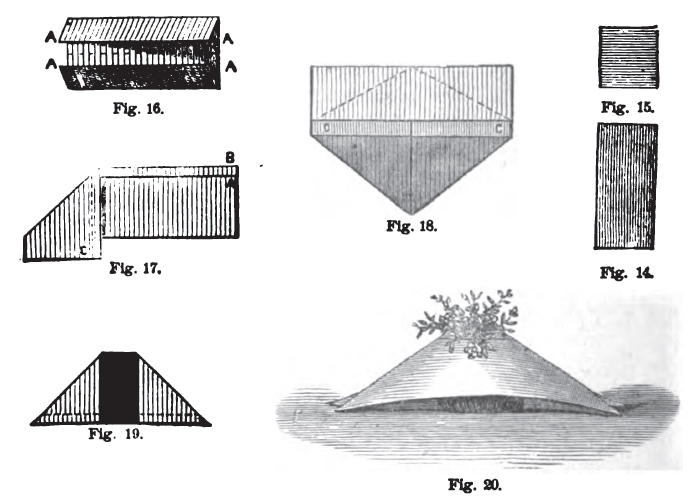
17, first one side and then the other, and iron down the crease; then partly unfold one side, as shown in the diagram, Fig. 18. The dotted lines mark the creases in the unfolded part, and c and c show how the piece marked c, in Fig. IV, is turned down. The piece raised is now folded down again, the dotted line, creased, passed over the other side, and the ends tucked in and creased down flat. The napkin now resembles Fig, 19. Arch it nicely over the dinner roll, and put a spray of flowers at the top to resemble the feather in a cocked hat, in the manner shown in Fig. 20.
The Basket.—Fold a napkin twice, like Figs. 14 and 15, once longways, and the second time across. This is to reduce its size.

Fold the four points to the centre, like Fig. 7; turn it over on the other side, and again fold the four points to the centre; again turn it face downwards, and, with the other side up, turn back the four corners, Fig. 21; fold it from A to B. Fig. 21, and c to D, both folds to be made keeping the part uppermost outwards. Open the last fold from c to D, and bring the shoulder B to the shoulder D by a fold at the dotted line between E. Repeat the same fold as that at E all round. The napkin will now stand on end as a basket, by standing it on its legs at E and the other three corners, and opening it back at F, in the way shown by Fig. 24. Fill the spaces with a few flowers, or cut the roll in four, put a portion in each, and just a flower or two. This pattern placed the reverse way on the plate also looks well, the dinner roll in the centre outside, Fig. 23; it requires the napkin to be very stiff, and exact in the folding. In Fig. 22 the bread is to be placed underneath.
The Mitre.—First fold the napkin in half; then fold down the corners as shown in Fig. 25; turn these corners down again, to meet in the middle, which is indicated by a dotted line. The napkin now looks like Fig. 20. Fold this in half at the dotted line in the centre, bringing the two points back to back, for the fold is

The Shell.—This is another very pretty and marked device. Lay the napkin flat on a table, and fold two sides to meet in the centre lengthways, like Fig. 36; fold it across the centre, and bring the side A A to meet the side B B. . The hems are kept inside in this fold. The long narrow piece thus formed must be folded in six equal pieces, and pressed close. It now resembles Fig. 44. Partly open it, and turn down the tops of the folds all along where the fold is double, in the manner shown by Fig. 35. Some can turn these down better if the lower end is kept close like a fan. When these corners are turned down, draw the end together, and pinch it firmly as a fan, and then set it upright on the plate, the two end folds level with the plate, like Fig. 32. If properly done,

it stands well. It is a very pretty addition to put alternately in each scallop of the shell a small flower and a leaf. Scarlet geraniums look exceedingly well.
The Victoria Regia.—Fold a napkin in half, and again in half, lengthways, keeping the hems to the edge; fold it a third time, also lengthways; then set it in twelve folds, like Fig. 44, as the shell was made, only the napkin is now only half the width, and there are twice as many folds. The corners are turned down (Fig. 35) as they were for the shell, beginning with the first hem; undo the plaits as little as possible; turn the first hem completely back, to make the first row of petals; turn back the second hem the same way, not quite so far; then turn down the first fold, which comes next, to form petals to meet those already made. The last fold is not turned down (see Fig. 40). Bring the two ends of the napkin together to form a round; the inner edges are thus forced up as a heart. A rosette is the figure formed, and the rosette represents the Victoria Regia (Fig. 33). A few small flowers, or even a small rose, look well arranged in the centre. This shape is difficult

to make, and requires very stiff damask. The petals need to be nicely set with the fingers, to resemble it.
To fold Fig. 58. Fold the napkin four times lengthways. Fold down one end as observed at A in Fig. 34—not to the centre by a couple of inches. Fold again at the dotted line B. Roll the end A as shown at c. Fig. 48 illustrates the process. Fig. 58 shows the complete design.
The Tiara.—Double the napkin four times lengthways. Fold down each corner, as shown in Fig. 39. Then fold by the lines across c D, and represent Fig. 53. Push the folds close together.

Source: The Successful Housekeeper ©1882
One of the accomplishments of an "expert waitress ” has long been the ability to fold a napkin in all manner of curious forms. This fancy doubtless comes from the fashion, at one time prevalent, of folding the napkin for each member of the household or each guest in a different manner. This was a French custom, and at one time napkin etiquette ran so high that they were perfumed with rose water and were changed with each course, at ceremonial dinners. A French work published in 1650, which undertook to teach how properly to wait on tables and to fold napkins, gives the following forms in which the cloths might be folded : “ Square, twisted, folded in bands, and in the forms of a double-and twisted shell, single shell. double melon, cock, hen, hen and chickens, two chickens, pigeon in a basket, partridge, pheasant, two capons in a pie, hare, two rabbits, sucking pig, dog with a collar, pike, carp, turbot, mitre, turkey, tortoise, the holy cross and the Lorraine cross.”
Breakfast napkins are considered of the right size if half a yard square ; but for dinner they should be three-quarters of a yard. They are sometimes made an eighth larger, but those are too large for convenience, and there is no necessity for the extra size.
Source: Good Housekeeping ©1894
Subscribe to:
Posts (Atom)