In 1835 it was the only time in the history of our country. I stumbled upon this little tidbit and thought with our current federal debt this was an interesting tidbit. In 1835 Andrew Jackson was president, his nickname was Old Hickory. He has since been praised for his stance and protection of Individual Liberties and democracy. However, he's equally rebuffed for his position on Indian Removal and Slavery.
I don't know enough as to why the government was able to propose a zero balance on the public debt but it could make for an interesting comment or two for our characters set in 1835. Also, this budget was set on Jan. 8, 1835.
Showing posts with label 1835. Show all posts
Showing posts with label 1835. Show all posts
Tuesday, May 23, 2017


Thursday, May 11, 2017
Economy
I'm closing the week out with yet another post from The American Frugal Housewife ©1835. I find this book helpful in two ways, one it has some great information for my 19th century characters. 2, in our day and age where gas prices are sky rocketing, I feel it is important to be as economical as possible and this book is Mrs. Child's work on the topic of economics. I believe the passage below gives the reader a peak into the heart of Mrs. Child and her views of economics.
The other day, I heard a mechanic say, ' I have a wife and two little children ; we live in a very small house; but, to save my life, I cannot spend less than twelve hundred a year.' Another replied, ' You are not economical; I spend but eight hundred.' I thought to myself,—' Neither of you pick up your twine and paper.' A third one, who was present, was silent; but after they were gone, he said, 'I keep house, and comfortably too, with a wife and children, for six hundred a year; but I suppose they would have thought me mean, if I had told them so.' I did not think him mean; it merely occurred to me that his wife and children were in the habit of picking up paper and twine.
Economy is generally despised as a low virtue, tending to make people ungenerous and selfish. This is true of avarice ; but it is not so of economy. The man who is economical, is laying up for himself the permanent power of being useful and generous. He who thoughtlessly gives away ten dollars, when he owes a hundred more than he can pay, deserves no praise,—ho obeys a sudden impulse,. more like instinct than reason: it would be real charity to check this feeling; because the good he does may be doubtful, while the injury he does his family and creditors is certain. True economy is a careful treasurer in the service of benevolence ; and where they are united, respectability, prosperity and peace will follow.
The other day, I heard a mechanic say, ' I have a wife and two little children ; we live in a very small house; but, to save my life, I cannot spend less than twelve hundred a year.' Another replied, ' You are not economical; I spend but eight hundred.' I thought to myself,—' Neither of you pick up your twine and paper.' A third one, who was present, was silent; but after they were gone, he said, 'I keep house, and comfortably too, with a wife and children, for six hundred a year; but I suppose they would have thought me mean, if I had told them so.' I did not think him mean; it merely occurred to me that his wife and children were in the habit of picking up paper and twine.
Economy is generally despised as a low virtue, tending to make people ungenerous and selfish. This is true of avarice ; but it is not so of economy. The man who is economical, is laying up for himself the permanent power of being useful and generous. He who thoughtlessly gives away ten dollars, when he owes a hundred more than he can pay, deserves no praise,—ho obeys a sudden impulse,. more like instinct than reason: it would be real charity to check this feeling; because the good he does may be doubtful, while the injury he does his family and creditors is certain. True economy is a careful treasurer in the service of benevolence ; and where they are united, respectability, prosperity and peace will follow.
Wednesday, May 10, 2017
Britannia Ware
The American Frugal housewife ©1835 I ran across an entry on how to treat Britannia ware. (Britannia ware should be first rubbed gendv with a woolen cloth and sweet oil; then washed in warm suds, and rubbed with soft leather and whiting. Thus treated, it will retain its beauty to the last.')
This made me wonder what exactly was Britannia ware and it's origins. My search resulted in an article written by Stephen Hall for the Historical Society in Beverly, MA. In the article Mr. Hall tells not only some of the history involved with the process of who created Britannia ware but also shares some of the folklore surrounding the invention. Unfortunately when I first posted this post back in 2011 the article has since disappeared from the internet. There is a note from the Beverly Historical Society on their timeline of Beverly History:
1812 The War of 1812 closed Beverly Harbor to trade First Britannia ware made in America in the shop of Israel Trask (160 Cabot Street, ruins of a kiln can still be seen in the backyard.)
However I did find the piece from "The Plough, the Loom, and the Anvil ©1856
BRITANNIA-WARE—A LARGE ESTABLISHMENT.
The business of making Britannia-ware in our country has grown to great proportions, and its growth is still increasing in magnitude. Very much the largest establishment for this important business we suppose to be in West Meriden, Ct., owned and operated by the " Meriden Britannia Co." The establishment, whilst it has a oneness, nuiy properly be divided into three more distinct factories. One is north of the depot, where steam power i< used, and where the ware made is mostly cast, and for. common use. Immense quantities and diverse qualities of ware are turned out of this shop, exciting the admiration of even traveled persons. Another factory is "over east" some three miles, where water power is used, and where1 ware is both cast and "spun up" in largo quantities, and some of it admirable qualities. Up stairs and down, through many stories, are ponderous machines and multitudes of men, actively at work upon ware in some stage of its construction, from the rough ingot to the burnished vase or tankard. But the largest factory is " down in Wallingford," whero more men are employed, and where all the ware is either roiled, pressed and run up, or is the product of all three processes of manufacturing. In this factory the perfection of the art of making this ware is seen. With engines and machines, newly invented and constructed, with many men of great ingenuity long applied, with ample means and facilities, an immense quantity of culinary and purely ornamental wares of astonishing excellence i3 thus turned out into the American market. Each factory has its manager. Silver plating and burnishing are done only at this place. The burnishing hall is large, and the large company of men engaged in it furnishes some of the finest countenances in the State. • These three manufactories, under the name of " Meriden Britannia Co." are the largest establishment in this business on this continent. It has, too, ite "commercial gentleman," who is constantly visiting towns and villages in all the latitudes and longitudes of our country, effecting sales to persons of taste and refinement, as well as to those who use this ware in common life. "Where does our ware go to?" asks the manufacturer, astonished at the quantity demanded. "Where dots all the Britannia ware come from?" asks the million of users and admirers. We cannot say where it all comes from, but we can say, that immense quantities go from the large establishment of the Meriden Company.
End Quote
You can do a quick search of Images for Britannia Ware and discover that is was pewter plates, cups, tea sets, etc.
Quite a while back on one of my historical writer's email loops I'm on, I was reflecting upon the death of Osama Bin Laden and how wars in my life time effect me and apply this to our characters with regard to the wars our characters have lived through. Britannia ware is a result of the war of 1812. The old adage "Necessity is the Mother of invention." holds true time and time again.
This made me wonder what exactly was Britannia ware and it's origins. My search resulted in an article written by Stephen Hall for the Historical Society in Beverly, MA. In the article Mr. Hall tells not only some of the history involved with the process of who created Britannia ware but also shares some of the folklore surrounding the invention. Unfortunately when I first posted this post back in 2011 the article has since disappeared from the internet. There is a note from the Beverly Historical Society on their timeline of Beverly History:
1812 The War of 1812 closed Beverly Harbor to trade First Britannia ware made in America in the shop of Israel Trask (160 Cabot Street, ruins of a kiln can still be seen in the backyard.)
However I did find the piece from "The Plough, the Loom, and the Anvil ©1856
BRITANNIA-WARE—A LARGE ESTABLISHMENT.
The business of making Britannia-ware in our country has grown to great proportions, and its growth is still increasing in magnitude. Very much the largest establishment for this important business we suppose to be in West Meriden, Ct., owned and operated by the " Meriden Britannia Co." The establishment, whilst it has a oneness, nuiy properly be divided into three more distinct factories. One is north of the depot, where steam power i< used, and where the ware made is mostly cast, and for. common use. Immense quantities and diverse qualities of ware are turned out of this shop, exciting the admiration of even traveled persons. Another factory is "over east" some three miles, where water power is used, and where1 ware is both cast and "spun up" in largo quantities, and some of it admirable qualities. Up stairs and down, through many stories, are ponderous machines and multitudes of men, actively at work upon ware in some stage of its construction, from the rough ingot to the burnished vase or tankard. But the largest factory is " down in Wallingford," whero more men are employed, and where all the ware is either roiled, pressed and run up, or is the product of all three processes of manufacturing. In this factory the perfection of the art of making this ware is seen. With engines and machines, newly invented and constructed, with many men of great ingenuity long applied, with ample means and facilities, an immense quantity of culinary and purely ornamental wares of astonishing excellence i3 thus turned out into the American market. Each factory has its manager. Silver plating and burnishing are done only at this place. The burnishing hall is large, and the large company of men engaged in it furnishes some of the finest countenances in the State. • These three manufactories, under the name of " Meriden Britannia Co." are the largest establishment in this business on this continent. It has, too, ite "commercial gentleman," who is constantly visiting towns and villages in all the latitudes and longitudes of our country, effecting sales to persons of taste and refinement, as well as to those who use this ware in common life. "Where does our ware go to?" asks the manufacturer, astonished at the quantity demanded. "Where dots all the Britannia ware come from?" asks the million of users and admirers. We cannot say where it all comes from, but we can say, that immense quantities go from the large establishment of the Meriden Company.
End Quote
You can do a quick search of Images for Britannia Ware and discover that is was pewter plates, cups, tea sets, etc.
Quite a while back on one of my historical writer's email loops I'm on, I was reflecting upon the death of Osama Bin Laden and how wars in my life time effect me and apply this to our characters with regard to the wars our characters have lived through. Britannia ware is a result of the war of 1812. The old adage "Necessity is the Mother of invention." holds true time and time again.
Tuesday, May 9, 2017
Setting Color in Fabric
I stumbled upon this interesting tidbit while reading The American Frugal Housewife ©1835. Personally, I've never heard of this before and found it fascinating. Their are two examples below, one is for carpet fibers and the other for material for clothing.
When a carpet is faded, I have been told that it may bo restored, in a great measure, (provided there be no grease in it,) by being dipped into strong salt and water. 1 never tried this; but 1 know that silk pocket handkerchiefs, and deep blue factory cotton will not fade, if dipped "in salt and water while new.
An ox's gall will set any color,—silk, cotton, or woollen. I have seen the colors of calico, which faded at one washing, fixed by it. Where one lives near a slaughterhouse, it is worth while to buy cheap, fading goods, and set them in this way. The gall can be bought for a few cents. Get out all the liquid, and cork it up in a large phial. One large spoonful of this in a gallon of warm water is sufficient. This is likewise excellent for takfng out spots from bombazine, bombazet, &jc. After being washed in this, they look about as well' as when new. It must be thoroughly stirred into the water, and not put upon the cloth* It is used without soap. After being washed in this, cloth which you want to clean should be washed in warm suds, without using soap.
When a carpet is faded, I have been told that it may bo restored, in a great measure, (provided there be no grease in it,) by being dipped into strong salt and water. 1 never tried this; but 1 know that silk pocket handkerchiefs, and deep blue factory cotton will not fade, if dipped "in salt and water while new.
An ox's gall will set any color,—silk, cotton, or woollen. I have seen the colors of calico, which faded at one washing, fixed by it. Where one lives near a slaughterhouse, it is worth while to buy cheap, fading goods, and set them in this way. The gall can be bought for a few cents. Get out all the liquid, and cork it up in a large phial. One large spoonful of this in a gallon of warm water is sufficient. This is likewise excellent for takfng out spots from bombazine, bombazet, &jc. After being washed in this, they look about as well' as when new. It must be thoroughly stirred into the water, and not put upon the cloth* It is used without soap. After being washed in this, cloth which you want to clean should be washed in warm suds, without using soap.
Tuesday, April 11, 2017
Etiquette & Manners
Etiquette & Manners is something often discussed on some of my of the writer loops I belong to as they pertain to the 19th century. Through Google books I've found a great source of books regarding such topics. Below is a list ordered by the year they were published. I've gathered this resource list over the past two years from Google Books. Hope it helps you in your search for proper behavior in the time period of your setting.
1832 Domestic Manners of the Americans
1835 Pencil Sketches
1837 The Young Lady's Friend
1839 Miss Leslie's Behavior Book
1842 Elegant Extracts
1843 Etiquette or, A Guide to The Usages of Society with a Glance at Bad Habits
1854 Etiquette Social Ethics and the Curtiousy of Society
1854 The Behavior Book
1860 The Gentlemen's Book of Etiquette and Manners
1860 The Hand Book of Etiquette
1866 Marine's Sensible Letter Writer
1868 Manners or Happy Homes
1870 Good Manners a Manual of Ediquette
1872 The Ladie's Book of Etiquette and Manual of Politeness
1873 The Gentlemen's Book of Etiquette and Manual of Politeness
1884 Don't: A Manual of Mistakes and Improprieties More or Less
1888 Manners
1889 American Etiquette and Rules of Politeness
1889 Perfect Etiquette or How to Behave in social...
1892 Etiquette An Answer to the Riddle, When? Where? How?
1896 Social Etiquette or Manners and Customs of Polite Society
1897 Manners for Men
1897 Practical Letter Writing
1899 Twenty Letters in Letter Writing and Business
1832 Domestic Manners of the Americans
1835 Pencil Sketches
1837 The Young Lady's Friend
1839 Miss Leslie's Behavior Book
1842 Elegant Extracts
1843 Etiquette or, A Guide to The Usages of Society with a Glance at Bad Habits
1854 Etiquette Social Ethics and the Curtiousy of Society
1854 The Behavior Book
1860 The Gentlemen's Book of Etiquette and Manners
1860 The Hand Book of Etiquette
1866 Marine's Sensible Letter Writer
1868 Manners or Happy Homes
1870 Good Manners a Manual of Ediquette
1872 The Ladie's Book of Etiquette and Manual of Politeness
1873 The Gentlemen's Book of Etiquette and Manual of Politeness
1884 Don't: A Manual of Mistakes and Improprieties More or Less
1888 Manners
1889 American Etiquette and Rules of Politeness
1889 Perfect Etiquette or How to Behave in social...
1892 Etiquette An Answer to the Riddle, When? Where? How?
1896 Social Etiquette or Manners and Customs of Polite Society
1897 Manners for Men
1897 Practical Letter Writing
1899 Twenty Letters in Letter Writing and Business
Friday, March 31, 2017
The Martha's Vineyard Campgrounds
Last week Paul and I celebrated 43 years of marriage.
I mention that to give the reason for my choice of locations for today's blog post. There is a book in Google books, A History of the Wesleyan Grove, Martha's Vineyard, camp meeting: ©1858' that will give you a great overview of what we now refer to as the "Campgrounds." The gingerbread houses bring tourist from all over. As a kid I used to sell bunches of flowers to the "old" (I may be that age now) ladies in the campgrounds. I also attended the Methodist church in the campground, and our high school class graduation ceremony was held there. I have many other memories associated with the campgrounds but that's not why you come to read my blog.
The first camp meeting was held in 1835 and the book linked above only covers to the year 1858. People came with their tents and camped on the grounds. The preacher's tent was elevated and in front of the group. There were only 9 tents that formed the first circle. However makeshift tents were made from sails and awnings. A well was dug for pure water. The land is right off the Oak Bluffs harbor. A quote from those first meetings was "Surely the Lord is in this place." God moved and continued to move for many years and decades. So much so, that tents were replaced with wooden camp houses. The grand illumination, which we grew up knowing as Illumination night, was filled with lighting paper lanterns and hanging them from houses and lines strung for the occasion. It's still owned by the same camp meeting association of 1835 and in August, they still host the Grand Illumination Night.
Here's a picture I took on my last visit to the Vineyard showing one of the gingerbread houses.

I mention that to give the reason for my choice of locations for today's blog post. There is a book in Google books, A History of the Wesleyan Grove, Martha's Vineyard, camp meeting: ©1858' that will give you a great overview of what we now refer to as the "Campgrounds." The gingerbread houses bring tourist from all over. As a kid I used to sell bunches of flowers to the "old" (I may be that age now) ladies in the campgrounds. I also attended the Methodist church in the campground, and our high school class graduation ceremony was held there. I have many other memories associated with the campgrounds but that's not why you come to read my blog.
The first camp meeting was held in 1835 and the book linked above only covers to the year 1858. People came with their tents and camped on the grounds. The preacher's tent was elevated and in front of the group. There were only 9 tents that formed the first circle. However makeshift tents were made from sails and awnings. A well was dug for pure water. The land is right off the Oak Bluffs harbor. A quote from those first meetings was "Surely the Lord is in this place." God moved and continued to move for many years and decades. So much so, that tents were replaced with wooden camp houses. The grand illumination, which we grew up knowing as Illumination night, was filled with lighting paper lanterns and hanging them from houses and lines strung for the occasion. It's still owned by the same camp meeting association of 1835 and in August, they still host the Grand Illumination Night.
Here's a picture I took on my last visit to the Vineyard showing one of the gingerbread houses.

Saturday, January 14, 2017
Character & Manners
One of the ways Character and Manners were taught in the 19th century was through the use of stories. The paragraphs below come from Pencil Sketches: or outlines of character and manners © 1835 by Eliza Leslie
JOHN W. ROBERTSON
A TALE OF A CENT.
Some there be that shadows kiss.—Shakespeare.
Selina Mansel was only sixteen when she took charge of her father's house and entered on the arduous task of doing as she pleased: provided always that she duly attended to his chief injunction, never to allow herself to incur a debt, however trifling, and to purchase nothing that she could not pay for on the spot. To the observance of this rule, which he had laid down for himself in early life, Mr. Mansel attributed all his success in business, and his ability to retire at the age of fifty with a handsome competence.
Since the death of his wife, Mr. Mansel's sister had presided over his family, and had taken much interest in instructing Selina in what she justly termed the most useful part of a woman's education, Such was Miss Eleanor Mansel's devotion to her brother and his daughter, that she had hesitated for twelve years about returning an intelligible answer to the love-letters which she received quarterly from Mr. Waitstill Wonderly, a gentleman whose dwelling-place was in the far, far east. Every two years this paragon of patience came in person: his home being at a distance of several hundred miles, and his habits by no means so itinerant as those of the generality of his countrymen.
On his sixth avatar, Miss Mansel consented to reward with her hand the constancy of her inamorato; as Selina had, within the last twelvemonth, made up two pieces of linen for her father, prepared the annual quantity of pickles and preserves, and superintended two house-cleanings, all herself—thus giving proof positive that she was fully competent to succeed her aunt Eleanor as mistress of the establishment.
Selina Mansel was a very good and a very pretty girl. Though living in a large and flourishing provincial town, which we shall denominate Somerford, she had been brought up in comparative retirement, and had scarcely yet begun to go into company, as it is called. Her understanding was naturally excellent; but she was timid, sensitive, easily disconcerted, and likely to appear to considerable disadvantage in any situation that was the least embarrassing.
You can read the rest of the story at Google books.
JOHN W. ROBERTSON
A TALE OF A CENT.
Some there be that shadows kiss.—Shakespeare.
Selina Mansel was only sixteen when she took charge of her father's house and entered on the arduous task of doing as she pleased: provided always that she duly attended to his chief injunction, never to allow herself to incur a debt, however trifling, and to purchase nothing that she could not pay for on the spot. To the observance of this rule, which he had laid down for himself in early life, Mr. Mansel attributed all his success in business, and his ability to retire at the age of fifty with a handsome competence.
Since the death of his wife, Mr. Mansel's sister had presided over his family, and had taken much interest in instructing Selina in what she justly termed the most useful part of a woman's education, Such was Miss Eleanor Mansel's devotion to her brother and his daughter, that she had hesitated for twelve years about returning an intelligible answer to the love-letters which she received quarterly from Mr. Waitstill Wonderly, a gentleman whose dwelling-place was in the far, far east. Every two years this paragon of patience came in person: his home being at a distance of several hundred miles, and his habits by no means so itinerant as those of the generality of his countrymen.
On his sixth avatar, Miss Mansel consented to reward with her hand the constancy of her inamorato; as Selina had, within the last twelvemonth, made up two pieces of linen for her father, prepared the annual quantity of pickles and preserves, and superintended two house-cleanings, all herself—thus giving proof positive that she was fully competent to succeed her aunt Eleanor as mistress of the establishment.
Selina Mansel was a very good and a very pretty girl. Though living in a large and flourishing provincial town, which we shall denominate Somerford, she had been brought up in comparative retirement, and had scarcely yet begun to go into company, as it is called. Her understanding was naturally excellent; but she was timid, sensitive, easily disconcerted, and likely to appear to considerable disadvantage in any situation that was the least embarrassing.
You can read the rest of the story at Google books.
Wednesday, November 30, 2016
Astronomy from Literary Gazette 1830
Celestial Phenomena from 1830 to 1836
To stimulate recent subscribers to the Literary Gazette to commence with the year the study of astronomy, a brief sketch is subjoined of the aost remarkable phenomena that will occur mm 1830 to 1836, inclusive. Some of these are connected with questions and predictions to the solution and fulfilment of which philosophers are looking forward with considerable interest; more particularly to the return of the three comets, whose periods are supposed to be kaown with some degree of certainty; namely, lbs cnmets of Encke, Biela, and Halley.
1830—Four visible occultations of Aldebarsn, one of which will be attended with singular circumstances connected with terrestrial position—to one part of the British Isles it will prove only an appulse of the star, and to another part an occultation. A total eclipse of the moon, the duration of which will be almost the longest possible, as the centre of the moon will pass very near the centre of the earth's shadow: about the middle of the eclipse the saoon will be in conjunction with a star in Aquarius, which conjunction will, in some places be an occultation. An occultation of Venus by the moon.
1831 An eclipse of the moon. Mars will pass over a star in Taurus. An occultation of Japiter by the moon. Mercury eclipsed by the san. An occultation of Saturn by the moon.
1832—This year will be remarkably replete with interesting phenomena. The comet of Eacke will return in the spring, and the comet «f Biela in the autumn of the year. A transit rf Mercury across the sun's disc. An eclipse rf the sun. An occultation of Saturn by the 2UOB. Three of the satellites of Jupiter sizxltaneou&ly eclipsed.
1833 An eclipse of the sun.
1834 and 1835—The comet of Halley will ae expected; it last passed its perihelion on the -3th of March, 1759: it is calculated to reach iie same point again 16th of March, 1835. A Sanaa t of Mercury across the sun's disc.
1836 A considerable solar eclipse.
end of quote
Note they didn't put in the 1833 Leonoids meteor storm. Coined "The Night It Rained Fire."
To stimulate recent subscribers to the Literary Gazette to commence with the year the study of astronomy, a brief sketch is subjoined of the aost remarkable phenomena that will occur mm 1830 to 1836, inclusive. Some of these are connected with questions and predictions to the solution and fulfilment of which philosophers are looking forward with considerable interest; more particularly to the return of the three comets, whose periods are supposed to be kaown with some degree of certainty; namely, lbs cnmets of Encke, Biela, and Halley.
1830—Four visible occultations of Aldebarsn, one of which will be attended with singular circumstances connected with terrestrial position—to one part of the British Isles it will prove only an appulse of the star, and to another part an occultation. A total eclipse of the moon, the duration of which will be almost the longest possible, as the centre of the moon will pass very near the centre of the earth's shadow: about the middle of the eclipse the saoon will be in conjunction with a star in Aquarius, which conjunction will, in some places be an occultation. An occultation of Venus by the moon.
1831 An eclipse of the moon. Mars will pass over a star in Taurus. An occultation of Japiter by the moon. Mercury eclipsed by the san. An occultation of Saturn by the moon.
1832—This year will be remarkably replete with interesting phenomena. The comet of Eacke will return in the spring, and the comet «f Biela in the autumn of the year. A transit rf Mercury across the sun's disc. An eclipse rf the sun. An occultation of Saturn by the 2UOB. Three of the satellites of Jupiter sizxltaneou&ly eclipsed.
1833 An eclipse of the sun.
1834 and 1835—The comet of Halley will ae expected; it last passed its perihelion on the -3th of March, 1759: it is calculated to reach iie same point again 16th of March, 1835. A Sanaa t of Mercury across the sun's disc.
1836 A considerable solar eclipse.
end of quote
Note they didn't put in the 1833 Leonoids meteor storm. Coined "The Night It Rained Fire."
Saturday, October 1, 2016
Lithographs
Lithographs made it possible for Salesmen to sell their products. What is a lithograph, you ask, originally printers found that with a grease pencil or crayon the printer could mark the limestone. The process then continued with rolling the ink on the stone and pressing the paper to it for a print. What was particularly helpful for these printers is that the stone could be used over and over again making as many prints as the printer wanted. It didn't take long before the stones were exchanged for metal plates.
What did this mean for the 19th century? Many things. As previously mentioned yesterday salesmen had copies of their product to sell in picture form. Currier & Ives begin in 1835 as did many other printers. It opened yet another business for mankind, one that only a handful of people had been able to do before. It allowed artists to get their work out. Illustrators were used in newspapers and on and on it went.
As the century developed so did the techniques. At first the lithographs were black and white and the artist would paint the color to the prints. By the 1880's advertising had blossomed and so did the printing base, allowing color to be printed. There were a lot of changes in the printing industry during the 19th century, just as there has been a lot in our own century.
What this all means for us who write historical fiction, think creatively, look at all the occupations that come just from the invention of the lithograph. There is the printer, the business man who owns the printing business, the artists who painted in the black and white prints and the artist who prepared the printing plates for the prints.
What did this mean for the 19th century? Many things. As previously mentioned yesterday salesmen had copies of their product to sell in picture form. Currier & Ives begin in 1835 as did many other printers. It opened yet another business for mankind, one that only a handful of people had been able to do before. It allowed artists to get their work out. Illustrators were used in newspapers and on and on it went.
As the century developed so did the techniques. At first the lithographs were black and white and the artist would paint the color to the prints. By the 1880's advertising had blossomed and so did the printing base, allowing color to be printed. There were a lot of changes in the printing industry during the 19th century, just as there has been a lot in our own century.
What this all means for us who write historical fiction, think creatively, look at all the occupations that come just from the invention of the lithograph. There is the printer, the business man who owns the printing business, the artists who painted in the black and white prints and the artist who prepared the printing plates for the prints.
Monday, September 5, 2016
Christian Campgrounds
On Martha's Vineyard there is a great campground with gingerbread houses and a center tabernacle. My graduation exercise was held there and from what I understand it is still being used today for High School graduations.
During the 19th century there were a lot of these Christian Camp meetings set up. Old Orchard Beach (approx. 1842) in Maine, The Methodist Campground (1835) in Oak Bluffs, MA and Simpson Park Campground (1865) in Michigan. Each of these played an important part on people's lives but also on the general economy of a region.
Today, few Christian Campgrounds remain and those that have, have changed how they run the day to day of the camp. Many can not move their families for the summer to a campground.
I have not done an extensive search but I believe the Methodist were pioneers and leaders in the Christian Campgrounds and revivals.
During the 19th century there were a lot of these Christian Camp meetings set up. Old Orchard Beach (approx. 1842) in Maine, The Methodist Campground (1835) in Oak Bluffs, MA and Simpson Park Campground (1865) in Michigan. Each of these played an important part on people's lives but also on the general economy of a region.
Today, few Christian Campgrounds remain and those that have, have changed how they run the day to day of the camp. Many can not move their families for the summer to a campground.
I have not done an extensive search but I believe the Methodist were pioneers and leaders in the Christian Campgrounds and revivals.
Thursday, September 1, 2016
Michigan Territory
In 1805 Michigan Territory was incorporated. At this time the people were primarily involved with the fur trade. Until 1812 the Indians were a vital part of the economy after the war of 1812 and over the next 30 years the Federal government started to take over the Indian lands and remove them from the area.
It is also important to note in this area that French were the first majority of European settlers, then the English.
The war of 1812 also changed the economics of the region, fur was no longer as valuable, lands were being developed for farm.
Here's an excerpt from Memoirs of Lenawee County, Michigan from the point of view of a six year old in 1835 retold as a grown man...
"It was very interesting to hear him tell of his childhood, when the Indians visited his home (there having been a trading station on the farm before his father purchased it); how the children, being afraid, clung to their mother; of the graves of an Indian chief and a papoose; of hunting deer and wild turkey, and of being lost in the woods on the farm while going after the cows. These stories are very dear to the children and also the grandchildren, ..."
What I find interesting in these little tidbits as a writer is what kind of game they hunted. What stuck out as such a vivid memory to a child and the "woods" on the farm. I think today we mostly picture the wide open fields for farmland. I know, I sometimes forget there was more on the farm then simply acres of farmland, especially during the 19th century.
It is also important to note in this area that French were the first majority of European settlers, then the English.
The war of 1812 also changed the economics of the region, fur was no longer as valuable, lands were being developed for farm.
Here's an excerpt from Memoirs of Lenawee County, Michigan from the point of view of a six year old in 1835 retold as a grown man...
"It was very interesting to hear him tell of his childhood, when the Indians visited his home (there having been a trading station on the farm before his father purchased it); how the children, being afraid, clung to their mother; of the graves of an Indian chief and a papoose; of hunting deer and wild turkey, and of being lost in the woods on the farm while going after the cows. These stories are very dear to the children and also the grandchildren, ..."
What I find interesting in these little tidbits as a writer is what kind of game they hunted. What stuck out as such a vivid memory to a child and the "woods" on the farm. I think today we mostly picture the wide open fields for farmland. I know, I sometimes forget there was more on the farm then simply acres of farmland, especially during the 19th century.
Saturday, August 6, 2016
Pencil History
William Monroe was the first to develop the pencil in the United States. He developed a way to grind down the graphite and combine it with clay and other substances to fashion into the lead of the pencil. In 1812 he sold his first pencils. Here’s the thing, the war of 1812 was going on with England, supplies were limited in what items could be purchased from Europe. This meant the pencil was one of those items. Also because of the war his cabinet making business was struggling. The old adage “Necessity is the mother of invention” well this certainly applied to the invention of the production of the modern pencil in America. Monroe also developed the technique of putting the lead into the center of the pencil.
By 1814 he had made nearly 175,000 pencils, which sold for about six thousand dollars, a very large amount of money at the time.
By 1835 he had made over 5 million pencils.
Other pencil businesses developed over the years but Monroe’s was one of the most successful. But there is another significant event that happened in the 1800’s.
March 30, 1858, Mr. Hymen L. Lipman patented the rubber eraser that attached to the pencil. Lipmand sold his patent for 100k and a lawsuit was filed against Faber (a pencil maker in NY) and the lawsuit made it all the way to the Supreme Court you can find this lawsuit on the Internet.
http://supreme.justia.com/us/92/347/case.html
By 1814 he had made nearly 175,000 pencils, which sold for about six thousand dollars, a very large amount of money at the time.
By 1835 he had made over 5 million pencils.
Other pencil businesses developed over the years but Monroe’s was one of the most successful. But there is another significant event that happened in the 1800’s.
March 30, 1858, Mr. Hymen L. Lipman patented the rubber eraser that attached to the pencil. Lipmand sold his patent for 100k and a lawsuit was filed against Faber (a pencil maker in NY) and the lawsuit made it all the way to the Supreme Court you can find this lawsuit on the Internet.
http://supreme.justia.com/us/92/347/case.html
Monday, August 17, 2015
1835 House Plans Part 2
This continues the series of 1835 House plans originally published in 1835 in London.
Country House
This house consists of two floors. On the ground are the parlour and drawing-room, at the back of which is the kitchen, above are three bed-rooms. The external appearance of the building is neat and simple; and it would form a pleasant occasional retreat to a gentleman engaged in business.


Design for a Double House.
The entrance to each dwelling is on the side. The plan is so divided that each has a good room in the centre of its front . The parlours and drawing-room may be thrown together by folding doors. The kitchen, wash-house, &c, are below stairs. Each house has three bed-rooms, on the one-pair floor. In the external appearance these two dwellings form one uniform building.


Design for a Villa.
Simplicity is the character of this design. A portico of Greek Doric columns occupies the centre of the elevation; on each side of which is a window down to the ground. This building is proposed rather as an occasional than a constant residence. The plan, however, affords sufficient accommodations for a small family desirous of enjoying in seclusion the pleasures of rural retirement.


Another Design for a Villa.
In this design the offices are in the basement. The sitting-rooms on the ground-floor, and the bed-rooms on the one-pair. Considering the dimensions of the house, the accommodations are numerous, and particularly suitable to a moderate-sized family. In the front of the house, between the projecting wings, is a Doric portico; over it is a balcony, to which a handsome veranda would be no inconsiderable improvement.


Country House
This house consists of two floors. On the ground are the parlour and drawing-room, at the back of which is the kitchen, above are three bed-rooms. The external appearance of the building is neat and simple; and it would form a pleasant occasional retreat to a gentleman engaged in business.


Design for a Double House.
The entrance to each dwelling is on the side. The plan is so divided that each has a good room in the centre of its front . The parlours and drawing-room may be thrown together by folding doors. The kitchen, wash-house, &c, are below stairs. Each house has three bed-rooms, on the one-pair floor. In the external appearance these two dwellings form one uniform building.


Design for a Villa.
Simplicity is the character of this design. A portico of Greek Doric columns occupies the centre of the elevation; on each side of which is a window down to the ground. This building is proposed rather as an occasional than a constant residence. The plan, however, affords sufficient accommodations for a small family desirous of enjoying in seclusion the pleasures of rural retirement.


Another Design for a Villa.
In this design the offices are in the basement. The sitting-rooms on the ground-floor, and the bed-rooms on the one-pair. Considering the dimensions of the house, the accommodations are numerous, and particularly suitable to a moderate-sized family. In the front of the house, between the projecting wings, is a Doric portico; over it is a balcony, to which a handsome veranda would be no inconsiderable improvement.


Monday, August 10, 2015
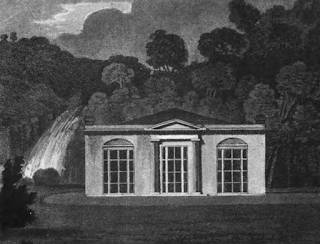
1835 House Plans
These plans and drawings come from a London Publication.
Design for a small Country House, consisting of a Ground Floor, containing Six Rooms.
This design would be appropriate to the accommodation of a small family, and might be elegantly decorated. It would also form a handsome lodge at the entrance to a Park j and might become the residence of a gate-keeper or bailiff; or could be divided into two smaller tenements. The front is adorned with a Doric portico and pediment, and the whole should be stuccoed in imitation of stone.

Design for a Villa.
This building contains all the conveniencies usually required for a small respectable family. It is so planned that the offices are separated from the other parts of the house. The parlour and sittingroom are of handsome proportions; and in summer the hall would become a very desirable apartment. The doors of the parlour and sitting-room would be considerably widened, and the three might then be thrown into one. The bed-rooms, which are four in number, are so contrived as to be completely out of sight in the front of the house.


Design for a Villa.
All the apartments, except the bed-rooms, are on the groundfloor; the elevation, in the Roman style, is adorned with a portico of the Ionic Order; the centre is surmounted by a dome. This design is small and compact, and would form a commodious and desirable residence.


Design for a small Country House, consisting of a Ground Floor, containing Six Rooms.
This design would be appropriate to the accommodation of a small family, and might be elegantly decorated. It would also form a handsome lodge at the entrance to a Park j and might become the residence of a gate-keeper or bailiff; or could be divided into two smaller tenements. The front is adorned with a Doric portico and pediment, and the whole should be stuccoed in imitation of stone.


Design for a Villa.
This building contains all the conveniencies usually required for a small respectable family. It is so planned that the offices are separated from the other parts of the house. The parlour and sittingroom are of handsome proportions; and in summer the hall would become a very desirable apartment. The doors of the parlour and sitting-room would be considerably widened, and the three might then be thrown into one. The bed-rooms, which are four in number, are so contrived as to be completely out of sight in the front of the house.


Design for a Villa.
All the apartments, except the bed-rooms, are on the groundfloor; the elevation, in the Roman style, is adorned with a portico of the Ionic Order; the centre is surmounted by a dome. This design is small and compact, and would form a commodious and desirable residence.


Saturday, September 6, 2014
Cows
If you lived in the 19th Century and worked outside of a city more than likely you knew and had experience with cows. Below are some pictures and brief info to help the writer identify the type of cow that might be in their books.
Short Horned Cows
 It has heen frequently asserted, that short-horn cows are had milkers, indeed that no kind of cattle are so deficient in milk. Those who say so do not know the still greater deficiencies of the Herefords, a species of cattle quite unknown in Scotland. The higher hred stocks of the Messrs. Collings, Mr. Mason, and Mr. Rohertson, yielded little milk. Indeed, Mr. Rohertson's cows could not supply milk sufficient for their own calves, at least not in the quantity which it was desired hy him they should receive. Cows were kept for the purpose of supplying the deficiency of milk of the high-hred cows. But this deficiency of milk did not altogether proceed from the circumstance of the cows heing of the short-horn hreed : hecause those eminent hreeders devoted their whole attention to the developement of flesh, and not at all to the developement of milk. Had the flesh heen neglected as much as the milk, and the property of giving milk as much cherished as the developement of flesh, their short-horn Coats would have heen deep milkers. As it is, the generality of shorthorn cows are not had milkers.
Source: The Farmers' Magazine Click link for the rest of the article.
Sussex Cow "Elsa"
 Winner of the Champion Prize given by the Sussex Herd Book Society for the best female in the Sussex classes, and of the Gold Medal presented by Her Majesty the Queen for the best animal in the Sussex classes, at the Jubilee Show of the Royal Agricultural Siicicty of England, Windsor, 1889. Bred and exhibited by Mr. W. B. Waterlow, of High Trees, Redhill, Surrey.
Source: The Complete Grazier and Farmers' and Cattle=Breeders Assistant Click link for the entire book.
Ayrshire Cow
 The Ayrshire cow, removed to England, is said not to maintain her dairy qualities at the best; there is tendency to flesh. The American-bred Jersey shows more horn, larger bone, and a less deer-like form than the Jersey-born.
The Ayrshire is exceptionally hardy. Though you may not expect to freeze her blood in the yard, and at the succeeding thaw find her milk flow unimpaired, her coat sleek, and her back straight, yet she will be as profitable with those who expect all this from a cow as any other.
Source: The Dairy Cow Click link for the entire book.
Jersey Cow
 Though it is rapidly being proved that cows of the Jersey and Guernsey breeds rank as first-rate for richness of milk and cream, for quantity and high quality of butter, for easy keeping qualities and for delicacy of meat, there yet seemed a want of a work which proves all these excellent qualities to be possessed by these breeds, and, by bringing them more prominently into notice, to advance the interests of the agricultural community, particularly that portion of it residing in the vicinity of large cities and towns; though by the constantly increasing advantages offered by most of the railways distant portions of the country are brought more nearly and advantageously together.
Source: The Jersey, Alderney and Guernsey Cow Click the link for the entire book.
Short Horned Cows

Source: The Farmers' Magazine Click link for the rest of the article.
Sussex Cow "Elsa"

Source: The Complete Grazier and Farmers' and Cattle=Breeders Assistant Click link for the entire book.
Ayrshire Cow

The Ayrshire is exceptionally hardy. Though you may not expect to freeze her blood in the yard, and at the succeeding thaw find her milk flow unimpaired, her coat sleek, and her back straight, yet she will be as profitable with those who expect all this from a cow as any other.
Source: The Dairy Cow Click link for the entire book.
Jersey Cow

Source: The Jersey, Alderney and Guernsey Cow Click the link for the entire book.
Wednesday, May 21, 2014
1835 Fashions
This is the only image I have so far for 1835 fashions and the sketch is a bit simple but I'm including in today's tidbit the text with the image from the 1835 fashion sheet. I love some of the wording in this text.

COATS
RIDING COATS for this month are made single-breasted, faced in the fronts with silk; velvet collars, and gilt buttons. The colors are a rich red brown, light green, and gold mixtures.
The new BROWN SURTOUT (for the Spring) will most probably take the lead this month; made single-breasted, to turn back to the second button in the waist; the collar (which is of velvet) is very broad in front, but rather narrow behind; the breasts faced with silk, and rather large fancy twist buttons.
THE BLUE DRESS COAT,
faced with satin, continues to be the favorite; a few Evening Coats, of a light-green color, will be worn: these have a very lively appearance, but the former are decidedly the most dressy.
TROUSERS
The newest materials for MORNING TROUSERS are the checked single-milled cashmeres, and striped merino doeskins, which, in contrast with their almost-numberless rivals, will obtain the decided preference with all who study neatness and gentlemanly taste. Broad linen cords, diagonal draped cantons, gambroons, &c., of various colors, of which there is an infinite variety, will also be much worn.
Black, lavender, and white for Dress.
Trousers are still made full in the legs.
WAISTCOATS
The Buff Waist-coat, richly braided with white, still continues to be much worn by Gentlemen of fast; they are now made with broad rolling collars, and silver buttons. A very neat variety of striped and checked Challis Waistcoats are introducing, which, with a few new silks, will be the fashion for this month. Some Waistcoats are made with plain upright collars, but the general mode is with a broad rolling collar--single-breast.
DRESS WAISTCOATS
as last month.
In full Dress an under Waistcoat, of scarlet, blue, or white.

COATS
RIDING COATS for this month are made single-breasted, faced in the fronts with silk; velvet collars, and gilt buttons. The colors are a rich red brown, light green, and gold mixtures.
The new BROWN SURTOUT (for the Spring) will most probably take the lead this month; made single-breasted, to turn back to the second button in the waist; the collar (which is of velvet) is very broad in front, but rather narrow behind; the breasts faced with silk, and rather large fancy twist buttons.
THE BLUE DRESS COAT,
faced with satin, continues to be the favorite; a few Evening Coats, of a light-green color, will be worn: these have a very lively appearance, but the former are decidedly the most dressy.
TROUSERS
The newest materials for MORNING TROUSERS are the checked single-milled cashmeres, and striped merino doeskins, which, in contrast with their almost-numberless rivals, will obtain the decided preference with all who study neatness and gentlemanly taste. Broad linen cords, diagonal draped cantons, gambroons, &c., of various colors, of which there is an infinite variety, will also be much worn.
Black, lavender, and white for Dress.
Trousers are still made full in the legs.
WAISTCOATS
The Buff Waist-coat, richly braided with white, still continues to be much worn by Gentlemen of fast; they are now made with broad rolling collars, and silver buttons. A very neat variety of striped and checked Challis Waistcoats are introducing, which, with a few new silks, will be the fashion for this month. Some Waistcoats are made with plain upright collars, but the general mode is with a broad rolling collar--single-breast.
DRESS WAISTCOATS
as last month.
In full Dress an under Waistcoat, of scarlet, blue, or white.
Subscribe to:
Posts (Atom)