Showing posts with label 1887. Show all posts

Tuesday, August 1, 2017

Clip Boards of the 19th Century called Letter-Clips

A question a while back on a historical writer's loop was searching for when clipboards were in use during the 19th century. Thanks to Carla for her links to the email loop with the answers that gave me further direction in answering this question.
Here are Carla's references:
1880
An Attorney General's report 1880 lists the item.
1887
The Writer Vol. 1-2 referencing a letter-clip with a description of the board.

I found some earlier references:
1842
Below is an image of a letter clip in 1842 from The Practical Mechanice & Engineer's Magazine Vol. 1 Page 32.
The same image is in another magazine a year earlier 1841.

1865
Referenced in the Household documents of an estate.
1871
Referenced in a Patent book as similar to a letter-clip.
1874
A Practical Dictionary with a description of the item.
1883
The New Letter-Clip

Thursday, April 6, 2017

California Gold Rush

The term California Gold Rush entered into our history reports in the late 1800's as best as I can tell. I was going to take the time and outline key events of the Gold Rush but came across a web page that has already done for us. The search for Gold helped in the expansion of California and in points west. It dated from 1848-1859.

California Gold Rush Timeline

And don't ignore sites written with children in mind. Sometimes it helps to simplify points by reading over such websites. Kidport Reference Library They also have a lot of links to other sites.

And if your looking for a story and how the California Gold Rush affected some of the towns, Munsey Magazine, Vol 10 has an article Mr. Justice Field located in Google books.

Wednesday, April 5, 2017

Height of Principle Monuments and Towers

This comes from Houghtalings Handbook of Useful Information ©1887. If you're interested in having the scanned images of this book, you can contact me privately.

NAMES. . . . . . . . . . . . . . . PLACES. . . . . FEET
Pyramid of Cheops. . . . . . . . . Eqypt. . . . . .486
Antwerp Cathedral. . . . . . . . . Belgium. . . . .476
Strasburg Cathedral. . . . . . . . France. . . . . 474
St. Peter's Church. . . . . . . . .Rome. . . . . . 456
St. Martin's Church at Landshut. . Germany. . . . .411
St. Paul's Church, London. . . . . England. . . . .365
Salisbury Cathedral. . . . . . . . England. . . . .400
Cathedral at Florence. . . . . . . Italy. . . . . .387
Cathedral at Cremona. . . . . . . .Lombardy. . . . 355
Cathedral at Utrecht. . . . . . . .Holland. . . . .356
Pyramid of Sakkarah. . . . . . . . Egypt. . . . . .356
Cathedral of Notre Dame, Munich. . Bavaria. . . . .348
St. Mark's Church. . . . . . . . . Venice. . . . . 328
Assinelli Tower, Bologna. . . . . .Italy. . . . . .272
Trinity Church. . . . . . . . . . .New York. . . . 284
Column at Delhi. . . . . . . . . . Hindostand . . .262
Porcelain Tower, Nankin. . . . . . China. . . . . .260
Church of Notre Dame. . . . . . . .Paris. . . . . .224
Bunker Hill Monument. . . . . . . .Massachusetts. .221
Leaning Tower of Pisa. . . . . . . Italy. . . . . .179
Washington Monument. . . . . . . . Baltimore. . . .555(in Houghtalings they had 175 ft)
Monument Place Vendome. . . . . . .Paris. . . . . .153
Trajan's Pillar, Rome. . . . . . . Italy. . . . . .151
Obelisk of Luxor, now in . . . . . Paris. . . . . .110
Egyptian Obelisk, now in . . . . . New York. . . . ---

I'm not certain why they have an error with the Washington Monument but I do know that the construction of the momument was halted during the American Civil War. The Washington Monument officially opened Oct. 9, 1888. Making it the tallest structure in the world. The Eiffel Tower was completed the next year in 1889 taking the title of the tallest structure in the world.

Monday, March 27, 2017

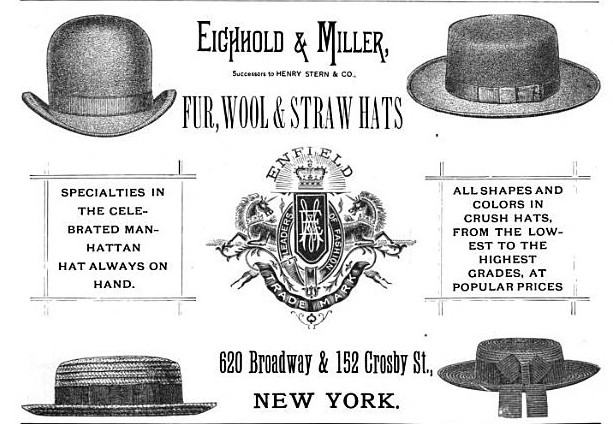
1887 Gentlemen's Hats

Last week there was a blog post with 1870 Gentlemen's Hats. Today I'm posting advertising pictures of 1887 hats from a periodical of the time.

Monday, February 27, 2017

Dressing Rice

A Black Man's Recipe to Dress Rice.—Wash him well, much wash in cold water, the rice flour make him stick. Water boil all ready verj fast. Throw him in, rice can't burn, water shake him too much. Boi> quarter of an hour or little more; rub one rice in thumb and finger, if all rub away him quite done. Put rice in colander, hot water run away; pour cup of cold water on him, put back rice in saucepan, keep him covered near the Are. then rice all ready. Eat him up!
Source: Dr. Chase's Recipes ©1887

Wednesday, February 8, 2017

Custard Pie

Custard goes back long before the 19th century. The recipe below is from the White House Cook Book, not to be confused that this cook book is authorized from the White House in Washington, DC. However later editions of this cook book were co-authored by White House steward Hugo Ziemann. The name was chosen as a marketing ploy, which seemed to work. Fannie Gillete the original author started her writing career and fame when she was sixty years old and with the first edition of the White House Cook Book in 1887.


BAKERS' CUSTARD PIE.
Beat up the yolks of three eggs to a cream. Stir thoroughly a tablespoonful of sifted flour into three tablespoonfuls of sugar; this separates the particles of flour so that there will be no lumps; then add it to the beaten yolks, put in a pinch of salt, a teaspoonful of vanilla, and a little grated nutmeg; next the well-beaten whites of the eggs; and lastly, a pint of scalded milk (not boiled) which has been cooled; mix this in by degrees, and turn all into a deep pie-pan, lined with puff-paste, and bake from twenty-five to thirty minutes.
I received this recipe from a celebrated cook in one of our best New York bakeries. I inquired of him "why it was that their custard pies had that look of solidity and smoothness that our home-made pies have not." He replied, "The secret is the addition of this bit of flour—not that it thickens the custard any to speak of, but prevents the custard from breaking or wheying, and gives that smooth appearance when cut."
Source: White House Cook Book ©1889 pg293

Thursday, January 26, 2017

Benjamin Franklin's Words of Wisdom

In honor of Benjamin Franklin's Birthday last week I've selected this list of quotes from Houghtaling's Handbook of Useful Information ©1887

Ben. Franklin's Words of Wisdom.
Want of care does us more damage than want of knowledge.

For want of a nail the shoe was lost, and for want of a shoe the horse was lost.

For age and want save while you may, no morning sun lasts all the day.

Experience keeps a dear school, but fools will learn in no other.

Lying rides upon debt's back; it is hard for an empty bag to stand upright.

Creditors have better memories than debtors.

Women and wine, game and deceit, make the wealth small and the want great.

What maintains one vice would bring up two children.

Plough deep while sluggards sleep; and you shall have corn to sell and to keep.

Work to-day for you know not how much you may be hindered tomorrow.

Fly pleasure and it will follow you. The diligent spinner has a large shift.

Now I have a sheep and a cow, everybody bids me good morrow.

Keep they shop, and they shop will keep thee.

If you would have your business done, go, if not, send.

Who dainties love shall beggars prove. Fools lay out money and buy repentance.

Foolish men make feasts, and wise men eat them.

He that by the plough would thrive, himself must either hold or drive.

The eye of the master will do more work than both his hands.

Silks and Satins, Scarlet and Velvets, put out the kitchen fire.

Always taking out of the meal tub and never putting in, soon comes to the bottom.

Drive thy business, let not that drive thee. Sloth makes all things difficult, industry all easy.

Early to bed and early to rise; makes a man healthy, wealthy and wise.

If you would know the value of money, try to borrow some.

When the well is dry, they know the worth of water.

Not to over see workmen, is to leave them your purse open.

If you would have a faithful servant, and one that you like, serve yourself.

By diligence and perseverance the mouse eat the cable in two.

Diligence is the mother of good luck; and God gives all things to industry.

Industry needs not wish, and he that lives upon hope will die fasting.

There are no gains without pains; then help hands, for I have no lands.

Buy what thou hast no need of, and ere long thou wilt sell thy necessaries.

At a great pennyworth pause awhile; many are ruined by buying bargains.

Thursday, January 19, 2017

Snow Shoes

Living in Florida we don't have any need for snowshoes. However, the temps this past week have been low enough that if there were rain we might just have snow. Which led me to this post this little tidbit about snowshows, enjoy. Below is an excerpt from "The Tribune Book of Open Air Sports" by Henry Hall ©1887


SNOWSHOES.
The snowshoe and toboggan might readily be called twins of the snow. The snowshoe is the only contrivance ever invented to facilitate walking on soft snow, and probably never will bo surpassed. It was formerly in universal use among the American Indians, and the Esquimaux and Laplanders still use the shoe to-day. Some of the tribes in Central Asia also employ it. Travellers have found the snowshoc all through the North of Europe and in Siberia and Tartary.
The American shoe is made of a piece of light ash, about half an inch thick, bent to a long oval, and fastened closely with cat-gut where the two ends meet. A strip of flat wood is fitted across the the frame about four inches from the large end, and other pieces about two feet from the ends, to give it spring and strength. The interior of this framework is woven with cat-gut, which allows the shoe to press on the snow without sinking. A hole about four inches square is left behind the centre of the front cross-bar for the partial protrusion of the toes in lifting the heel. The centre bears the weight of the body. The Indian shoe measures from two to six feet in length, and from thirteen to twenty inches in width ; but for club races it has been reduced to the regulation measurement of not less than ten inches in width, without limitation as to length. A short, broad shoe is preferable for the forest or long tramps on soft snow. The Indian's shoo was always broad, adapted for the chase. Some of the tribes turned up the shoe at the toe.
A member of the Montreal Snowshoe Club applied the shape of the poinied turned-up too of thei shoe used by the Sioux to that made tand used by the Iroquois; and this modification is now the shoe in general use. Moccasins are worn on the feet, and by means of an ingenious tie, also introdued by the Montreal Club, the snowshoes can be slipped on and off with greatest case.
To the accomplished snowshoer walking is a delightful pastime. He tramps over fields and buried fences unmindful of drifts or obstructions. In all Canadian cities there are numerous snowshoe clubs that take weekly tramps in costume. Baces and sports are also carried on on these shoes. In the Western parts of our own country the snowshoe is much used. It is said that the most expert runner, "Snowshoc Thompson,'' once made 1,600 feet in 22 seconds, and he is also said to have jumped into a snow-drift from a height of 180 feet.

Tuesday, December 20, 2016

Seed Vitality

This comes from Houghtaling's Handbook of Useful Information ©1887
Number of Years Seeds Retain their Vitality
Vegetables . . . . . . . . .Years
Cucumber . . . . . . . . . 8 to 10
Melon . . . . . . . . . . . . 8 to 10
Pumpkin . . . . . . . . . . .8 to 10
Squash . . . . . . . . . . . . 8 to 10
Broccoli . . . . . . . . . . . 5 to 6
Cauliflower . . . . . . . . . 5 to 6
Artichoke . . . . . . . . . . .5 to 6
Endive . . . . . . . . . . . . .5 to 6
Pea . . . . . . . . . . . . . . . 5 to 6
Radish . . . . . . . . . . . . .4 to 5
Beets . . . . . . . . . . . . . .3 to 4
Cress . . . . . . . . . . . . . .3 to 4
Lettuce . . . . . . . . . . . . 3 to 4
Mustard . . . . . . . . . . . .3 to 4
Okra . . . . . . . . . . . . . . 3 to 4
Rhubarb . . . . . . . . . . . .3 to 4
Spinach . . . . . . . . . . . . 3 to 4
Turnip . . . . . . . . . . . . . 3 to 6
Asparagus . . . . . . . . . . .2 to 3
Beans . . . . . . . . . . . . . .2 to 3
Carrots . . . . . . . . . . . . .2 to 3
Celery . . . . . . . . . . . . . 2 to 3
Corn (on cob) . . . . . . . .2 to 3
Leek . . . . . . . . . . . . . . 2 to 3
Onion . . . . . . . . . . . . . .2 to 3
Parsley . . . . . . . . . . . . .2 to 3
Parsnip . . . . . . . . . . . . .2 to 3
Pepper . . . . . . . . . . . . . 2 to 3
Tomato . . . . . . . . . . . . .2 to 3
Egg Plant . . . . . . . . . . . 1 to 2
Herbs
Anise . . . . . . . . . . . . . . 3 to 4
Caraway . . . . . . . . . . . . 2
Summer Savory . . . . . . .1 to 2
Sage . . . . . . . . . . . . . . . 2 to 3

Thursday, December 15, 2016

Average Annual Temperature in United States 1887

Place of               Average
Observation      Temperature
Tucson, Arizona . . . . 69
Jacksonville, FL. . . . 69
New Orleans, LA. . . 69
Austin, Tx . . . . . . . .67
Mobile, Al . . . . . . . .66
Jackson, Mississippi. .64
Little Rock, AR . . . . 63
Columbia, S.C. . . . . .62
Ft. Gibson, Indian Ter  60
Raleigh, N.C.  . . . . .59
Atlantia, GA . . . . . .58
Nashville, Tn. . . . . .58
Richmond, VA . . . . 57
Louisville, Ky. . . . . 56
San Francisco, CA . . 55
Washington, D.C. . . .55
St. Louis, Missouri . . 55
Baltimore, Maryland . 54
Harrisburg, PA . . . . . 54
Wilmington, De. . . . .53
Trenton, NJ . . . . . . . 53
Columbus, OH . . . . .53
Portland, Or . . . . . . .53
Ft. Boise, Idaho. . . . .52
Salt Lake City, Ut . . .52
Romney, W.V. . . . . .52
Indianapolis, IN . . . . 51
Leavenworth, KS . . . 51
Santa Fe, N.M. Ter. . .51
Sterlacoom, W. Ter. . .51
Hartford, CT. . . . . . . 50
Springfield, IL. . . . . . 50
Camp Scott, NV. . . . .50
Des Moines, IA. . . . . 49
Omaha, NE . . . . . . . .49
Denver, CO. . . . . . . . 48
Boston, MA. . . . . . . . 48
Albany, NY. . . . . . . . 48
Providence, RI . . . . . .48
Detroit, MI. . . . . . . . . 47
Ft. Randall, Dakota Ter. .47
Sitka, Alaska . . . . . . . 46
Concord, NH . . . . . . . 46
Augusta, Me . . . . . . . .45
Madison, Wisconsin . . 45
Helena, Montana Ter . . 43
Montpelier, Vermont. . . 43
St. Paul, Minnesota . . . .42

Friday, December 9, 2016

Most Northern Point Reached by Arctic Explorers

From Houghtalings Handbook of Useful Information ©1887

The following table shows the furthest points of north latitude reached by Arctic explorers, up to and including the Greely expedition:
Year..........Explorer.........................................No. Latitude
1607 .........Hudson..........................................80d 23m 00s
1773 .........Phipps (Lord Musgrove) .................80d 48m 00s
1806 .........Scoresby ........................................81d 12m 42s
1827 .........Parry .............................................82d 45m 30s
1874 .........Meyer (on land) .............................82d 09m 00s
1875 .........Markham (Nare's expedition) ..........83d 20m 26s
1876 .........Payer .............................................83d 07m 00s
1884 .........Lockwood (Greely's party) ..............83d 24m 00s

The distance from the farthest point of polar discovery to the pole itself is 6 deg. 46 min., or, in round numbers, 460 miles. It is thirty miles less than from Chicago to Omaha, by the lines of the Chicago, Milwaukee and St. Paul railway, over which the traveler rides in twenty hours. But this polar radius, though only 460 miles in extent, is covered by ice gorges and precipices of incredible difficulty; and frost is so severe that no instrument of human invention can measure its intensity, and it blisters the skin like extreme heat.

The greatest progress that has ever been made across these wilderness of storm, of fury and desolation, was at the rate of five or six miles in a day, the explorers often necessarily resting as many days as they had before travelled miles in a single day, debarred by the obstacles that they encountered.

Monday, December 5, 2016

Value of Bar Iron


This comes from Houghtalings Handbook ©1887

Value of a Bar of Iron for Various Purposes.
A bar of iron worth five dollars, worked into horse-shoes, is worth ten dollars and fifty cents; made into needles, it is worth three hundred and fifty-five dollars; made into penknife-blades it is worth three thousand two hundred and eighty-five dollars; made into balance-springs of watches, it is worth two hundred and fifty thousand dollars.

Friday, December 2, 2016

Friday an Eventful day in America

Houghtaling's Handbook of Useful Information ©1887 say:

Friday, Columbus sailed on his voyage of discovery, Friday he discovered America. Friday, St. Augustine, Fla., the oldest town in the United States, was founded. Friday, Geo. Washington was born. Friday, Bunker Hill was seized and fortified. Friday the surrender of Saratoga was made. Friday, Cornwallis surrendered Yorktown. Friday, the Pilgrims arrived.

It's Friday, enjoy your weekend.

Wednesday, November 30, 2016

Salaries of U.S. Officials

Source is Houghtalings Handbook of Useful Information © 1887

(Salaries per Year)
Pension Agents at
Augusta, Me $4,000
Boston, Ma $4,000
Chicago, Ill $4,000
Concord, N.H. $4,000
Des Moines Iowa $4,000
Detroit, Mich $4,000
Indianapolis, Ind $4,000
Knoxville, Tenn $4,000
Louisville, Ky $4,000
Milwaukee, Wis $4,000
New York, N.Y. $4,000
Philadelphia, PA $4,000
Pittsburgh, PA $4,000
San Francisco, CA $4,000
Syracuse, N.Y. $4,000
Topeka, Kans $4,000
Washington, D.C. $4,000

Tuesday, November 29, 2016

19th Century Photography

Wikipedia has a great overview of the history of the camera. There are a few dates that should be noted for those of us who write historical fiction.

In 1839 the first commercially produced camera, a Daguerreotype Giroux was sold.

1840 an American Chamfered daguerreian was made

Daguerrotypes are shown at the Great Exhibit in London in 1851 by 1853 New York Daily Tribune estimates that in the US 3 million daguerrotypes are being produced yearly.

The first studio that took portrait shots opened in 1853 in Paris.

In 1854 a boom of portrait studios worldwide over the next decade.

1859 a panoramic camera was invented.

1861-1865 Civil War is photographed by Mathew Brady and staff creating 7000 negatives.

Color Photography is introduced to the world in 1868

Eastman sets up Dry Plate Company in 1880

In 1887 a detective camera was patented by Eastman.

1888 First Kodak camera containing 20 foot roll of paper.

1889 first Kodak camera containing film

1900 Brownie camera introduced.

And behind every camera there is a photographer. I stumbled on this page and thought it might be helpful as well. It is a list of 19th century photographers, along with the dates they were in operation and where. Wikipedia has a great overview of the history of the camera. There are a few dates that should be noted for those of us who write historical fiction.

In 1839 the first commercially produced camera, a Daguerreotype Giroux was sold.

1840 an American Chamfered daguerreian was made

Daguerrotypes are shown at the Great Exhibit in London in 1851 by 1853 New York Daily Tribune estimates that in the US 3 million daguerrotypes are being produced yearly.

The first studio that took portrait shots opened in 1853 in Paris.

In 1854 a boom of portrait studios worldwide over the next decade.

1859 a panoramic camera was invented.

1861-1865 Civil War is photographed by Mathew Brady and staff creating 7000 negatives.

Color Photography is introduced to the world in 1868

Eastman sets up Dry Plate Company in 1880

In 1887 a detective camera was patented by Eastman.

1888 First Kodak camera containing 20 foot roll of paper.

1889 first Kodak camera containing film

1900 Brownie camera introduced.

And behind every camera there is a photographer. I stumbled on this page and thought it might be helpful as well. It is a list of 19th century photographers, along with the dates they were in operation and where.

The Greatest Billiard Match

The greatest billiard march ever played in America was 2,000 points up, four caroms, for $10,000, between Phelan and Sweereiter, at Detroit, Mich., on April 12, 1859. Phelan was the winner, scoring 2,001 points to his opponent's 1,994.

Micahael Phelan is written up today as: The Father of American Billiards. An expert player, author, manufacturer, inventor, and tireless promoter of the game. Worked endlessly to improve the game's image, and spread its popularity to all levels of society. Authored the first American books devoted exclusively to billiards. Founded The Billiard Cue, billiards' first periodical. His Arcadia Billiard Parlor, in New York City, set the trend for the lavish rooms to follow. Holds numerous patents for table design and cushions. Was the first to put ivory "diamonds" on the rails. His "angular" pockets—perhaps his greatest invention—led to incredible shotmaking streaks. Won the first major stakes match in American history, winning $15,000, in 1859.
Source: The above information comes from Recroomonline.com online. They are a great source for overall tidbits on the personalities in the sport of Pool.

Saturday, November 26, 2016

Deepest Wells in the World

Deepest Wells in the World.

The deepest well drilled in the United States is that of George Westinghouse, at Homewood, near the city of Pittsburgh, Pa., which on Dec. 1, 1886, had reached a depth of 4,618 feet, when the tools were lost and drilling ceased. The Buchanan farm well of the Niagara Oil Company, drilled by Frederick Crocker, in Hopewell township, Washington, Co., Pa., is 4,303 feet deep. The Rush well of the Niagara Oil Company, in Washington, Co., Pa., was abandoned at 3,330 feet. The deep well of Jonathan Watson, near Titusville, Pa., was drilled about 3,500 ft. J.M. Guffey & Co.'s well on the Walz farm at West Newton, Westmoreland Co., Pa., was drilled to a depth of 3,500 ft. The well of Isaac Willets at Sargent's Mills, near Sycamore, in Greene County, Pa., was abandoned at 3,008 feet.

The deepest bore hole in Europe is at Schladebach, near Kotschan station, on the railway between Corbetha and Leipzig, and was untertaken by the Prussian Government in search for coal. The apparatus used is a diamond drill, down the hollow shaft of which water is forced, raising again to the surface outside the shaft of the drill and inside the tube in which the drill works. By this method cores of about fifty feet in length have been obtained. The average length bored in twenty-four hours is twenty to thirty-three feet, but under favorable circumstances as much as 180 feet has been bored in that time. Other deep holes are as follows:

Domnitz, near Wetting . . . 3,287 ft
Probat-Jesar, Mecklenburg . . . 3,957 ft
Sperenberg, near Zossen . . . 4,173 ft
Unseburg, near Strassfurt. . . .4,242 ft
Leith-Elmshorn, Holstein . . . 4,390 ft
Schladebach. . . 4,515 ft

Wednesday, November 23, 2016

Time Required for Digesting Food Part 2

Continued from yesterday's post from Houghtaling's Handbook ©1887

FOOO . . . . . . . . . . . . . . HOW COOKED . . . . . . . . . . . . . . HOURS.MINUTES
Fowls, domestic. . . . . . . . . . . Roasted. . . . . . . . . . . . . . 4.00
Hashed meat and vegetables. .Warmed . . . . . . . . . . . . . . 2.30
Lamb, fresh . . . . . . . . . . . . . . Broiled . . . . . . . . . . . . . . 2.30
Milk . . . . . . . . . . . . . . Boiled . . . . . . . . . . . . . . 2.00
Milk . . . . . . . . . . . . . . Raw . . . . . . . . . . . . . . 2.15
Mutton, fresh . . . . . . . . . . . . . . Broiled . . . . . . . . . . . . . . 3.00
Oysters, fresh . . . . . . . . . . . . . . Broiled . . . . . . . . . . . . . . 3.00
Oysters, fresh . . . . . . . . . . . . . . Raw . . . . . . . . . . . . . . 2.55
Oysters, fresh . . . . . . . . . . . . . . Roasted . . . . . . . . . . . . . . 3.15
Parsnips . . . . . . . . . . . . . . Boiled . . . . . . . . . . . . . . 2.30
Pork, steak . . . . . . . . . . . . . . Broiled . . . . . . . . . . . . . . 3.15
Pork, fat and lean . . . . . . . . . . . . . . Roasted . . . . . . . . . . . . . . 5.15
Pork, recently salted . . . . . . . . . . . . . . stewed . . . . . . . . . . . . . . 3.00
Pork, recently salted . . . . . . . . . . . . . . Fried . . . . . . . . . . . . . . 4.15
Potatoes, Irish . . . . . . . . . . . . . . Baked . . . . . . . . . . . . . . 2.30
Potatoes, Irish . . . . . . . . . . . . . . Boiled . . . . . . . . . . . . . . 3.30
Salmon, salted . . . . . . . . . . . . . . Boiled . . . . . . . . . . . . . . 4.00
Sausages, fresh . . . . . . . . . . . . . . Broiled . . . . . . . . . . . . . . 3.20
Soup, bean . . . . . . . . . . . . . . Boiled . . . . . . . . . . . . . . 3.00
Soup, chicken . . . . . . . . . . . . . . Boiled . . . . . . . . . . . . . . 3.00
Soup, mutton . . . . . . . . . . . . . . Boiled . . . . . . . . . . . . . . 3.30
Soup, beef, vegetables . . . . . . . . . . . . . . Boiled . . . . . . . . . . . . . . 4.00
Trout, salmon, fresh . . . . . . . . . . . . . . Boiled . . . . . . . . . . . . . . 1.30
Turkey, domesticated . . . . . . . . . . . . . . Roasted . . . . . . . . . . . . . . 2.30
Veal, fresh . . . . . . . . . . . . . . Boiled . . . . . . . . . . . . . . 4.00
Veal, fresh . . . . . . . . . . . . . . Fried . . . . . . . . . . . . . . 4.30

Time Required for Digesting Food

The information below comes from Houghtaling's Handbook ©1887

Time Required for Digesting Food

FOOD . . . . . . . . . . . . . . HOW COOKED. . . . . . . HoursMinutes
Apples, sour, hard . . . . . . . raw . . . . . . . . . . . . . . 2.50
Apples, sweet, mellow . . . . raw . . . . . . . . . . . . . . 1.30
Bass, striped . . . . . . . . . . . . . . Broiled . . . . . . . . . . . . . . 3.00
Beans, pod . . . . . . . . . . . . . . Boiled . . . . . . . . . . . . . . 2.30
Beans and green corn . . . . . Boiled . . . . . . . 3.45
Beef . . . . . . . . . . . . . . . . . Fried . . . . . . . 4.00
Beefstead . . . . . . . . . . . . . . Broiled . . . . . . . 3.00
Beef, fresh, lean, dry . . . . . . . Roasted . . . . . . . 3.30
Beef, fresh, lean, rare . . . . . . . Roasted . . . . . . . 3.00
Beets . . . . . . . . . . . . . . Boiled. . . . . . . 3.00
Bread, corn . . . . . . . . . . . . . . Baked . . . . . . . 3.15
Bread, wheat, fresh . . . . . . . Baked . . . . . . . 1.30
Cabbage . . . . . . . . . . . . . . Raw . . . . . . . . . . . . . . 2.30
Cabbage, with vinegar . . . . . . . Raw . . . . . . . 2.00
Cabbage . . . . . . . . . . . . . . Boiled . . . . . . . . . . . . . . 4.30
Carrot, orange . . . . . . . . . . Boiled . . . . . . . . . . . . . . 3.13
Catfish . . . . . . . . . . . . . . Fried. . . . . . . . . . . . . . 3.30
Cheese, old, strong . . . . . . . Raw . . . . . . . . . . . . . . 3.30
Chicken, full grown . . . . . . . Fricasseed . . . . . . . 2.45
Codfish, cured dry . . . . . . . Boiled . . . . . . . . . . . . . . 2.00
Custard . . . . . . . . . . . . . . Baked . . . . . . . . . . . . . . 2.45
Duck, tame . . . . . . . . . . . . . . Roasted . . . . . . . . . . . . . . 4.00
Duck, wild . . . . . . . . . . . . . . Roasted . . . . . . . . . . . . . . 4.30
Eggs, fresh . . . . . . . . . . . . . . Raw. . . . . . . . . . . . . . 2.00
Eggs, fresh. . . . . . . . . . . . . . Scrambled . . . . . . . . . . . . . . 1.30
Eggs, fresh. . . . . . . . . . . . . . Roasted. . . . . . . . . . . . . . 2.15
Eggs, fresh. . . . . . . . . . . . . . Soft boiled. . . . . . . . . . . . . . 3.00
Eggs, fresh. . . . . . . . . . . . . . Hard boiled. . . . . . . . . . . . . . 3.30
Eggs, fresh. . . . . . . . . . . . . . Fried. . . . . . . . . . . . . . 3.30

Thursday, November 17, 2016

Language of Flowers Part 2

Continuing yesterday's post with the rest of the list from Houghtalings Handbook ©1887

Language of Flowers Con't.

FLOWERS . . . . . . . SENTIMENTS
Geranium, Apple . . . . . . . Prsent preference
Geranium, Ivy . . . . . . . Your hand for the next dance
Geranium, Nutmeg . . . . . . . I expect a meeting
Geranium, Oak . . . . . . . Lady deign to smile
Geranium, Rose . . . . . . . Preference
Geranium, Silver Leaf . . . . . . . Recall
Gillyflower . . . . . . . Lasting beauty
Golden Rod . . . . . . . Encouragement
Guelder Rose (Snowball) . . . . . . . Winter
Hawthorn . . . . . . . Hope
Heliotrope, Peruvian . . . . . . . I love you; Devotion
Honeysuckle . . . . . . . Bond of love
Horse-Chestnut . . . . . . . Luxury
Hyacinth . . . . . . . Jealousy
Mint . . . . . . . Virtue
Morning Glory . . . . . . . Coquetry
Myrtle . . . . . . . Love
Oats . . . . . . . Music
Orange . . . . . . . Generosity
Pansy . . . . . . . Think of Me
Pink . . . . . . . Pure affection
Pink, Double-Red. . . . . . . Pure, ardent love
Rose, Moss . . . . . . . Superior Merit
Rose, Tea . . . . . . . Always lovely
Rose, White . . . . . . . I am worthy of you
Tuberose . . . . . . . Dangerous pleasures
Verbena . . . . . . . Sensibility
Violet, Blue . . . . . . . Love
Violet, White . . . . . . . Modesty