To give you an idea of who this man was and what he accomplished I'm sharing his obit with you.
JAMES BOGARDUS's
1874. April 13. James Bogardus, an eminent American inventor, died, aged seventy-four years. He was bora in Catskill, N. Y., March 14, 1800. He began his career at the age of fourteen, in working upon watches. Several inventions marked his efforts in this direction, and obtained favorable notice at exhibitions. The " ring-spinner," in spinning cotton, was his first great invention, mi. Telegraph made in 1S28. A machine from Great usecj in making bank note plates, the first dry gas states. meter, the first rotary fluid meter, a celebrated medallion engraving machine, an engine turning machine, a glass pressing machine, besides other important changes in other machines, were the subject of his inventions. The manufacture of wrought iron beams was suggested by him, and the first complete iron building in the world was erected by him. He was skilled in scientific lines, and some of his Suggestions have been of great value in those directions. His life was full of practical results.
Here's a link with a picture and some history on cast-iron buildings. James built the first one in 1847. Many of the buildings used facades and other used the cast-iron for support beams.
Here is a link to the building built in 1848. Cast-iron Building
In 1856 he wrote a book titled "Cast iron buildings: their construction and advantages." Unfortunately this book is not available for a free download. But much has been written on James Bogardus.
And here is a link to the World Catalogue with the search for the book. Perhaps a location near you has a copy.
Showing posts with label architecture. Show all posts
Showing posts with label architecture. Show all posts
Tuesday, June 20, 2017


Saturday, August 20, 2016
Greek Revival
During the 19th century there were other architectural designs besides Victorian, and yet most of us tend to think only of the Victorian. The Greek Revival dominated american architecture during the period 1818-1850.
The Orwell Congregational church in Vermont was Greek Revival built in 1843. Here's a link to pictures of the church. Link
Here's the link to Google images with Greek Revival architecture.
Link
The Orwell Congregational church in Vermont was Greek Revival built in 1843. Here's a link to pictures of the church. Link
Here's the link to Google images with Greek Revival architecture.
Link
Friday, April 29, 2016
Castle Garden Opera House & more
Below is some information I found on Castle Garden Opera House. It's located in Battery Park, New York City, New York. The first image comes from The American Magazine ©1886. It ceased being an Opera House in 1855 and was the processing center for immigrants coming to America between 55-1890. Then it became an Aquarium from 1896 to 1841. Today's tidbit is about it's use as an Opera House and Immigration Center.

The garden had a fairly comfortable auditorium, where the summer heat was tempered by the sea breeze, but its stage was small, and the acoustic properties were poor; yet for several seasons it attracted fashionable audiences, and some of the best music ever heard in New-York was produced within its walls. In 1850, September 11, Jenny Lind made there her first memorable appearance before an American audience; there Parodi, Sontag, and Mario and Grisi sang, and there Jullien drew immense audiences to hear his famous orchestra. But its glory did not last long, for with the opening of the Academy of Music in Fourteenth street in 1854, music deserted it and moved with fashion northward.

Tour of the Harbor.—Emerging from either river into the harbor, the Battery and Governor's Island (see Military Affairs) are quickly left behind, and the massive commercial and office buildings at the lower end of the city group themselves into a magnificent mountain of stately architecture, supporting banners of sun-gilded steam and smoke, and bristling with gables, turrets and flagstaffs. Far above all tower the campanile of the Produce Exchange and Trinity's sacred spire. At the right, as you gaze stern-ward, the breadth of East River, the delicately arched line of the graceful suspension bridge and the looming heights of Brooklyn extend the picture grandly in that direction; while at the left are the broad level of the Hudson, and the tall elevators and green background of Jersey City, far enough away to take on an ideal beauty. The focal and foreground point of the splendid scene is the Battery—green with trees and lawns, marked by the quaint structure of Castle Garden, and fringed with white, where the gentle surf breaks against its curving sea-wall.
...
n 1847 Castle Garden began its career as a theatre, and here many of the greatest actors and singers of the last generation were seen and heard. The fort was remodeled inside, and shut in with a high roof. It was fitted up as luxuriously as any place of amusement in the country at that time. In August, 1847, the Havana Opera Company, the leading opera organization of the period, appeared there, and came again in 1850, many fine plays having been given in the interim. Then followed the wonderful introduction of Jenny Lind to the United States, under the management of P. T. Barnum, when seats were sold by auction for hundreds of dollars, and the town went wild over the Swedish diva.' In 1855 the dramatic manager's lease expired, and Castle Garden was leased to the State Board of Emigration to become an immigrant depot, and since then the name has become synonymous with its use. To this building all steerage passengers from Europe were brought in barges to make their landing; and every arrangement possible was made for their safety and welfare.while endeavoring to meet friends, preparing for a residence in the city or waiting to be forwarded to western destinations. Nearly ten millions of immigrants have passed through its halls and been placed upon the records. The United States has now taken the whole matter of immigration out of the hands of the State Board, has abandoned Castle Garden and is establishing a new depot on Ellis Island. What will be the future of the historic building is beyond conjecture at this writing.
The Battery park contains 21 acres, is shaded by large trees and provided with a broad walk along the sea-wall and with a great number of seats. There is no spot in the metropolis more cool and beautiful in warm weather than this, but for 35 years it has been almost entirely given up to the immigrants, lodging-house runners and other hangers-on at Castle Garden, whose presence has kept away all but the tenement-house population of the neighborhood, for no longer, as of yore, does any one of wealth or taste live near it. At its eastern end stands the Revenue Barge Office, a branch of the Custom House, surmounted by a tower 90 ft. high; and beyond that the group of ferries to Brooklyn known collectively as South Ferry. Anchored at the Battery is one of the free public baths which are provided at various suitable places along both river-banks.
Source: A Week In New York ©1893
This image is of when it was being used for Immigration.

On the water-front of the Battery is Castle Garden, a quaint-looking old building, which for years has been the chief gateway through which millions of self-exiled Europeans have made their entrance into the New World, and become acquainted with the metropolis of the Great Republic of the earth. Castle Garden is a circular brick structure, with a history of its own. It was originally erected under the title of Castle Clinton, as a fortress, in 1807 by the National Government, who gave it to the city in 1823; subsequently it was converted into a summer-garden and opera-house; hence its name Castle Garden. It has often been the scene of great civic "pomp and circumstance;" within its walls warriors and statesmen, now historic personages, were wont to be banqueted and have their glories fulminated; and within its gray interior the celebrated songsters of a past age discoursed sweet melody to the lovers of music. Here a great ball was held in 1824 in honor of the Marquis Lafayette; here, in 1832, President Andrew Jackson, and in 1843, President Tyler, were given popular receptions; and here, in later days, the grand voices of the late Jenny Lind, Sontag, Parodi, Mario, and of many another famous singer, were heard.
In 1855 it became the immigrant depot for the reception of incomers from Europe, and to here barges bring from the ocean steamships, as they arrive in the river, men, women, and children of all nations, in every variety of costume and of every tongue. Here the ethnologist may find for study groups of different types of mankind that he can nowhere else in the whole wide world meet with duplicates of. The last published records show that during the year ending December 31, 1886, 300,918 immigrants passed through Castle Garden. At one time the immigrants were the prey of sharpers, who, under pretence of taking a kindly and fatherly interest in them, fleeced them and left them destitute, for the public authorities to care and provide for. These scandals and abuses led to the appointment of a Board of Emigration Commissioners, to take charge of the immigrants when brought to Castle Garden. A register of all persons arriving here and of their intended destination was kept. Here they could be met by friends, have letters written, their money exchanged for American coin, be supplied with food at moderate prices, have their baggage weighed and checked, have medical attendance if sick, be forwarded by boat or rail to their destinations, or, if staying in the city, referred to boarding-house keepers, who are under the supervision of the Commissioners. Connected with the Garden is also a labor bureau.
Source: Illustrated New York ©1888
Here's a photo from 1906

Yesterday I posted a tidbit on another Opera House on Heroes, Heroines, and History. Check it out.

The garden had a fairly comfortable auditorium, where the summer heat was tempered by the sea breeze, but its stage was small, and the acoustic properties were poor; yet for several seasons it attracted fashionable audiences, and some of the best music ever heard in New-York was produced within its walls. In 1850, September 11, Jenny Lind made there her first memorable appearance before an American audience; there Parodi, Sontag, and Mario and Grisi sang, and there Jullien drew immense audiences to hear his famous orchestra. But its glory did not last long, for with the opening of the Academy of Music in Fourteenth street in 1854, music deserted it and moved with fashion northward.

Tour of the Harbor.—Emerging from either river into the harbor, the Battery and Governor's Island (see Military Affairs) are quickly left behind, and the massive commercial and office buildings at the lower end of the city group themselves into a magnificent mountain of stately architecture, supporting banners of sun-gilded steam and smoke, and bristling with gables, turrets and flagstaffs. Far above all tower the campanile of the Produce Exchange and Trinity's sacred spire. At the right, as you gaze stern-ward, the breadth of East River, the delicately arched line of the graceful suspension bridge and the looming heights of Brooklyn extend the picture grandly in that direction; while at the left are the broad level of the Hudson, and the tall elevators and green background of Jersey City, far enough away to take on an ideal beauty. The focal and foreground point of the splendid scene is the Battery—green with trees and lawns, marked by the quaint structure of Castle Garden, and fringed with white, where the gentle surf breaks against its curving sea-wall.
...
n 1847 Castle Garden began its career as a theatre, and here many of the greatest actors and singers of the last generation were seen and heard. The fort was remodeled inside, and shut in with a high roof. It was fitted up as luxuriously as any place of amusement in the country at that time. In August, 1847, the Havana Opera Company, the leading opera organization of the period, appeared there, and came again in 1850, many fine plays having been given in the interim. Then followed the wonderful introduction of Jenny Lind to the United States, under the management of P. T. Barnum, when seats were sold by auction for hundreds of dollars, and the town went wild over the Swedish diva.' In 1855 the dramatic manager's lease expired, and Castle Garden was leased to the State Board of Emigration to become an immigrant depot, and since then the name has become synonymous with its use. To this building all steerage passengers from Europe were brought in barges to make their landing; and every arrangement possible was made for their safety and welfare.while endeavoring to meet friends, preparing for a residence in the city or waiting to be forwarded to western destinations. Nearly ten millions of immigrants have passed through its halls and been placed upon the records. The United States has now taken the whole matter of immigration out of the hands of the State Board, has abandoned Castle Garden and is establishing a new depot on Ellis Island. What will be the future of the historic building is beyond conjecture at this writing.
The Battery park contains 21 acres, is shaded by large trees and provided with a broad walk along the sea-wall and with a great number of seats. There is no spot in the metropolis more cool and beautiful in warm weather than this, but for 35 years it has been almost entirely given up to the immigrants, lodging-house runners and other hangers-on at Castle Garden, whose presence has kept away all but the tenement-house population of the neighborhood, for no longer, as of yore, does any one of wealth or taste live near it. At its eastern end stands the Revenue Barge Office, a branch of the Custom House, surmounted by a tower 90 ft. high; and beyond that the group of ferries to Brooklyn known collectively as South Ferry. Anchored at the Battery is one of the free public baths which are provided at various suitable places along both river-banks.
Source: A Week In New York ©1893
This image is of when it was being used for Immigration.

On the water-front of the Battery is Castle Garden, a quaint-looking old building, which for years has been the chief gateway through which millions of self-exiled Europeans have made their entrance into the New World, and become acquainted with the metropolis of the Great Republic of the earth. Castle Garden is a circular brick structure, with a history of its own. It was originally erected under the title of Castle Clinton, as a fortress, in 1807 by the National Government, who gave it to the city in 1823; subsequently it was converted into a summer-garden and opera-house; hence its name Castle Garden. It has often been the scene of great civic "pomp and circumstance;" within its walls warriors and statesmen, now historic personages, were wont to be banqueted and have their glories fulminated; and within its gray interior the celebrated songsters of a past age discoursed sweet melody to the lovers of music. Here a great ball was held in 1824 in honor of the Marquis Lafayette; here, in 1832, President Andrew Jackson, and in 1843, President Tyler, were given popular receptions; and here, in later days, the grand voices of the late Jenny Lind, Sontag, Parodi, Mario, and of many another famous singer, were heard.
In 1855 it became the immigrant depot for the reception of incomers from Europe, and to here barges bring from the ocean steamships, as they arrive in the river, men, women, and children of all nations, in every variety of costume and of every tongue. Here the ethnologist may find for study groups of different types of mankind that he can nowhere else in the whole wide world meet with duplicates of. The last published records show that during the year ending December 31, 1886, 300,918 immigrants passed through Castle Garden. At one time the immigrants were the prey of sharpers, who, under pretence of taking a kindly and fatherly interest in them, fleeced them and left them destitute, for the public authorities to care and provide for. These scandals and abuses led to the appointment of a Board of Emigration Commissioners, to take charge of the immigrants when brought to Castle Garden. A register of all persons arriving here and of their intended destination was kept. Here they could be met by friends, have letters written, their money exchanged for American coin, be supplied with food at moderate prices, have their baggage weighed and checked, have medical attendance if sick, be forwarded by boat or rail to their destinations, or, if staying in the city, referred to boarding-house keepers, who are under the supervision of the Commissioners. Connected with the Garden is also a labor bureau.
Source: Illustrated New York ©1888
Here's a photo from 1906

Yesterday I posted a tidbit on another Opera House on Heroes, Heroines, and History. Check it out.
Monday, March 28, 2016
The Sitting Room
This short tidbit gives a bit of insight into a very popular room during the 19th Century.
The Sitting-room.
IN almost every house there is a room, generally a small one, that is made to serve as substitute, at one time or another, for all the other reception rooms; in the class of house under notice, it is sometimes termed a morningroom, sometimes a breakfast-room, but we have preferred to adopt the term sitting-room.
By reason of its varied uses, we shall adopt a suite of furniture something after the style used for a dining-room, but lighter in construction, in order that it may not appear disproportionate in its place. The wood we would suggest for this suite is walnut, or some wood of a similar tone. The upholstering may be in tapestry or velvet, the colours of which will be best regulated by a careful consideration of the amount of wear to which it is likely to be exposed.
The furniture designed for this room will also be well adapted for cottages, where space is often the main consideration.


In Figs. 1 and 2 are shown the front and side elevations of the fireplace, with overmantel. It will be noted that we have endeavoured to meet the views of those who like a large surface of mirror, while we have at the same time paid due regard to construction and proportion. The panels in the sides may either be of wood or of plate looking-glass. The other details will be given in enlarged drawings in our next paper. The upper portion, it will be seen, is arranged as a shelf for the display of potteries and trophies.
The woodwork, as in our previous designs for the like purpose, given in this series, is protected by a marble interior, the same material being used for the kerb fender indicated in the sketch. The grate shown is one having a straight front, with painted tiles in monochrome, either blue, marone, or sepia, on an ivory ground. Some persons may possibly take exception to the subjects; these may, however, be varied at the option of the purchaser, although, without specially defending the practice of using such subjects for fireplace decoration as are here shown, we cannot see that they are in any respect less suitable to the purpose than some of the half-clad classical figures adopted by many of our leading artists.
The Sitting-room.
IN almost every house there is a room, generally a small one, that is made to serve as substitute, at one time or another, for all the other reception rooms; in the class of house under notice, it is sometimes termed a morningroom, sometimes a breakfast-room, but we have preferred to adopt the term sitting-room.
By reason of its varied uses, we shall adopt a suite of furniture something after the style used for a dining-room, but lighter in construction, in order that it may not appear disproportionate in its place. The wood we would suggest for this suite is walnut, or some wood of a similar tone. The upholstering may be in tapestry or velvet, the colours of which will be best regulated by a careful consideration of the amount of wear to which it is likely to be exposed.
The furniture designed for this room will also be well adapted for cottages, where space is often the main consideration.


In Figs. 1 and 2 are shown the front and side elevations of the fireplace, with overmantel. It will be noted that we have endeavoured to meet the views of those who like a large surface of mirror, while we have at the same time paid due regard to construction and proportion. The panels in the sides may either be of wood or of plate looking-glass. The other details will be given in enlarged drawings in our next paper. The upper portion, it will be seen, is arranged as a shelf for the display of potteries and trophies.
The woodwork, as in our previous designs for the like purpose, given in this series, is protected by a marble interior, the same material being used for the kerb fender indicated in the sketch. The grate shown is one having a straight front, with painted tiles in monochrome, either blue, marone, or sepia, on an ivory ground. Some persons may possibly take exception to the subjects; these may, however, be varied at the option of the purchaser, although, without specially defending the practice of using such subjects for fireplace decoration as are here shown, we cannot see that they are in any respect less suitable to the purpose than some of the half-clad classical figures adopted by many of our leading artists.
Monday, February 8, 2016
NYC Houses
Below is a description of a series of houses built in NYC. This comes from "The Manufacturer and Builder" ©1879. What I find interesting in this tidbit is the fact that the author admits that the house has a feel of more overall openness. Enjoy!
On the south side of East Seventy-first street, between Fourth and Lexington avenues, Mr. Chas. MacDonald has just completed three houses, which are well worth the attention of those who admire progress in architecture and approve of a change in the monotonous style of buildings that line our tip-town streets. Each house stands only upon n lot of 16.8x56, and yet there appears to be more room in the hallway than is generally found in n twenty foot house. True, it is done at the sacrifice of space in the front parlor, but the center and rear parlors make up for it in width, thus leaving the front parlor virtually to be used as a large reception room. The dining room is on the first floor in the rear of the parlor and extends across the full width of the house, while the middle room and parlor proper are lighted by a transom light, the dining room being lighted by a dome, giving the entire floor A most cheerful aspect. The rear room is connected with the kitchen by a stairway and dumbwaiter. In the wide hallway created by the cutting of the front room lire largo ornamental closets, adding considerably to the conveniences of a floor that is generally bereft of those foatures. The large front room in the basement is intended for a breakfast room, while the remainder of the basement is divided into a laundry, kitchen and storerooms, and withal there is n good sized yard. The houses are four stories high, of brown stone, and the front might bo called a French Gothic. The plans were made by John G. Prague, architect.
On the south side of East Seventy-first street, between Fourth and Lexington avenues, Mr. Chas. MacDonald has just completed three houses, which are well worth the attention of those who admire progress in architecture and approve of a change in the monotonous style of buildings that line our tip-town streets. Each house stands only upon n lot of 16.8x56, and yet there appears to be more room in the hallway than is generally found in n twenty foot house. True, it is done at the sacrifice of space in the front parlor, but the center and rear parlors make up for it in width, thus leaving the front parlor virtually to be used as a large reception room. The dining room is on the first floor in the rear of the parlor and extends across the full width of the house, while the middle room and parlor proper are lighted by a transom light, the dining room being lighted by a dome, giving the entire floor A most cheerful aspect. The rear room is connected with the kitchen by a stairway and dumbwaiter. In the wide hallway created by the cutting of the front room lire largo ornamental closets, adding considerably to the conveniences of a floor that is generally bereft of those foatures. The large front room in the basement is intended for a breakfast room, while the remainder of the basement is divided into a laundry, kitchen and storerooms, and withal there is n good sized yard. The houses are four stories high, of brown stone, and the front might bo called a French Gothic. The plans were made by John G. Prague, architect.
Monday, December 28, 2015
1896 Society Building
Have you every come across a Society Building in your research? Well, today's post are the floor layouts of a Society Building. I found them interesting for not only my characters to attend a play or show but also if one of them were to work in an office.
 First Floor
 Second Floor
 Third Floor
 Fourth Floor
 Fifth Floor
 Roof
Roof

Also today I'm the host author on Heroes, Heroines & History Come check it out.


Also today I'm the host author on Heroes, Heroines & History Come check it out.
Monday, December 14, 2015
1896 Six Room City Cottage Floor Plans
Below you will find the floor plans for the 1896 Six Room City Cottage and the article written by a fellow concerned about some aspects of the plan. I've chosen to add these comments because it might give you as the author some information as to what your characters might be concerned about with regard to their home or the one they hope to build. Also, I've chosen these plans because you'll see the use of closets, bathrooms and a 19th Century modern kitchen. Another fun fact is these are the basic plans of the house my husband and I rented when he was a college student. The differences were that ours was a duplex (so it was double this floor plan for the entire house) and the right side was the left side in our portion of the duplex. It was a great old house and we have a lot of memories from living there.


Six-Boom Cottage for a City Lot.
From N. H. D., Newburg, N. Y.--I am an interested reader of the paper and in studying the plans of workingman’s cottages published from time to time I find some very good points, but the fault with the majority of the plans is that there is no stair hall proper for the two-story portion or else it starts in a cramped section of the building. The floor plan submitted by “ R. _B.” of Meriden, Conn, and published in the September issue is, in my opinion, very convenient. The shape of the bathroom as well as its location is exceedingly odd, as it cuts otf the square angles of the “kitchen and the two bedrooms, but necessitates two doors more than are necessary. The family bedroom is at the rear of the house, and I should like to inquire how the correspondent proposes to warm it. The sink is too far from the stove and the small room marked “entry " at the front of the house is of no use whatever. Another fault is that the cottage takes too much ground for the frontage. This is the fault I find with most of the plans submitted. They cannot be erected on a common city lot of a frontage of 25 feet, and it is well known that in the city a lot 25 feet front will cost anywhere from $200 upward. A house for such a lot is, in my opinion. the best for the workingman. I send herewith the floor plans for a two-story frame cottage. which I consider well adapted for a 25-foot lot. It can be built in a good manner for about $1000 and possibly less. It can. however, be made to cost more, according to the finish inside and out. The frontage is such that by building from 18 inches to 2 feet from the line on one side light are placed under the cables. and a composition consisting principally of plaster of paris and wood chips is poured on, the cables, thus being imbedded in the concrete mixture, which solidifies in a few minutes. The vertical part of the concrete inclosing the floor beams is supported by wire netting passed around the flanges of the beam. If a flat ceiling is required, iron bars are laid acrOsS the bottom would be given to the dining room and bedroom over it, and at the same time there would be a nice passageway to reach the rear of the house and yard. Again, no one could block the light and air from that side. The parlor has a bay window with arch and the dining room has two windows. The kitchen, it will be noticed from an inspection of the plans, may be entered from both hall and dining room, this arrangement giving direct communication between the kitchen and the front door. The pantry is conveniently located to both rooms, while the entry tends to keep the cold air from the kitchen in the winter. The sink is placed near the stove and is convenient for hot and cold water. On the second floor are three good sized sleeping rooms. a sewing room, four closets and a bathroom. The arrangement is such that the sleeping rooms and bathroom can be heated by stoves or other means as may be most convenient. The bathroom is so located that a direct connection is had for water and waste pipes from the sink in the kitchen. The plans show the position of the closets with regard to the


Six-Boom Cottage for a City Lot.
From N. H. D., Newburg, N. Y.--I am an interested reader of the paper and in studying the plans of workingman’s cottages published from time to time I find some very good points, but the fault with the majority of the plans is that there is no stair hall proper for the two-story portion or else it starts in a cramped section of the building. The floor plan submitted by “ R. _B.” of Meriden, Conn, and published in the September issue is, in my opinion, very convenient. The shape of the bathroom as well as its location is exceedingly odd, as it cuts otf the square angles of the “kitchen and the two bedrooms, but necessitates two doors more than are necessary. The family bedroom is at the rear of the house, and I should like to inquire how the correspondent proposes to warm it. The sink is too far from the stove and the small room marked “entry " at the front of the house is of no use whatever. Another fault is that the cottage takes too much ground for the frontage. This is the fault I find with most of the plans submitted. They cannot be erected on a common city lot of a frontage of 25 feet, and it is well known that in the city a lot 25 feet front will cost anywhere from $200 upward. A house for such a lot is, in my opinion. the best for the workingman. I send herewith the floor plans for a two-story frame cottage. which I consider well adapted for a 25-foot lot. It can be built in a good manner for about $1000 and possibly less. It can. however, be made to cost more, according to the finish inside and out. The frontage is such that by building from 18 inches to 2 feet from the line on one side light are placed under the cables. and a composition consisting principally of plaster of paris and wood chips is poured on, the cables, thus being imbedded in the concrete mixture, which solidifies in a few minutes. The vertical part of the concrete inclosing the floor beams is supported by wire netting passed around the flanges of the beam. If a flat ceiling is required, iron bars are laid acrOsS the bottom would be given to the dining room and bedroom over it, and at the same time there would be a nice passageway to reach the rear of the house and yard. Again, no one could block the light and air from that side. The parlor has a bay window with arch and the dining room has two windows. The kitchen, it will be noticed from an inspection of the plans, may be entered from both hall and dining room, this arrangement giving direct communication between the kitchen and the front door. The pantry is conveniently located to both rooms, while the entry tends to keep the cold air from the kitchen in the winter. The sink is placed near the stove and is convenient for hot and cold water. On the second floor are three good sized sleeping rooms. a sewing room, four closets and a bathroom. The arrangement is such that the sleeping rooms and bathroom can be heated by stoves or other means as may be most convenient. The bathroom is so located that a direct connection is had for water and waste pipes from the sink in the kitchen. The plans show the position of the closets with regard to the
Monday, November 2, 2015
Thoughts on House Designs
Below are some excerpts from "Convenient Houses, with Fifty Plans for the Housekeeper:"©1889 I enjoy reading the thought processes that folks during the 19th Century thought about with regard to designing and maintaining a house.
THERE is a definite relation between the work of the housekeeper and that of the architect.
...
The floor-plan of a house has a definite relation to house keeping requirements, which is not fully appreciated. The difference between a good floor-plan and a poor one may make the difference of three or four tons of coal in the heating of a house during the winter. It may influence the keeping of a servant, the wages to be paid, or may control the necessity for one or more than one. It makes more difference to a man who lives in a house that costs two thousand dollars or three thousand dollars, as to whether he burns seven or ten tons of coal in warming it, than it does to the man who lives in a ten-thousand-dollar or twelve-thousand-dollar house as to whether he burns fourteen or twenty tons. The cost of fuel is of more importance to a man of moderate means than to one of wealth. Then in the matter of service: it is difficult to keep a good servant in a bad kitchen, or in a badly planned house where there is a vast amount of sweeping and other work to be done every day Those who plan factories and mills arrange them with reference to the saving of labor. The idea in saving labor is to save money.
...
The architect may do a great deal for the housekeeper by making his mouldings and interior wood-work so that they will not catch dust, and can be readily cleaned. Some of our friends, who have studied the artistic qualities of house-building to the exclusion of all other considerations, will say that a regard for housekeeping requirements, in the matter of interior decorations and construction, is placing too great a limit upon their work. They will say that beauty and general artistic qualities are not always consonant with the means which will make easy housekeeping, — that they are limited by such considerations. This need not be so; it is simply a question of ingenuity and thoughtfulness. One may be careless of utility, and make very beautiful things. Another may be thoughtful and careful as to housekeeping requirements, and design something quite as beautiful and attractive as the former.
If you would like to read more here's a link to Convenient Houses, with Fifty Plans for the Housekeeper
THERE is a definite relation between the work of the housekeeper and that of the architect.
...
The floor-plan of a house has a definite relation to house keeping requirements, which is not fully appreciated. The difference between a good floor-plan and a poor one may make the difference of three or four tons of coal in the heating of a house during the winter. It may influence the keeping of a servant, the wages to be paid, or may control the necessity for one or more than one. It makes more difference to a man who lives in a house that costs two thousand dollars or three thousand dollars, as to whether he burns seven or ten tons of coal in warming it, than it does to the man who lives in a ten-thousand-dollar or twelve-thousand-dollar house as to whether he burns fourteen or twenty tons. The cost of fuel is of more importance to a man of moderate means than to one of wealth. Then in the matter of service: it is difficult to keep a good servant in a bad kitchen, or in a badly planned house where there is a vast amount of sweeping and other work to be done every day Those who plan factories and mills arrange them with reference to the saving of labor. The idea in saving labor is to save money.
...
The architect may do a great deal for the housekeeper by making his mouldings and interior wood-work so that they will not catch dust, and can be readily cleaned. Some of our friends, who have studied the artistic qualities of house-building to the exclusion of all other considerations, will say that a regard for housekeeping requirements, in the matter of interior decorations and construction, is placing too great a limit upon their work. They will say that beauty and general artistic qualities are not always consonant with the means which will make easy housekeeping, — that they are limited by such considerations. This need not be so; it is simply a question of ingenuity and thoughtfulness. One may be careless of utility, and make very beautiful things. Another may be thoughtful and careful as to housekeeping requirements, and design something quite as beautiful and attractive as the former.
If you would like to read more here's a link to Convenient Houses, with Fifty Plans for the Housekeeper
Monday, October 19, 2015
1884 Farm Houses
A Farm House Costing $2,900
This plan of a farm-house embraces a commodious and convenient interior, with such external features as to clearly express its purpose. It will be recognized as at once adapted to rural situations and domestic life, providing much valuable space, and afiording a variety of pleasing and symmetrical outlines, with due economy in expense of construction. Perhaps the most striking fea' ture is the breadth of the front, which is 51 feet. (The average depth is 22 feet 7 inches.) As far as practicable, all prolonged vertical lines are avoided, leaving horizontal ones to prevail, as of more practical utility and value. Where opportunities abound for “ spreading out,” as in the-country, it would he obviously incompatible to build tall, or stilted houses, that would not comport with their surroundings, nor provide the conveniences desirable in all rural habitations.


A Stone House costing $2,900
These plans were designed for the substantial dwelling of a farmer in easy circumstances. The outside appearance truthfully expresses its rural and its domestic purpose. The interior accommodations are carefully arranged for comfort and convenience. The materials and method of construction insure permanency ; with little care, this _ building would last for many generations. *. . . EXTERIOR, (fig. 111.)—The elevation shows that this house was intended for the country—it looks like a farm-house—in fact it would be out of place anywhere else. Its peculiar solid, independent, and home-like character is due to the massive stone walls, large door and window openings, broad and steep slated roof, truncated gables, substantial chimneys, and heavy sheltering eaves, all arranged in simple, expressive, and harmonious combination. All superfluous ornamentation is avoided, as inconsistent with rural simplicity and truthfulness. Vines and creepers will be suggested by the rough stone walls and piazza posts ; and to their delicate tracery may be left the work of “ filling in ” their more appropriate and agreeable decomtions.


Monday, September 28, 2015
1896 House, Carriage House & Floor Plans
The year is 1896 and below you'll find the front view of the house and the floor plan. What I like about these plans are the details of the kitchen and pantry.


Also I have this other building related tidbit from 1896 it's from an advertisement but has a great image of a window sash lock.

1896 Carriage House
 Side View

Ground Level Floor Plans
 Upper Level Floor Plans


Also I have this other building related tidbit from 1896 it's from an advertisement but has a great image of a window sash lock.

1896 Carriage House


Ground Level Floor Plans


Monday, September 14, 2015
Hot Water & Hot Water Heating
Hot water and hot water heating were a modern convenience during the 19th Century. I was fortunate or not so fortunate to live in several houses that had forced hot water heating. Those huge cast iron radiators could burn your fingers, which meant keeping the tiny hands of the children away from them.
Below are two different excerpts regarding basic information on today's hot topic. Sorry couldn't resist.
ONE of the chief improvements in modern house arrangements is bringing a supply of hot water to every floor of the house on which it may be wanted. A boiler is fixed behind the kitchen fire, the flame passing behind it as well as in front. It is provided with a constant supply of water from the main cistern placed higher than the level to which the hot water has to rise. From the boiler a pipe is led to the top of the house, through which the water rises from becoming lighter as it gets heated, and flows back again to the boiler, with branches along its course to the various taps for baths, lavatories, and house-maids' closets. The pipe conveying the water upwards is called the flow pipe, that downward the return. At the highest part of it there is usually a closed iron cistern, strongly made, to resist the pressure of the steam should the water become too hot and boil. This is merely an expansion of the pipe, providing a greater quantity of hot water than the boiler alone would contain. Sometimes this hot water store is provided in a closed cistern or cylinder near the boiler, with a separate flow and return pipe to it, besides that carried through the house to supply the taps, which in this case has no cistern in its course. This plan has the advantage that there is an economy of heat, for a less quantity of hot water is moving a long distance through the house, motion being only another form of heat. The water ought never to be so hot as to boil, for the force of the steam shakes the pipes and loosens the joints. In case it should, escape pipes must be provided for it. To boil the water is needless waste of heat, and, where it contains lime, boiling it deposits the lime in the boiler and pipes in the form of a hard white crust. This thickens the boiler and prevents the fire acting on the water in it, and sometimes chokes the pipes, which is more serious. With limy water, therefore, a large boiler in which the water cannot readily rise to the boiling point is best; and in every case there must be provision for cleaning it. This is best done from the back, if it can be made accessible. The danger of a stoppage in the pipes is that the water in the boiler, not being able to flow, may be turned into steam and burst it. This sometimes occurs from the pipes freezing in some part of their course during the night when the kitchen fire is off. Or the supply-pipe may freeze, or from some other cause the supply may be stopped, in which case the boiler, getting empty, will become red hot; the water when it comes into it again will be turned instantly into steam, and burst it. It is absolutely necessary to protect all pipes from frost; for ice forming in them, from its expansion, bursts them, flooding the house when the thaw comes and allows the water to flow again. They are too often arranged with reckless disregard of this rule. They are placed in outside walls, and carried through attics where the temperature is often below freezing. To guard against frost, the hot and cold water pipes are sometimes placed together; but this cools the former and makes the latter tepid, and is no security, as the hot-water pipes may freeze if the kitchen fire is off. Besides being placed where they will be protected from the external atmosphere—the main supply-pipe well underground out of the reach of frost, and those in the house rather against inside than outside walls—they should be covered, wherever exposed, with soft felt, or some other non-conducting substance. This has also the advantage of keeping up the temperature of the hot-water supply. The cisterns also should be placed where they cannot freeze. It is an advantage when all the places where the water supply is brought are kept each above the other in one part of the house. Any leakage is thus confined to one part, where, not being over principal rooms, it does little harm, and the risk of stoppage in pipes and drains is less than when they are carried level along floors. In town houses with a small surface on each floor, the planning can generally, without inconvenience, be so arranged; but in country houses, which cover more ground, water is wanted at various points all over them, and it may be necessary to trust to good plumber-work to avoid this risk. But even in houses covering a large extent of ground I have sometimes found it possible to arrange the places where water is wanted in one position, each over the other, for the different floors; and where it is necessary to have water supply in several positions throughout the house, these should in each case be over one another.
Source: House Planning ©1880
HEATING DEVICES AS WE FIND THEM. FURNACE ESTIMATES.—
COMBINATION HOT AIR AND HOT WATER. DISH-WARMING
ARRANGEMENTS. HOW TO GET A GOOD HEATING APPARATUS.
FOR the present, people who build must take things as they find them, and use heating and ventilating apparatus as regularly manufactured. Experiments are uncertain. The theory of the proper heating and ventilating of a house as set forth in previous chapter is correct. The fulfilment of the ideas in dwelling-house heating remains to be practically worked out. It is not the business of the architect, or the housewife, or the owner of the house, to work out these mechanical details. It will be done in time by competent mechanical experts.
In the estimates subsequently given, the furnace is the only means considered for general heating. However, this does not indicate a prejudice in favor of that particular method. The furnace is considered and figured upon as the ordinary method of heating houses of moderate cost. It is the least expensive plant to be used for general heating. Indirect radiation from hot water or steam is to be preferred to a furnace. A combination of a hot-air furnace with hot water, or steam, is used with fair success. In this case, a hot-water coil is placed in an ordinary furnace, which connects with hot-water radiators in a conservatory or other room for the purpose of contributing a uniform degree of heat to that room. The water supply is a tank, located well above the level of the radiators, and connecting through an inlet pipe with the coil in the furnace. The proper means of supplying this tank with water is through a ball-cock or float-cock, the float of which opens the valve when the water gets low in the tank. Thus the supply is as constant as the source. A hot-water radiator of this kind may be used in connection with a device for warming dishes or keeping food warm. The heat is gentle, uniform, and constant. This is a general advantage of all hot-water heating.
Aside from the automatic arrangements for controlling the steam or water pressure in the heating apparatus, and thus measurably controlling the temperature in the building, other more positive automatic arrangements are provided which undertake to maintain any fixed temperature. These are proprietary devices, patented and advertised.
Complaints are made of the general inefficiency of everything under the sun: hence, furnaces and other heating apparatus come in for their share. An architect is sometimes asked how he would heat a certain building. He answers, " Hot water, steam, or furnace." — "Oh, I wouldn't have steam. My uncle had a steam plant in his house, and they nearly froze to death all last winter; and they burned over a ton of coal a week." The same things are said, and truly, of every kind of heating apparatus made, when we consider them in general classes. General complaints of a similar nature are made of everything. In regard to the steam plant or hot-water apparatus, or anything else of which this thing may have been said, one may first acknowledge its truthfulness, and then consider what it all means. Something is at fault. It may be that the whole design of the apparatus is faulty. The design may be right, and the construction bad. Everything else may be right, but the apparatus too small; or there may be some little defect which has to do with the placing of the apparatus in the house. Sometimes, when everything is in good form, the apparatus does not receive proper attention: hence trouble.
It may be asked how one is to get a good heating apparatus for a dwelling-house. The first thing to be determined is, the particular kind to be used: whether hot-water, steam, or hot-air furnace. There are many manufacturers of the various apparatus, who are regularly in the business. To these may be submitted plans of the building, and a request for estimates and suggestions. It is the experience of an architect that one who is putting money regularly in the manufacture or production of anything will not waste his energies for a great length of time on a bad thing, if he knows it. The evidence that an establishment has been putting up good furnaces or other heating apparatus is long-continued business success. If the owner of a house writes to an old-established, wealthy concern, and sends his plans, he is as certain to get a reliable proposition as he can be of anything. A local agent of an establishment of this kind may misrepresent, unintentionally or otherwise. The surest way is to go to headquarters. The local agent does not always know exactly what should be done. A competent architect can settle all these matters for an owner. However, if an architect says there are only one or Avo furnaces or heating apparatus which are all right, he is either ignorant or dishonest. There are many different kinds which will give fair satisfaction.
The idea in this chapter is to take things as we find them, and suggest what may be done. The theories outlined in the previous chapter may be correct, but they do not amount to anything to a man who is building to-day. The only purpose of this chapter is to suggest to those who are building that they go to a first-class house, pay a fair price, and get the best possible apparatus regularly in the market.
Source: Convenient Houses ©1889
Below are two different excerpts regarding basic information on today's hot topic. Sorry couldn't resist.
ONE of the chief improvements in modern house arrangements is bringing a supply of hot water to every floor of the house on which it may be wanted. A boiler is fixed behind the kitchen fire, the flame passing behind it as well as in front. It is provided with a constant supply of water from the main cistern placed higher than the level to which the hot water has to rise. From the boiler a pipe is led to the top of the house, through which the water rises from becoming lighter as it gets heated, and flows back again to the boiler, with branches along its course to the various taps for baths, lavatories, and house-maids' closets. The pipe conveying the water upwards is called the flow pipe, that downward the return. At the highest part of it there is usually a closed iron cistern, strongly made, to resist the pressure of the steam should the water become too hot and boil. This is merely an expansion of the pipe, providing a greater quantity of hot water than the boiler alone would contain. Sometimes this hot water store is provided in a closed cistern or cylinder near the boiler, with a separate flow and return pipe to it, besides that carried through the house to supply the taps, which in this case has no cistern in its course. This plan has the advantage that there is an economy of heat, for a less quantity of hot water is moving a long distance through the house, motion being only another form of heat. The water ought never to be so hot as to boil, for the force of the steam shakes the pipes and loosens the joints. In case it should, escape pipes must be provided for it. To boil the water is needless waste of heat, and, where it contains lime, boiling it deposits the lime in the boiler and pipes in the form of a hard white crust. This thickens the boiler and prevents the fire acting on the water in it, and sometimes chokes the pipes, which is more serious. With limy water, therefore, a large boiler in which the water cannot readily rise to the boiling point is best; and in every case there must be provision for cleaning it. This is best done from the back, if it can be made accessible. The danger of a stoppage in the pipes is that the water in the boiler, not being able to flow, may be turned into steam and burst it. This sometimes occurs from the pipes freezing in some part of their course during the night when the kitchen fire is off. Or the supply-pipe may freeze, or from some other cause the supply may be stopped, in which case the boiler, getting empty, will become red hot; the water when it comes into it again will be turned instantly into steam, and burst it. It is absolutely necessary to protect all pipes from frost; for ice forming in them, from its expansion, bursts them, flooding the house when the thaw comes and allows the water to flow again. They are too often arranged with reckless disregard of this rule. They are placed in outside walls, and carried through attics where the temperature is often below freezing. To guard against frost, the hot and cold water pipes are sometimes placed together; but this cools the former and makes the latter tepid, and is no security, as the hot-water pipes may freeze if the kitchen fire is off. Besides being placed where they will be protected from the external atmosphere—the main supply-pipe well underground out of the reach of frost, and those in the house rather against inside than outside walls—they should be covered, wherever exposed, with soft felt, or some other non-conducting substance. This has also the advantage of keeping up the temperature of the hot-water supply. The cisterns also should be placed where they cannot freeze. It is an advantage when all the places where the water supply is brought are kept each above the other in one part of the house. Any leakage is thus confined to one part, where, not being over principal rooms, it does little harm, and the risk of stoppage in pipes and drains is less than when they are carried level along floors. In town houses with a small surface on each floor, the planning can generally, without inconvenience, be so arranged; but in country houses, which cover more ground, water is wanted at various points all over them, and it may be necessary to trust to good plumber-work to avoid this risk. But even in houses covering a large extent of ground I have sometimes found it possible to arrange the places where water is wanted in one position, each over the other, for the different floors; and where it is necessary to have water supply in several positions throughout the house, these should in each case be over one another.
Source: House Planning ©1880
HEATING DEVICES AS WE FIND THEM. FURNACE ESTIMATES.—
COMBINATION HOT AIR AND HOT WATER. DISH-WARMING
ARRANGEMENTS. HOW TO GET A GOOD HEATING APPARATUS.
FOR the present, people who build must take things as they find them, and use heating and ventilating apparatus as regularly manufactured. Experiments are uncertain. The theory of the proper heating and ventilating of a house as set forth in previous chapter is correct. The fulfilment of the ideas in dwelling-house heating remains to be practically worked out. It is not the business of the architect, or the housewife, or the owner of the house, to work out these mechanical details. It will be done in time by competent mechanical experts.
In the estimates subsequently given, the furnace is the only means considered for general heating. However, this does not indicate a prejudice in favor of that particular method. The furnace is considered and figured upon as the ordinary method of heating houses of moderate cost. It is the least expensive plant to be used for general heating. Indirect radiation from hot water or steam is to be preferred to a furnace. A combination of a hot-air furnace with hot water, or steam, is used with fair success. In this case, a hot-water coil is placed in an ordinary furnace, which connects with hot-water radiators in a conservatory or other room for the purpose of contributing a uniform degree of heat to that room. The water supply is a tank, located well above the level of the radiators, and connecting through an inlet pipe with the coil in the furnace. The proper means of supplying this tank with water is through a ball-cock or float-cock, the float of which opens the valve when the water gets low in the tank. Thus the supply is as constant as the source. A hot-water radiator of this kind may be used in connection with a device for warming dishes or keeping food warm. The heat is gentle, uniform, and constant. This is a general advantage of all hot-water heating.
Aside from the automatic arrangements for controlling the steam or water pressure in the heating apparatus, and thus measurably controlling the temperature in the building, other more positive automatic arrangements are provided which undertake to maintain any fixed temperature. These are proprietary devices, patented and advertised.
Complaints are made of the general inefficiency of everything under the sun: hence, furnaces and other heating apparatus come in for their share. An architect is sometimes asked how he would heat a certain building. He answers, " Hot water, steam, or furnace." — "Oh, I wouldn't have steam. My uncle had a steam plant in his house, and they nearly froze to death all last winter; and they burned over a ton of coal a week." The same things are said, and truly, of every kind of heating apparatus made, when we consider them in general classes. General complaints of a similar nature are made of everything. In regard to the steam plant or hot-water apparatus, or anything else of which this thing may have been said, one may first acknowledge its truthfulness, and then consider what it all means. Something is at fault. It may be that the whole design of the apparatus is faulty. The design may be right, and the construction bad. Everything else may be right, but the apparatus too small; or there may be some little defect which has to do with the placing of the apparatus in the house. Sometimes, when everything is in good form, the apparatus does not receive proper attention: hence trouble.
It may be asked how one is to get a good heating apparatus for a dwelling-house. The first thing to be determined is, the particular kind to be used: whether hot-water, steam, or hot-air furnace. There are many manufacturers of the various apparatus, who are regularly in the business. To these may be submitted plans of the building, and a request for estimates and suggestions. It is the experience of an architect that one who is putting money regularly in the manufacture or production of anything will not waste his energies for a great length of time on a bad thing, if he knows it. The evidence that an establishment has been putting up good furnaces or other heating apparatus is long-continued business success. If the owner of a house writes to an old-established, wealthy concern, and sends his plans, he is as certain to get a reliable proposition as he can be of anything. A local agent of an establishment of this kind may misrepresent, unintentionally or otherwise. The surest way is to go to headquarters. The local agent does not always know exactly what should be done. A competent architect can settle all these matters for an owner. However, if an architect says there are only one or Avo furnaces or heating apparatus which are all right, he is either ignorant or dishonest. There are many different kinds which will give fair satisfaction.
The idea in this chapter is to take things as we find them, and suggest what may be done. The theories outlined in the previous chapter may be correct, but they do not amount to anything to a man who is building to-day. The only purpose of this chapter is to suggest to those who are building that they go to a first-class house, pay a fair price, and get the best possible apparatus regularly in the market.
Source: Convenient Houses ©1889
Monday, September 7, 2015
1893 Large Barn Plans
As the 19th Century progressed larger farms were being built. Below is an example of one such farm. David Lyman lived in Conn. and had this barn built. I've included what the author of the Barn Plans and Outbuildings author wrote.
THE BARN" OF MR. DAVID LYMAN.
 Among the many large and expensive barns now scattered through the country, there are few more thoroughly satisfactory to old school farmers with broad ideas, than one built by the late Mr. David Lyman, of Middlefleld, Connecticut. Mr. Lyman required a very large barn for his farm purposes simply, and built one, a front view and interior plans of which are here given. The elevation of the building, figure 1, shows entrances to its two main floors; there is a basement below.
 The Upper, Or Hay Floor.—This floor is shown in figure 2 ; all the hay, grain, and straw are stored here. It maintains the same level throughout. Two thrashing floors cross the building, and are entered from the high ground on the west by a very easy ascent. The main entrance crosses over an engine room, seen in figures 1 and this room is built of stone, arched above, and is roomy as well as secure.
By means of a hay fork and a number of travellers, the hay is taken from the loads and dropped in any part of the immense bays. The forks are worked by one horse, attached to a hoisting machine, of which there are two, placed near the great doors during the haying season, as indicated by the letters marked H, P, in the plan, figure 2.
 On the main floor are bins for grain and ground feed, provided with shutes connecting them with the feeding floor. There are hay scales, also—a fixture in one of the floors—which afford the means of being very accurate in many things, in regard to which guess work is ordinarily the rule. The great ventilators, so conspicuous in figure 1, pass from the feeding floor to the roof, and are furnished with doors at different elevations, quite to the top of the mow, thus forming convenient shutes to throw down hay or straw. A long flight of stairs passes from the principal barn floor to the cupola, from wl.ich a magnificent view is obtained of the whole farir. and surrounding country.
The Feeding Floor is entered by several doors. Two double doors open upon a spacious floor in the rear of the horse stalls, which extends through the middle of the main barn. The northwest corner, figure 3, is occupied by a large harness and tool room, with a chimney and a stove. On the right of the front entrance is the carriage room, which is closed by a sliding door, or partition. There is room on the open part of this floor, behind the horse stalls, and adjacent, to drive in three wagons at a time, and let the horses stand hitched. Between the ox stalls in the south wing, is a ten-foot passage way through which carts with roots or green feed may be driven, the stairs in the middle being hinged at the ceiling and fastened up. The stalls are seven feet wide, and arranged to tie up two cattle in each. A gutter to conduct off the urine runs along behind each range of stalls, and there are well secured traps, one in about every fifteen feet, through which the manure is dropped to the cellar. The letter C, wherever it occurs in figure 3, indicates a trap door of a- manure drop. The letter D is placed wherever there are doors which, in the engraving, might be taken for windows.
The cattle pass to the yards through doors in the ends of the wings. The south yard is nearly upon a level with the floor, sloping gradually away toward the south and east; but the large barn yard is on the level of the manure cellar, and an inclined way gives access to the yard on the east side, from the cow stalls. Three roomy, loose boxes are provided, one for horses, and two as lying-in stables for cows. Near the points marked W, and F, stands the hydrant for flowing water, and the trough for mixing feed, and here, too, the shutes for grain and cut feed discharge from the floor above.
Ventilation And Light.—Four immense ventilating trunks, four feet square, rise from the feeding floor straight to the roof. These are capped by good ventilators of the largest size, and cause a constant change of air in the stables, the draft being ordinarily sufficient to be felt like a fresh breeze, by holding the hand anywhere within a few feet of the openings. This keeps the air in the whole establishment sweeter and purer than in most dwellings. The windows on all sides of this floor are of large size, with double sashes, hung with weights.
 The Barn Cellar.—This is arranged for hogs, roots, and manure. The fixed partitions in the cellar are only two, one enclosing the root cellar, and the other, outside of that, shutting off a wide, cemented passage way, extending from the door at the northeast corner, around two sides of the root cellar, as shown in figure 4. The rest of the cellar is occupied by the manure, and hogs are enclosed in different parts of the cellar, according to convenience.
Size Of Bars'.—The building covers more than onefifth of an acre of land, and thus there is over three-fifths of an acre under a roof. The main barn is fifty-five by eighty feet. The wings are each fifty-six feet long, the south one being thirty-five wide, and the east wing thirtyone and one-half feet wide. The four leading points sought for and obtained were: first, economy of room under a given roof, second, plenty of light, third, plenty of air, and ventilation which would draw off all deleterious gas as fast as generated, and fourth, convenience to save labor. Saving of manure, and many other things were of course included. The windows are all hung with pulleys, and are lowered in warm days in winter, and closed in cold days. This is important.
THE BARN" OF MR. DAVID LYMAN.


By means of a hay fork and a number of travellers, the hay is taken from the loads and dropped in any part of the immense bays. The forks are worked by one horse, attached to a hoisting machine, of which there are two, placed near the great doors during the haying season, as indicated by the letters marked H, P, in the plan, figure 2.

The Feeding Floor is entered by several doors. Two double doors open upon a spacious floor in the rear of the horse stalls, which extends through the middle of the main barn. The northwest corner, figure 3, is occupied by a large harness and tool room, with a chimney and a stove. On the right of the front entrance is the carriage room, which is closed by a sliding door, or partition. There is room on the open part of this floor, behind the horse stalls, and adjacent, to drive in three wagons at a time, and let the horses stand hitched. Between the ox stalls in the south wing, is a ten-foot passage way through which carts with roots or green feed may be driven, the stairs in the middle being hinged at the ceiling and fastened up. The stalls are seven feet wide, and arranged to tie up two cattle in each. A gutter to conduct off the urine runs along behind each range of stalls, and there are well secured traps, one in about every fifteen feet, through which the manure is dropped to the cellar. The letter C, wherever it occurs in figure 3, indicates a trap door of a- manure drop. The letter D is placed wherever there are doors which, in the engraving, might be taken for windows.
The cattle pass to the yards through doors in the ends of the wings. The south yard is nearly upon a level with the floor, sloping gradually away toward the south and east; but the large barn yard is on the level of the manure cellar, and an inclined way gives access to the yard on the east side, from the cow stalls. Three roomy, loose boxes are provided, one for horses, and two as lying-in stables for cows. Near the points marked W, and F, stands the hydrant for flowing water, and the trough for mixing feed, and here, too, the shutes for grain and cut feed discharge from the floor above.
Ventilation And Light.—Four immense ventilating trunks, four feet square, rise from the feeding floor straight to the roof. These are capped by good ventilators of the largest size, and cause a constant change of air in the stables, the draft being ordinarily sufficient to be felt like a fresh breeze, by holding the hand anywhere within a few feet of the openings. This keeps the air in the whole establishment sweeter and purer than in most dwellings. The windows on all sides of this floor are of large size, with double sashes, hung with weights.

Size Of Bars'.—The building covers more than onefifth of an acre of land, and thus there is over three-fifths of an acre under a roof. The main barn is fifty-five by eighty feet. The wings are each fifty-six feet long, the south one being thirty-five wide, and the east wing thirtyone and one-half feet wide. The four leading points sought for and obtained were: first, economy of room under a given roof, second, plenty of light, third, plenty of air, and ventilation which would draw off all deleterious gas as fast as generated, and fourth, convenience to save labor. Saving of manure, and many other things were of course included. The windows are all hung with pulleys, and are lowered in warm days in winter, and closed in cold days. This is important.
Monday, August 31, 2015
1885 Rural House Designs
Hi all,
Here are some 1885 floor plans and images of different rural home designs.
Five Room Cottage
 Downstairs
 Upstairs

8 Room Dwelling
 Floor Plans

Design 3
 Downstairs
 Upstairs

Design 5
 Downstairs
 Upstairs

Here are some 1885 floor plans and images of different rural home designs.
Five Room Cottage


8 Room Dwelling


Design 3


Design 5


Monday, August 24, 2015
1830 Farm Laborer's House Plans
Below are some illustrations for the construction of the laborers homes for farmlands. These are English in design but they will give you a good sense of what was in them.
The Labourer's Cottage cannot be too simple in its form, and it should be comprised in a very small compass. His wants are few, but his comforts should be carefully studied. The relative situation of doors and chimneys is of the greatest consequence to him, and it too frequently happens that this is little attended to, if at all. In rooms of very small dimensions this consideration must never be lost sight of, or the poor man's dwelling may be rendered a wretched habitation. In the Plan No. I. it will appear that the Bed Room, being within the Kitchen, must be warm, the Kitchen itself is defended by the Porch, while the Outhouse or Washhouse, containing the oven and copper, is quite independent of the other two apartments. The dwelling is only one story in height, and the rooms are kept to the smallest possible size.


For a Labourer's Cottage one story in height, explaining a design, comprehending the same number of apartments as No. I, under a different arrangement. These Cottages may be built of brick, and covered with tile, the whole being splashed, to produce the effect of age. In stone countries the roofs should be covered with rag. All the wood work should be painted in imitation of oak.


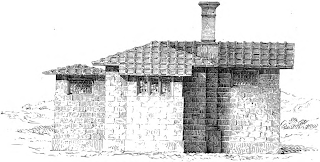
This Design presents a Labourer's Cottage in the Italian style. It is very small, comprehending only a Kitchen, Bed Room, and Outhouse, with an oven. The walls may be of brick or stone, and covered with tile, of the form so much seen in Italy, derived originally from the Greek. The windows are kept high from the ground, a peculiarity much to be observed in this character; and the simplicity of the whole effect is not unpleasing, as exhibited in the Perspective View.



The Labourer's Cottage cannot be too simple in its form, and it should be comprised in a very small compass. His wants are few, but his comforts should be carefully studied. The relative situation of doors and chimneys is of the greatest consequence to him, and it too frequently happens that this is little attended to, if at all. In rooms of very small dimensions this consideration must never be lost sight of, or the poor man's dwelling may be rendered a wretched habitation. In the Plan No. I. it will appear that the Bed Room, being within the Kitchen, must be warm, the Kitchen itself is defended by the Porch, while the Outhouse or Washhouse, containing the oven and copper, is quite independent of the other two apartments. The dwelling is only one story in height, and the rooms are kept to the smallest possible size.


For a Labourer's Cottage one story in height, explaining a design, comprehending the same number of apartments as No. I, under a different arrangement. These Cottages may be built of brick, and covered with tile, the whole being splashed, to produce the effect of age. In stone countries the roofs should be covered with rag. All the wood work should be painted in imitation of oak.


This Design presents a Labourer's Cottage in the Italian style. It is very small, comprehending only a Kitchen, Bed Room, and Outhouse, with an oven. The walls may be of brick or stone, and covered with tile, of the form so much seen in Italy, derived originally from the Greek. The windows are kept high from the ground, a peculiarity much to be observed in this character; and the simplicity of the whole effect is not unpleasing, as exhibited in the Perspective View.


Subscribe to:
Posts (Atom)